
 Worksheets
S&E Asia Test Review
Total questions: 81
Worksheet time: 1hrs 7mins
Shintoist believe in the following beliefs/ideals...
Suffering exists but can be overcome through enlightenment
Each person has a place in society
Everything in nature contains kami (spirit of ancestors)
A person's karma can determine his/her position in the next life
This religion is from Japan and claims no founder.
Buddhism
Confucianism
Hinduism
Shinto
In the belief system of Shintoism, it follows . . . .
A sacred text that must be adhered to at all times
No set of rituals
no single, primary god or text
to shun others
Since Shinto offers no ideas of a moral code, a god, or life after death, many Japanese who practice Shinto _______________.
also practice another religion as well.
never practice another religion
makeup and follow their own god or gods
develop their own set of moral code.
Shintoists follow daily rituals that help _____________________________.
their soul stay holy and sacred
abide by their ancestral rules and regulations
connect them to nature and to their ancestors
set goals for their spiritual life
Confucianism is the philosophy of which modern S.E. Asian Culture?
Japanese
Vietnamese
Chinese
Indonesian
Who believed that the way to bring peace to ancient China was for people to behave with good character and virtue?
Confucius
Shinto
Buddha
Gandhi
What is Confucius' Golden Rule?
Treat others how you want to be treated.
Be kind to everyone.
Speak kindly and listen to others.
Rule with strength and fairness.
Confucianism is based on _________________________________.
following many gods and traditions.
treating animals with respect and kindness without eating them.
the belief that all living things possess a soul and must be worshipped.
society and traditions and does not follow one ruling god.
Confucianism teaches that ___________________________________.
no one should be in one type of relationship.
all must take from the world and never give back.
allow all to do what they want.
there are five basic types of relationships in society.

Where did Hinduism originate?
Indus Valley (now called Pakistan / India)
China
Mongolia
Saudi Arabia
Hindus are polytheistic, meaning they ___________________________________.
believe in many gods and goddesses
believe in one god or goddess
practice many religions
practice one religion

"What comes around goes around" is a way to describe ____________.
karma
caste
A moral cause and effect (consequence) that affects one's future incarnation is called
reincarnation
fate
li
karma
The caste system divides Indian society into groups based on birth, wealth, or occupation.
True
False
Which belief is shared by both Hindus and Buddhists?
Each soul is reincarnated after death.
Everyone has the same social status.
Which of the following is a difference between a religious and an ethnic group?
An ethnic group shares a common sacred text, but a religious group does not.
A religious group shares linguistic similarities, but an ethnic group does not.
An ethnic group shares similar ideas of ethics, but a religious group does not.
A religious group shares the same religious texts, but an ethnic group does not.
Which religion originated in India and follows the teachings of one man?
Hinduism
Confucianism
Shintoism
Buddhism
Who is the founder of Buddhism?
Siddhartha Guatama
Mahatma Gandhi
Moksha
Confucius
What do Buddhists call the ultimate state of enlightenment?
Dukkha
Kami
Vedas
Nirvana
About 90 percent of China's population lives in the________.
North
Desert
Mountains
East
How have the Himalayan Mountains affected India?
The Himalayan Mountains made much of India a desert.
The Himalayan Mountains helped India to trade with China.
The Himalayan Mountains isolated India from China.
The Himalayan Mountains provided good soil for the development of agriculture.
The MOST LIKELY reason why people settle near rivers is to___________.
encourage the development of religion.
encourage the development of schools.
grow crops and transport them to market.
isolate themselves from nearby enemies.
Japan is a chain of mountainous islands with a strong, industrialized economy, few natural resources, and a high literacy rate. Based on this knowledge, what kind of work would most people do?
fishing and high-tech manufacturing
farming and agriculture
exporting of natural resources
forestry and mineral extraction (mining)
A recent air quality study conducted by the World Health Organization showed that 7 of 10 of the world's most polluted cities are in China. What is the MOST LIKELY effect of such pollution on the people of China?
The Chinese population is moving from urban to rural areas to escape the pollution.
The water sources of the nation are being severely damaged as a result of the air pollution.
The Chinese government is cooperating with the United Nations to solve the pollution problem.
Respiratory and heart disease related to air pollution are the leading causes of death in China.
Which two Asian nations are facing the GREATEST problems with air and water pollution?
India and Japan
Japan and China
India and China
Taiwan and India

Which is the MOST likely reason for the high population density in the northeastern part of India?
there is little pollution there
the Ganges River is in the region
most of the factories are located in that region
most people want to live close to the Himalaya Mountains
Which of these would have the BIGGEST impact on the interaction between India and China?
the Three Gorges Dam
the Himalaya Mountains
the flooding of the Indus River
the pollution of the Ganges River

The Yellow River (Huang He River) does not contain as many cities along its banks as other rivers in China. Why is this the case?
It is found entirely in a desert.
It was re-routed by the Communist government in 1950.
It was controlled by bandits and warlords until 1949.
It is plagued by rapid currents and constant flooding.

This photograph is from the Oshiwara River in Mumbai, India. What would be the MOST likely impact from this type of pollution?
global warming
outbreak of cholera
decreased precipitation
decreased crop production
Coal-burning factories and increased automobile usage has caused the GREATEST increase in which of these?
air pollution
nuclear waste
soil depletion
water pollution
1. 1931: Flooding in China killed between 2,000,000 and 4,000,000 people.
2. 1887: Yellow River floods claimed between 1,000,000 and 2,000,000 lives.
3. 1938: Yellow River floods killed between 500,000 and 700,000 people.
To control the devastating effects of flooding, China has built the
Banqiao Dam.
the Grand Canal.
Three Gorges Dam.
Second Great Wall.
Seasons in South Asia depend MOSTLY on
cyclones.
hurricanes.
monsoons.
tornadoes.

Based on this map, when Winter Monsoons strike India they come over the
Hindu-Kush Mountains.
Himalayan Mountains.
Bay of Bengal.
Indian Ocean.

As of 2007, the estimated population of India was over 1.1 billion, while that of Japan was 127 million. Which statement BEST explains a comparison of the population density of the two countries?
Japan is a smaller, more compact country than India.
Japan is prone to more frequent earthquakes.
The Himalayas are located north of India.
Japan is closer to China than India.
In the Hindu religion the Ganges River is considered holy, and ritual bathing in its waters is practiced by an estimated 60,000 people per day. What is the MOST LIKELY effect of this practice?
Such use of the river has raised major health risks for the population of the area.
Tourism in the area has increased, and many new settlements are being established along the river.
The government has passed laws to restrict access to the water to discourage pollution and contamination.
The government of India has worked to dam the river flow so people can practice ritual bathing without contaminating the water.
Which of these would MOST likely impact the economic development of Southeast Asia?
avalanches
drought
tornadoes
typhoons

Which of these is the BEST explanation for the high population density in China's eastern regions?
The region is not capable of supporting large scale farming.
The region is close to the ocean and has a favorable climate.
The region was traditionally home to the emperor and the gods.
The region was destroyed by civil war which caused people to leave.

The Yellow River (Huang He River) is sometimes referred to as "China's Sorrow." What would be the BEST explanation for this sad nickname?
It was the site of the Communist Revolution in 1949.
Flooding has caused massive human and property loss over time.
It has re-routed to force people to follow the Communist government.
The Yellow River became dry after construction of the Three Gorges Dam.

How would you describe pollution in the Ganges River?
People do not drink the polluted water
The river is not seen as significant by Hindus
Even though it is polluted, the river is important for trade and is water supply
Plant and animal life are not impacted by the pollution in the river
Why are water features important for the citizens of Southern and Eastern Asia?
Water features provide irrigation and are important means of transportation.
Water features are important for recreation but do not serve an economic purpose.
Water features are primary sources of transportation since there are no airports in Asia.
Water features are only used for religious rituals and purposes.
Why do people live near rivers?
They form borders between cities and towns.
They supplies millions of people with water for drinking, irrigation, and industrial uses.
People can use the river to get over the Himalayan Mountains.
Water from the rivers are used to irrigate the Gobi Desert.
Which river is located in China?
The Chang Jiang (Yangtze River)
The Ganges River
The Indus River
The Euphrates River
What MAJOR impact did Hinduism have on Indian society?
It let to equality between all members of society.
It spread the teachings and beliefs of Buddha
It divided Indian society into a class structure called the caste system
It let to the creation of Islam and division of India
What is the BEST explanation for the growth of Hinduism and Buddhism into the main religions in South Asia?
Both religions spread the beliefs of the Buddha and Krishna.
Neither religion is very common in South Asia.
Both religions led to the caste system and division of society.
Both religions originated in India.
Very little of Japan's land mass is suitable for agriculture. What is the main effect of this problem?
Japan has many rivers useful for transportation.
Japan has to import much of its food.
Japan is still able to provide food for it's large population.
Mountains have no impact on where people live in Japan.
Why is Confucianism considered a philosophy instead of a religion?
Confucius believed all things in nature have spirits.
Confucius never wrote any of his ideas down for his followers.
Confucius believed that there is only one god.
Confucius teachings are more about ethics and behavior than religion.
What decision did the Chinese government make to help minimize the devastating effects of air pollution?
To require new businesses be built only along rivers.
To require everyone to wear a special mask while outside.
To use hydroelectricity as a cleaner source of energy.
To build new forests to help the environment.
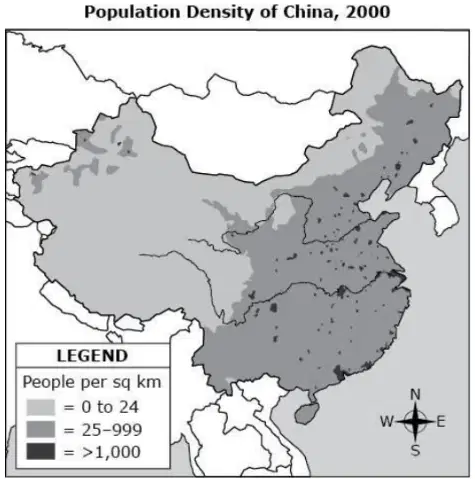
Where do most people in China live?
Along the coast and Yangtze and Yellow rivers.
Near the Gobi and Taklamakan deserts.
Along the Ganges River.
There is completely even population distribution in China.
What are some MAJOR causes of air pollution in South and East Asia?
Dumping sewage in rivers.
Poor infrastructure and cell service.
Coal burned in homes and vehicle emissions.
Seasonal monsoon rains.
Which is the Largest country in East Asia?
Taiwan
Japan
China
Mongolia
Which Country is an archipelago?
China
Mongolia
Taiwan
Japan
North or South Korea
an ENORMOUS mountain range north of India, that stretches across West China.
The Himalayan Mountains
The Appalachian Mountains
The Ural Mountains
The Andes Mountains
Which East Asia river has yellow-colored silt and is known as the muddiest river in the world?
Yangtze
Xiang
Huang He
Yellow Sea
The ____ is the longest river in Asia.
Yangtze
Huang He
Yalu
Mekong

Which river involves religious practices that involve human ashes to be dumped in the river in India?
Huang He River
Yangtze River
Ganges River
Yellow River

Which marks the Ganges River?
2
3
9
11

Physical feature "F" that forms the border between China and India
Mt. Everest
Himalaya Mountains
Gobi Desert
Ganges River

What country is this? (yellow)
Pakistan
India
Bangladesh
Sri Lanka
Nepal
Which marks the Ganges River?
2
3
9
11

What physical features is #4?
Bay of Bengal
Deccan Plateau
Ganges Delta
Indian Ocean

What physical feature is #2?
Bay of Bengal
Indian Ocean
Indus River
Ganges Delta

What physical feature is #6?
Indian Ocean
Bay of Bengal
Indus River
Deccan Plateau

Asia's largest desert. It stretches across southern Mongolia & northern China.
Plateau of Tibet
Gobi Desert
Korean Peninsula
Himalayas

This peninsula juts from northeast China between the Yellow Sea and the Sea of Japan.
Plateau of Tibet
Gobi Desert
Korean Peninsula
Himalayas

This country (labeled #2) lies south of Mongolia. The East China Sea and South China Seas border it.
China
Japan
Mongolia
Korea

This country consists of a long string of islands off the coast of East Asia.
China
Japan
Korea
Mongolia

This large body of water is labeled #14
Pacific Ocean
Indian Ocean
South China Sea
Yellow Sea

This body of water lies to the east of India.
Indian Ocean
Bay of Bengal
South China Sea
East China Sea

This body of water lies east of China.
Sea of Japan
Yellow Sea
East China Sea
South China Sea

This body of water lies between China and the Korean Peninsula.
Sea of Japan
Yellow Sea
East China Sea
South China Sea

This body of water lies between the Korean Peninsula and Japan.
Sea of Japan
Yellow Sea
East China Sea
South China Sea

This LARGE body of water is the deepest and largest in the world and lies east of the Asian continent.
Indian Ocean
Pacific Ocean

North Korea
Mongolia
Japan
South Korea

What country is shown by the number "5" on the map?
North Korea
South Korea
China
Japan


