Worksheets
transformations Saturday
Total questions: 83
Worksheet time: 3hrs 26mins

Moves right 7

-Moves left 2

The blue is f(x)=|x|, red must be

If the blue is f(x)=x2, then the red must be
Describe the transformation
f(x)+3
3 Units Up
3 Units Down
3 Units Left
3 Units Right
Describe the transformation
f(x−2)
2 Units Up
2 Units Down
2 Units Left
2 Units Right
Describe the transformation
f(x+5)
5 Units Up
5 Units Down
5 Units Left
5 Units Right
Describe the transformation
f(x)−6
6 Units Up
6 Units Down
6 Units Left
6 Units Right
Describe the transformations
g(x+4)−6
4 Units Left
6 Units Up
4 Units Left
6 Units Down
4 Units Right
6 Units Up
4 Units Right
6 Units Down
Describe the transformations
−g(x)+2
Reflected across the x-axis
2 Units Up
Reflected across the x-axis
2 Units Down
Reflected across the y-axis
2 Units Up
Reflected across the y-axis
2 Units Down
Describe the transformation
3h(x)
Vertical Stretch by a factor of 3
Vertical Shrink by a factor of 3
Horizontal Stretch by a factor of 3
Horizontal Shrink by a factor of 1/3
Describe the transformation
h(31x)
Vertical Stretch by a factor of 31
Vertical Shrink by a factor of 31
Horizontal Stretch by a factor of 3
Horizontal Shrink by a factor of 31
y = g(x) to y = - g(x + 6) - 10
Shifted down 10 units
Shifted left 6 units
Shifted up 10 units
Shifted left 6 units
Shifted up 10 units
Shifted right 6 units
Shifted down 10 units
Shifted left 6 units
y = -2|x|
Vertical Stretch by a factor of 2 and reflected over x-axis
Vertical Shrink by a Factor of 2 and reflected over the x-axis
g(x) = 5x2 + 2
Down 2
Up 2
Up 2
Down 2

Vertical stretch by 1/2, left 1, down 3
Vertical stretch by 1/2, right 1, down 3
Vertical Shrink by 1/2, left 1, down 3
Vertical Shrink by 1/2, right 1, down 3
The original graph is f(x). The new graph has been moved right 4 and up 3. The new graph is:
f(x+3)−4
f(x−4)+3
f(x+4)+3
f(x+3)+4
f(x) has been moved two to the left
f(x+2)
f(x)+2
f(x−2)
f(x)−2
Which function has a shift right 3?
f(x−3)
f(x+3)
f(x)+3
f(x)−3
Challenge: Which transformation is NOT part of the function notation below?
−2f(x−3)Reflect across the x-axis
shift 3 units down
stretch factor of 2
shift 3 units right
What does the transformation f(x) → f(x+1)−9 do to the graph of f(x) ?
shifts it left 1 unit and down 9 units
shifts it right 1 unit and down 9 units
shifts it right 9 units and up 1 unit and
shifts it left 9 units and down 1 unit
What does the transformation f(x) → 31f(x)+4 do to the graph of f(x) ?
Shrinks the graph vertically by a factor of 31 and shifts up 4 units.
Stretches the graph by a factor of 31 and shifts up 4 units.
Shifts the graph left 31 of a unit and up 4 units.
Shifts the graph right 3 units and down 4 units.
Describe the transformation that occurred: p(x)=f(x+3)
shift right 3
stretch factor of 3
shift up 3
shift left 3
h(x)=f(x)+2
Describe the transformation that occurred.
Shift up 2 units
Shift left 2 units
Stretch factor of 2
Shift right 2 units
w(x)=f(x−7)
Describe the transformation that occurred.
Shift down 7
Shift up 7
Shift right 7
Shrink factor of 7
m(x)=f(x+1)
Describe the transformation that occurred.
Shift left 1 unit
Shift right 1 unit
Vertical stretch factor of 1
Shift up 1 unit
What is the transformation from g(x) to g(x−3)+5
Shift right 3, up 5
Shift left 3, up 5
Shift left 3, down 5
Shift right 3, down 5
If the graph of f(x) has a stretch factor of 3 and is shifted 7 units up, what is the new function g(x) ?
g(x)=f(x+7)+3
g(x)=3f(x)+7
g(x)=f(x−3)+7
g(x)=3(x+7)
Which has a shift 2 units to the right?
f(x)+2
f(x)−2
f(x+2)
f(x−2)
h(x)=51f(x)
Describe the transformation that occurred
stretch factor of 51
shrink factor of 51
shift up 51
shift left 51
h(x)=32p(x)
Identify the transformation
stretch factor of 32
shrink factor of 32
reflection over the x-axis
shift down 32
Which of the following have a reflection over the x-axis? Select all that apply.
undefined
y=x−3+2
y=−(x+4)2−3
y=4∣x∣+2


y=f(x)+2
y=f(x)−2
y=f(x+2)
y=f(x−2)

y=f(x)+2
y=f(x)−2
y=f(x+2)
y=f(x−2)

y=f(x)+3
y=f(x)−3
y=f(x+3)
y=f(x−3)

y=f(x)+3
y=f(x)−3
y=f(x+3)
y=f(x−3)

y=f(x+5)+3
y=f(x−5)−3
y=f(x+5)−3
y=f(x−5)+3

y=f(x)+2
y=f(x)−2
y=f(x+2)
y=f(x−2)

y=f(2x)
y=f(1/2x)
y=2f(x)
y=1/2f(x)

y=f(2x)
y=f(1/2x)
y=2f(x)
y=1/2f(x)
Describe the transformation that occurred
h(x) = 1/5f(x)
vertical stretch by 5
vertical compression by 5
vertical translation by 5
vertical translation by -5
Which of the following transformations are present (select all that apply)?
-2f(2(x - 1)) + 2
reflection over horizontal axis
reflection over vertical axis
horizontal compression
vertical shift
Rotation about origin
-2f(x - 1) + 2
y = f(1/5x)

Shift up 1
Shift down 1
Shift left 1
Shift right 1

Shift up 2
Shift down 2
Shift left 2
Shift right 2

shift up 2 and right 1
shift down 2 and left 1
shift left 2 and up 1
shift right 2 and down 1

Shift left 2
Shift down 2
Reflection across the x-axis
How has the function f(x)=7(3)x−5 been transformed from the parent function?
Shift up 5
Vertical stretch (SF 3)
Shift down 5
Vertical stretch (SF 7)
Shift up 5
Vertical stretch (SF 7)
Shift down 5
Vertical stretch (SF 3)
How has the function f(x)=−5(3)x been transformed from the parent function?
Shifted up 5,
Reflected over x-axis
Shifted down 5,
Vertical stretch (SF 5)
Reflected over x-axis,
Vertical stretch (SF 5)
Shifted down 5,
Reflected over x-axis
How has the function f(x)=31(3)x−4 been transformed from the parent function?
(choose two answers)
Shifted left 4
Shifted down 4
Horizontal stretch (SF 1/3)
Reflection over the x-axis
Vertical stretch (SF 3)
g(x) = -2(x+3) -6

Describe the transformation(s) of the function when compared to its parent function.
Translation left 3 units
Translation down 3 units
Horizontal stretch by a factor of -1
Reflected across x-axis
Describe the transformation(s) of the function when compared to its parent function.
Translation up 2 units and translation right 1 unit
Translation down 2 units and Translation left 1 unit
Translation left 2 units and Translation up 1 unit
Translation right 2 units and Translation down 1 unit
What transformations have happened to f(x) = 2x if the new equation is
g(x) = -2(x+3) -6
reflects across the x-axis, translate right 3 units, translate up 6 units
reflects across the x-axis, translate up 3 units, translate left 6 units
reflects across the x-axis, translate right 3 units, translate down 6 units
reflects across the x-axis, translate left 3 units, translate down 6 units
Given g(x)=(1/2)x
Write a function that is translated 5 units left and translated 4 units up.
f(x)= (1/2)x+5 + 4
f(x)= (1/2)x+4 + 5
f(x)= (1/2)x-5 - 4
f(x)= (1/2)x+5 - 4


What transformations occur in the following function?
right 3, up 2
right 3, down 2
Given g(x)=5x
Write a function that is reflected over the y-axis and translated 4 units to the right.
f(x)= -5x-4
f(x)= -5x+4
f(x)= 5(x-4)

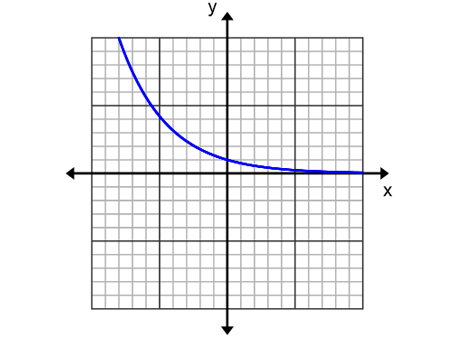

What kind of shift happens with this function?
shift 4 units up
shift 4 units down
What is the transformation?
Horizontal Translation left 1
Horizontal Translation right 1
What is the transformation?
Vertical Translation up 2 and Horizontal translation left 1
Vertical Translation down 2 and Horizontal Translation left 1