
NEW
Font size
 Worksheets
ETS1.2 Spectroscopes TCAP Review
Total questions: 15
Worksheet time: 8mins
What tool helps scientists determine the chemical composition of distant stars?
microscope
optical telescope
space probe
spectroscope
What is the major advantage of space-based telescopes (such as the Hubble Space Telescope) over Earth-based telescopes?
They are millions of miles closer to the subject.
They are less expensive to build and maintain.
They are above the Earth’s atmosphere which can cause distortions.
They are affected less by the gravity of the Earth and the Moon.
A scientist wants to observe the different bands of colors of light from a distant star. What device can the scientist use?
microscope
radio telescope
space probe
spectroscope
An astronomer wants to analyze the composition of a distant star. What is the best tool the astronomer can use?
satellite
space probe
spectroscope
telescope
An astronomer wants to study celestial objects with the shortest wavelengths. What kind of telescope should the astronomer use for this task?
infrared telescope
optical telescope
radio telescope
X-ray telescope
A space mission to Mars detected the presence of argon in its atmosphere. Which type of instrument was in the space mission to Mars that helped detect the presence of argon?
radio telescope
reflector telescope
satellite
spectroscope
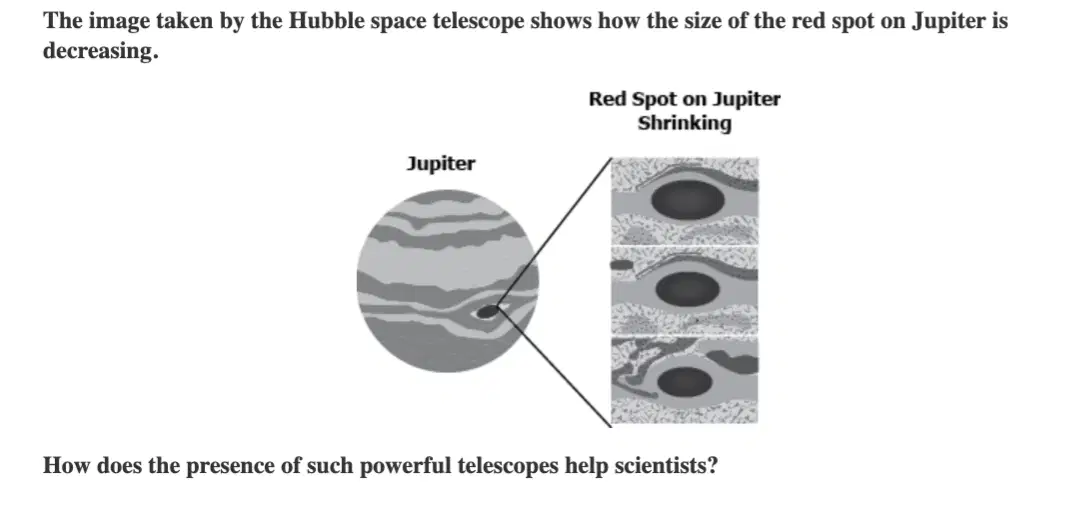
How does the presence of such powerful telescopes help scientists?
The telescopes collect detailed images of the behavior of phenomena on distant objects.
The telescopes deflect harmful cosmic rays in space.
The telescopes are used as global positioning systems.
The telescopes collect detailed weather data.

How do the two telescopes compare?
The refracting telescope uses lenses to focus light, while the reflecting telescope uses mirrors.
The refracting telescope uses incoming radio waves to focus light, while the reflecting telescope uses mirrors.
The refracting telescope uses lenses to focus light, while the reflecting telescope uses radio waves.
The refracting telescope uses mirrors to focus light, while the reflecting telescope uses lenses.
What is the advantage of placing instruments in high orbits?
The instruments are located in an environment with less gravity.
Researchers are able to conduct repairs and modifications to the instruments better.
The instruments can be larger in size and mass to carry more detection equipment.
Gases in Earth’s atmosphere do not interfere with the instruments gathering data.
An astronomer wants to gather information on the gravitational field of a planet in the solar system. Which technology would the astronomer send to the planet to get the required data?
spectroscope
space probe
reflector telescope
radio telescope
Which device do astronomers use to determine the chemical composition of a star?
gyroscope
microscope
spectroscope
telescope
Astronomers often need to collect data and observations from distant objects to which it is dangerous for astronauts to travel. Which instrument helps astronomers safely collect samples from distant objects to which they cannot travel?
radio telescope
satellite
space probe
spectroscope
Based on the scientist’s conclusion, which question should she investigate next to help determine why one star burns brighter than the other?
How quickly does each star rotate?
Which elements compose each star?
What shape is each star?
Which elements can be found on the planets in the solar system of each star?
What is an intended benefit of space telescopes?
They help monitor weather patterns.
They help navigate through the use of global positioning systems (GPS).
They produce detailed images of objects in the universe.
They protect Earth by filtering harmful rays through large lenses.
How does the spectrum obtained from the spectroscope help the astronomer?
It helps the astronomer determine that the star is two times larger than its neighboring star.
It helps the astronomer determine that there are 3.2 light years between the star and Proxima Centauri.
It helps the astronomer determine that the star is made mostly of hydrogen.
It helps the astronomer determine that there are 4.32 light years between the star and the Sun.

