
NEW
Font size
 Worksheets
Fossils TCAP Review
Total questions: 36
Worksheet time: 35mins

The diagram shows a cross section of the layers of a sedimentary rock with some fossils in it. Assume that the rock layers have been preserved in their original sequence, which fossil is the oldest?
Fish skeleton
Spiral shell
Clam shell
Fern leaf
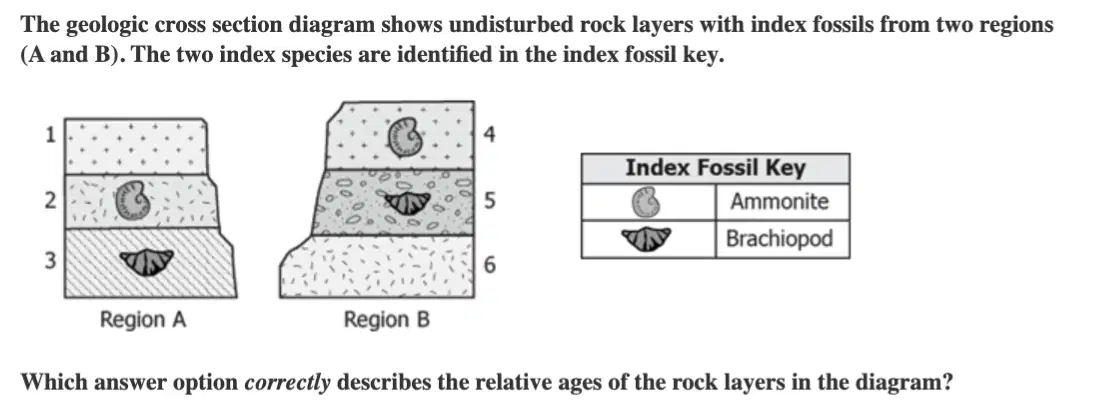
The geologic cross section diagram shows undisturbed rock layers with index fossils from two regions (A and B). The two index species are identified in the index fossil key. Which answer option correctly describes the relative ages of the rock layers in the diagram?
Layer 6 is older than layer 3. Layer 2 is younger than layer 4.
Layer 6 is older than layer 3. Layers 2 and 4 are the same age.
Layer 6 is younger than layer 3. Layers 2 and 4 are the same age.
Layer 6 is younger than layer 3. Layer 2 is older than layer 4.
Researchers have discovered fossils of tropical trees and ferns in modern-day Greenland and Antarctica. What can be inferred from this evidence?
Greenland and Antarctica once had tropical climates.
Ocean currents carried the floating fossils to Greenland and Antarctica.
Migratory birds carried the seeds of the trees and ferns from the tropics.
The tropical trees and ferns adapted to the colder northern and southern climates.
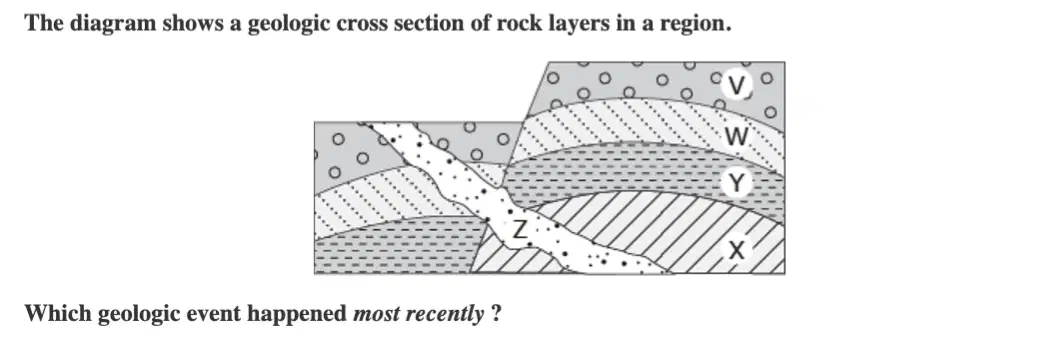
Which geologic event happened most recently?
Folding of rock layers W, Y, and X
Intrusion of igneous rock Z
Faulting of rock layers V, W, Y, and X
Intrusion of rock layer Y
Which method describes a way of arranging fossils in chronological order?
comparing the fossils with other similar living species
arranging the fossils on the basis of their sizes and masses
correlating each fossil to the rock layer in which it was found
evaluating the condition of the fossils when they are discovered
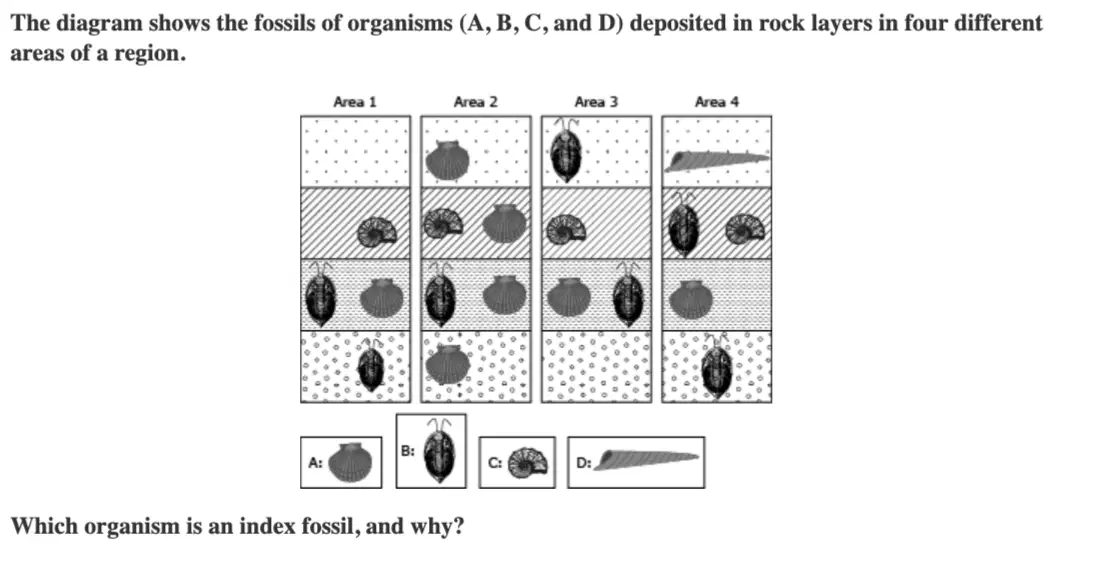
Which organism is an index fossil, and why?
Organism A. It is found in all four rock layers of Area 2.
Organism B. It is found in different rock layers across the four areas.
Organism C. It is found only in one rock layer across all the four areas.
Organism D. It is found only in one rock layer of Area 4.
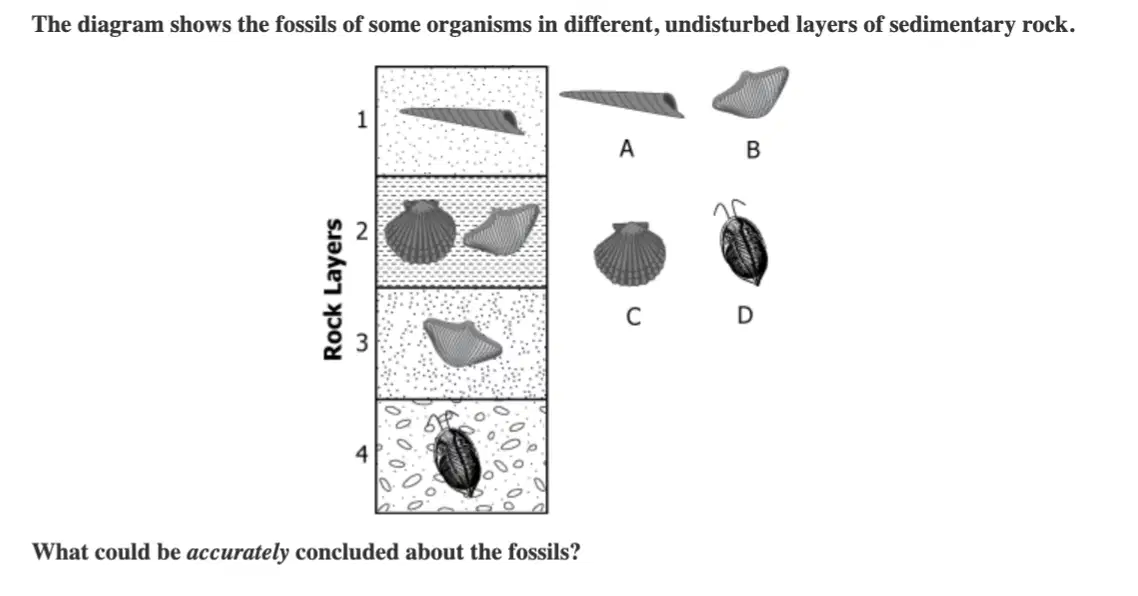
The diagram shows the fossils of some organisms in different, undisturbed layers of sedimentary rock. What could be accurately concluded about the fossils?
Organism A evolved from organism D.
Organism B had the largest population.
Organisms B and C were genetically identical.
Organism D existed before organisms B and C.
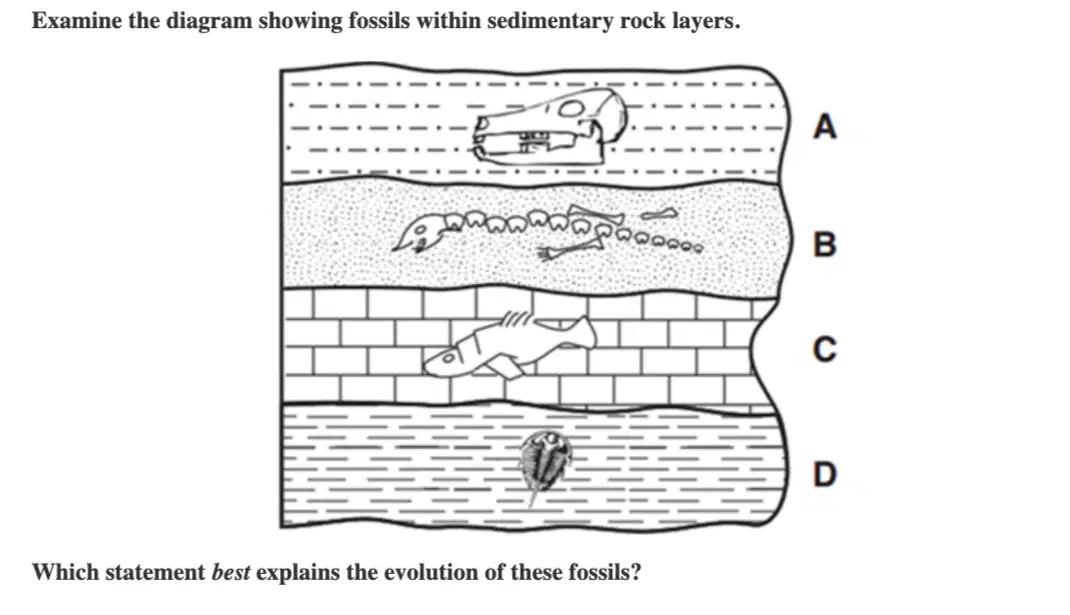
Examine the diagram showing fossils within sedimentary rock layers.
The fossil in layer A is more closely related to a modern organism.
The fossil in layer B is more closely related to a modern organism.
The fossil in layer C is more closely related to a modern organism.
The fossil in layer D is more closely related to a modern organism.
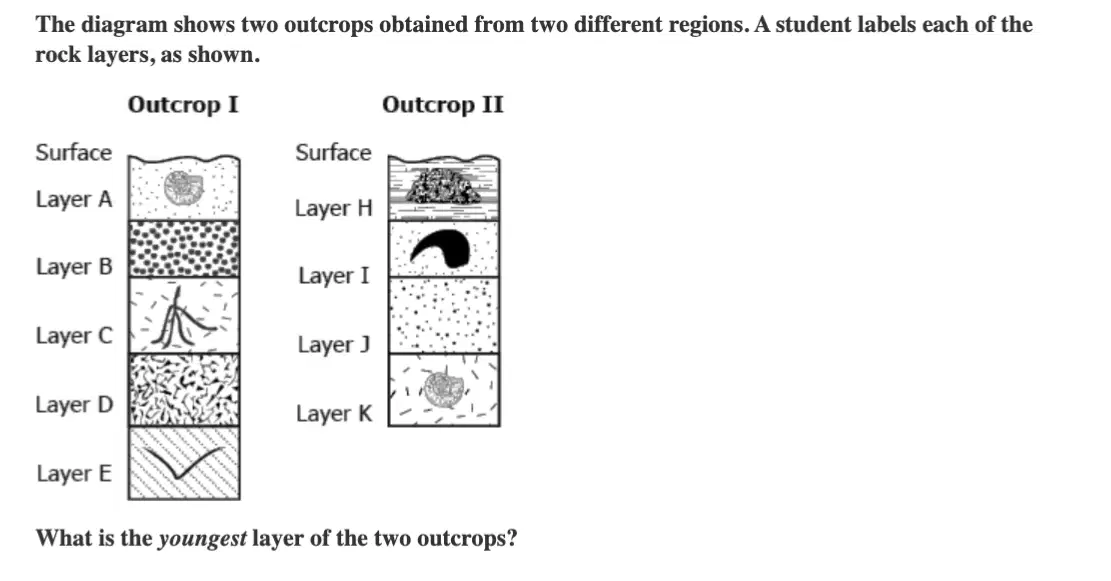
The diagram shows two outcrops obtained from two different regions. A student labels each of the rock layers, as shown. What is the youngest layer of the two outcrops?
Layer A
Layer E
Layer H
Layer K
What must be true in order for a species to serve as an index fossil?
The species must have only lived in a small geographic area.
The species must have only lived for a short period of geologic time.
The species must not be extinct.
The species must look similar to several other species.
Which condition allows for the fossilization of an organism?
when there is a warmer winter in the organism’s habitat
when the size of the organism is very large
when scavengers eat the organism quickly
when the organism is buried before decomposition
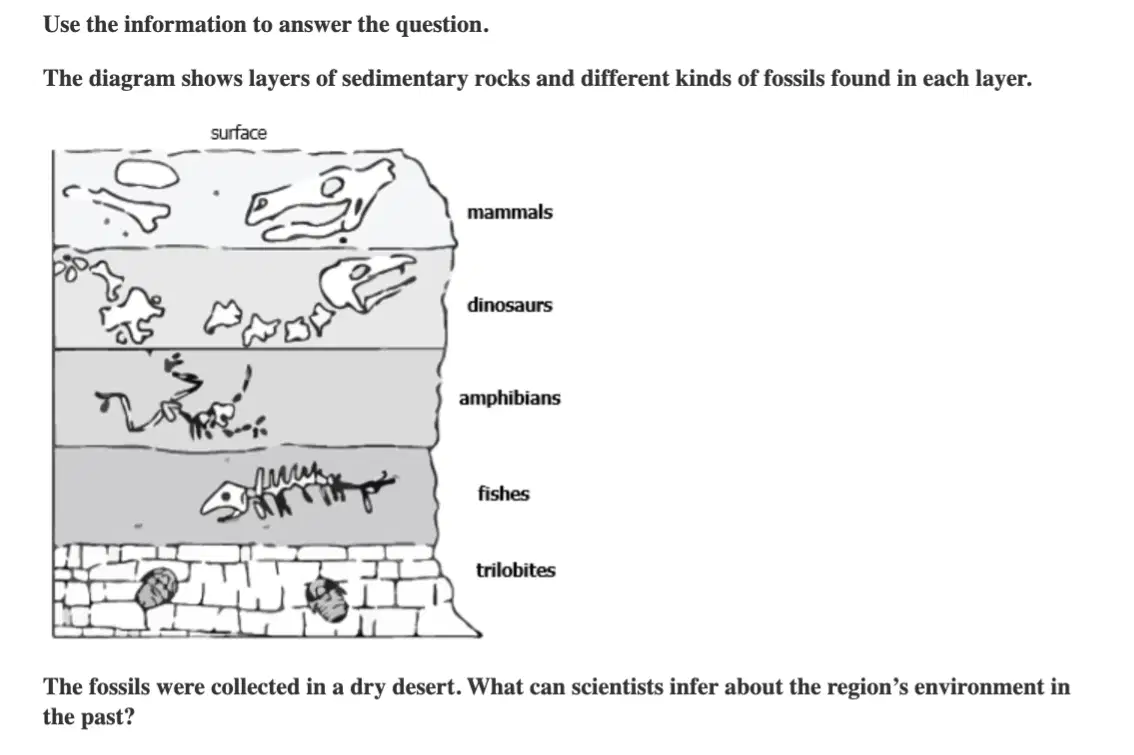
Use the information to answer the question. The fossils were collected in a dry desert. What can scientists infer about the region’s environment in the past?
The region experienced a large natural disaster in the past.
The region had a warmer climate in the past.
The region was submerged under water in the past.
The region was covered in the snow in the past.
In which kind of rock do we usually find a fossil?
sedimentary rock
metamorphic rock
igneous rock


The number of years that have passed since the rock formed is the rock's ____ age, or its actual age.
relative
law of superposition
absolute
index fossil
The age of a rock compared to the ages of other rocks is the rock's
absolute age
geologic age
sedimentary age
relative age
The process of a species disappearing forever
biosphere
natural habitat
extinction
population
species

Scientist study the ____________________ to learn about the history of life, past environments on Earth, and how different groups of organisms have changed over time.
fossil record
historical record
animal record
Earth record
If you know the age of a rock, you know the relative age of the _________________ that was found inside.
sticky tar
fossil
amber
ice
The scientific study of fossils.
Geology
Paleontology
Biology
Anthropology
Which of the follow is INCORRECT about an index fossil?
The fossil must have lived only during a short part of the Earth's history.
Many fossils of the organism must be found in the rock layers.
The fossil must be found over a wide area of the Earth and be unique.
The fossil must only be found in one area.


This type of fossil is tree sap hardened and replaced by minerals.
Petrified wood
Imprint
Amber
Mold

What type of fossil is pictured here?
Mold fossil
Trace fossil
Cast fossil
Body fossil

