Wayground logo

Free Printable Worksheets

Font size

S
M
L
XL
Worksheets

Ions and Isotopes

Total questions: 53

Worksheet time: 37mins

Name
Class
Date
1.

How many neutrons are in an atom of carbon-14?

a)

6

b)

8

c)

10

d)

14

2.

How many protons does this isotope of titanium have?

a)

22

b)

26

c)

48

d)

70

3.

How many electrons are in an atom that has an atomic number of 34, an atomic mass of 74 and a charge of -2?

a)

2

b)

34

c)

36

d)

40

4.

Write the hyphen notation for the isotope that has 39 protons and 50 neutrons.

a)

Yttrium-11

b)

Tin-39

c)

Tin-89

d)

Yttrium-89

5.
If X is the symbol for an element, which of the following two symbols represent    isotopes of the same element?     I. 7735X  II. 7733X  III. 8137X  IV. 8135 X
a)
I and II
b)
III and IV
c)
I and IV
d)
I and III
6.
What is the name of the pictured isotope?
a)
Carbon-12
b)
Carbon-13
c)
Carbon-14
d)
Carbon-15
7.

An atom that has gained or lost electrons.

a)

Normal/Neutral Atom

b)

Ion

c)

Isotope

8.

An atom with the same number of protons and electrons (no charge) and the expected atomic mass or number of neutrons from the periodic table.

a)

Neutral/Normal Atom

b)

Ion

c)

Isotope

9.

A negatively charged ion that has gained electrons

a)

Anion

b)

Cation

c)

Neutral Atom

d)

Isotope

10.

A positively charged ion that has lost electrons

a)

Anion

b)

Cation

c)

Neutral Atom

d)

Isotope

11.

The atomic number of an atom is equal to:

a)

the number of protons

b)

the number of neutrons

c)
the total number of protons and neutrons
d)

the total number of protons, neutrons and electrons

12.

Adding or subtracting neutrons makes the element change into an...

a)
ion
b)
mixture
c)
isotope
d)
neutral atom
13.

What is the charge on a lithium atom that loses 1 electron?

a)
+1
b)
0
c)
-1
d)
-2
14.

Is the element shown in this image an anion, cation, isotope, or normal atom?

a)

normal atom

b)
isotope
c)

cation

d)

anion

15.
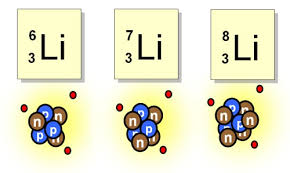
Which atom has  4 neutrons?
a)
Li-6
b)
Li-7
c)
Li-8
d)
they have the same # of neutrons
16.
Carbon has an atomic number of 6 and an atomic mass of 12. Which elements are considered isotopes of carbon?
a)
Carbon-12
b)
Carbon-13
c)
Carbon-14
d)
Both Carbon-13 and Carbon-14
17.
How many neutrons does Lithium have (atomic mass = 6.94)
a)
3
b)
4
c)
6.94
d)
24.94
18.

What is a representation of an ion?

a)

Li

b)

Na-22

c)

O-2

19.

How many neutrons does this bromine atom have?

a)

35

b)

45

c)

80

20.

What is the charge of this Bromine atom?

a)

+1

b)

no charge (neutral)

c)

-1

21.

What is the atomic number of Fe?

a)
26
b)
55.845
c)
56
d)
None of these
22.
How many neutrons does B (Boron) contain?
a)
5
b)
11
c)
6
d)
10.811
23.
If an atom has an extra neutron, it is a(n)
a)

Cation

b)

Anion

c)
Isotope
d)
Neutral Atom
24.
If an atom gains an electron it is a(n)
a)

Cation

b)

Anion

c)
Isotope
d)
Neutral Atom
25.
If an atom loses an electron it is a(n)
a)

Cation

b)

Anion

c)
Isotope
d)
Neutral Atom
26.
An atom's atomic mass comes from its
a)
Nucleus
b)
Electron cloud
c)
Protons
d)
Electrons
27.
Can an atom of Helium have 3 neutrons?
a)
Yes, because it can be an ion
b)
No, because protons identify the atom
c)
Yes, because it can be an isotope
d)
No, because only neutral atoms exist
28.

Can an atom of Helium have 3 protons?

a)
Yes, because it can be an ion
b)
No, because protons identify the atom
c)
Yes, because it can be an isotope
d)
No, because only neutral atoms exist
29.
If an atom has more electrons than protons, it is a(n)
a)
Positive ion
b)
Negative ion
c)
Isotope
d)
Neutral atom
30.
If an atom has more protons than electrons, it is a(n)
a)
Positive ion
b)
Negative ion
c)
Isotope
d)
Neutral atom
31.
If an atom has an equal number of protons and electrons it is a...
a)
Positive ion
b)
Negative ion
c)
Isotope
d)
Neutral atom
32.

What charge does an atom have when it GAINS electrons?

a)

Positive

b)

Negative

c)

Neutral

33.

What is the mass number of bromine?

a)

35

b)

45

c)

80

d)

79.904

34.

What type of atom is this?

a)

Neutral atom

b)

Cation

c)

Anion

d)

Isotope

35.

What changes to make an atom an ion (as opposed to a regular, neutral atom)?

a)

The number of electrons

b)

The number of protons

c)

The number of neutrons

36.

What changes to make an atom an isotope (as opposed to a regular, neutral atom)?

a)

The number of electrons

b)

The number of protons

c)

The number of neutrons

37.

How many neutrons does this Neon atom have?

a)

21

b)

11

c)

10

d)

12

38.

What is the representation of an isotope?

a)

N-3

b)

Al+3

c)

Si

d)

P-33

39.

A(n) _____________ is an atom that has gained or lost electrons.

a)

isotope

b)

neutron

c)

ion

d)

proton

40.

An isotope is an atom that has the same atomic number as other atoms of an element, but a different number of ____________.

a)

neutrons

b)

protons

c)

electrons

d)

photons

41.

What is the mass number of an atom with 5 protons, 6 neutrons, and 5 electrons?

a)

5

b)

11

c)

16

d)

10

42.

What is the atomic number of an atom that has 6 protons, 8 neutrons, and 6 electrons?

a)

6

b)

14

c)

20

d)

12

43.

What is the charge on an ion that forms when a neutral atom loses 1 electron?

a)

negative

b)

positive

44.

What is the charge on an ion that forms when a neutral atom gains two electrons?

a)

negative

b)

positive

45.

How many neutrons does this isotope of lithium have?
a)
8
b)
3
c)
4
d)
5
46.

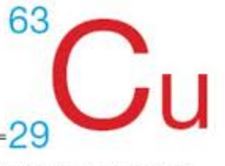
How many electrons does a neutral Copper atom have?

a)
63
b)
29
c)
92
d)
34
47.
Found in the nucleus of the atom
a)
electrons only
b)
protons only
c)
neutrons and protons
d)
neutrons and electrons
48.
In a correctly written symbol what would be located in the "A" position?
a)
number of neutrons
b)
atomic number
c)
number of electrons 
d)
mass number
49.
An element is defined by its number of 
a)
protons
b)
electrons
c)
neutrons
d)
protons + electrons
50.
Isotopes are atoms of the same element that have the same number of __________ but different number of __________ . Therefore, isotopes of the same element have different masses. 
a)
protons, neutrons
b)
protons, electrons
c)
neutrons, protons
d)
electrons, protons
51.
A neutral atom of the isotope 2612Mg would consist of
a)
12 protons, 26 neutrons, 26 electrons
b)
26 protons, 12 neutrons, 26 electrons
c)
26 protons, 14 neutrons, 14 electrons
d)
12 protons, 14 neutrons, 12 electrons
52.

What is the mass number of the element shown?

a)

15

b)

7

c)

8

d)

0

53.

An atom has 12 protons and 13 neutrons in its nucleus. Which is the correct symbol?

a)
b)
c)
d)