
NEW
Font size
 Worksheets
Natural Selection and Adaptation TCAP Review
Total questions: 30
Worksheet time: 15mins
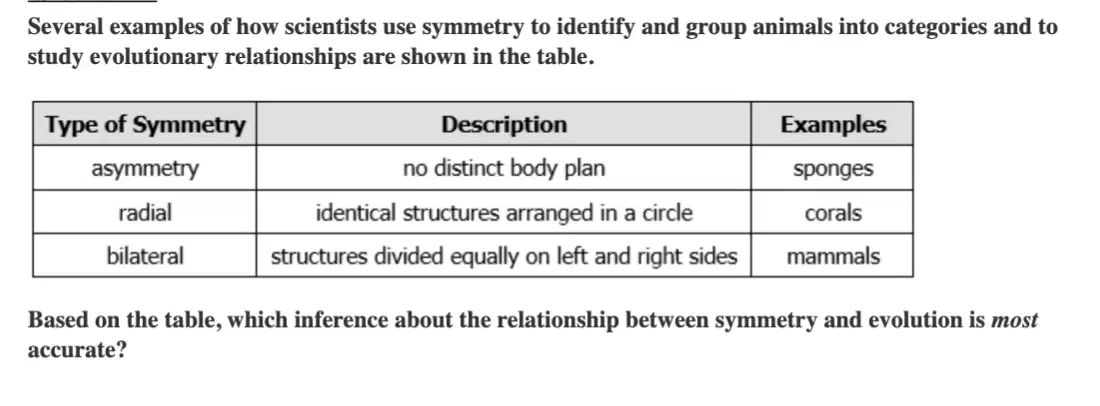
Based on the table, which inference about the relationship between symmetry and evolution is most accurate?
Organisms with different types of symmetry are more closely related than organisms with the same symmetry.
Organisms with the same type of symmetry may be more closely related than organisms with different symmetries.
Organisms with radial symmetry evolved into organisms that are either asymmetrical or that exhibit bilateral symmetry.
Organisms with bilateral symmetry evolved into organisms that are either asymmetrical or that exhibit radial symmetry.
A biologist in Nebraska discovers that deer mice living in sandy regions have lighter fur than deer mice living in forested areas (with darker soils) just a few kilometers away. Which statement best explains why the fur color of deer mice varies?
Variation in fur color helps the mice avoid predators.
Variation in fur color helps the mice locate more food.
Variation in fur color helps the mice hunt more easily.
Variation in fur color helps the mice stay warm during winter.

Julian listed some possible factors that would increase the chances of survival of a species during rapid environmental change. Which factors did Julian list correctly?
1 and 3
1 and 4
2 and 3
2 and 4
Which statement is true about genetic variation and species adaptation?
Less genetic variation in a population has no effect on the probability of survival of a species during changing habitat conditions.
Less genetic variation in a population provides a species with a greater probability of survival during changing habitat conditions.
More genetic variation in a population provides a species with a greater probability of survival during changing habitat conditions.
More genetic variation in a population has no effect on the probability of survival of a species during changing habitat conditions.
Young deer have reddish-brown coats covered with white spots. Their coat color helps them blend in with the trees in the woods where they live. What is an advantage of this adaptation?
It helps the parents locate their young ones quickly.
It helps the young deer stay warm in cold weather.
It helps the parents find food in the woods quickly.
It helps the young deer avoid being spotted by predators.

Examine the diagram of a plant commonly found in the deserts of North America. Which statement explains how the plant has adapted for survival in an environment with limited precipitation?
The plant has spines on its “leaves” where birds can perch and prevent other animals from eating the plant.
The plant has no roots which enables it to absorb water quickly from the ground when it rains for transport to the “leaves.”
The plant is able to hold large amounts of water in its “leaves,” so it can survive periods of drought.
The plant allows ants to live in its “leaves,” and the ants protect and provide nutrients for the plant.

The diagram shows the wings of a bat and a bird. The bone structure inside both the wings is very different, but the wings of both animals help them in flight. What can be concluded by a comparison of the wings?
The organisms have a similar cellular structure.
The organisms evolved from a common ancestor that could fly.
The organisms developed through similar embryological stages.
The organisms developed similar adaptations in similar environments.

Four species of finch (W, X, Y, and Z) with different food sources inhabit a coastal island. There is a disease that kills most of the trees that produce large, heavy seeds that are the primary food source for finch W. Shortly after the trees die, there is a population boom among a type of insect that makes its home in dead trees. These insects are the primary food source for finch Z. What is the most probable impact on the finch species on the island?
The population of finch species W will decrease, and the population of species Z will decrease.
The population of finch species W will decrease, and the population of species Z will increase.
The population of finch species W will increase, and the population of species Z will decrease.
The population of finch species W will increase, and the population of species Z will increase
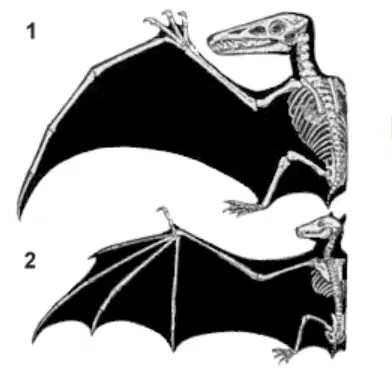
Which term describes the structures of the pterosaur and the bat?
analogous structures
heterozygous structures
homologous structures
tectonic structures
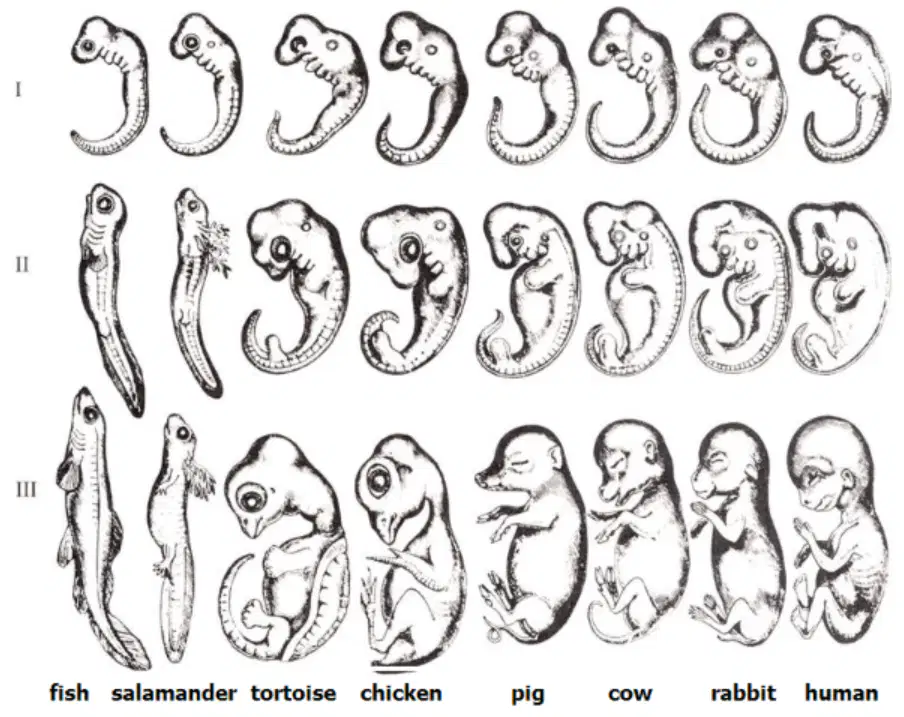
What is the term that describes the relationships among the organisms shown?
embryological similarities
superposition similarities
taxonomic similarities
tectonic similarities
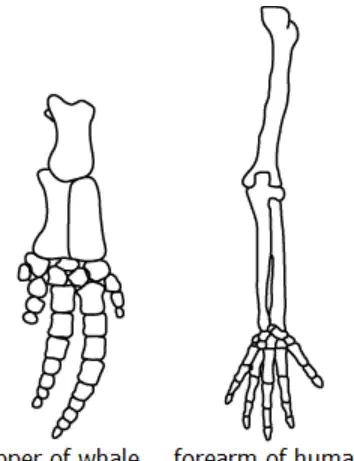
What explains the similarity in the skeletal structures of the two different organisms?
Humans have evolved from whales.
Whales have evolved from humans.
Humans lived in the sea in the past.
Whales and humans share a common ancestry

Why do the Galapagos finches have different beak sizes and shapes?
to drink more water
to build different types of nests
to protect themselves from their predators
to take advantage of different types of food
Which law or theory describes the changes in organisms and species over time?
Law of Classification
Law of Superposition
Theory of Continental Drift
Theory of Evolution
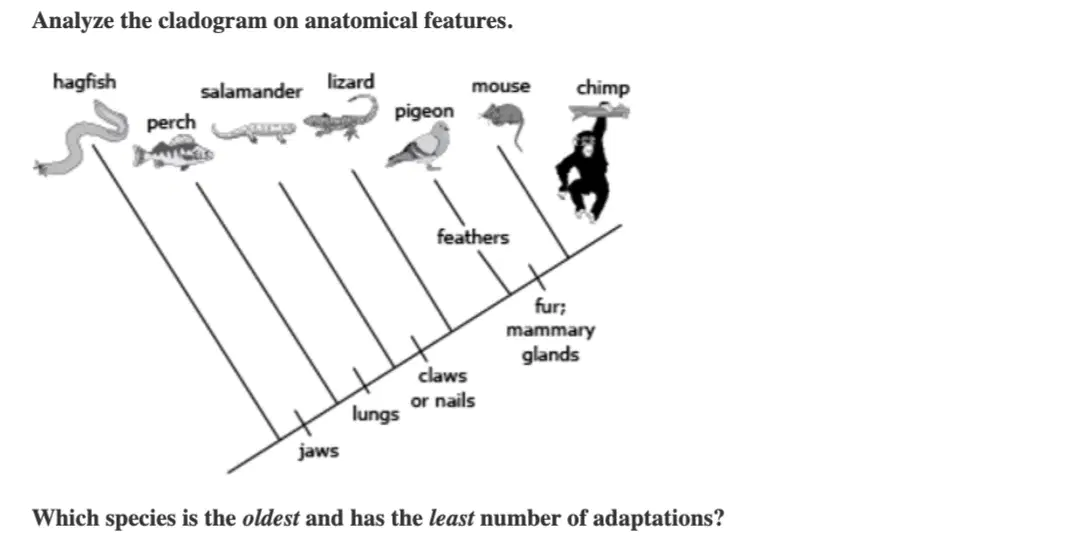
Analyze the cladogram on anatomical features.
chimp
hagfish
pigeon
salamander
The Boreal owl is a small owl that has feathers resembling the bark of a tree. How do these feathers help the Boreal owl?
The feathers help the owl locate prey.
The feathers help the owl stay the same temperature as its environment.
The feathers help the owl avoid predators by enabling it to hide.
The feathers help the owl nest in tree trunks.
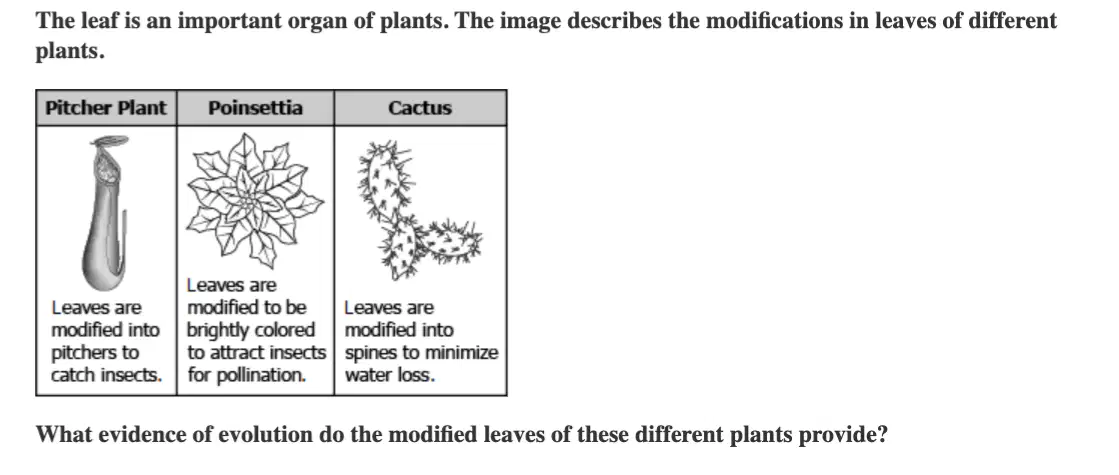
What evidence of evolution do the modified leaves of these different plants provide?
Plants evolved from different ancestors.
Plant leaves are designed to suit different functions.
Plants evolved in the same geographical location.
Plant leaves are easily distinguished from each other。

Which term best describes what happened to Species 2 between 1880 and 1950?
adaptation
classification
evolution
extinction

Which species of bird would be most likely to adapt to a change in food source?
Species P
Species Q
Species R
Species S

The table shows the color variations of butterflies found in a forest. A forest fire occurs, and the entire forest is covered with ash. There is a dramatic decrease in bright red butterflies. Which trait or process explains the survival of the other butterflies?
adaptive behavior
common ancestor
migratory instincts
natural selection
DDT is a chemical that is sprayed to lower the population of mosquitos in an effort to reduce the risk of certain diseases. Due to genetic variation in the mosquito population, a few are resistant to DDT and survive. What will be the future impact on the mosquito population after years of DDT use?
increase in the number of mosquitoes that are sensitive to DDT
increase in the number of mosquitoes that are resistant to DDT
increase in the number of mosquitoes that can be used to treat diseases
increase in the number of mosquitoes that can withstand all types of chemicals

The Arctic Fox's fur changes from dark in the summer to white in the winter. How does this adaptation help the fox survive in the winter?
This adaption helps the fox hibernate and protect itself from the cold.
This adaption helps the fox defend itself by mimicking a polar bear.
This adaption helps the fox move quicker and migrate.
This adaption helps the fox camouflage itself to hunt prey.
What will most likely happen to a species if the environment changes more quickly than the species can adapt?
become more diverse
evolve
become extinct
overpopulate
What role does genetic variation play in the evolution of species?
It reduces the chance that species will possess characteristics well-suited for a changing environment.
It increases the chance that species will possess characteristics well-suited for a changing environment.
It allows multicellular organisms to change their traits during their lifetimes.
It allows unicellular organisms to change their DNA after they die.
Which phrase best defines natural selection?
elimination of the smallest organisms by the largest organisms
survival of the organisms which occupy a very large area in the environment
survival of the organisms that best adapt to the environment
elimination of the weakest organisms by the strongest organisms
Which statement supports the theory of natural selection?
All organisms produce more offspring than can survive.
Organisms live in harmony with one another despite limited resources.
Organisms with favorable traits are more likely to die.
Over time advantageous traits will be found in more of the population.

Four species of finch (W, X, Y, and Z) with different food sources inhabit a coastal island. There is a disease that kills most of the trees that produce large, heavy seeds that are the primary food source for finch W. Shortly after the trees die, there is a population boom among a type of insect that makes its home in dead trees. These insects are the primary food source for finch Z. What is the most probable impact on the finch species on the island?
The population of finch species W will decrease, and the population of species Z will decrease.
The population of finch species W will decrease, and the population of species Z will increase.
The population of finch species W will increase, and the population of species Z will decrease.
The population of finch species W will increase, and the population of species Z will increase
Why do the Galapagos finches have different beak sizes and shapes?
to drink more water
to build different types of nests
to protect themselves from their predators
to take advantage of different types of food
Certain antibiotics are no longer effective against the bacteria that they used to kill. How might this be explained?
Bacteria that were resistant to the antibiotic survived to reproduce.
Changes in the environment made the antibiotic ineffective.
The number of bacteria is now greater than what the antibiotic can kill.
The antibiotic has become weaker over time.
The table below consists of various combinations of physical features on which organisms depend for survival.
Which pair of climatic conditions are living organisms adapted to in the desert ecosystem?
1. less water and high temperature
2. more water and high temperature
3. more water and low temperature
4. less water and low temperature
1
2
3
4

