

wayground logo

Free Printable Worksheets

Font size

S
M
L
XL
Worksheets

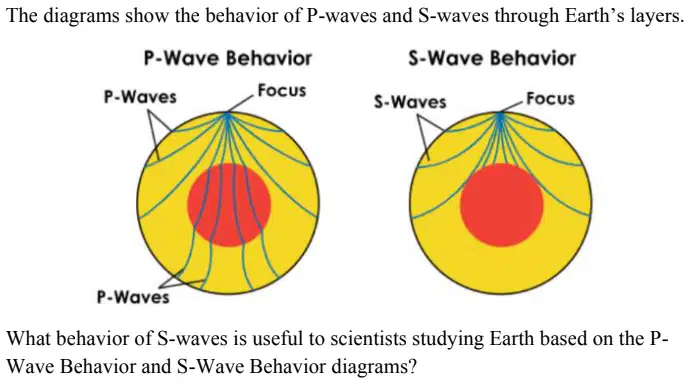
Earth's Interior OST Practice

Total questions: 11

Worksheet time: 8mins
Name
Class
Date
1.
What are the two sources of thermal energy in Earth’s interior?
a)
solar heating and gravity
b)
combustion and solar heating
c)
gravity and radioactive decay
d)
radioactive decay and combustion
2.
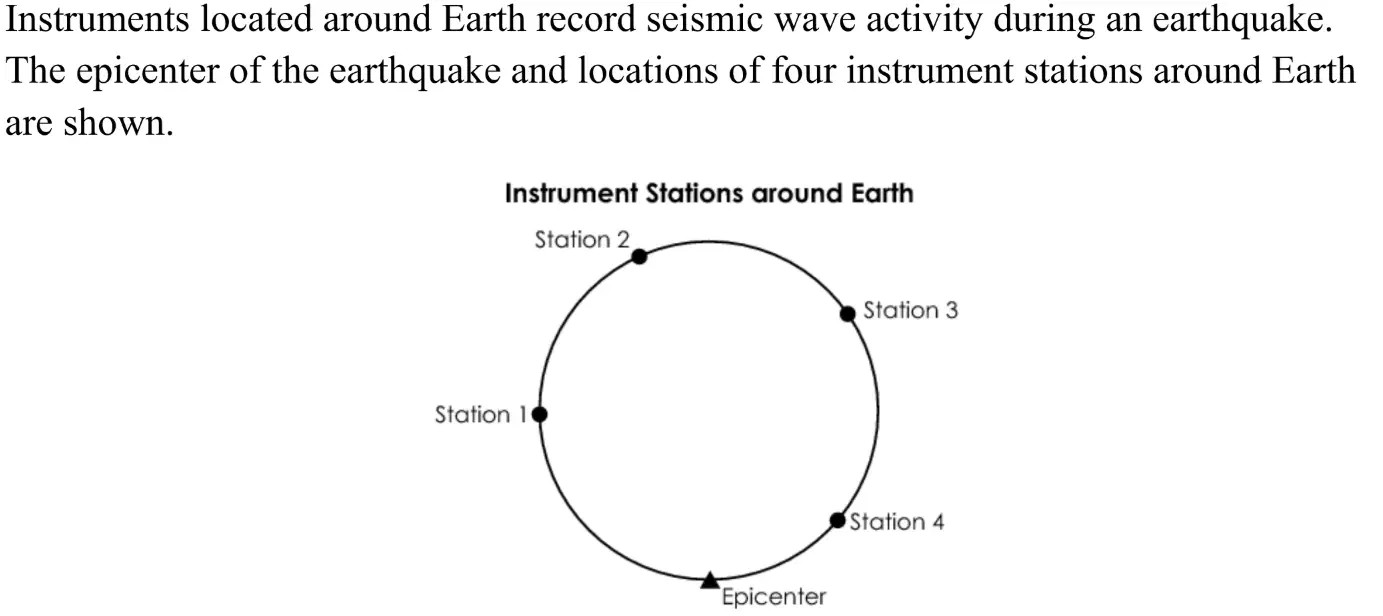
Which stations will record fewer waves than the others?
a)
Stations 1 & 4
b)
Stations 2 & 3
c)
Stations 3 & 4
d)
Stations 1 & 2
3.
Select the two statements that explain why fewer waves were recorded at some stations in the questions above.
a)
Part of Earth’s interior bent some of the waves.
b)
Different materials in Earth reflect some of the waves.
c)
Some waves are blocked by water on the Earth’s surface.
d)
Weather events near the stations can prevent waves from being recorded.
4.

The composition of Earth from its surface to its center 6,300 kilometers (km) down can be studied using seismic waves. There are two basic types of seismic waves, S-waves and P-waves. Students studying Earth’s interior are given the following information about P and S waves and how they travel through Earth. • S-waves travel only through solids. • P-waves at 30km depth change direction. • P-waves can travel through solids and liquids. • S-waves and P-waves are detected from 5,200 km to 6,300 km deep. • P-waves, but no S-waves, are detected from 2,900 km to 5,200 km deep. • S-waves and P-waves are detected from the surface (0km) to 2,900 km deep. Select the four statements that can be concluded from the information.
a)
There is a change in density occurring at 30 km.
b)
There is a liquid layer from 2,900 km to 5,200 km.
c)
The densest material is found from 5,200 km to 6,300 km.
d)
There is a density change that occurs at 2,900 km and 5,200 km.
e)
The densest material is found from 2,900 km to 5,200 km.
5.
Select the two processes that occur at mid-ocean ridges.
a)
Material rises from the mantle to the crust.
b)
Sediments from the crust sink into the mantle.
c)
Crustal rock subducts into the mantle and melts.
d)
Thermal energy rises from the mantle to the crust.
e)
Tsunami waves transfer energy from the crust to the mantle.
6.
Which statement about seismic waves is accurate?
a)
Seismic waves only relate to earthquakes.
b)
Seismic waves have uniform motion within Earth’s layers.
c)
Seismic waves change speed when density changes in Earth’s layers.
d)
Seismic waves determine differences in temperature in Earth’s layers.
7.
Which statement describes the heat that results from the radioactive decay of elements deep in Earth’s interior?
a)
It originally came from our sun.
b)
It is the reason the inner core is solid.
c)
It drives the convection currents in the mantle.
d)
It heats the atmosphere and makes life possible.
8.
a)
S-waves travel faster than P-waves and can alert scientists to future earthquakes.
b)
S-waves travel to more locations on Earth’s surface and show up on more seimsmographs.
c)
S-waves are unable to travel through some materials and can help scientists identify layers of Earth’s interior.
d)
S-waves are unable to reach depths below the crust so scientist can record wave speeds along Earth’s surface.
9.
How are scientist able to estimate the thickness of each layer of the Earth?By studying __________
a)
 radio waves
b)
sonar waves
c)
laser waves
d)
seismic waves
10.

S waves are known secondary waves because …….

a)

They are slower than primary waves.

b)

They travel through solid layers only.

c)

They are faster than primary waves.

d)

They travel through liquid layers only.

11.
Which type of wave arrives first during an earthquake?
a)
Primary (p-wave) waves
b)
Secondary (s-wave) waves
c)
Rayleigh Waves
d)
Love Waves