
 Worksheets
Review Test #3
Total questions: 57
Worksheet time: 24mins
What was the name of the first network built (before the internet)? Just use the acronym.
ARPANET
INTERNET
LAN
WAN
What are the two types of networks?
LAN and WAN
MAN and PAN
VPN and VLAN
SAN and CAN
Finish the name: Distributed ___________ - ____________ Network.
Packet-Switched
Computing - Analysis
Computing - Storage
Computing - Transmission
TRUE OR FALSE: The internet is controlled by the government.
TRUE
FALSE
What is the “utility” of the internet?
To connect all devices with each other
To store personal data
To create local networks
To manage hardware resources
What is a packet?
A small unit of data transmitted over a network
A type of internet browser
A physical envelope for mailing
A type of computer virus
What information is put on the outside of the packet?
Destination IP address
Sender's name
Packet size
Encryption key
How is the packet transferred to New York from London?
By airplane
Through an undersea cable
Via a satellite link
Using a VPN
How is data sent from Los Angeles to New York?
By email
Through a series of network nodes
Via a physical courier
Using a direct fiber optic line
What does the packet prioritize: Speed or Staying Together?
Speed
Staying Together
Neither
Both equally
A term that refers to the way in which the nodes of a network are linked together.
Network
Topology
Connection
The participating computers in a network are referred to as
Clients
Servers
Nodes
CPUs
Bus, ring and star topologies are mostly used in the
LAN
MAN
WAN
In which topology there is a central controller or hub?
star
ring
mesh
bus
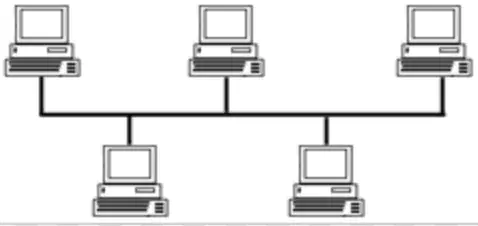
Which one is a BUS topology
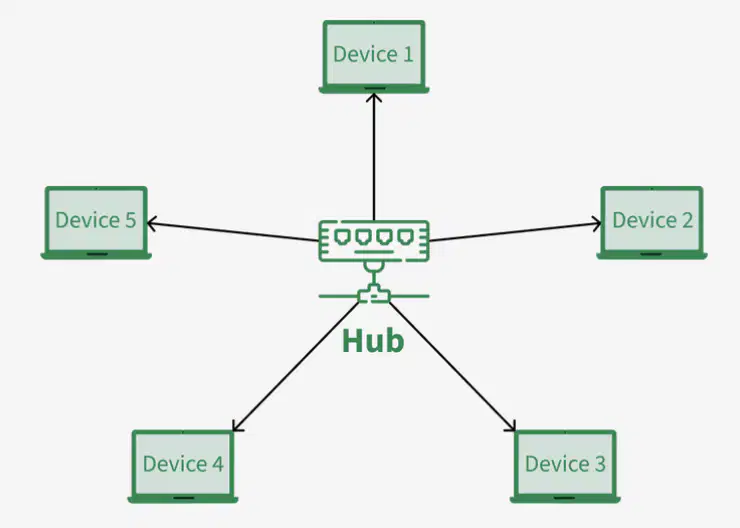

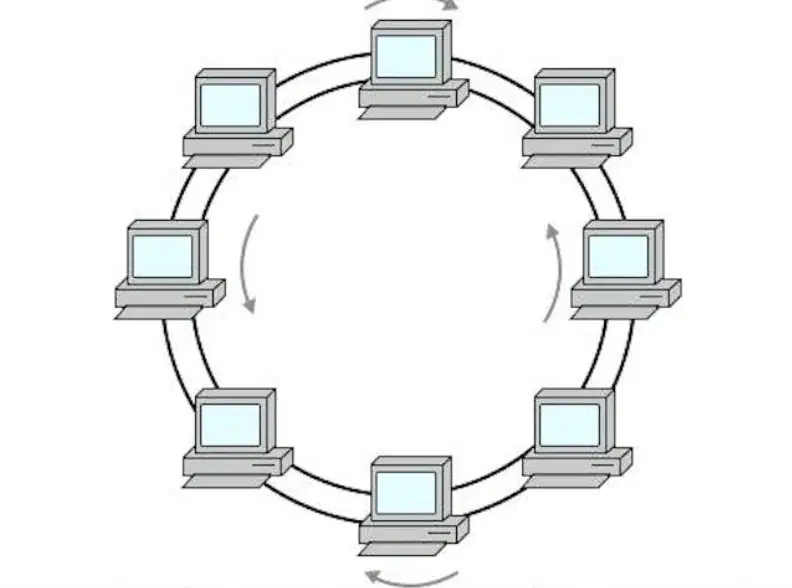
A BUS topology is (Which one is correct)?
Easy to set up
Expensive to set up
Hard to set up
Which one is a RING topology
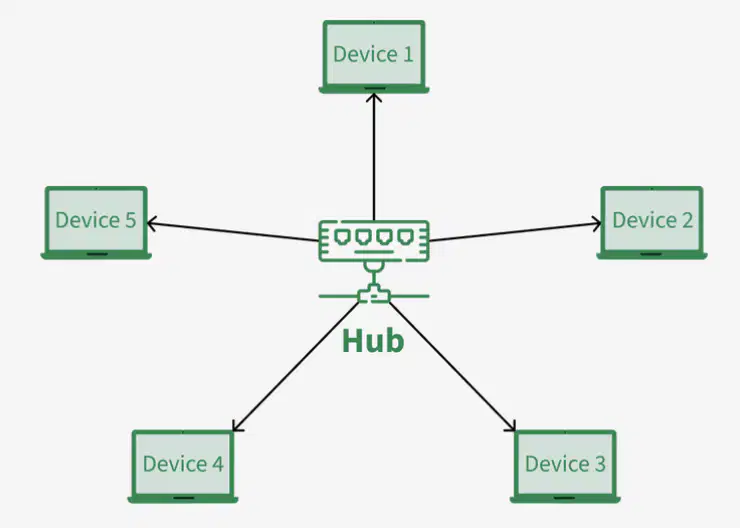

Which one is a STAR topology?


A star topology will cause a network failure if...
If the center fails
If one of the many of the computers fail
If the printer fails

What is a network
A stand alone computer
Two or more interconnected computers
A computer without a server
Networked computers can share (select which one is true)
Hardware, software and data
Optical discs, software and data
Hardware, software and Clients
What is the main characteristic of a Bus Topology?
All nodes are connected to a central hub
All nodes are connected to multiple cables
All nodes are connected wirelessly
All nodes are connected to a single cable
Explain the advantages and disadvantages of using Bus Topology.
Advantages: Difficult to set up, expensive, suitable for large networks. Disadvantages: Unlimited scalability, multiple points of failure, performance improves with heavy traffic.
Advantages: Easy to set up, cost-effective, suitable for large networks. Disadvantages: Limited scalability, single point of success, performance can improve with heavy traffic.
Advantages: Easy to set up, cost-effective, suitable for small networks. Disadvantages: Limited scalability, single point of failure, performance can degrade with heavy traffic.
Advantages: Difficult to set up, cost-effective, suitable for small networks. Disadvantages: Limited scalability, single point of failure, performance can improve with heavy traffic.
What is the main characteristic of a Star Topology?
Decentralized connection to multiple hubs
No connection to any hub or switch
Connection to a single computer
Centralized connection to a hub or switch
Explain the advantages and disadvantages of using Star Topology.
Advantages: Dependent on the central hub, if it fails the entire network goes down. Disadvantages: Easy to install and manage, if one device fails it does not affect the rest of the network.
Advantages: Requires minimal cabling, if one device fails it affects the rest of the network. Disadvantages: Easy to install and manage. Data travels slowly.
Advantages: Easy to install and manage, if one device fails it does not affect the rest of the network. It is scalable and data travels pretty fast on it. Disadvantages: Dependent on the central hub, if it fails the entire network goes down.
Advantages: Difficult to install and manage, if one device fails it affects the rest of the network. Disadvantages: Not dependent on the central hub, if it fails the entire network goes down.
What is the main characteristic of a Ring Topology?
Mesh network
Circular network
Linear network
Star-shaped network
Explain the advantages and disadvantages of using Ring Topology.
Advantage: Ring Topology is the most secure and reliable network topology. It is scalable and fault tolerant. Disadvantage: It is expensive to set up and data travels slowly along it.
Advantage: Ring Topology allows for easy identification and isolation of network issues. It is fault tolerant and cheap to set up. Disadvantage: It is not scalable and there is a single point of failure.
Advantage: Ring Topology is the fastest and most efficient network topology. It is scalable and complex. Disadvantage: It is not redundant and it is expensive to set up.
Advantage: Easy and cheap to install. and it provides equal access to all devices. Data travels quickly and it has some redundancy, though not a lot. Disadvantages: Single point of failure, not fault tolerant and not scalable.
What is the main characteristic of a Mesh Topology?
There is no connection between nodes
Each node is connected to only one other node
Each node is connected to many other nodes
Nodes are connected in a circular fashion
Explain the advantages and disadvantages of using Mesh Topology.
Advantages: Medium reliability, some fault tolerance, moderate scalability, and can handle moderate traffic loads. Disadvantages: Moderately expensive to implement and maintain, somewhat complex to manage and configure.
Advantages: High reliability, fault tolerance, scalability, and can handle heavy traffic loads. Disadvantages: Expensive to implement and maintain, complex to manage and configure.
Advantages: Low reliability, no fault tolerance, limited scalability, and cannot handle heavy traffic loads. Disadvantages: Inexpensive to implement and maintain, simple to manage and configure.
Advantages: No reliability, no fault tolerance, no scalability, and cannot handle any traffic loads. Disadvantages: Cheap to implement and maintain, easy to manage and configure.
What is the main characteristic of a Bus Topology?
No central cable
Single central cable
Multiple central cables
Star-shaped connection
Explain the process of data transmission in a Bus Topology.
Data transmission in a Bus Topology occurs through a central hub.
Data transmission in a Bus Topology occurs through a single shared communication line.
Data transmission in a Bus Topology occurs through multiple separate communication lines.
Data transmission in a Bus Topology occurs wirelessly.
ISP means:
Internet Service Provider
International Service Protocol
Internal Server Program
Internet Security Protocol
What is a protocol?
A set of rules for communication
A type of computer hardware
A programming language
A network cable
In order for a new technology to adapt to the internet it must know which ____________ to work with.
protocol
device
browser
language
An internet address is defined as:
A unique identifier for a device on a network
A type of computer virus
A physical location of a server
A programming language
IP stands for:
Internet Protocol
Internal Program
Input Process
Information Provider
Visiting a website is just your computer asking _________________ for information.
another computer/server
a printer
a smartphone
a keyboard
How many bits long are IP addresses?
16 bits
32 bits
64 bits
128 bits
The organization of the IP numbers (what does each chunk mean) is:
Each chunk represents a different part of the network and host address.
Each chunk is a random number with no specific meaning.
Each chunk represents a different protocol.
Each chunk is used for encryption.
Which version of IP addresses do we currently use?
IPv4
IPv6
MAC address
Subnet mask
What is the new version of the IP address called?
IPv2
IPv4
IPv6
IPX
A traceroute is used to show:
the path data takes from one computer to another
the amount of data transferred
the speed of the internet connection
the type of network protocol used
You can use traceroute to help you find ____________ ?
network problems
printer issues
software bugs
disk errors
Describe what a PING does.
It sends a signal to another computer to check if it is reachable.
It encrypts data for secure transmission.
It traces the route packets take to a destination.
It blocks incoming network traffic.
A TRACE ROUTE does which of the following?
Shows the route that data travels to get to a destination.
Deletes all files in a directory, and resets the machine to factory.
Compiles source code into machine code.
Encrypts data for secure transmission.
What is the command that you use to type into a Windows machine to perform a traceroute for Google.com?
traceroute google.com
trace google.com
tracert google.com
ping google.com
For each route the computer send _______ data packets to each router and it will record the roundtrip to router.
three
one
five
ten

The picture below shows a problem on the 5th hop because:
The 5th hop has the highest latency
The 5th hop has the lowest latency.
The 5th hop is unreachable.
The 5th hop is the destination.
This picture shows a problem at the 5th hop due to ...
Problem with the home server due to disconnection
Problem in the network path, potentially due to congestion, distance, or device issues
Problem with the host due to disconnection
A high round-trip time can mean an error or issue occurred. What else could it mean?
Network congestion- there is too much data traveling on the same route
Low bandwidth- there is not enough capacity on the network cable
Server maintenance- the destination computers need to be repaired
All of the above
What does the term 'latency' refer to in networking?
The security level of a network connection.
The number of devices connected to a network.
The amount of data that can be transmitted in a given time period.
The time it takes for a data packet to travel from source to destination.
What is the primary function of a router in a network?
To forward data packets between computer networks.
To encrypt data for secure transmission.
To store data permanently.
To provide power to network devices.
The computers in Prime Medical Hospital building are linked so that the staff can share the files and printers.This kind of network is an example of
PAN
LAN
WAN
The largest computer network is called
Local Area Network
Modem
World wide web
The internet
What network covers a LARGE geographical area?
LAN
WAN
BAN
KAN

