
 Worksheets
Speciation and Developmental Biology Quiz
Total questions: 15
Worksheet time: 8mins
To determine if individuals from separate populations are indeed distinct species, Drosophila biologists often test to see if individuals from the different populations will mate with each other. This is an application of the ________ species concept.
evolutionary
phenetic
phylogenetic
biological
Allopatric speciation requires
differences in phenology.
abutting distributions.
overlapping distributions.
complete geographic isolation.

In the phylogeny depicted in the figure, the nine P species are from the Pacific side of the Isthmus of Panama, and the seven C species are from the Caribbean side. Which of the following is the most likely cause of speciation?
sympatric speciation
parapatric speciation
allopatric speciation via dispersal across the Isthmus of Panama
allopatric speciation via isolation when the Isthmus of Panama was fully formed
A small population of a species invades an island where the species is not found. The island population subsequently diverges from the ancestral population and becomes a new species. This is an example of
the vicariance model of allopatric speciation.
parapatric speciation.
sympatric speciation.
the peripheral isolate model of allopatric speciation.
Which of the following is not a postzygotic isolating mechanism?
Hybrids are sterile.
Zygotes die early in embryogenesis.
Hybrids are inviable.
Male gametes are not transferred to the female gametes.
The ________ species concept defines a species as a cluster of individuals that occupy a particular niche.
phonetic
evolutionary
biological
ecological
What is the difference in how the biological species concept and ecological species concept delineate species boundaries?
The biological species concept uses polymorphic characters to assign boundaries, while the ecological species concept uses shared, derived characters.
The biological species concept uses shared, derived characters to assign boundaries, while the ecological species concept uses competition.
The biological species concept uses competition to assign boundaries, while the ecological species concept uses gene flow.
The biological species concept uses the pattern of gene flow to assign boundaries, while the ecological species concept uses competition.
Parapatric speciation and sympatric speciation both describe how populations diverge into separate species without a geographic barrier to dispersal. What distinguishes these two modes of speciation?
In sympatric speciation, the populations are not adjacent to each other but do have a hybrid zone.
In sympatric speciation, the populations are adjacent to one another and typically have a hybrid zone between the populations.
In parapatric speciation, the populations are not adjacent to each other and do not have a hybrid zone.
In parapatric speciation, the populations are adjacent to one another and typically have a hybrid zone between the populations.

Which of the following embryonic developmental stages is most similar across all three groups?
Stage 4
Stage 2
Stage 3
Stage 1
Karl Ernst von Baer proposed that diagnostic traits for distinguishing species among vertebrates appear at the ________ stages of development.
middle
latest
beginning and end
earliest
A totipotent cell
is fixed into a single developmental pathway.
arises through homeotic transformation.
will become a stem cell.
can differentiate into any adult cell.
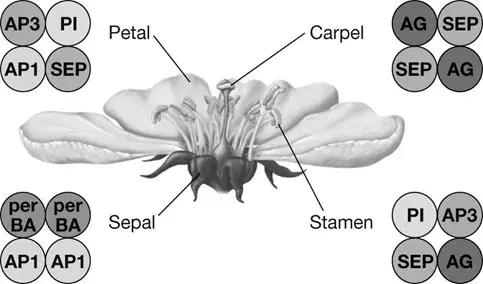
Imagine that a researcher replaced the MADS-box AP1 gene with the MADS-box AG gene. One possible effect on flowers would be that
stamens would be changed into petal-like structures.
petals would be changed in to sepal-like structures.
stamens would be changed into carpel-like structures.
petals would be changed into stamen-like structures.
MADS-box genes affect
fruit fly development.
segmentation in animals.
lateral lines in fish.
plant leaves, roots, and flowers.
What is a regulatory enhancer of a gene?
the chromatin in areas surrounding the gene
a section of DNA that targets proteins for degradation and thus stops the expression of the unwanted genes
a functionless gene copy that is the result of gene duplication
a section of DNA that lies outside of that gene but is involved in regulating the timing and level of that gene’s expression
Which of the following cell types would you expect to be totipotent?
germ line cells
brain cells
blood stem cells that can become various types of blood cells
embryonic cells early in development

