
 Worksheets
RC Beam - Quiz (3)
Total questions: 22
Worksheet time: 11mins
What is the formula for the design load at the ultimate limit state?
w = 1.35 G_k + 1.5 Q_k
w = 1.0 G_k + 1.0 Q_k
w = 1.5 G_k + 1.35 Q_k
w = 1.25 G_k + 1.5 Q_k
What is the formula for the design load at the serviceability limit state?
w = 1.35 G_k + 1.5 Q_k
w = 1.0 G_k + 1.0 Q_k
w = 1.5 G_k + 1.35 Q_k
w = 1.25 G_k + 1.5 Q_k
What is the formula for calculating the self-weight of a beam?
Unit weight of concrete × b_w × h
Unit weight of steel × length × width
Density of material × volume
Mass × acceleration
Which of the following is considered a permanent action (G_k) in loadings?
Self-weight of slabs
Loads from moving objects/people
Wind loads
Snow loads
What type of load is classified as a variable action (Q_k)?
Loads from moving objects/people
Self-weight of the beam
Finishes/building services
Point loads from secondary beams
What does the symbol "d" represent in the context of effective depth?
Distance from the compression face to the center of the tension reinforcement
Distance from the compression face to the center of the compression reinforcement
Total height of the structure
Width of the reinforcement bar
How is the effective depth "d" calculated?
d = h + cover + Ø_link + Ø_bar/2
d = h - cover - Ø_link - Ø_bar/2
d = cover + Ø_link + Ø_bar/2
d = h - cover + Ø_link + Ø_bar/2
What does the symbol "d’" represent in the context of effective depth?
Distance from the compression face to the center of the tension reinforcement
Distance from the compression face to the center of the compression reinforcement
Total height of the structure
Width of the reinforcement bar
How is the effective depth "d’" calculated?
d’ = h - cover - Ø_link - Ø_bar/2
d’ = cover + Ø_link + Ø_bar/2
d’ = h + cover + Ø_link + Ø_bar/2
d’ = cover - Ø_link - Ø_bar/2
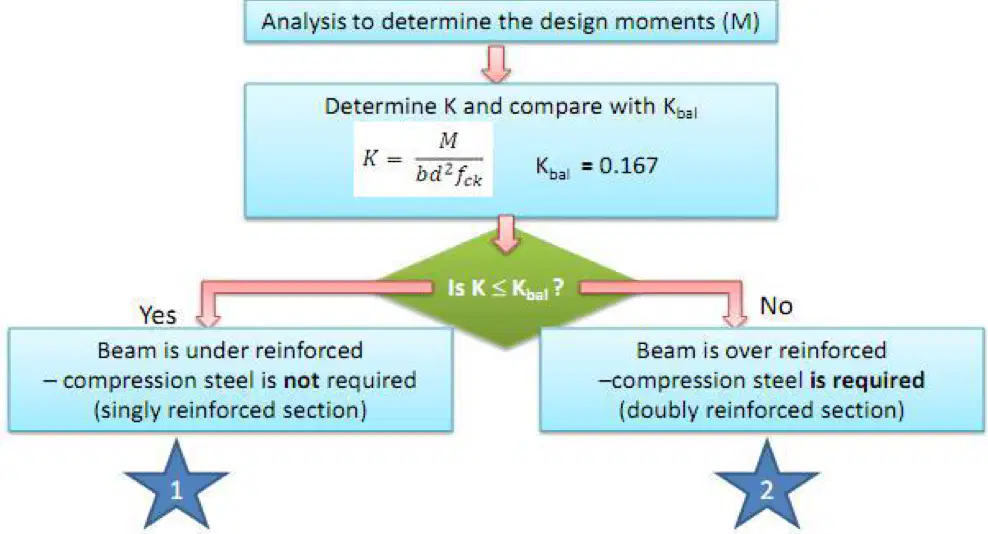
What is the purpose of determining the design moments (M) in the reinforcement design process?
To calculate the beam's length
To determine the beam's width
To analyze the structural load requirements
To decide the color of the beam
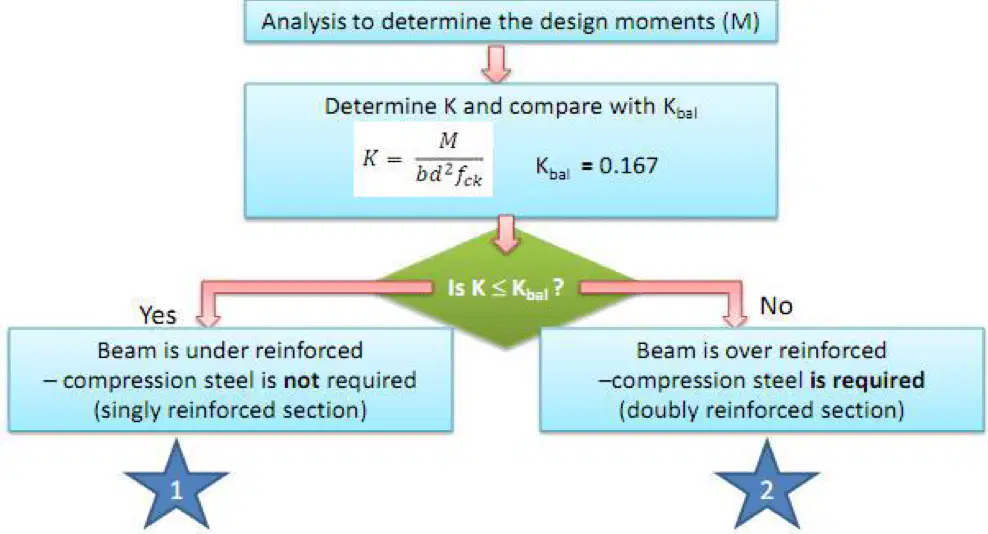
In the flowchart, what does the variable K represent in the formula K=bd2fckM ?
The beam's length
The beam's width
The design moment ratio
The color of the beam
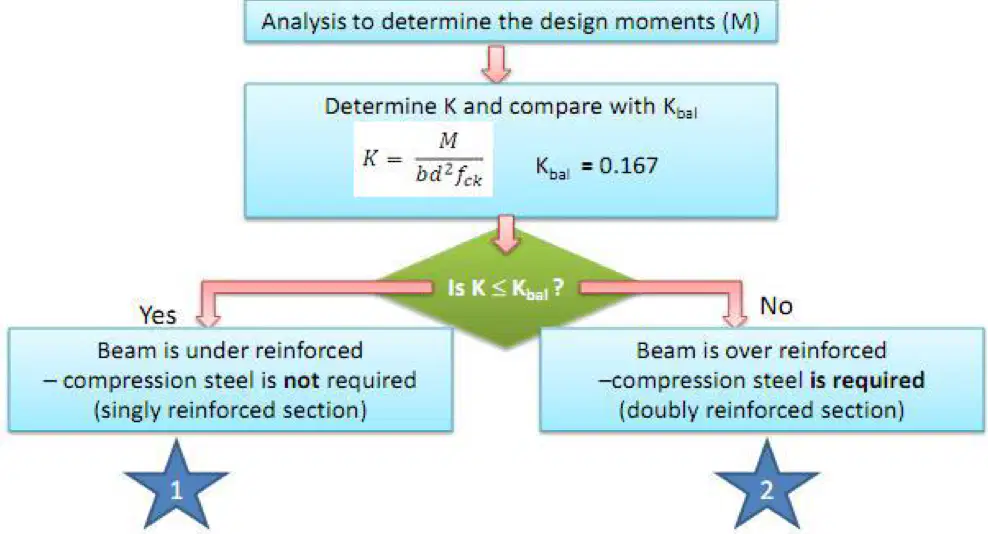
What does it mean if K is less than or equal to $ K_{bal} $ in the flowchart?
The beam is over reinforced
The beam is under reinforced
The beam is perfectly balanced
The beam is not reinforced
What is the maximum reinforcement requirement formula in a singly reinforced design?
As,max = 0.04 Ac
As,max = 0.04 Ab
As,max = 0.04 Ad
As,max = 0.04 Af
What is a factor that must be considered in the shear reinforcement design process?
Shear failure
Thermal expansion
Electrical conductivity
Magnetic properties
What does the shear stress that comes with changes in bending moment produce?
Corner/edge tension
Axial compression
Lateral displacement
Torsional stress
What is the most common method to resist shear in shear reinforcement design?
Provide horizontal shear reinforcement
Provide vertical shear reinforcement
Use only bent-up bars
Use no reinforcement
What are bent-up bars also known as in shear reinforcement design?
Horizontal bars
Inclined bars
Vertical bars
Straight bars
What is another name for shear reinforcement?
Ties
Stirrups
Beams
Columns
What could extreme deflection cause in a structure?
Improved stability
Enhanced durability
Defects to finishes and partitions
Increased load capacity
What is the relationship between the actual and allowable deflection ratios?
(l/d)_actual ≥ (l/d)_allowable
(l/d)_actual ≤ (l/d)_allowable
(l/d)_actual = (l/d)_allowable
(l/d)_actual > (l/d)_allowable
What is one suggested solution if the actual deflection exceeds the allowable deflection in a beam?
Decrease the area of tension reinforcement
Increase the area of tension reinforcement
Reduce the depth of the beam
Ignore the deflection issue
What is a method to address a deflection check failure in a beam?
Calculate the actual value of deflection using detailed calculation
Reduce the beam's width
Increase the beam's length
Ignore the deflection check

