wayground logo

Free Printable Worksheets

Font size

S
M
L
XL
Worksheets

Semester 2 Exam Review

Total questions: 200

Worksheet time: 4hrs 59mins

Name
Class
Date
1.
Waves move ___ through vibrations
a)
Energy
b)
Matter
c)
Mass
d)
Weight
2.
Longitudinal waves are ______.
a)
Parallel
b)
Perpendicular
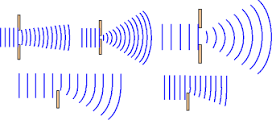
c)
Crazy
3.
Transverse waves are ___.
a)
Parallel
b)
Perpendicular
c)
Weird
4.
What is the amplitude?
a)
length
b)
height
c)
# of waves
5.
Which is the wavelength?
a)
1
b)
2
c)
3
d)
4
6.
The loudness of the sound depends on
a)
wavelength
b)
amplitude
c)
frequency
7.
Which electromagnetic wave is responsible for cell phones?
a)
gamma
b)
xray
c)
microwaves
d)
radio
8.
Which color has the lowest frequency?
a)
red
b)
green
c)
blue
d)
violet
9.
Which color has the highest frequency?
a)
blue
b)
yellow
c)
orange
d)
violet
10.

The highest point on a wave is:

a)

the crest

b)

the trough

c)

the top

d)

the coast

11.

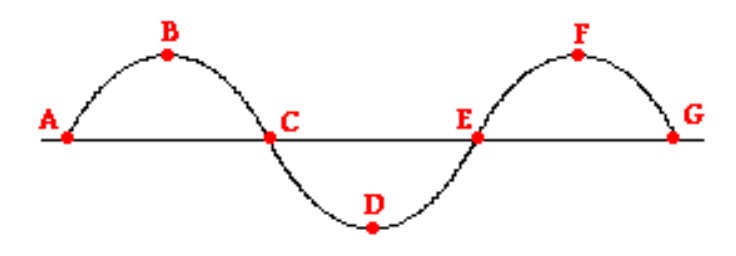
Which letter(s) represent the trough of the wave?

a)

A

b)

B & D

c)

D

d)

C & G

12.

Mechanical waves usually travel fastest through:

a)

solids

b)

liquids

c)

gases

13.
When light hits a black object, like the one in the picture, what will happen to the different colors?
a)
All colors of light will bounce off
b)
All colors of light pass through it
c)
All colors of light will be absorbed
d)
None of the above
14.

When light passes through a prism, why do you see different colors?

a)

Each color has a different wavelength, so they all bend at different angles

b)

Because Stone Cold said so

c)

Because the prism is magical and allows you see the colors

d)
15.
What is frequency?
a)
waves
b)
distance between equilibrium to crest
c)
hand motion
d)
The number of wave cycles completed in one second
16.
Compression means.....
a)
Far apart
b)
Close together
c)
Complicated
d)
Stretch
17.
Low Amplitude = ______________
a)
Quieter Sounds
b)
Louder sounds
18.
High Amplitude =__________________
a)
Louder sounds
b)
Quieter Sounds
19.
In General Sound waves travel the fastest in __________
a)
solid
b)
liquid
c)
Gas
d)
plasma
20.
What is the resulting direction of a surface wave?
a)
parallel
b)
circular
c)
opposite
d)
perpendicular
21.
What kind of wave is pictured?
a)
Transverse
b)
Longitudinal
c)
surface
d)
none of the above
22.
What kind of wave is pictured below?
a)
compressional wave
b)
transverse wave
c)
sound wave
d)
mechanical wave
23.
a)
Longitudinal Wave
b)
Transverse Wave
24.
a)
A is compression
b)
A is the trough
c)
A is the rarefraction
25.
a)
B is called rarefaction
b)
B is called compression
c)
B is called the crest
26.
The material through which a wave travel 
a)
trough
b)
medium
c)
crest
d)
vibration
27.
Speed = wavelength x frequency
The speed of a wave on a rope is 50 cm/s and its wavelength is 10 cm. What is the wave's frequency?
a)
50 cm/s
b)
5 Hz
c)
10 cm
28.
Energy can neither be created or destroyed
a)
Law of conservation of Mass
b)
Law of conservation of Energy
29.
a)
Reflection
b)
Refraction
30.
a)
Diffraction
b)
Interference
31.
a)
Refraction
b)
Reflection
32.

High pitched waves would have wavelengths that are...

a)

at a rarefaction

b)

far apart

c)

close together

d)

at the trough

33.
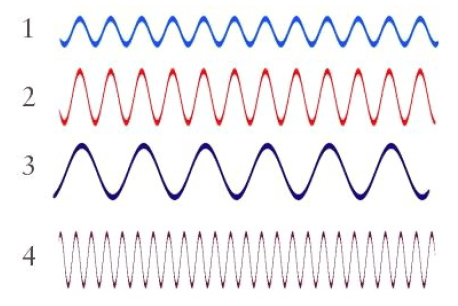
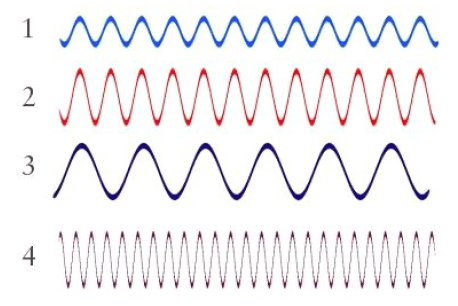
Which wave in the diagram has the greatest frequency?
a)
1
b)
2
c)
3
d)
4
34.
Which of the following can sound travel through?
a)
solid
b)
liquid
c)
gas
d)
all of the above
35.

Electromagnetic waves include the following except

a)

radio waves

b)

X-rays

c)

ocean waves

d)

microwaves

36.
How often a wave occurs is the wave's __________________
a)
crest
b)
frequency
c)
wavelength
d)
resting point
37.
The frequency of a wave is measured in __________________. 
a)
inches
b)
hertz
c)
periods
d)
eras
38.
What are the highest parts of a transverse wave called?
a)
amplitude
b)
trough
c)
resting point
d)
crest
39.
What number represents the amplitude?
a)
1
b)
2
c)
3
d)
4
40.

Which color has the longest wavelength?

a)

Yellow

b)

Red

c)

Green

d)

Purple

41.
The frequency of infrared waves is..
a)
1012 Hz
b)
1020 Hz
c)
104 Hz
d)
1015 Hz
42.

The frequency of an x-ray is --

a)

1.41 x 10⁻¹⁰ Hz

b)

1.41 x 10¹⁸ Hz

c)

1.41 x 10¹⁰ Hz

d)

1.41 x 10⁻¹⁸ Hz

43.

The wavelength of an infrared ray is --

a)

10-5 m

b)

1012 Hz

c)

105 m

d)

10-12 Hz

44.
Which wave in the diagram has the greatest wavelength?
a)
1
b)
2
c)
3
d)
4
45.
which material does sound travel the fastest?
a)
solid 
b)
liquid 
c)
gases
46.
This type of Electromagnetic wave shows a break in bones.
a)
gamma ray
b)
x-ray
c)
brokenometer
d)
radio wave
47.
_____________________light is the only type of EM wave detected by the human eye.
a)
Red
b)
Gamma
c)
Microwave
d)
Visible
48.
What is the lowest point on a wave?
a)
amplitude
b)
peak
c)
trough
d)
wavelength
49.
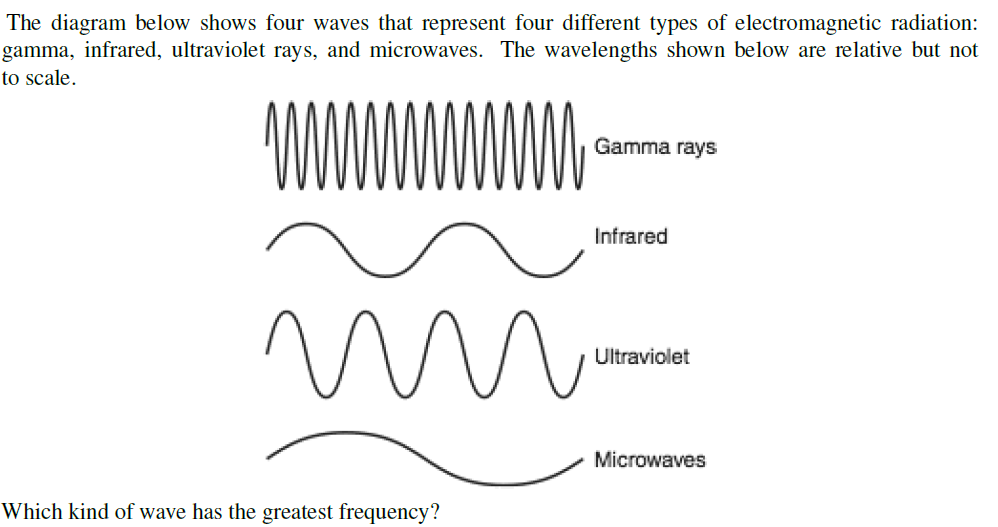
Which kind of wave has the greatest frequency?
a)
gamma rays
b)
infrared
c)
ultraviolet
d)
microwaves
50.
Determine the wavelength of this wave?
a)
1m
b)
2m
c)
3m
d)
4m
51.

When an object stores energy as a result of its position, it has:

a)

Kinetic Energy

b)

Power

c)

Work

d)

Potential Energy

52.

The energy an object has as a result of its motion.

a)

Kinetic Energy

b)

Power

c)

Work

d)

Potential Energy

53.

Energy can be defined as the ability to:

a)

Do work

b)

Apply a force

c)

Have power

d)

Sleep

54.

You climb stairs as part of a new workout routine. If you wanted to increase the work you do during your workout, you could: (Check all that apply)

a)

Run up the stairs faster

b)

Hold something heavy while you do it

c)

Go up more stairs

d)

Hop up the stairs instead of running

55.

Which of the following is NOT a fossil fuel?

a)

Coal

b)

Uranium

c)

Oil

d)

Natural Gas

56.

Which of the following statements are true according to the law of conservation of energy?

a)

Energy cannot be created

b)

Energy cannot be destroyed

c)

Energy can be converted from one form to another

d)

All of the above

57.

Work is the transfer of...

a)

Energy

b)

Force

c)

Mass

d)

Motion

58.

If it takes 7.5 J of work to move a box 0.75 m, how much force did you exert? Be sure to include a unit with your answer!

(a)  

59.

A worker uses a cart to move a load of bricks that weighs 680 N a distance of 15 m across a parking lot. What amount of work does the worker perform? Be sure to include a unit with your answer!

(a)  

60.

Based on the information provided in the picture, what is the Kinetic Energy at point B?

(a)  

61.

Work or not? - Lifting a heavy box off the ground.

a)

Work

b)

Not Work

62.

Work or not? - Your phone slipping out of your hand and falling to the ground.

a)

Work

b)

Not Work

63.

Work or not? - Carrying a box to your car.

a)

Work

b)

Not Work

64.

Choose the image below that shows potential energy decreasing then increasing if following the arrows from left to right?

a)
b)
65.

Using the image identify the three forms of heat transfer.

Conduction, Convection, Radiation.

a)

A: Conduction

B: Radiation

C: Convection

b)

A: Radiation

B: Conduction

C: Convection

c)

A: Convection

B: Conduction

C: Radiation

d)

A: Radiation

B: Convection

C: Conduction

66.

A student is investigating the motion of a pendulum. The student holds the weight at Point A and then releases it. Where is the kinetic energy the greatest?

a)

Point 1

b)

Point 2

c)

Point 3

d)

Point 4

67.

A girl is riding her bike at a speed of 12 m/s. The girl and her bike have a combined mass of 77 kg. What is the KE of the girl and her bike? Use the formula:  

KE = 12mv2KE\ =\ \frac{1}{2}mv^2    

a)

1078 J

b)

5544 J

68.

Where would an object have the most potential energy?

a)

top of a hill

b)

bottom of a hill

c)

on the way down a hill

d)

it never has potential energy

69.

How does a wind turbine change forms of energy?

a)

Mechanical to electrical

b)

Electrical to mechanical

c)

Radiant to electrical

d)

Chemical to electrical

70.

Heat always travels from...

a)

Warm to cool

b)

Cool to warm

c)

Warm to warm

d)

Cool to cool

71.

A hot air balloon rising is an example of ...

a)

conduction

b)

convection

c)

radiation

d)

connection

72.

A snowman melting in the sun

a)

convection

b)

conduction

c)

radiation

d)

connection

73.

Thermal energy that is transferred from one substance to another.

a)

heat

b)

temperature

c)

thermal energy

d)

radiation

74.

Which Apple has the greatest Gravitational Potential Energy?

a)

Apple A

b)

Apple B

c)

Apple C

d)

Apple D

75.

What is the Energy Conversion that is shown in the image?

a)

Radiant to Thermal

b)

Thermal to Chemical

c)

Chemical to Radiant

d)

Radiant to Chemical

76.

Calculate the potential energy of a roller coaster at the top of a 72 m hill that has a mass of 112 kg. PE = m x h x g (g = 9.8 m/s2)

a)
79,027 J
b)
790,720 J
c)
7,020 J
d)
790,700 J
77.

At which point of the roller coaster is potential energy the greatest?

a)

W

b)

X

c)

Y

d)

Z

78.

Where does the rollercoaster have the highest amount of kinetic energy?

a)
A
b)
B
c)
C
d)
D
79.
Which direction will the heat flow while this person holds a hot cup of tea?
a)
from the cup to her hand
b)
from her hand to the cup
c)
no heat is transferred
80.
_______ is force applied through a distance.
a)
Effort
b)
Resistance
c)
Power
d)
Work
81.
Which of the following equations should be used to calculate work done?
a)
W = F × d
b)
W = F/d
c)
W = F × a
d)
W = m × d
82.
How does a ramp make it easier to move a heavy object a certain distance?
a)
by decreasing the amount of force required to move the object
b)
by decreasing the amount of work required to move the object
c)
by decreasing the distance the object moves
d)
by increasing the amount of force required to move the object
83.
What two factors determine how much kinetic energy an object has from its motion?
a)
the object’s position and mass
b)
the object’s speed and surface area
c)
the object’s speed and mass
d)
the object’s speed and position
84.
Which is NOT a form of energy?
a)
friction
b)
thermal
c)
electrical
d)
chemical
85.
A microwave oven changes ________ energy into radiant energy.
a)
nuclear
b)
electrical
c)
mechanical
86.
A gas stove transforms the chemical energy in natural gas into __________ energy.
a)
radiant
b)
nuclear
c)
thermal
87.
The total of an object's kinetic energy and potential energy.
a)
work
b)
speed
c)
mechanical energy
d)
kinetic
88.
The gravitational potential of an object depends on its __________ and __________
a)
speed and mass
b)
weight and height
c)
work and energy
d)
size and shape
89.

Which of the following is the unit for GPE?

a)

m/s

b)

m/s^2

c)

g

d)

kg

90.

Which of the following is the unit for KE?

a)

kg

b)

J

c)

m/s

d)

W

91.

Which of the following is the unit for Velocity?

a)

m/s^2

b)

kg

c)

J

d)

m/s

92.
Convert: 186.5 K to C
a)
-86.4 C
b)
-50 C
c)
-68.4 C
d)
180 K
93.

Convert: -45.9 C to K:

a)

227.1 K

b)

400 K

c)

0 K

d)

373 K

94.

Which of the following is the correct formula in converting ℃ to ℉

a)

5/9 (℉-32)

b)

9/5 (℃)+32

95.

Using the formula 5/9 (℉-32), convert 110 ℉ to ℃.

a)

33

b)

23

c)

53

d)

43

96.

A bunsen burner flame has a temperature of 1700 K, what is this temperature in Celsius?

a)

1427 oC

b)

1973 oC

c)

1463 oC

d)

6.3 oC

97.

The value 34 oC is equal to (a)   Kelvin.

98.

when it is hot the atoms move...

a)

slow

b)

fast

c)

still

d)

there are no atoms

99.

When it is cold the atoms move...

a)

slow

b)

fast

c)

still

d)

there are no atoms

100.

What tool is used to measure temperature?

a)

a balance

b)

a thermometer

c)

a hydroscope

d)

a scale

101.

_______is the splitting of atomic nuclei

a)

Fission

b)

nuclear reaction

c)

Fusion

d)

bayler reaction

102.

_____is the joining of atomic nuclei

a)

Fusion

b)

chain reaction

c)

Photosynthesis

d)

Fission

103.
What is a chain reaction?
a)
When electrons are emitted causing electricity
b)
When a nuclear fission reaction occurs, the protons emitted can strike other nuclei in the sample, and cause them to split
c)
When a nuclear fission reaction occurs, the neutrons emitted can strike other nuclei in the sample, and cause them to split
d)
When a nuclear fission reaction occurs, the electrons emitted can strike other nuclei in the sample, and cause them to split
104.

How is the alpha particle written in a nuclear equation?

a)

42He

b)

24He

c)

0-1e

d)

00γ

105.
Which type of nuclear radiation is being emitted here?
a)
Alpha
b)
beta
c)
gamma 
d)
none
106.
Solve this equation for alpha decay.
85209At = ___ + 24He
a)
83205Bi
b)
86209Rn
c)
81207Tl
d)
85208At
107.

Gamma rays have

a)

no mass

b)

a huge mass

c)

a small mass

d)

an average mass

108.
Solve this equation for beta decay.
614C = ___ + -10e
a)
410Be
b)
714N
c)
210He
d)
613C
109.
Has the symbol
a)
Alpha
b)
Beta 
c)
Gamma
110.

Has the lowest penetrating power.  Can only penetrate 0.05 mm into the body and can be stopped by the skin.

a)
Alpha
b)
Beta
c)
Gamma
d)

Electron capture

111.
Has the highest penetrating power.  Can penetrate our body.  Even several cm thick of lead or several meters thick of concrete cannot stop all of it.
a)
Alpha
b)
Beta
c)
Gamma
112.
Uranium-238  decays into  Thorium-234  by emitting .........
a)
an alpha particle
b)
a beta particle
c)
gamma rays
d)
visible light
113.
Radioactive materials have unstable...
a)
electrons
b)
protons
c)
nuclei
d)
neutrons
114.
In a correctly written symbol what would be located in the "A" position?
a)
number of neutrons
b)
atomic number
c)
number of electrons 
d)
mass number
115.
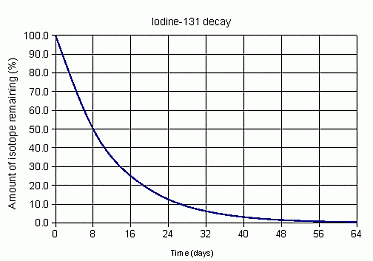
What is the half-life of iodine-131?
a)
32 days
b)
8 days
c)
16 days
d)
24 days
116.

The % of the parent isotope remaining after 2 Half Lives.

a)

50%

b)

25%

c)

12.5%

d)

6.25%

117.
What is Half-life?
a)
The amount of time it takes for some of the nuclei in a sample of the isotope to decay
b)
The amount of time it takes for half the electrons in a sample of the isotope to decay
c)
The amount of time it takes for half the nuclei in a sample of the isotope to decay
d)
the amount of time it takes to double the nuclei in a sample of the isotope to decay
118.

A beta particle is also called _____.

a)

an isotope

b)

a mass number

c)

an electron

d)

a fusion

119.

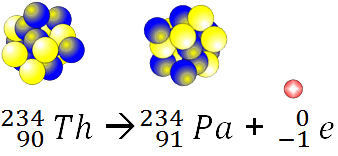
Which nuclear process if shown in the picture?

a)

alpha decay

b)

beta decay

c)

fusion

d)

fission

120.

high-energy photons emitted by a radioisotope

a)

positron

b)

radioactivity

c)

alpha particle

d)

gamma radiation

e)

beta particle

121.

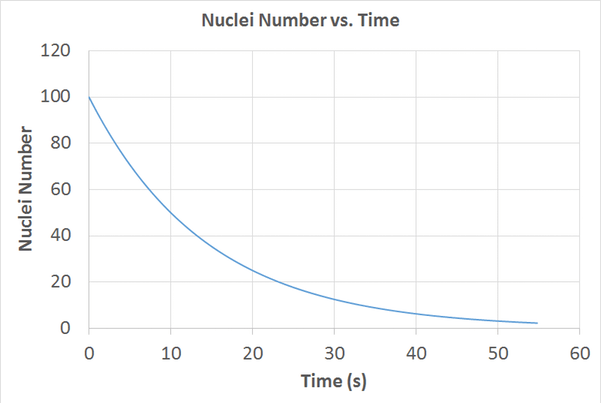
What is the Half life of this isotope?

a)

5 seconds

b)

10 seconds

c)

15 seconds

d)

20 seconds

122.

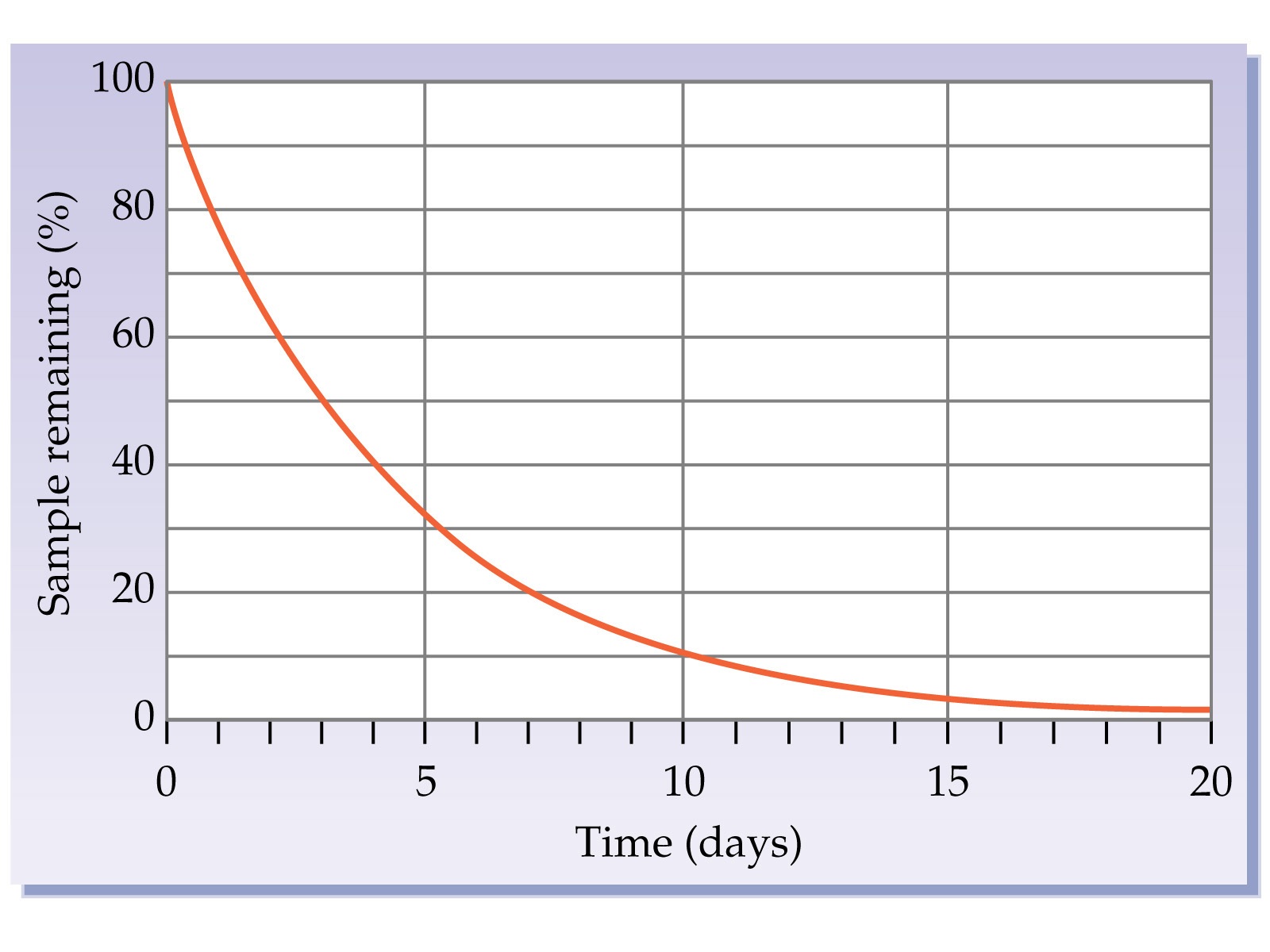
What is the Half Life of this isotope?

a)

3 days

b)

5 days

c)

8 days

d)

10 days

123.

What mineral is used to create Nuclear Power?

a)

Uranium

b)

Cobalt

c)

Iron

d)

Gold

124.

What do Nuclear Power plants Produce?

a)

Tesla cars

b)

Electricity

c)

Water

d)

Carbon dioxide

125.

What is radioactivity?

a)

An unstable atom releases energy to become stable

b)

A stable atom gains energy and becomes unstable

c)

When a bomb goes off.

d)

Negatively charged particles are emitted from the nucleus
126.

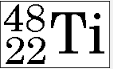
How many neutrons does this isotope of titanium have?

a)

48

b)

22

c)

26

d)

70

127.

What do these symbols represent?

a)

alpha particle

b)

beta particle

c)

gamma ray

d)

neutron

128.

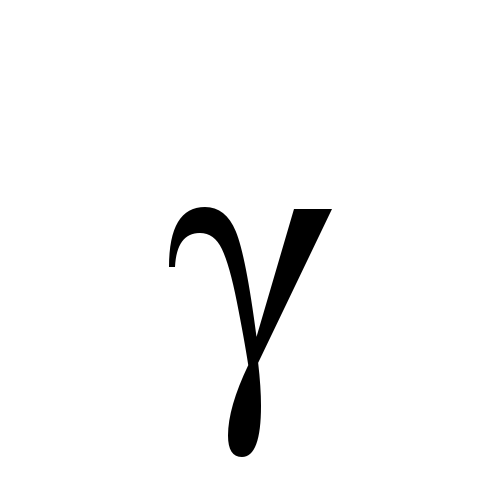
What is the symbol for a gamma ray?

a)
b)
c)
d)
129.

How many protons are in the nucleus of the element shown?

a)

19

b)

9

c)

10

d)

28

130.

A neutral atom of the isotope 2612Mg would consist of

a)

12 protons, 26 neutrons

b)

26 protons, 12 neutrons

c)

26 protons, 14 neutrons

d)

12 protons, 14 neutrons

131.

How many neutrons does an Oxygen-19 isotope have?

a)

19

b)

8

c)

11

d)

10

132.

Three types of nuclear radiation are _______ radiation, _________radiation, and _____________ radiation.

a)

alpha, beta, and gamma

b)

theta, beta, and kappa

c)

alpha, beta, positron

133.
What happens to the atomic number during alpha decay?
a)
The atomic number decreases by 4
b)
The atomic number increases by 1
c)
The atomic number decreases by 2.
d)
The atomic number stays the same.
134.

In the symbol 167N what the 7 stand for?

a)

Mass number

b)

Atomic number

c)

Atomic mass

d)

Number of neutrons

135.
If we start off with element 24X50 after an alpha decay we get another element Y that looks like
a)
22Y50
b)
22Y46
c)
20Y48
d)
26Y54
136.

Solve the nuclear decay reaction:

a)
b)
c)
d)
137.

The % of the parent isotope remaining after 1 Half Life.

a)

50%

b)

25%

c)

12.5%

d)

6.25%

138.

What is the only difference between two different isotopes of the same element?

a)

Number of neutrons

b)

Number of protons

c)

Number of electrons

d)

Size of atom

139.

Isotopes of an element have a different number of...

a)

Protons

b)

Neutrons

c)

Electrons

d)

Mass

140.

Which subatomic particle is used to identify the atom, as it never changes?

a)

protons

b)

neutrons

c)

electrons

141.

The purpose of a switch is to?

a)

Start and stop electric current

b)

Make a motor move

c)

Turn on a light

d)

Heat up wires

142.

The purpose of wires are to?

a)

Turn a switch on

b)

Turn off a light

c)

Carry electric current to different parts of the circuit

d)

Make a motor move

143.

The plus sign on a battery shows which terminal?

a)

Positive

b)

Negative

144.

The minus sign on a battery shows which terminal?

a)

Positive

b)

Negative

145.

If one part of the circuit is broken what will happen?

a)

The electricity will continue to flow

b)

The electricity will stop flowing

c)

The electricity will move faster

d)

The electricity will move slower

146.

The 3 components needed to complete a light circuit are? (Choose 3)

a)

Motor

b)

Light bulb

c)

Switch

d)

Wires

e)

Battery

147.

In a circuit the energy flows from which terminal to the rest of the component?

a)

Negative

b)

Positive

148.

Which circuit shown will produce light when the switch is closed?

a)
b)
c)
d)
149.

A student constructs the circuit shown for a science demonstration. With the switches in these positions, which lights are on?

a)

All the lights

b)

1 and 2 only

c)

3 and 4 only

d)

none of the lights

150.

The circuits below are an example of ...

a)

Series circuits

b)

Simple circuits

c)

Parallel circuits

d)

Insulated circuits

151.

The pathway through which electrical current flows.

(El camino a través de la cual fluye la corriente eléctrica.)

a)

Electric Circuit

(Circuito eléctrico )

b)

Conductor

(Conductor)

c)

Insulator

(Aislante)

d)

Flow

(Fluir)

152.

Material that allows heat or electrical energy to easily flow through it.

(Material que permite que la corriente eléctrica fluya fácilmente.)

a)

Electric Circuit

(Circuito eléctrico )

b)

Conductor

(Conductor)

c)

Insulator

(Aislante)

d)

Flow

(Fluir)

153.

Material through which heat or electricity does not easily flow.

(Material a través de la cual el calor o la electricidad no fluyen fácilmente.)

a)

Electric Circuit

(Circuito eléctrico )

b)

Conductor

(Conductor)

c)

Insulator

(Aislante)

d)

Flow

(Fluir)

154.

The flow of electricity around a circuit.

(El flujo de electricidad en un circuito.)

a)

Electric Circuit

(Circuito eléctrico )

b)

Conductor

(Conductor)

c)

Insulator

(Aislante)

d)

Electric Current

(Corriente eléctrica)

155.

Which of the following items can be used to conduct electricity?

(¿Cuál de los siguientes elementos puede usarse para conducir electricidad?)

a)
b)
c)
d)
156.

Portable source of stored chemical energy

a)

Battery

b)

Light Bulb

c)

Motor

d)

Component

157.

A complete pathway for the flow of electric current.

a)

Parallel Circuit

b)

Closed Circuit

c)

Series Circuit

d)

Circuit

158.

A circuit that has 2 or more pathways for current to flow to multiply components at the same time.

a)

Parallel Circuit

b)

Closed Circuit

c)

Series Circuit

d)

Circuit

159.

Series Circuit

a)

A circuit that has 2 or more pathways for current to flow to multiply components at the same time

b)

A complete pathway for the flow of electric current

c)

A circuit that has only 1 pathway for currents to flow to multiple components

d)

A pathway for the flow of electric current

160.

Energy that flows through circuits and can produce heat, light, motion, and sound

a)

Wire

b)

Electricity

c)

Parallel Circuit

d)

Circuit

161.
What is a closed path for electrons to flow through?
a)
static electricity
b)
circuit
c)
amperes
162.
Identify the conductor below.
a)
cloth rag
b)
plastic bottle
c)
gold ring
163.
Identify the insulator below.
a)
aluminum foil
b)
paperclip
c)
rubber eraser
164.
As the resistance in a circuit increases, the electric current __________.
a)
increases
b)
decreases
c)
stays the same
165.
Electricity is the flow of _________.
a)
protons
b)
neutrons
c)
electrons
166.
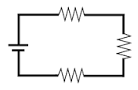
What type of circuit is pictured?
a)
series
b)
Parallel
167.
What type of circuit is pictured?
a)
series
b)
parallel
168.

is the opposition to the flow of charges in a material.

a)

Resistance

b)

Voltage

c)

Time

d)

Current

169.

What would happen if in a circuit the voltage is increase?

a)

The time would increase

b)

The current would increase

c)

The current would decrease

d)

The current would stay the same

170.

What would happen if in a circuit, the resistance increases but the voltage stays the same?

a)

The current would decrease

b)

The current would increase

c)

The voltage would decrease

d)

The voltage would increase

171.

In order to electrical current to flow through a wire the wire must be connected in a ____________ that includes a source of electrical current.

a)

averager matter

b)

Complete loop

c)

In an incomplete loop

d)

Interrupted Circuit

172.

Why electrical wiring usually are covered with a layer of plastic?

a)

To make it look pretty

b)

To help electricity flow along the wire

c)

To make it safe

d)

To add more energy

173.
this circuit is .....?
a)
open
b)
parallel
c)
closed
d)
The cutest little circuit evah!
174.
What size resistor would produce a 3 Amp current flow with a 12 Volt battery
a)
1 Ohm
b)
3 Ohms
c)
4 Ohms
d)
12 Ohms
175.
What is current measured in?
a)
Ω (Ohms)
b)
V (Volts)
c)
A (Amps)
d)
W (Watts)
176.
What is resistance measured in?
a)
Ω (Ohms)
b)
V (Volts)
c)
A (Amps)
d)
W (Watts)
177.
What is the Voltage of a circuit that has a resistance of 5 Ω and a current of 2 A?
a)
25 V
b)
10 V
c)
2.5 V
d)
0.4 V
178.
The mathematical relationship among Voltage, Current, and Resistance
a)
Faraday's Law
b)
Tesla's Law
c)
Edison's Law
d)
Ohm's Law
179.
Current times Resistance equals
 (I X R)
a)
Power
b)
Voltage
c)
Amperage
d)
Ohm
180.

Voltage divided by Resistance

(V / R)

a)

Current

b)

Power

c)

Ohms

d)

Watts

181.
How many Volts would we need to produce a current flow of 8 Amps through a 6 Ohm resistor
a)
12 volts
b)
24 volts
c)
1.3333
d)
48 volts
182.
This circuit has a 24 volt battery and the resistor is 8 ohms. How many amps are running through the circuit?
a)
3 Amps
b)
192 Amps
c)
2 Amps
d)
4 Amps
183.
How many Volts would it take to push 1 Amp through a resistance of 1 Ohm
a)
10 volts
b)
1 volt
c)
48 volts
d)
5 volts
184.
What size resistor would produce a 3 Amp current flow with a 12 Volt battery
a)
1 Ohm
b)
3 Ohms
c)
4 Ohms
d)
12 Ohms
185.
What is this symbol?
a)
resistor
b)
switch
c)
battery
d)
bulb
186.

An alarm clock draws 0.5 A of current when connected to a 120 volt circuit. Calculate its resistance.

a)

60Ω

b)

120Ω

c)

180Ω

d)

240Ω

187.

A circuit contains a 1.5 volt battery and a lamp with a resistance of 3 ohms. Calculate the current.

a)

0.5A

b)

1A

c)

1.5A

d)

2A

188.

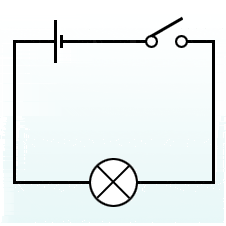
What components are in this schematic diagram?

a)

battery, switch, bulb, wire

b)

switch, switch, bulb

c)

battery, switch, bulb, motor

189.

What is the name of this component?

a)

fuse

b)

cell

c)

wire

d)

bell

190.
What is this symbol for?
a)
light bulb
b)
switch
c)
battery
d)
resistor
191.
What will happen when these magnets are brought close together?
a)
They will attract each other.
b)
They will repel each other.
c)
Both magnets will turn to the left
d)
Both magnets will turn to the right
192.
Where is the force of attraction the strongest on a magnet?
a)
at the poles
b)
in the middle
c)
above the magnet
d)
below the magnet
193.

Why does a compass needle point north?

a)

Because it is being attracted to the Magnetic South Pole

b)

Because north is up

c)

Because it is being attracted to the Magnetic North Pole

d)

Because north is down

194.

The entire region surrounding a magnet is known as the:

a)

Magnetic Domain

b)

Lodestone

c)

A Compass

d)

Magnetic Field

195.

Which metal can be attracted to magnets?

a)

Copper

b)

Aluminum

c)

Iron

d)

Gold

196.
What do the lines around this magnet represent?
a)
North Pole
b)
South Pole
c)
Magnetic Declination
d)
Magnetic Field
197.
Magnetism is generated by moving
a)
protons.
b)
electrons.
c)
neutrons.
d)
elements.
198.
A paper clip is an example of a:
a)
magnetic material
b)
permanent magnet
c)
bar magnet
d)
insulator
199.
What kind of magnet can be turned on and off?
a)
refridgerator magnet
b)
electromagnet
c)
magnetite
d)
iron
200.
A simple electromagnet can be made with which of the following?
a)
an electric current
b)
a turbine and nail
c)
a nail, a wire, and a battery
d)
a compass and a battery