
 Worksheets
Unit 5 Test Review
Total questions: 24
Worksheet time: 12mins
Which combination of abiotic factors would most likely support a dense forest biome?
High precipitation, moderate temperatures, and rich soil nutrients
Low precipitation, high temperatures, and sandy soil.
High altitude, low temperatures, and rocky soil
Constant direct sunlight, low precipitation, and saline soil
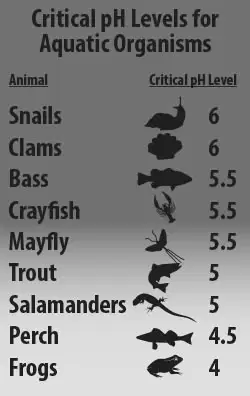
A local pond ecosystem has experienced a significant decrease in water pH due to acid rain.
Which of the following would most likely be a direct consequence of the change in pH on the
biotic factors within the pond?
Increased water temperature during summer months
A decrease in the population of aquatic organisms that are sensitive to pH level.
The introduction of a new species of fish from a nearby lake
An increase in the clarity of the water, making it easier for sunlight to penetrate

If the pH changes to a level 5, what will most likely happen in this ecosystem?
The crayfish population will increase
The mayfly population will increase.
The snail population will decrease.
The salamanders will decrease,
In a coastal marine ecosystem, various processes contribute to the carbon cycle. Which of
the following best describes the natural carbon cycling in a coastal marine ecosystem?
The decomposition of dead marine animals adds carbon to the geosphere, and
volcanic eruptions remove carbon from the atmosphere.
Combustion of fossil fuels adds carbon to the atmosphere, and the formation of coral
reefs removes carbon from the hydrosphere.
Respiration by marine organisms adds carbon to the atmosphere, and
photosynthesis by phytoplankton removes carbon from the atmosphere.
Decomposition of plastic waste in the ocean adds carbon to the hydrosphere, and
absorption of carbon dioxide by ocean water removes carbon from the geosphere.
3
September
Shell-forming organisms such as corals and mollusks trap CO2 by forming their shells. A
marine ecosystem study has observed a decline in corals and mollusks due to ocean
acidification. When ocean acidification increases, what could be a potential long-term effect
of their decline on carbon dioxide?
Increased carbon dioxide levels in the atmosphere decreases the shell-forming
organisms.
Increased carbon dioxide levels in the atmosphere increases the shell-forming
organisms
Decreased carbon dioxide levels in the lithosphere turns fossil fuels into shells
Decreased carbon dioxide in the atmosphere increases photosynthetic plankton.
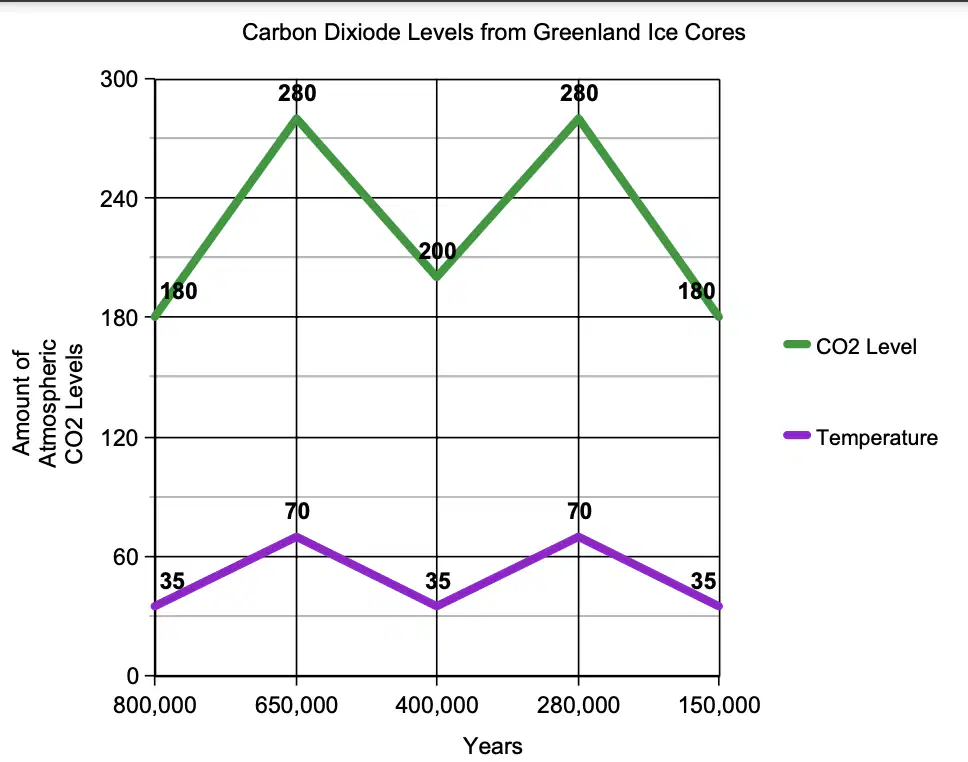
Greenland ice core samples were collected and the results of the atmospheric CO2 levels
were placed into a graph.
What prediction about the future atmospheric conditions is supported by the data table?
a. Global temperatures will increase if CO2 levels decrease
b. A decrease in global temperatures if CO2 levels decrease
c. No change in global temperatures, as CO2 levels stabilize naturally
d. A rapid shift to an ice age due to sudden increase in CO2 levels
Recent studies of ice core samples have shown that during periods when the Earth's
atmosphere contained higher concentrations of greenhouse gases, such as carbon dioxide
(CO2) and methane (CH4), the global temperatures were also elevated. This pattern suggests
a strong relationship between greenhouse gas concentrations and Earth's climate.
Which of the following conclusions can most accurately be drawn from the correlation
between high concentrations of greenhouse gases and global temperatures?
a. Higher greenhouse gas concentrations cause a decrease in global temperatures due
to increased reflection of solar radiation.
b. Higher greenhouse gas concentrations in the atmosphere have no significant impact
on global temperatures, suggesting other factors are more important.
c. Higher greenhouse gas concentrations are associated with elevated global
temperatures, likely due to a stronger greenhouse effect.
d. The correlation between high greenhouse gas concentrations and elevated global
temperatures is coincidental and unrelated to each other.
Scientists use different ways to learn about Earth's past weather. These methods give special
clues about old climates, helping us understand climate changes better. Which option best
explains what these clues can tell us about how the weather was previously?
a. Ice cores can reveal past atmospheric composition indicating greenhouse gas
concentrations.
b. Ice cores can reveal past atmospheric composition by showing the occurrence of
hurricanes.
c. Tree rings can indicate past climate conditions such as the presence of greenhouse
gases.
d. Tree rings can indicate past climate conditions by providing records of aquatic life.
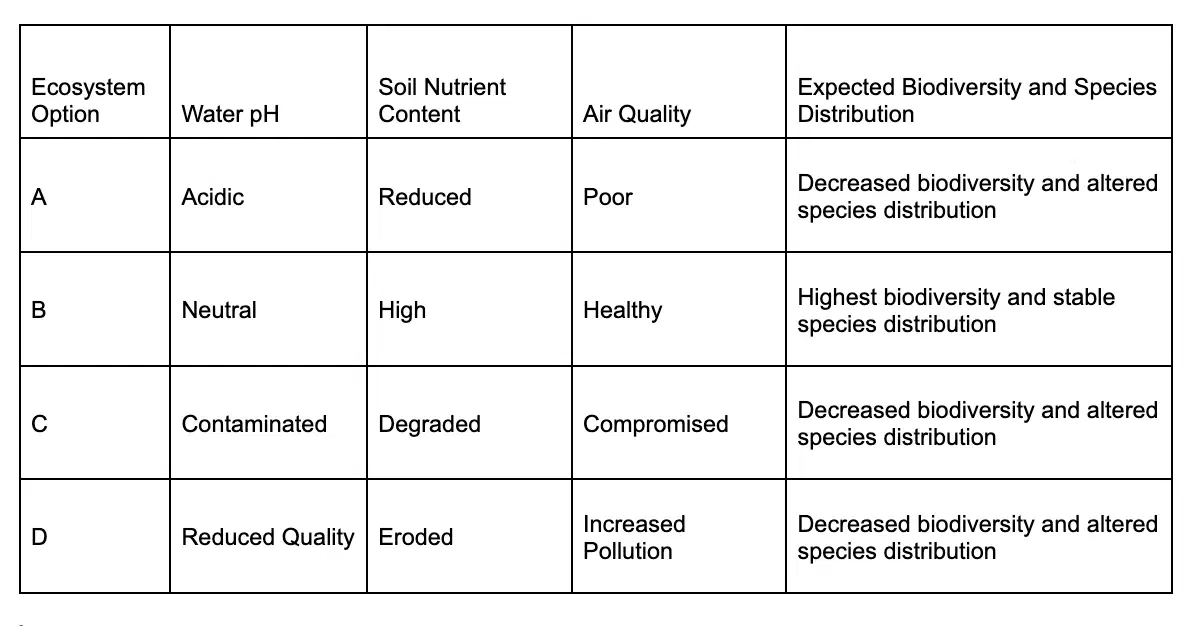
Researchers collected data on water pH, soil nutrient content, and air quality in various
ecosystems. Which of the following explanations explains why ecosystem B is most stable?
Ecosystem B has degraded soil and acidic water.
Ecosystem B has healthy air quality and high nutrient soil.
Ecosystem B has degraded soil and increased air pollution.
Ecosystem B has contaminated water and healthy air quality.
A student made a claim about a coastal ecosystem.
Claim: A coastal ecosystem is contaminated with a small, but consistent, amount of toxic
chemicals due to runoff from nearby agricultural activities. The food chain in this ecosystem
includes plankton, small fish that feed on plankton, larger fish that feed on small fish, and
eagles that feed on the larger fish.
Based on the student’s claim, which organism will most likely have the highest concentration
of toxic chemicals in the food chain?
Plankton, because they are the first to absorb the toxic chemicals from the
contaminated water.
Small fish, because they consume large quantities of plankton that have absorbed the
toxic chemicals
Larger fish, because they feed on small fish, accumulating higher concentrations of
the chemicals in their tissues.
Eagles, because they are at the top of the food chain and consume larger fish.
Which statement best explains bioaccumulation?
Bioaccumulation occurs when a pollutant moves from a lower trophic level to a higher
one, increasing in concentration along the food chain.
Bioaccumulation refers to the gradual increase of pollutants within an
individual organism over time
Bioaccumulation is the process by which pollutants decrease in concentration as they
move up the food chain due to metabolic breakdown by organisms.
Bioaccumulation describes the rapid removal of pollutants from an ecosystem through
natural processes such as decomposition.
How does biodiversity impact the environment?
Biodiversity increases the chance organisms will go extinct due to a natural disaster
Biodiversity decreases the stability of an ecosystem.
Biodiversity decreases the ecological resources in an environment.
Biodiversity increases the amount of genetic material in the environment and
helps stabilize ecosystems.
Succession is like nature's way of healing and building ecosystems over time. Imagine it as
starting a new garden on empty land or fixing one after it's been damaged. At first, only
certain tough plants can grow in these tough spots, kind of like the first helpers. These
pioneers make the place better for other plants to come in later. There are two types: primary,
which is starting from scratch where there's no soil, and secondary, which is more like fixing
up an area where the ground is still okay but everything else is gone. Over time, more and
more different kinds of plants and animals move in, making the area richer and full of life until
it reaches a stable, happy community. This whole process shows how nature can bounce
back and fill empty or damaged spaces with life again.
According to the paragraph, which of the following best summarizes how succession brings
an ecosystem back to a healthy state?
Succession is a rapid process that instantly restores ecosystems to their original
state, without the need for pioneer species
Succession involves only the introduction of animals to an ecosystem to stimulate its
recovery and does not rely on plants.
Succession is nature's way of healing and rebuilding ecosystems over time,
starting with pioneer plants in damaged or barren areas, and gradually
introducing more diverse life forms until a stable, thriving community is
established.
Succession occurs when humans intervene to plant specific species in an ecosystem,
bypassing the natural recovery process.
Forest fires might seem harmful, but they actually help forests grow back healthier. After a
fire, the land starts to heal. First, quick-growing plants, called pioneer species, pop up. These
plants are tough and can grow in the tough conditions left after a fire. They help get the forest
ready for other plants to come back. As time goes on, more plants and animals return,
making the forest full of life again. This process shows how forests can recover and even
become better places for plants and animals to live.
According to the paragraph, which of the following best summarizes the process of
succession after a forest fire?
Forest fires destroy all life in an area, and the ecosystem cannot recover without
human intervention.
After a forest fire, the area remains barren and lifeless, as the conditions are too
harsh for any new growth.
Pioneer species quickly grow in the conditions left after a fire, preparing the
land for other plants and animals to return, gradually restoring the forest's
biodiversity and health.
Forest fires permanently change the ecosystem to a state where only fire-resistant
species can survive, reducing biodiversity
What percentage of energy is typically transferred from one trophic level to the next in an ecosystem?
1%
10%
50%
100%
What role do decomposers play in an ecosystem?
They are primary producers
They consume primary consumers
They break down dead organic matter
They compete with primary producers
What role do oceans play in the carbon cycle?
They absorb carbon dioxide from the atmosphere.
They act as a carbon source
They decompose organic matter.
They convert carbon into fossil fuels.
Which process in the carbon cycle involves plants converting carbon dioxide into organic matter?
Cellular respiration
Decomposition
Photosynthesis
Combustion
What can tree rings tell us about past climates?
The color of past climates
The temperature of the past year
The age of a tree and climate conditions during each year of growth
The future climate trends
Periods of substantial volcanic activity have resulted in:
Global warming events
No significant climate change
Decreased biodiversity
Global cooling events
How can habitat fragmentation negatively impact biodiversity?
By increasing genetic variation.
By isolating populations and reducing genetic diversity.
By creating more habitats for species.
By increasing the number of species in a habitat.
What is the effect of climate trends on species distribution?
They stabilize species distribution.
They cause shifts in species distribution.
They have no impact on species distribution.
They reduce species distribution.
What is meant by ecosystem resilience?
The ability of an ecosystem to avoid ecological disturbances
The ability of an ecosystem to adapt to new species
The ability of an ecosystem to return to equilibrium after a disturbance
The ability of an ecosystem to increase in size
How does biodiversity influence the health of an ecosystem?
More biodiversity makes an ecosystem less stable
More biodiversity leads to a healthier and more stable ecosystem
Less biodiversity prevents ecological disturbances
Less biodiversity increases the ecosystem's resilience

