Wayground logo

Free Printable Worksheets

Font size

S
M
L
XL
Worksheets

Energy Pyramid and Food Chain Concepts

Total questions: 37

Worksheet time: 1hrs 10mins

Name
Class
Date
1.

What would happen to the bird if the green fish died out?

a)

the bird population would grow

b)

the bird population would die out

c)

the smaller fish will die out

2.

What is the bottom layer of the an energy pyramid?

a)

producer

b)

tertiary consumer

c)

Secondary consumer

d)

primary consumer

3.

What does an energy pyramid show?

a)

Energy flow in a community

b)

Longest lifespans

c)

The stronger animal the higher it is on the pyramid

4.
Which level will contain plants?
a)
A
b)
B
c)
C
d)
D
5.
Only eats meat
a)
omnivore
b)
herbivore
c)
carnivore
d)
primary consumer
6.
Only eats plants
a)
omnivore
b)
carnivore
c)
herbivore
d)
tertiary consumer
7.
An organism that needs to eat other organisms to obtain energy is known as a:
a)
Autotroph
b)
Producer
c)
Consumer
d)
Mutualist
8.
The arrows in a food chain or web represents what?
a)
They point to the organism that is being eaten.
b)
It shows how sunlight flows within an ecosystem.
c)
They show what direction the energy is flowing between organisms. 
d)
They represent how water is transferred within a habitat.
9.
In an energy pyramid, energy_______ as you move up the pyramid.
a)
Increases
b)
Decreases
c)
Stays the same
d)
Changes up and down
10.

In this energy pyramid, which organism has the least amount of energy available?

a)

Producers

b)

Herbivores

c)

Carnivores

d)

Top Predator

11.

In this energy pyramid, which organisms have the most energy available?

a)

Producers

b)

Carnivores

c)

Herbivores

d)

Top Predator

12.
This diagram shows the amount of energy that moves from one feeding level to another in a food web.
a)
Energy Pyramid
b)
Food Web
c)
Ecosystem
d)
Food Chain
13.

All of the nonliving things in an environment

a)

Biotic

b)

Heterotroph

c)

Decomposer

d)

Abiotic

14.
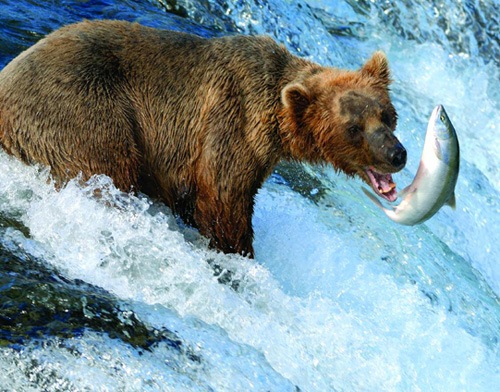
Bears eat a variety of foods including fish, berries, other types of vegetation.  Bears would best be classified as – 
a)
producers
b)
herbivores
c)
carnivores
d)
omnivores
15.
Snakes eat many types of small mammals including mice and rabbits as well as other lizards.  Snakes would best be classified as a - 
a)
producers
b)
herbivores
c)
carnivores
d)
omnivores
16.
Horses eat grasses and other plants in order to gain their nutrition.  Horses would best be classified as - 
a)
producers
b)
herbivores
c)
carnivores
d)
omnivores
17.
A living organism that puts materials from dead  plants and animals back to the soil is called a ____________?
a)
carnivore
b)
decomposer
c)
herbivore
d)
omnivore
18.
How much of the energy in each level of a ecological pyramid gets lost as heat or used by the organism so that it cannot be passed on to the next trophic level?
a)
80%
b)
90%
c)
10%
d)
20%
19.
In this ecological pyramid which type of consumer gets only 10% of the energy stored in plants?
a)
Herbivore
b)
Carnivore
c)
Omnivore
d)
Secondary Consumer
20.
The diagram represents a pyramid of energy in an ecosystem.  Which level would most likely contain organisms that do photosynthesis?
a)
A
b)
B
c)
C
d)
D
21.

Select the correct answer from each drop-down menu.


What is the source of energy in our ecosystem?


In our ecosystem, the ________ is the source of all energy. In terms of the ecological pyramid, _____ of energy is passed from one level to next level.

a)

air

b)

Sun

c)

water

d)

10%

e)

50%

22.
In an ecological pyramid, which type of organism always has the least amount of energy available?
a)
Producers
b)
Herbivores
c)
Carnivores
d)
Top Predator
23.
If there are 100 Kcal of energy available in the producers, how much energy would be available in the herbivores?
a)
10 Kcal
b)
1 Kcal
c)
100 Kcal
d)
1000 Kcal
24.
In this energy pyramid, what is the proper name for ANY ORGANISM ABOVE THE PRODUCER LEVEL?
a)
decomposers
b)
consumers
c)
producers
d)
omnivores
25.
What makes an energy pyramid different than a food web or chain?
a)
It shows energy flowing from the top of the chain and downward. 
b)
The tropic levels are the opposite
c)
It shows the amount of energy in each trophic level
d)
It shows specific predator/prey relationships
26.

This diagram shows how energy flows through an eco-system. What is the first source of energy in this pyramid?

a)

sharks and large birds

b)

algae, plankton and seagrass

c)

herbivorous fish, crustaceans and sea urchins

d)

seals and carnivorous fish

27.
Eat primary consumers (can be carnivores and omnivores)
a)
Tertiary Consumers
b)
Secondary Consumers
c)
Quaternary Consumers 
d)
Top Predators 
28.
An organism that uses an outside source of energy like the sun to create energy-rich food molecules.
a)
Consumer
b)
Producer
c)
Decomposer
d)
Parasite 
29.
What does a Primary Consumer eat?
a)
Tertiary Consumers
b)
Secondary Consumers
c)
Producers
30.
Which organism recieves the least amount of energy from the producer?
a)
Owl
b)
Grasshopper
c)
Lilypad
d)
Mouse
31.

The primary consumer is

a)

Grass

b)

Grasshopper

c)

Mouse

d)

Owl

32.

The primary consumer is

a)

Grass

b)

Grasshopper

c)

Mouse

d)

Owl

33.

tertiary consumers

a)

Eat the primary consumer

b)

Eat plants and animals

c)

Consume the producer

d)

eat the secondary consumer

34.

How much energy is moved from one trophic level to the next trophic level?

a)

100%

b)

1/2

c)

10%

d)

25%

35.

How many calories will be passed on from 250 to the next trophic level?

a)

2,500

b)

25

c)

2.5

d)

10%

36.

a primary consumer is always a

a)

omnivore

b)

carnivore

c)

omnivore or herbivore

d)

herbivore

37.

a producer always

a)

eats other producers

b)

gets energy from the sun

c)

is a herbivore

d)

is a plant