
Font size
 Worksheets
WW1 & 2 Review WH
Total questions: 60
Worksheet time: 1hrs 15mins
Germany’s entrance into World War I was based on a pre-arranged agreement with Austria-Hungary. This is an example of
a treaty.
a contract.
an ultimatum.
an alliance.
How did trench warfare change the nature of fighting during World War I?
Armies had to abandon the use of heavy artillery.
Paratroopers were used to get behind enemy lines.
Troops were forced into defensive positions leading to a stalemate.
Civilians were forced to engage in military activities that increased casualties.
Which event led to the US getting involved in WW1?
Assassination of Franz Ferdinand
Alliances
Zimmerman Telegram
Treaty of Versailles
WWI brought many new technological advancements such as?
Using horses as war mounts
Military deployment
Cannons and naval ships
Tanks, Submarines, and poison gases
What is the definition of "war of attrition"?
A deadlock in which neither side can defeat the other
Putting all your resources into the war effort
Payment for war damages
Wearing the enemy down with constant attacks
How is "total war" best defined?
A deadlock in which neither side can defeat the other
Putting all your resources into the war effort
Payment for war damages
Wearing the enemy down with constant attacks
What are "reparations" in the context of war?
A deadlock in which neither side can defeat the other
Putting all your resources into the war effort
Payment for war damages
The right people have to govern their own country
What does "self-determination" refer to?
A deadlock in which neither side can defeat the other
Putting all your resources into the war effort
Payment for war damages
The right people have to govern their own country
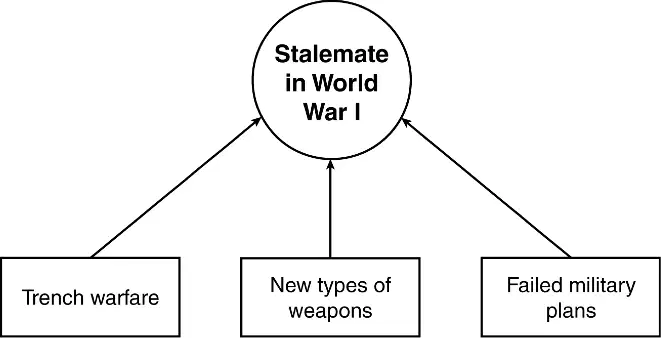
Which event changed the situation illustrated in this diagram?
the collapse of the Ottoman Empire
the formation of secret alliances
the entry of the United States into the conflict
the use of submarine warfare
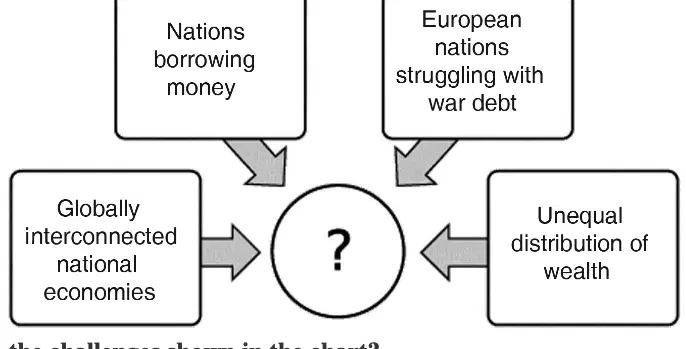
Use the graphic organizer to answer the question. What resulted from the challenges shown in the chart?
worldwide economic depression
rapid expansion of American industries
trade embargoes on communist nations
free trade embargoes in North America
Which nations adopted a fascist system of government before World War II?
Poland and Lithuania
Russia and Japan
Italy and Germany
England and France
Germany initiated World War II in Europe by invading which country?
the Soviet Union
Austria
Czechoslovakia
Poland
In 1935, Italy invaded and conquered which African nation?
Ethiopia
Morocco
Libya
Egypt
How did the expansionist policies of Italy, Germany, and Japan contribute to the outbreak of World War II?
They fostered a climate of international cooperation and understanding
They led to increased tensions and a series of military conflicts
They promoted economic growth and prosperity
They had little impact on global politics
Which policy did Neville Chamberlain adopt in 1939 as a response to Nazi aggression?
appeasement
brinkmanship
détente
multilateralism
Which of the following explains one reason for the high number of military casualties in the Soviet Union during World War II?
Great Britain supported internal uprisings.
Italy established a blockade of major ports.
Chinese nationalist forces attacked from the south.
Nazi Germany invaded using blitzkrieg tactics.
Which German action caused significant civilian casualties in Great Britain during World War II?
blockades of commercial shipping
persecution of minority groups
occupation of the Sudetenland
bombing raids on London
What was a result of the Battle of Midway in 1942?
Japan captured large numbers of U.S. ground troops.
Japan was stopped from further expansion in the Pacific.
The United States secured a base for an invasion of Japan.
The United States suffered severe damage to its forces in the Pacific.
Use the photograph to answer the question.
Midway
Iwo Jima
Leyte Gulf
Guadalcanal
What was the primary objective of the D-Day landings?
To capture Berlin
To liberate Italy
To open a Western Front in Europe
To destroy the German Navy
What was the ultimate outcome of the Battle of Stalingrad?
A decisive German victory.
A Soviet victory that halted the German advance into the Soviet Union.
A stalemate that led to further negotiations.
A strategic retreat by the Soviet forces.
Which World War II battle involved the greatest mobilization of land and sea forces?
Okinawa
Normandy
El Alamein
Guadalcanal
Which United States military figure accepted Japan’s surrender in World War II and managed the occupation of Japan by the United States?
George Patton
Chester Nimitz
Douglas MacArthur
Dwight Eisenhower
Which pairing of world leader and country is correct?
Franklin Roosevelt/Great Britain
Benito Mussolini/France
Winston Churchill/United States
Josef Stalin/Russia
Which military leader was the commander of the D-Day invasion for the Allied forces?
George Patton
Douglas MacArthur
Chester Nimitz
Dwight Eisenhower
What was the name for the secret project to build an atomic bomb?
Manhattan Project
Tuskegee Airben
Secret Boom
Normandy
Which future president served as commander during the French invasion?
Dwight Eisenhower
Winston Churchill
Neville Chamberlain
Erwin Rommel
Who was the British leader that signed an appeasement with Hitler?
Benito Mussolini
Douglas MacArthur
Adolph Hitler
Neville Chamberlain
Who was the fascist leader of Italy?
Adolph Hitler
Dwight Eisenhower
Benito Mussolini
Neville Chamberlain
Which was a major cause of the rise dictators in Europe after WW1?
economic prosperity
Treaty of Versailles
redrawing of European borders
German win of WWI
The D-Day Allied invasion of France took place where?
Paris
Plymoth
Tokyo
Normandy
Who was the American General overseeing the Pacific Theater?
General Douglas MacArthur
General Eisenhower
General Rommel
General Lee
What is the name of the new political party to rise in Germany following WW1?
Socialist
Nazi
Fascist
Bolshevik
Japan's goal was to take over
North America
Soviet Union
Eastern Asia
Western Asia

What is the name of this iconic poster woman?
Tanya the Tank
Wonder Woman
Eleanor Roosevelt
Rosie the Riveter
What event ended the war with Japan?
The battle of Midway
Okinawa
Doolittle Raids
Dropping the Atom bomb
The League of Nations was a proposal created by
Teddy Roosevelt
William H Taft
Archduke Franz Ferdinand
Woodrow Wilson
What issues led to the American involvement in WW1?
Yellow Journalism, DeLome Letter, Sinking of the USS Maine
Sinking of the Lusitania, Zimmerman Note, Unrestricted submarine warfare
The invasion of Poland, Soviet Non Aggression Pact, Pearl Harbor, Munich Conference

The maps depict Europe before & after World War I.
Use them to answer the question.
A major reason for the changes illustrated in these maps was the success of -----------
totalitarianism.
isolationism.
nationalism.
communism.
In What years did WW1 occur?
1914 - 1918
1815 - 1818
1939-1945
1861-1865

This image is an example of WW1...
Advertisement
News Article
Famous Art
Propaganda
After the central powers lost WW1, Germans were forced to take responsibility for all of the damages by signing what treaty?
The Treaty of Nanjing
The Treaty of WW1
The Treaty of Versailles
The treaty of Paris
Who ruled as a dictator in Italy?
Adolf Hitler
Joseph Stalin
Benito Mussolini
The Allies consisted of......
Japan, Germany, and America
America, France, and China
America, Russia and Great Britain
Germany, China, Japan, and Hawaii
MASS EVACUATION OF BRITISH TROOPS ACROSS THE ENGLISH CHANNEL IN FRANCE
DUNKIRK
BLITZKRIEG
OPERATION OVERLORD
BATTLE OF BRITAIN
GERMAN TERM FOR "LIGHTNING WAR"
DUNKIRK
BLITZKRIEG
OPERATION OVERLORD
BATTLE OF BRITAIN
________________________ was Hitler's mass murder of over 12 million people.
D-Day
The Holocaust
Pearl Harbor
The atomic bomb
What was the battle that took place along 5 beaches in Normandy, France.
Operation Torch
D-Day
Invasion of France
Operation Fortitude
In which battle did Hitler violate the Nazi-Soviet Pact?
Battle of Stalingrad
Operation Torch
Battle of Soviets
Operation Barbarossa

