
 Worksheets
Fluid Mechanics Quiz
Total questions: 25
Worksheet time: 13mins
What is a key characteristic that defines a fluid?
It has a fixed shape.
It deforms continuously under the application of shear stress.
It resists deformation under shear stress.
It is always incompressible.
Which states of matter are classified as fluids?
Solids and Liquids
Liquids and Gases
Solids and Gases
Only Liquids
How do molecules in a gas typically behave compared to molecules in a liquid?
They are fixed in position relative to each other.
They are more closely packed and have stronger intermolecular forces.
They are far apart and move randomly, filling the entire volume of a container.
They vibrate about fixed positions.
Gauge pressure is typically measured relative to what?
A perfect vacuum
Standard atmospheric pressure at sea level
Local atmospheric pressure
The pressure at the center of the Earth
A pressure reading of 0 kPa absolute corresponds to:
Atmospheric pressure
Standard gauge pressure
A perfect vacuum
A negative gauge pressure equal to atmospheric pressure
A pressure relief valve is set to open at a gauge pressure of 4 bar. If the atmospheric pressure is 101.3 kPa, at what absolute pressure will the valve open?
400 kPa
401.3 kPa
501.3 kPa
300 kPa
The gauge pressure in a tire is 220 kPa. If the atmospheric pressure is 101 kPa, what is the absolute pressure in the tire?
119 kPa
220 kPa
321 kPa
0 kPa (vacuum)
A simple U-tube manometer open to the atmosphere is used to measure the gauge pressure of a gas. The fluid in the manometer is water (density 1000 kg/m³), and the height difference is 0.3 meters. What is the gauge pressure of the gas in kPa? (Take g = 9.81 m/s²)
2.943 Pa
29.43 Pa
294.3 Pa
2.943 kPa
A liquid occupies a volume of 5 liters and has a mass of 4 kg. What is the density of the liquid in kg/m³? (Note: 1 liter = 0.001 m³)
0.8 kg/m³
8 kg/m³
80 kg/m³
800 kg/m³
A fluid has a density of 1200 kg/m³. What is its specific gravity relative to water at 4°C?
0.833
1.2
12
1200
A rectangular tank contains 2 m³ of a liquid with a specific gravity of 1.5. What is the mass of the liquid in the tank? (Take the density of water as 1000 kg/m³)
300 kg
1500 kg
2000 kg
3000 kg
What is the fundamental principle that explains how a hydraulic jack multiplies force?
Archimedes' Principle
Boyle's Law
Charles's Law
Pascal's Principle
Hydraulic jacks are commonly used in which of the following applications?
Lifting vehicles for maintenance or repair
Pumping water from a well
Generating electricity
Measuring atmospheric pressure
A hydraulic jack has a pump piston with an area of 2 cm² and a lifting ram with an area of 40 cm². If a force of 100 N is applied to the pump piston, what is the theoretical force exerted by the lifting ram?
5 N
200 N
2000 N
4000 N
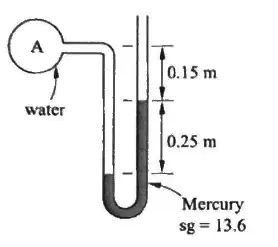
What is the pressure in point A?
250 N/m²
1233.5 N/m²
31882.5 N/m²
318825 N/m²
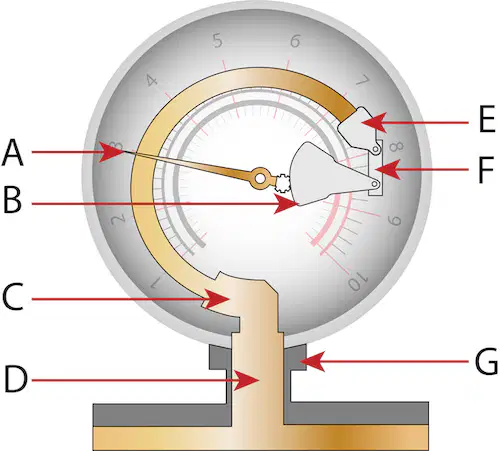
Name the Bourdon tube components
pivot and pivot pin (A), indicator needle (B), bourdon tube moving end (C), sector gear (D), bourdon tube’s stationary end (E), socket block (F), and inlet pipe (G)
indicator needle (A), sector gear (B), bourdon tube’s stationary end (C), inlet pipe (D), bourdon tube moving end (E), pivot and pivot pin (F), and socket block (G)
pivot and pivot pin (A), socket block (B), bourdon tube moving end (C), sector gear (D), bourdon tube’s stationary end (E), indicator needle (F), and inlet pipe (G)
indicator needle (A), bourdon tube moving end (B), inlet pipe (C), socket block (D), sector gear (E), bourdon tube’s stationary end (F), and pivot and pivot pin (G)

Name the type of fluid flow of profile (a)
Steady flow
Laminar flow
Turbulent flow
Transitional flow
Name the type of fluid flow of profile (b)
Steady flow
Laminar flow
Turbulent flow
Transitional flow
Name the type of fluid flow of profile (c)
Steady flow
Laminar flow
Turbulent flow
Transitional flow
Which of the following statements accurately describes the buoyant force acting on an object submerged in a fluid?
The buoyant force is equal to the weight of the object.
The buoyant force is equal to the volume of the object.
The buoyant force is equal to the density of the fluid.
The buoyant force is equal to the weight of the fluid displaced by the object.
The Reynolds number (Re) is a dimensionless quantity used in fluid mechanics to predict:
The density of the fluid.
The type of flow.
The average velocity of the fluid.
The viscosity of the fluid.
Which fundamental principle of fluid mechanics is applied when analyzing the flow rates in a branching pipe system with an incompressible fluid under steady flow conditions?
Conservation of Energy (Bernoulli's Principle)
Conservation of Mass (Continuity Equation)
Conservation of Volume
Conservation of Momentum
A pipe with a diameter of 0.45 m has water flowing through it at a velocity of 2m/s. What is the volume flow rate in this pipe?
0.318 m³/s
0.159 m³/s
0.9 m³/s
1.41 m³/s
The operation of a Venturi meter, which measures fluid flow rate by observing a pressure difference created by a change in pipe diameter, is a direct application of:
Archimedes' Principle
Pascal's Principle
Newton's Third Law
Bernoulli's Theorem
Which of the following is NOT a condition required for the direct application of the most common form of Bernoulli's equation?
The fluid is viscous.
The fluid is incompressible.
The flow is steady.
The analysis is performed along a single streamline.

