
Font size
 Worksheets
Section 3 Review
Total questions: 75
Worksheet time: 2hrs 56mins
In this system of government, all power is concentrated in a strong, central government.
Confederal
Federal
Unitary
Parliamentary
In this system of government, the majority of the power lies in individual state governments loosely connected by a weak central government.
Confederal
Federal
Unitary
Parliamentary
In this system of government, power is shared between a strong central government and strong state governments.
Confederal
Federal
Unitary
Parliamentary

What system of government does this picture represent?
Confederal
Federal
Unitary
Parliamentary
Powers that are written into the Constitution are known as:
observed
enumerated
written
elastic
The main job of the legislative branch is to
resolve disputes involving the law
enforce and carry out federal laws
make laws needed for the country
obey laws once they are passed
The most important task of the executive branch is to
resolve disputes involving the law
enforce and carry out federal laws
decide which laws are constitutional
change laws to fit changing needs
The judicial branch is responsible for
resolving disputes under the law
putting federal laws into effect
vetoing laws it doesn't like
making new laws to stop crime
The "elastic clause" gives Congress the power to
make adjustments as times change
declare actions of the president unconstitutional
veto decisions of the Supreme Court
powers needed to carry out its other powers
The power to ratify treaties belongs to the
House
Senate
Supreme Court
president
Who has the power to declare war?
Congress
Supreme Court
States
President
Which principle does the US Supreme Court apply when it declares an act of Congress unconstitutional?
Separation of Powers
Checks and Balances
Rule of Law
Natural Rights
Describe the structure of the Legislative Branch.
A two-house (bicameral) legislature
Includes the President and Judges
Includes just the House of Representatives
Includes just the Senate.
Click on any enumerated powers Congress has.
~collect taxes~
~coin money~
~make rules about citizenship~
~regulate trade~
create an army and navy~
~impeach and remove public officials~
~approve presidential appointments~
~ratify (approve) treaties~
~declare war~
Click on all the powers the U.S. President has.
~send armed forces into combat - but not declare war~
~makes treaties with other nations~
~nominates people to work in government positions~
~grants pardons~
The Supreme Court addresses issues around constitutionality. What does that mean?
It means that they have to decide if the law or action violates the Constitution.
It means that they have to decide if the President likes the law or action.
It means they have to decide whether or not the Articles had the same law.
The Supreme Court and lower Federal Courts
Legislative Branch
Executive Branch
Judicial Branch
President, Vice President, and Executive Departments (Cabinet)
Legislative Branch
Executive Branch
Judicial Branch
House of Representatives and the Senate
Legislative Branch
Executive Branch
Judicial Branch
What happens between when a bill is introduced and when it is voted upon?
The president vetoes it
There is a debate on the floor of the chamber
Citizens write to their representative with an idea for a bill
The president signs it into law
Powers of congress that are not written in the constitution but are suggested are called
Delegated Powers
Enumerated Powers
Implied Powers
Legislative Powers
What role does the Vice-President of the United States play in the Senate?
Chairs all standing and select committees
Breaks ties in the Senate
Serves as the Speaker of the House
Chairs the special committees
What happens to a bill after it is recommended by a committee in Congress?
It is signed into law by the President
It is forwarded to the full house for a vote
It is discarded and not considered further
It is sent to the Supreme Court for review
What happens to a bill if the President SIGNS it?
it becomes a Law
It is rejected
What happens to a bill if the President VETOES it?
it becomes a Law
It is rejected
Jake, a soldier, failed to return to base after
going on leave, so he/she is charged for being
Absent Without Official Leave (AWOL) and
brought to trial.
Civil Law
Military Law
Criminal Law
Juvenile Law
Anna ordered an iPhone off the internet
from a private seller, but never received the order.
The seller is refusing to refund her money, so she
takes the seller to court.
Criminal Law
Juvenile Law
Civil Law
Military Law
Noah was caught by a security camera
robbing a gas station. He was arrested and brought
to trial. Found guilty, he was given a fine and
sentenced to 10 years in prison.
Military Law
Civil Law
Military Law
Criminal Law
A group of students choose to wear black
armbands to school to protest a law they are
unhappy about. When school administrators hear
about the plan, they create rules against wearing
armbands, warning students that they will be
suspended if they follow through. Later, the case
goes all the way to the U.S. Supreme Court, who
rules that students do not lose their right to free
speech just by stepping on school property.
Constitutional Law
Civil law
Military Law
Criminal Law
U.S. Supreme Court case that determined that “separate but equal” segregation was not equal in public education
Brown v. Board of Education
Plessy v. Ferguson
District of Columbia v. Heller
Miranda v. Arizona
U.S. Supreme Court case that determined that states cannot violate the Equal Protection Clause under the Fourteenth Amendment when undertaking election recounts.
Bush v. Gore
District of Columbia v. Heller
United States v. Nixon
Miranda v. Arizona
the section of the Fourteenth Amendment that says that states must apply the law equally and cannot discriminate against citizens or groups of citizens
Equal Protection Clause
Miranda v. Arizona
Supremacy Clause
judicial review
U.S. Supreme Court case that upheld the Sixth Amendment right that all defendants must be appointed a lawyer if they cannot afford their own attorney
Gideon v. Wainwright
Brown v. Board of Education
United States v. Nixon
Tinker v. Des Moines
U.S. Supreme Court case that determined that the First Amendment does not protect all types of student speech in school
Hazelwood v. Kuhlmeier
Gideon v. Wainwright
Brown v. Board of Education
District of Columbia v. Heller
U.S. Supreme Court case that determined that juvenile court must comply with the Fourteenth Amendment
In re Gault
Brown v. Board of Education
Tinker v. Des Moines
Hazelwood v. Kuhlmeier
the power of the U.S. courts to examine the laws or actions of the legislative and executive branches of the government and to determine whether such actions are consistent with the U.S. Constitution
judicial review
separation of powers
Equal Protection Clause
Supremacy Clause
U.S. Supreme Court case that established judicial review
Marbury v. Madison
Gideon v. Wainwright
United States v. Nixon
Bush v. Gore
U.S. Supreme Court cases that upheld the Fifth Amendment protection from self-incrimination
Miranda v. Arizona
Bush v. Gore
District of Columbia v. Heller
Tinker v. Des Moines
U.S. Supreme Court case that determined that “separate but equal” segregation was not discrimination
Plessy v. Ferguson
Gideon v. Wainwright
United States v. Nixon
Brown v. Board of Education
the structure of the federal government, according to the U.S. Constitution, that sets up three branches with their own distinct powers and responsibilities
separation of powers
Equal Protection Clause
legal precedent
segregation
the right in the Fifth Amendment that protects a person from being forced to reveal to the police, prosecutor, judge, or jury any information that might subject him or her to criminal prosecution
self-incrimination
arbiter
unanimous
segregation

The headline describes an action by citizens.
What conclusion can be drawn from the headline?
Citizens can be involved in policy making through their representatives.
Citizens can be directly involved in policy making.
Only elected officials may change constitutions.
Only elected officials make policy.
The U.S. Constitution outlines individual rights in the Bill of Rights. Where can an outline of individual rights be found in the Florida Constitution?
Article II
Preamble
Article IV
Declaration of Rights
Which statement about the amendment processes of the Florida and US Constitutions is correct?
Amendments to the Florida Constitution are added to a separate section of the document.
The US Constitution has been amended much more often than the Florida Constitution.
Amendments to the US Constitution are added to main articles of the document.
It is much easier to amend the Florida Constitution than the US Constitution.
How does the supremacy of the Constitution affect the states?
States must have all new laws approved by Congress.
States may not pass any laws that go against the Constitution.
States are expected to pass the exact same laws as the United States.
States are required to defend every new law before the Supreme Court.
What is a similarity between the Florida and U.S. Constitutions?
They both contain a list of rights of citizens
They both have the same number of amendments
They both contain the supremacy clause
They both set up local governments
What are the three words both the U.S. and Florida constitutions begin with?
(a)
What is one way a Florida state Constitutional amendment can be adopted?
At least 60% of voters vote for it in a general election
Three-Fourths of the U.S. House and Senate vote for it
Three-Fourths of the Florida House and Senate vote for it
The Governor signs the proposed amendment

The newspaper headline below describes an event in U.S. history.
Based on the headline, what happened before the event presented in the image?
Two-thirds of each house of Congress voted to support the amendment.
The president rejected the amendment after Congress voted to support it.
Three-fourths of each house of Congress voted to support the amendment.
The president forwarded the amendment to the states after Congress voted to support it.
A proposed amendment to the Constitution becomes law when it is ratified by
a national election.
the Supreme Court.
three-fourths of the states.
the U.S. House and Senate.
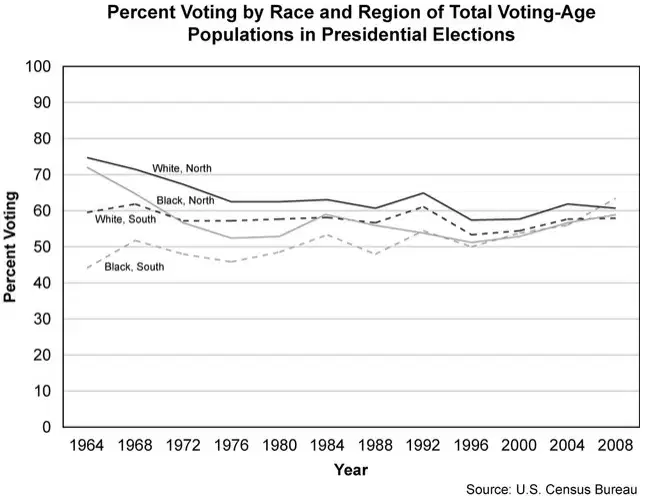
The graph shows the percentage of the voting-age population who voted in presidential elections from 1964 to 2008. The lines represent white voters and black voters in the North and in the South. Use the graph to answer any questions that follow.
What was the primary reason for the large gap between black voter participation rates in the North and black voter participation rates in the South?
Most northern states held voter registration drives and other get-out-the-vote efforts aimed at assisting black voters.
Black citizens in the North were more interested in politics than black citizens in the South.
Many southern states implemented measures that were intended to make it difficult for black citizens to vote.
Citizens did not need to register to vote in order to vote in the North.
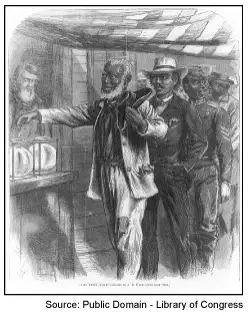
The image shows an 1867 wood engraving entitled "The First Vote".
The action that is illustrated in the above wood engraving was made possible by the passage of which amendment?
the Tenth Amendment
the Thirteenth Amendment
the Fifteenth Amendment
the Twenty-sixth Amendment
Because of the Twenty-sixth Amendment, American citizens are eligible to vote at what age?
16
18
21
25
How did the ratification of the Nineteenth Amendment affect the American political process?
Efforts to disenfranchise minority voters became criminal offenses.
Issues important to women became central to many political campaigns.
African Americans were elected for the first time in many Southern states.
Citizens were granted the power to directly elect members of the US Senate.
In which of these is VOTING normal?
DEMOCRACY
THEOCRACY
ABSOLUTE MONARCHY
DICTATORSHIP
Which of these is ruled by a few?
Oligarchy
Democracy
Dictatorship
Absolute Monarchy
Every citizen is given an equal vote in government and together everyone makes all of the important decisions
autocracy
direct democracy
oligarchy
representative democracy
Citizens elect lawmakers to represent their interests in government. Also known as an indirect democracy or a republic.
autocracy
direct democracy
oligarchy
representative democracy
Also known as a republic
autocracy
direct democracy
oligarchy
representative democracy
In early European history, government power was held by a variety of kings and queens who ruled their kingdoms with mostly unlimited powers.
absolute monarchy
constitutional monarchy
oligarchy
dictatorship
What type of rule is a democracy?
rule by God
rule by one, through force
rule by the people

