
 Worksheets
Field 054: Computer Science Assessment Design and Framework
Total questions: 90
Worksheet time: 48mins
Apply knowledge of decomposing a problem into simpler parts.
True
False
Apply characteristics of algorithmic thinking, including the use of flowcharts and pseudocode.
True
False
Demonstrate knowledge of the use of sequence, selection, iteration, and recursive thinking in algorithm design.
True
False
Demonstrate knowledge of the concept of abstraction for managing program complexity.
True
False
Demonstrate knowledge of how program components fit together to complete the problem-solving process.
True
False
Demonstrate knowledge of the practical application of algorithms. Fill in the blank: The practical application of algorithms involves _________?
solving real-world problems using step-by-step procedures
memorizing code syntax without understanding
ignoring efficiency and optimization
randomly guessing solutions
Interpret flow of control in an algorithm. Fill in the blank: The flow of control in an algorithm refers to _________.
the order in which individual statements, instructions, or function calls are executed or evaluated
the amount of memory used by an algorithm
the speed at which an algorithm completes its execution
the number of variables declared in an algorithm
Predict output of a given algorithm (e.g., program tracing). Fill in the blank: Program tracing is used to _________.
Fill in the blank: To solve a specific problem, one must _________
select an appropriate algorithm based on the problem requirements
ignore the problem requirements and choose any algorithm
always use the most complex algorithm available
avoid using algorithms altogether
Evaluate an algorithm in terms of correctness. Fill in the blank: An algorithm is correct if _________.
it produces the expected output for all valid inputs
it runs faster than all other algorithms
it uses the least amount of memory
it always terminates regardless of input
Fill in the blank: Big-O notation is used to _________.
describe the complexity and efficiency of an algorithm
measure the physical size of a computer
define the syntax of a programming language
specify the color scheme of a user interface
Apply knowledge of the characteristics and uses of searching (i.e., linear and binary) and sorting algorithms (e.g., bubble, selection). Fill in the blank: Linear and binary search algorithms are used for _________, while bubble and selection algorithms are used for _________.
searching data; sorting data
sorting data; searching data
searching data; searching data
sorting data; sorting data
Demonstrate knowledge of tools and techniques for locating, collecting, and storing small-scale and large-scale data sets from a variety of sources (e.g., files, database). Fill in the blank: Tools such as _________ are used for collecting and storing data sets.
files and databases
spreadsheets and charts
emails and browsers
keyboards and monitors
Fill in the blank: Data analysis often involves using tools like _________ to identify patterns.
databases, spreadsheets, and algorithms
paintbrushes and canvases
musical instruments and scores
cooking utensils and recipes
Fill in the blank: Models and representations are used to _________?
describe and evaluate processes and phenomena
create physical objects only
ignore scientific evidence
replace real-world systems entirely
Apply knowledge of computer models and data analysis techniques for analyzing and simulating real-world problems. Computer models are used to _________.
analyze and simulate real-world problems
create physical objects directly
replace all human decision-making
store large amounts of unrelated data
Fill in the blank: Block-based languages are a type of _________.
programming language
musical instrument
mathematical equation
chemical compound
Fill in the blank: The agile methodology is a type of _________
software development methodology
cooking technique
musical genre
mathematical equation
Good programming practices include _________
indenting, spacing, comments, naming conventions, and documentation
using only one variable name for all purposes
avoiding comments and documentation
writing code without any formatting
Apply knowledge of tools related to the development of computer artifacts (e.g., IDEs, APIs, libraries, mobile device simulators). Fill in the blank: IDE stands for _________?
Integrated Development Environment
Internet Data Exchange
Internal Device Emulator
Interactive Design Editor
Fill in the blank: Debugging is the process of _________?
finding and fixing errors in a computer program
writing new features for a computer program
designing the user interface of a computer program
compiling a computer program
Fill in the blank: Parallel processing is a concept where _________
multiple processes are executed simultaneously
a single process is executed repeatedly
data is stored in a sequential manner
only one task is performed at a time
Language-defined data types include which of the following?
integer, float, and Boolean
string, character, and array
list, tuple, and dictionary
function, module, and package
Which of the following is a property or method of strings?
length
integer
array
boolean
Constants, variables, and classes are used to ______ in programming.
store and organize data
perform calculations
display graphics
connect to the internet
Apply a basic knowledge of data structures.
Arrays, lists, and queues
Only arrays
Only stacks
Only trees
Which of the following is not an arithmetical operator as defined by the language?
Addition
Subtraction
Multiplication
Assignment
Relational operators include which of the following?
Addition, subtraction, multiplication
Greater than, less than, equal to
And, or, not
Increment, decrement, assignment
Logical operators include which of the following?
AND, OR, and NOT
IF, THEN, ELSE
ADD, SUBTRACT, MULTIPLY
EQUAL, GREATER, LESS
Conditional selection structures include which of the following?
for and while loops
if and if-else statements
switch and case statements
break and continue statements
Iterative control structures include which of the following?
if and switch statements
while and for loops
break and continue statements
try and catch blocks
Principles of modularization involve breaking programs into modules such as:
functions, objects, and classes
variables and constants
loops and conditions
files and folders
Inheritance in object-oriented programming allows classes to:
Inherit properties and methods from other classes
Store data in a database
Execute code faster
Create user interfaces
Which of the following is not a principle of object-oriented design?
Abstraction
Information hiding
Encapsulation
Constructor
Function calls use parameters, and parameter-passing techniques include:
Only pass-by-value
Only pass-by-reference
Pass-by-value and pass-by-reference
Neither pass-by-value nor pass-by-reference
Which of the following best describes program modules and modularization strategies?
They include functions and objects, and help organize code.
They are only used for debugging.
They are unrelated to code organization.
They refer only to variables.
Information such as text, image, and sound can be represented digitally using what type of data?
Hexadecimal data
Binary data
Decimal data
Analog data
Which of the following are different number systems used in computing?
Binary, decimal, and hexadecimal
Octal, binary, and trinary
Decimal, octal, and duodecimal
Hexadecimal, trinary, and quaternary
Basic computer architecture includes which of the following components?
Processors, memory, storage, and sensors
Monitors, keyboards, and mice only
Printers, scanners, and speakers only
Cables and connectors only
Operating systems are responsible for which of the following?
Managing hardware and software resources and providing services for computer programs
Designing computer hardware
Writing application software
Connecting computers to the internet
Which of the following are strategies for troubleshooting basic hardware and software problems?
Ignoring the problem
Identifying, diagnosing, and resolving the problem
Replacing the device immediately
Waiting for the problem to fix itself
Demonstrate knowledge of terminology and concepts related to computer networks (e.g., client, server, bandwidth, _______).
protocol
keyboard
printer
monitor
Identify the basic structure and features of the (a) .
Demonstrate knowledge of concepts related to data transfer on the Internet (e.g., routing, packet switching, _______).
https
encryption
compression
firewall
Demonstrate knowledge of terminology and concepts related to mobile technologies (e.g., apps, wireless connectivity, _______) and the interaction between mobile devices and networks.
security
batteries
screens
chargers
Demonstrate knowledge of cybersecurity issues related to networks and the Internet (e.g., firewalls, data encryption, _______).
malware
cookies
bandwidth
HTML
Demonstrate knowledge of significant events (e.g., vacuum tube, transistors, integrated circuit, Turing test) and influential contributors (e.g., Charles Babbage, Ada Lovelace, Grace Hopper, Clarence Ellis) in the history of _______ science.
computer
biological
chemical
astronomical
Demonstrate knowledge of the responsible use of technology, social media, and digital citizenship, including appropriate etiquette, cyberbullying, and consequences of _______.
misuse
privacy
security
innovation
Demonstrate knowledge of the impact of technology on society (e.g., environment, economy, financial markets, medicine, education) and the influence of society on _______.
technology
weather
mathematics
sports
Demonstrate knowledge of issues related to the ethical and legal use of computers and information (e.g., big data, privacy, confidentiality, information sharing, intellectual property rights, _______).
hacking
recycling
gardening
cooking
Demonstrate knowledge of issues related to the equitable use of technology (e.g., language, disabilities, access to technology, culture, _______ status).
socioeconomic
marital
employment
residential
Demonstrate knowledge of issues related to the safe and effective use of technology and digital citizenship, including online safety and privacy of electronic student _______.
information
desks
uniforms
lunches
Apply knowledge of principles and concepts related to an inquiry-based computer science _______.
curriculum
experiment
algorithm
hardware
Apply knowledge of issues related to diversity in computer science education and strategies for fostering an _______ computing learning environment.
inclusive
exclusive
isolated
competitive
Apply knowledge of developmentally appropriate instructional strategies and practices to support the diverse needs of all _______.
learners
teachers
administrators
parents
Demonstrate knowledge of effective approaches for promoting collaboration and developing _______ skills.
communication
mathematical
mechanical
artistic
Demonstrate knowledge of issues related to mobile computing, computer literacy, computational thinking, and collaboration and communication in (a) science.
Which of the following best describes the iterative problem-solving process?
Solving a problem in one step without feedback
Creating multiple algorithms at once
Repeating a cycle of testing, debugging, and refining
Writing code without planning
What is the first step when decomposing a problem into simpler parts?
Write the main function
Identify the inputs and outputs
Break the problem into smaller subproblems
Test the entire program
Which symbol is used to represent a decision point in a flowchart?
Rectangle
Diamond
Oval
Arrow
Which of the following is an example of selection in an algorithm?
Looping until a condition is false
A function call
An if-else statement
A list of instructions executed in order
Which best demonstrates the concept of abstraction?
Writing long code to solve a simple task
Ignoring errors in a program
Hiding details by using functions and parameters
Adding comments throughout the code
Recursive thinking is used when:
The program has multiple inputs
A task can be broken down into smaller versions of the same task
Only one output is expected
The problem is too simple for iteration
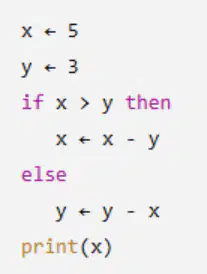
What is the output of the following pseudocode? x ← 5 y ← 3 if x > y then x ← x - y else y ← y - x print(x)
A. 2
B. 3
What is the big-O complexity of a linear search algorithm?
O(1)
O(log n)
O(n)
O(n²)
Which sorting algorithm compares each item with the next and swaps them if they are out of order, continuing this process until the list is sorted?
Merge Sort
Selection Sort
Bubble Sort
Insertion Sort
Which best describes a binary search?
Compares every item in the list
Divides the list in half repeatedly
Uses nested loops to find items
Searches items stored in a tree structure
Which of the following best evaluates the correctness of an algorithm?
How fast the algorithm runs
If the algorithm produces the expected result for all valid inputs
If the code is written in Python
How many loops it contains
A student is working with a large dataset in a spreadsheet. What tool should they use to find trends or patterns?
Merge cells
Filter and sort
Add row numbers
Change font size
Which of the following best represents the use of a simulation?
Creating a pie chart of expenses
Writing a function to add two numbers
Modeling a disease outbreak to predict its spread
Filtering a list of email addresses
Which tool is best for visualizing data trends from a large dataset?
Text editor
Flowchart
Line graph
Debugger
Which technique is most useful when comparing two large data sets to find relationships?
Using a binary search
Modeling data with visualizations like scatterplots
Printing out all the data
Sorting each dataset alphabetically
Which of the following best describes an object-oriented programming language?
Emphasizes functions without state
Uses blocks to create logic
Organizes code around objects and classes
Is always compiled to machine code
What is the main difference between the waterfall and agile development methodologies?
Agile follows strict step-by-step planning, waterfall does not
Waterfall is iterative, agile is linear
Agile allows for frequent changes and customer feedback during development
Waterfall emphasizes teamwork more than agile
What does the term camelCase typically refer to in programming?
A naming convention where all letters are capitalized
Using underscores to separate words
A format where the first word is lowercase, and each subsequent word begins with a capital letter
Writing comments in code
Which of the following tools is commonly used to build, run, and debug programs in a single interface?
Simulator
API
IDE
Compiler
Which of the following is an example of an event-driven concept?
A loop counting from 1 to 10
A function running when a button is clicked
A program that calculates compound interest
A program using bubble sort
Which data type is best suited for representing true/false conditions?
Float
Boolean
Integer
String
What does the substring method return when applied to a string?
A new string containing all characters in uppercase
A new string without spaces
A new string extracted from a specific portion of the original string
The length of the original string
Which structure would be the most appropriate to store a fixed-size collection of 10 integers?
Class
String
Array
Function
What is the result of 10 % 3 in most programming languages?
A. 3
B. 2
C. 0
D. 1
Which operator would evaluate to true only if both conditions are true?
|| (OR)
&& (AND)
!= (NOT equal)
! (NOT)
What would be the result of the following pseudocode? count = 0 for i in range(0, 3): count = count + i print(count)
A. 3
B. 2
C. 0
D. 6
What does information hiding in object-oriented programming refer to?
Storing objects in a private database
Hiding data by encrypting it
Making implementation details private to reduce complexity
Using functions without parameters
Which of the following best demonstrates inheritance in programming?
A class that initializes variables
A function that calls another function
A subclass that extends a superclass
A string method that concatenates two strings
What is the purpose of a constructor in object-oriented programming?
To clean up memory
To call a superclass
To initialize a new object
To declare variables
What term describes passing the value of a variable into a function so that changes made to it don’t affect the original variable?
Reference passing
Parameter linking
Pass by value
Pass by reference
What is one advantage of modularizing a program using functions or objects?
It reduces the number of files needed.
It improves maintainability and readability.
It eliminates the need for testing.
It increases memory usage.
How is text represented in a computer system?
A. A series of 0s and 1s
B. Sound waves
C. Electrical pulses
D. Decimal code
Which number system uses base 16?
Decimal
Binary
Octal
Hexadecimal

