
 Worksheets
Grade 8 Social Studies Unit 13/14 Assessment
Total questions: 30
Worksheet time: 16mins
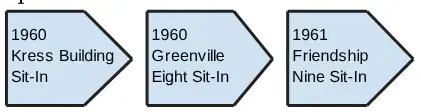
What role did these events play in the Civil Rights Movement in South Carolina?
These events demonstrated the effectiveness of nonviolent resistance and student activism and inspired further action.
The protests were primarily significant because they led to immediate legislative changes in South Carolina.
These events were isolated incidents by Civil Rights leaders that had little impact on the broader movement.
The protests raised awareness but were less influential than similar events in other Southern states.
Use the text to answer the question.
A few days ago (Monday, July 20) I had luncheon with Governor Byrnes of South Carolina, my great friend a man in whose company I always find a great deal for enjoyment. He came to talk to me about the possibility of a Supreme Court ruling that would abolish segregation in public schools of the country. He is very fearful of the consequences in the South. He did not dwell long upon the possibility of riots, resultant ill feeling, and the like. He merely expressed very seriously the opinion that a number of states would immediately cease support for public schools.
Excerpt from President Eisenhower's Diary, 1953
How does Governor Byrnes’s perspective reflect the broader attitudes and strategies of Southern states regarding school integration in the 1950s?
It reveals a strategy of passive resistance to federal mandates.
It illustrates a threat of systemic resistance to maintain segregation.
It demonstrates a willingness to compromise on integration policies.
It shows a focus on legal challenges to integration rulings.
How was the creation of White Citizens’ Councils in South Carolina a response to the national Civil Rights Movement?
They exemplified the small-scale organizing techniques used by civil rights activists.
They represented an attempt to maintain white social and political dominance.
They demonstrated a shift towards racial integration among white Southerners.
They illustrated the economic motivations behind resistance to civil rights.
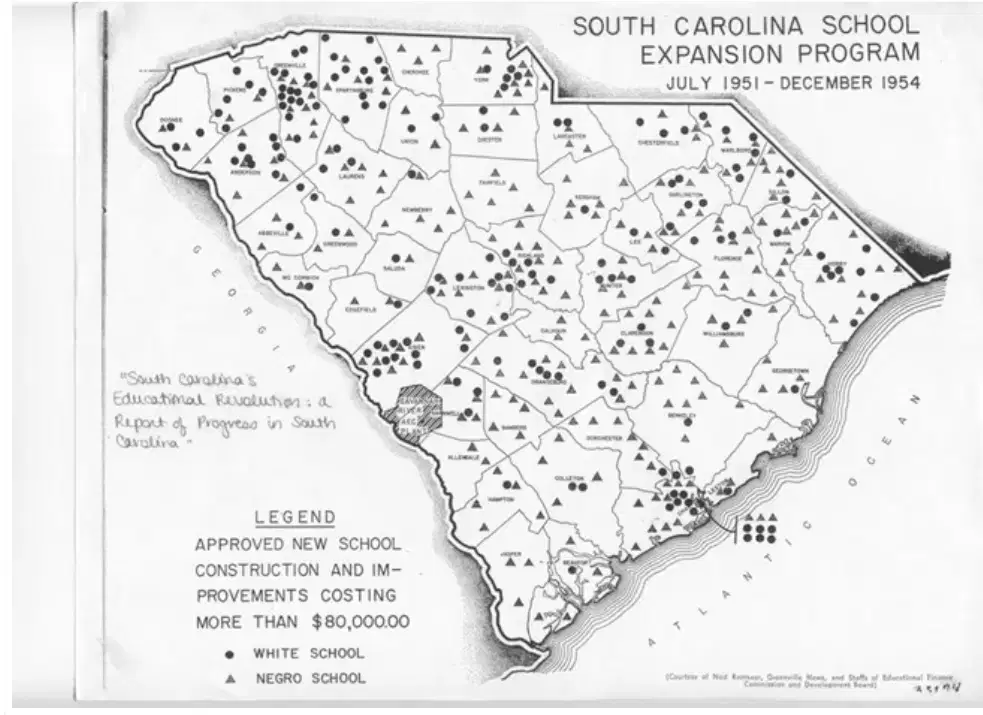
Based on the map, how did the South Carolina School Expansion Program represent a change in South Carolina’s approach to public school integration?
It showed an immediate acceptance of integration policies following legal challenges.
It indicated a shift towards voluntary integration of schools across the state.
It demonstrated a genuine commitment to educational equality for all races.
It represented a strategic attempt to preserve segregation while appearing to address inequalities.
Which statement best describes how the use of the court system and legislation caused a change? Choose two that apply.
The Civil Rights Act of 1964 prohibited discrimination in public accommodations, employment, and education.
The Voting Rights Act of 1965 had no significant impact on political participation in South Carolina.
The Brown v. Board of Education decision led to immediate and complete desegregation of all public schools in South Carolina.
The Voting Rights Act of 1965 increased voter registration and participation of African Americans, contributing to a political realignment in the state.
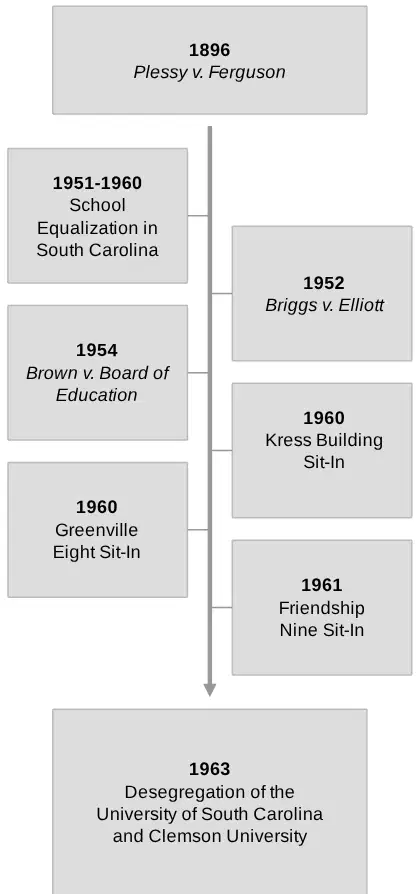
Based on the timeline, how did civic participation contribute to a major change in the identity of South Carolina?
Civic participation evolved from legal challenges to direct action, culminating in the desegregation of higher education.
Early successes of civic participation regressed, followed by decreased activity.
Civic participation remained constant throughout the period, with little change in approach or effectiveness.
Legal challenges were the only effective form of civic participation, rendering other methods unnecessary.
Use the text to answer the question.
Voting Rights Act of 1965
The Voting Rights Act of 1965 is the fourth bill to be enacted by the U.S. Congress since 1957 that attempts to safeguard the right of every citizen to vote, regardless of race or color. The previous three legislative measures attempted to secure the right to vote through court cases initiated largely on a case-by-case, county-by-county basis. These cases, brought either by the U.S. Attorney General or an individual, did not adequately meet the dimensions of the problems of racial discrimination in voting. The 1965 Act provides new tools to assure the right to vote and supplements the previous authority granted by the Civil Rights Acts of 1957, 1960 and 1964. It is intended primarily to enforce the Fifteenth Amendment to the Constitution of the United States. . . .
Excerpt from a summary of the act by the U.S. Commission on Civil RightsWhich of the following best describes the social and political conditions leading to the Voting Rights Act of 1965?
A) State governments were effectively enforcing voting rights without federal intervention.
B) The case-by-case approach of earlier laws proved insufficient to address racial discrimination in voting.
C) Racial discrimination in voting had been completely eliminated by previous legislation.
D) The U.S. Congress had become less interested in civil rights issues between 1957 and 1965.
Use the text to answer the question.
NAACP COUNSEL REJECTS PLEAS FOR “PATIENCE” Recalcitrant [uncooperative] southern communities groping for ways and means of evading the United States Supreme Court’s edict banning segregation in public education, were warned that they will be called to account if they have not worked out a plan of desegregation by September, 1955. The admonition [criticism] was laid down by Thurgood Marshall, NAACP special counsel, in a major address before the association’s 46th annual convention which closed here June 26. The National Association for the Advancement of Colored People, he said did not mean to retreat one inch from its demand, first expressed in its brief filed with the United States Supreme Court last year, that school desegregation begin by September, 1955, and not later than September, 1956.
Excerpt from a newspaper article, Marshall Outlines Program to Spur School Integration, 1955
Which of the following court cases led to the response referenced in the article?
Brown v. Board
Loving v. Virginia
Elmore v. Rice
Plessy v. Ferguson
Use the text to answer the question.
NAACP COUNSEL REJECTS PLEAS FOR “PATIENCE” Recalcitrant [uncooperative] southern communities groping for ways and means of evading the United States Supreme Court’s edict banning segregation in public education, were warned that they will be called to account if they have not worked out a plan of desegregation by September, 1955. The admonition [criticism] was laid down by Thurgood Marshall, NAACP special counsel, in a major address before the association’s 46th annual convention which closed here June 26. The National Association for the Advancement of Colored People, he said did not mean to retreat one inch from its demand, first expressed in its brief filed with the United States Supreme Court last year, that school desegregation begin by September, 1955, and not later than September, 1956.
Excerpt from a newspaper article, Marshall Outlines Program to Spur School Integration, 1955
Which of the following conclusions can be drawn about the NAACP’s strategy in pursuing school desegregation?
The NAACP was primarily focused on negotiation and compromise with southern communities.
The NAACP was willing to extend deadlines indefinitely to accommodate southern resistance.
The NAACP was relying solely on public opinion to pressure southern communities into compliance.
The NAACP was adopting an active legal approach, prepared to challenge communities that failed to desegregate.
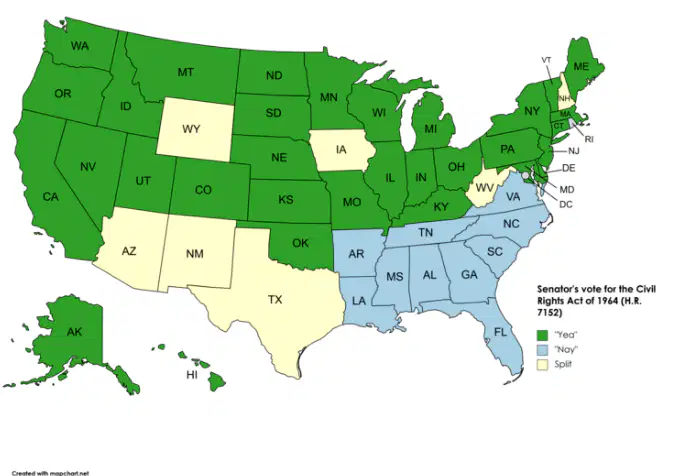
Based on the map, which of the following statements is most correct?
Every state had at least one senator who voted in favor of the Civil Rights Act.
The majority of Midwestern states voted against the Civil Rights Act.
All Southern states unanimously voted for the Civil Rights Act.
There was a regional divide in voting between Northern and Southern states.
Use the text to answer the question. The very basis of our individual rights and freedoms is the certainty that the President and the Executive Branch of Government will support and insure the carrying out of the decisions of the Federal Courts, even, when necessary with all the means at the President’s command. Unless the President did so, anarchy would result. There would be no security for any except that which each one of us could provide for himself. The interest of the nation in the proper fulfillment of the law’s requirements cannot yield to opposition and demonstrations by some few persons. Mob rule cannot be allowed to override the decisions of the courts. Excerpt from a press release for President Eisenhower, 1957
Individual citizens have the right to override court decisions they disagree with.
The President should remain neutral in civil rights disputes to maintain order.
The President should defer to state governments in matters of civil rights enforcement.
The Executive Branch must support and enforce federal court decisions, even if unpopular.
How did the Servicemen’s Readjustment Act (GI Bill) apply differently to groups of veterans? Choose two that apply.
Native Americans had the most access to housing benefits due to the trust status of reservation lands.
Women were encouraged to pursue traditionally feminine roles rather than take advantage of educational benefits.
Veterans in rural areas often had more educational options than urban veterans.
African Americans had limited access to higher education due to segregation in many colleges.
Use the text to answer the question.
I have analyzed closely the bill which was sent to me for signature. . . . At long last, the principle is recognized that displaced persons should be admitted to the United States. Two hundred thousand displaced persons may be admitted in the next 2 years, as well as 2,000 recent Czech refugees and 3,000 orphans. . . .
The bill discriminates in callous fashion against displaced persons of the Jewish faith. . . .
The primary device used to discriminate against Jewish displaced persons is the provision restricting eligibility to those displaced persons who entered Germany, Austria, or Italy on or before December 22, 1945. Most of the Jewish displaced persons . . . now in those areas arrived there after December 22, 1945, and hence are denied a chance to come to the United States under this bill. . . .
I have signed this bill, in spite of its many defects, in order not to delay further the beginning of a resettlement program and in the expectation that the necessary remedial action will follow when the Congress reconvenes.
Excerpt from President Truman’s “Statement by the President Upon Signing the Displaced Persons Act,” 1948
Which of the following statements best summarizes President Truman's view of the Displaced Persons Act of 1948?
He signed the bill despite its flaws, hoping for future improvements to address its shortcomings.
He was indifferent to the bill’s contents and signed it without much consideration.
He fully supported the bill and believed it would solve the displaced persons problem.
He opposed the bill entirely and refused to sign it into law due to its discriminatory nature.
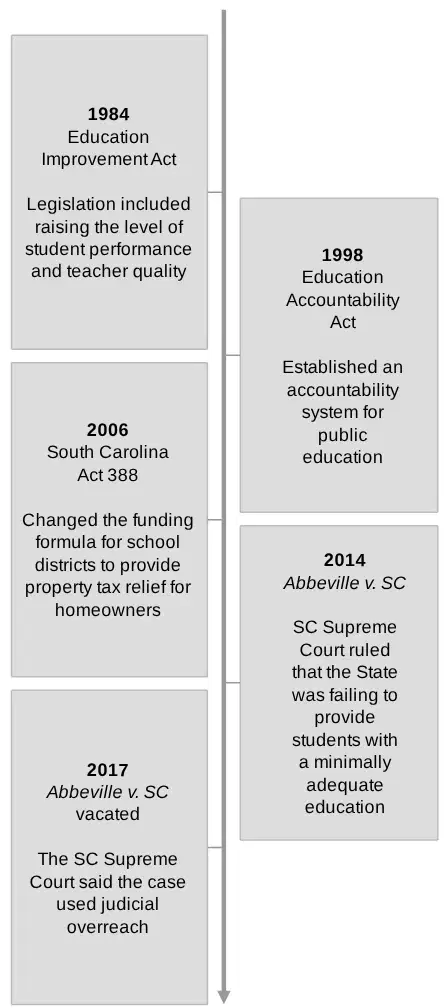
What pattern of continuity is displayed by the timeline?
Positive actions by the South Carolina Department of Education
Use of the Judicial Branch to drive educational change
An emphasis on improving educational access and equity
A system of school integration for children of all races

How did the massacre at Mother Emanuel AME Church impact the decision to remove the Confederate flag from the South Carolina State House?
The massacre caused the Confederate flag to be moved to another location on the Statehouse grounds.
The massacre led to a temporary increase in the flag’s visibility, leading to public support to keep it flying.
The massacre increased scrutiny of the Confederate flag, leading to calls for its removal.
The massacre had no impact on the Confederate flag debate; the flag remained unchanged.
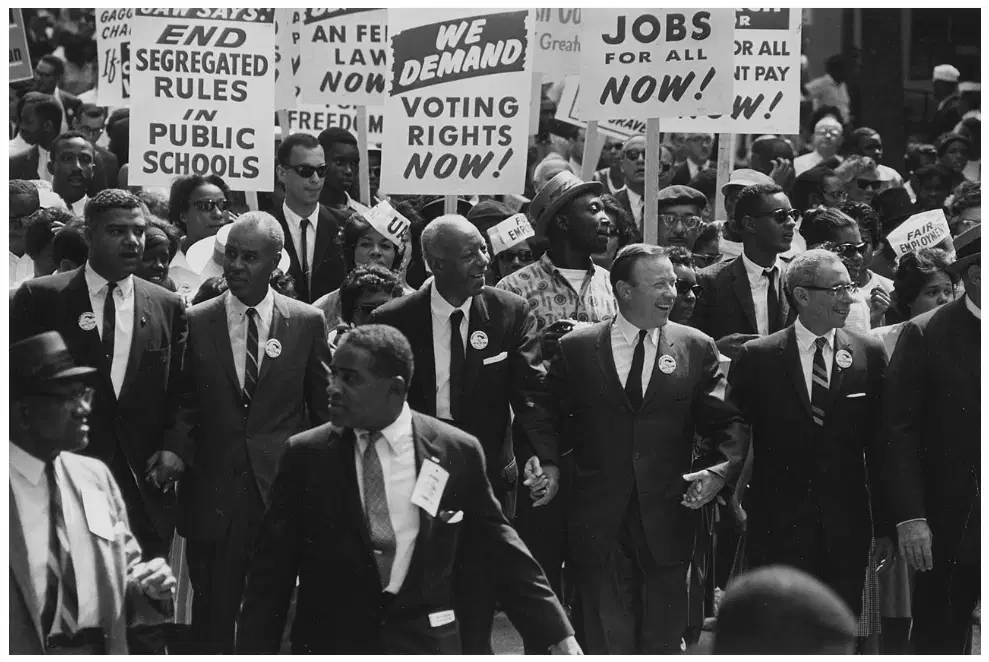
Based on the image, what goals were the demonstrators hoping to achieve? Select two answers.
Demonstrators wanted higher paying jobs.
Demonstrators wanted integration of schools.
Demonstrators wanted equal pay for women.
Demonstrators wanted citizenship for immigrants.
Demonstrators wanted voting rights.
Use the text below to answer the question.
In analyzing the bus protests certain factors emerge: . . .
5. The campaign is based on the most stable social institution in [African American] culture - the church.
6. The protest requires community sharing through mass meetings, contributions, economic assistance, hitchhiking etc.
7. The situation permits and requires a unified leadership.
8. The method of non-violence - Christian love, makes humble folk noble and turns fear into courage.
9. The exigencies [urgent need] of the struggle create a community spirit through community sacrifice.
Excerpt from the Southern Negro Leaders Conference On Transportation and Non-Violent Integration, 1957
How does the source illustrate the contribution of civic participation and its impact on the Civil Rights Movement?
Civic participation reduced the role of religious institutions in the movement to encourage violent activism.
Civic participation eliminated the need for leadership in the protests and decreased progress.
Civic participation weakened the resolve of protesters and negatively impacted the movement.
Civic participation transformed individual struggles into a unified community effort to progress the movement.
Match the court case to the correct explanation of how it helped expand the rights of African Americans.
Economic: Led to the desegregation of public transportation and improved transportation access for African American workers, expanding job opportunities.
Flemming v. S.C. Electric and Gas
Loving v. Virginia
Elmore v. Rice
Briggs v. Elliot
Match the court case to the correct explanation of how it helped expand the rights of African Americans.
Social: Helped establish the legal and moral arguments that led to the outlawing of school segregation and contributed to the eventual desegregation of public schools
Flemming v. S.C. Electric and Gas
Loving v. Virginia
Elmore v. Rice
Briggs v. Elliot
Match the court case to the correct explanation of how it helped expand the rights of African Americans.
Political: Ended the practice of whites-only Democratic Party primary elections in South Carolina and opened up the political process to African Americans
Flemming v. S.C. Electric and Gas
Loving v. Virginia
Elmore v. Rice
Briggs v. Elliot
Which issue played the GREATEST role in why many South Carolina voters began to support the Republican party in the years following World War II?
civil rights
the Cold War
women's rights
increased taxes
In the case of Plessy v. Ferguson in 1896 the Supreme Court expressly declared that under the 14th Amendment
no person was denied any of his rights if the States provided separate but equal facilities. This decision has been
followed in many other cases. It is notable that the Supreme Court, speaking through Chief Justice Taft, a former
President of the United States, unanimously declared in 1927 in Lum v. Rice that the "separate but equal" principle
is "within the discretion of the State in regulating its public schools and does not conflict with the 14th
Amendment."...
- Senator Strom Thurmond, 1956 "Southern Manifesto"
Based on this passage, which court verdict was Senator Thurmond speaking against?
Plessy v. Ferguson
Dred Scott v. Sanford
Brown v. Board of Education
Regents of the University of California v. Bakke
How did President Truman's Executive Order 9981 serve as a turning point for political platforms?
Truman's executive order abolished voting discrimination and led to his reelection based on overwhelming African American support.
Truman's executive order allowed separate, but equal treatment of African Americans causing South
Carolina to support a Democratic candidate instead of their usual Republican ticket.
Truman's executive order allowed African Americans to attend nonsegregated schools allowing him
to gain support in northern states, but leading to racial violence and a conservative Republican
opposition.
Truman's executive order abolished discrimination in the US Armed Forces allowing him to gain support from African American voters, but led to South Carolina voting for Strom Thurmond after voting Democratic for six decades.
She was a Civil Rights leader who, in 1955, refused to give up her seat on a segregated bus to a white man in Montgomery, Alabama. Her actions led to the Montgomery Bus Boycott that eventually led to the court ordered end of segregation on the city's busses.
Rosa Parks
Modjeska Monteith Simkins
Septima Poinsette Clark
Linda Brown
This Supreme Court case, decided in 1954, declared that the segregation doctrine of "separate but equal," was not Constitutional when applied to the public school system.
Brown v. Board
Plessy v. Ferguson
Flemming v. SCE&G
Sedgefield v. BCSD
This Supreme Court case of the 1950s concerned segregated schools in South Carolina and was eventually combined with the famous Brown v. Board of Education.
Briggs v. Elliot
Plessy v. Ferguson
Flemming v. SCE&G
BCSD v. South Carolina
He was South Carolina's governor from 1947 to 1951, a former segregationist presidential candidate, and a U.S. Senator from 1956 to 2003.
Henry McMasters
Strom Thurmond
Fritz Hollings
Mr. Childers
Which of these politicians would be BEST known for their role in the Civil Rights era?
Gerald Ford
Strom Thurmond
Barry Goldwater
Officer Scrio
Which political party did the Southern Democrats represent at one point?
Republicrats
Democrats
Dixiecrats
Dixietoons
What are the two main political parties? Select two.
Tea Party
Libertarians
Democrats
Republicans

