
 Worksheets
8.1 Sound
Total questions: 25
Worksheet time: 13mins
Name
Class
Date
1.

1. What do a guitar string, a ruler being flicked and a (music) triangle all have in common?
a)
They all jump
b)
They all vibrate to make a sound.
c)
They are all found in an orchestra
d)
They all sing
e)
Smithy is a world champion at triangle playing
2.

2. How does sound travel from a loud speaker to a person listening on the other side of the room.
a)
The speaker vibrates which causes air particles to vibrate. These vibrations get passed on from particle to particle till they reach the ear.
b)
Sound particles are given out by the speaker, they travel through the air until they reach the ear.
c)
It just does. Sound magically appears in your head
d)
Psychic energy travels from the loud speaker to the ear through the particles in the air.
3.

3. This picture shows a child's Xylophone toy. Which bar will make the highest pitched sound?
a)
The shortest bar
b)
The longest bar
c)
The one in the middle
d)
They all make the same pitched sound
e)
Bar bar black sheep
4.

4. To make the sound louder they should:
a)
hit a longer bar
b)
hit a shorter bar
c)
hit it harder
d)
hit it more gently
e)
stick it up your nose
5.
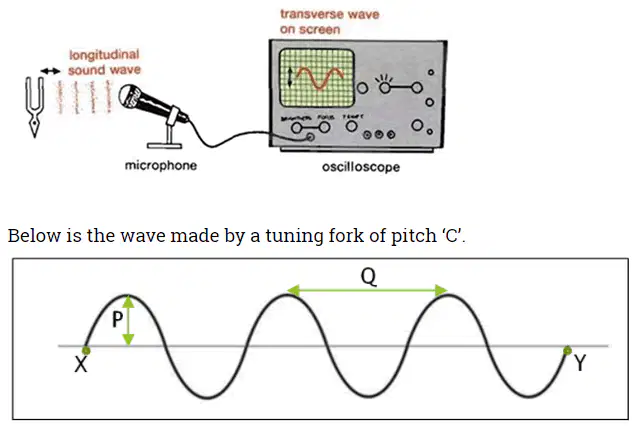
5. The following is a picture of how sound from a tuning fork can be seen as waves on an oscilloscope. What does the arrow ‘P’ represent?
a)
wavelength
b)
frequency
c)
amplitude
d)
pitch
e)
porpoise
6.
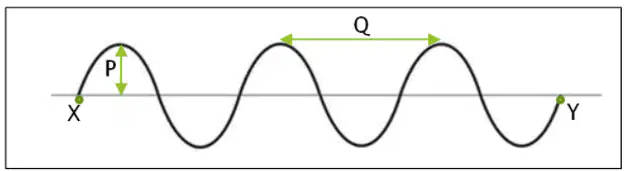
6. What does the arrow ‘Q’ represent?
a)
wavelength
b)
frequency
c)
amplitude
d)
pitch
e)
quiditch
7.
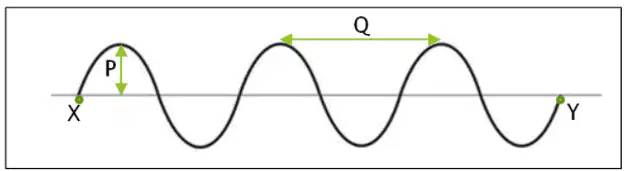
7. If a lower pitch tuning fork was used arrow P would
a)
Get longer
b)
Get shorter
c)
Stay the same
d)
Go spinny winny
8.
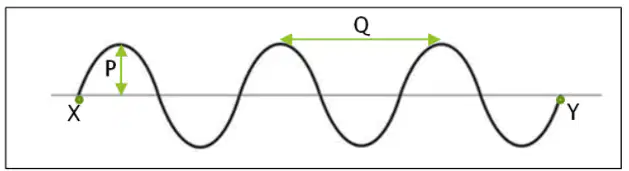
8. If a lower pitch tuning fork was used arrow Q would
a)
Get longer
b)
Get shorter
c)
Stay the same
d)
Explode
9.
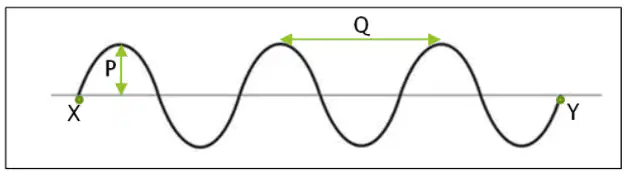
9. If the tuning fork was struck more softly arrow P would
a)
Get longer
b)
Get shorter
c)
Stay the same
d)
Turn into a pumpkin
10.
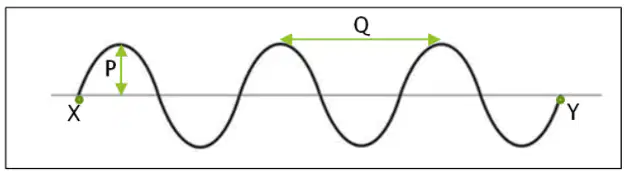
10. If the tuning fork was struck more softly arrow Q would
a)
Get longer
b)
Get shorter
c)
Stay the same
d)
Badger, badger, badger, badger......
11.
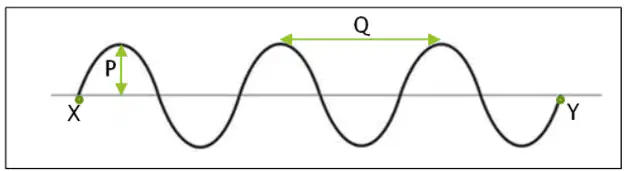
11. How many waves are there between X and Y?
a)
3
b)
4
c)
5
d)
6
12.
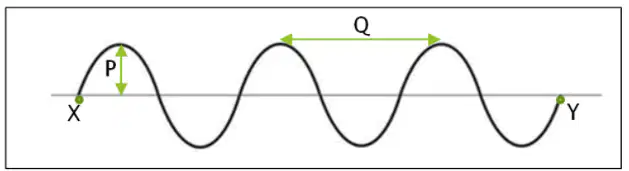
12. How big is the wavelength if the distance between X and Y is 6m?
a)
6÷ 6 = 1
b)
6 ÷ 3 = 2
c)
6cm ÷ 6 = 1cm
d)
6m ÷ 3 = 2m
13.
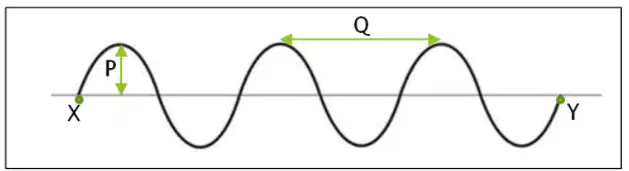
13. If it took 3s for the wave to travel from X to Y, what’s the frequency?
a)
3 waves ÷ 3s = 1 Hz
b)
3 waves ÷ 3s = 0.5 Hz
c)
6 waves ÷ 3s = 2 Hz
d)
12cm ÷ 3s = 2 Hz
14.
14. The astronauts who landed on the Moon had to wear spacesuits. The spacesuits were filled with air because there is a vacuum on the Moon. The astronauts had radios in their helmets. Without the radios, they could not hear each other speaking. This is because
a)
Their parties are rubbish because there's no atmosphere
b)
There's no vibrations to carry the particles
c)
There's no particles to carry the vibrations
d)
There's no air so they can't breathe
15.
15. A Hummingbird beats its wings about 15 times per second. How many beats will it have produced in 20 s?
a)
E = mc² = (9.11⨯10⁻³¹) ⨯ (3⨯10⁸)² = 8.2⨯10⁻¹⁴ J
b)
20 ÷ 15 = 1.33 beats
c)
15 x 20 = 300 beats
d)
15 + 20 = 35 beats
16.
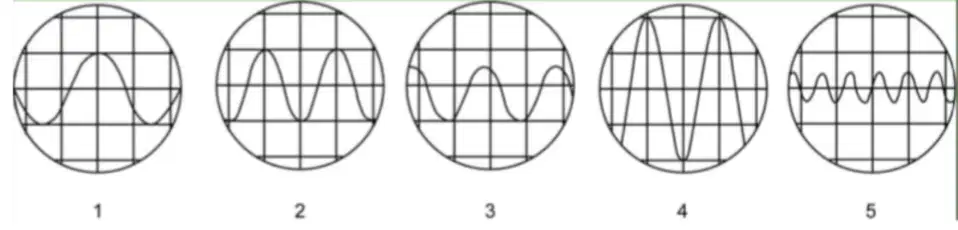
16. Which diagram shows the highest frequency?
a)
1
b)
2
c)
3
d)
4
e)
5
17.
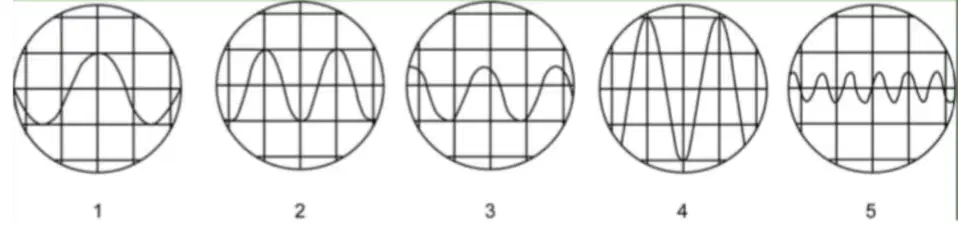
17. Which diagram shows the loudest sound?
a)
1
b)
2
c)
4
d)
5
e)
3
18.
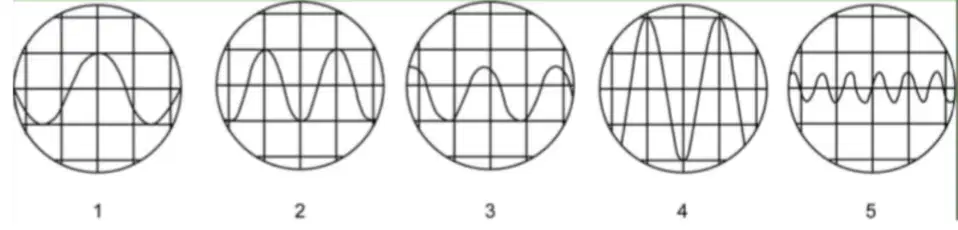
18. Which diagram shows the longest wavelength?
a)
1
b)
2
c)
3
d)
4
e)
5
19.

19 (a) Label A is........
a)
Ossicles
b)
Ear drum
c)
Auditory nerve
d)
Large bones
e)
Ninkynonk
20.
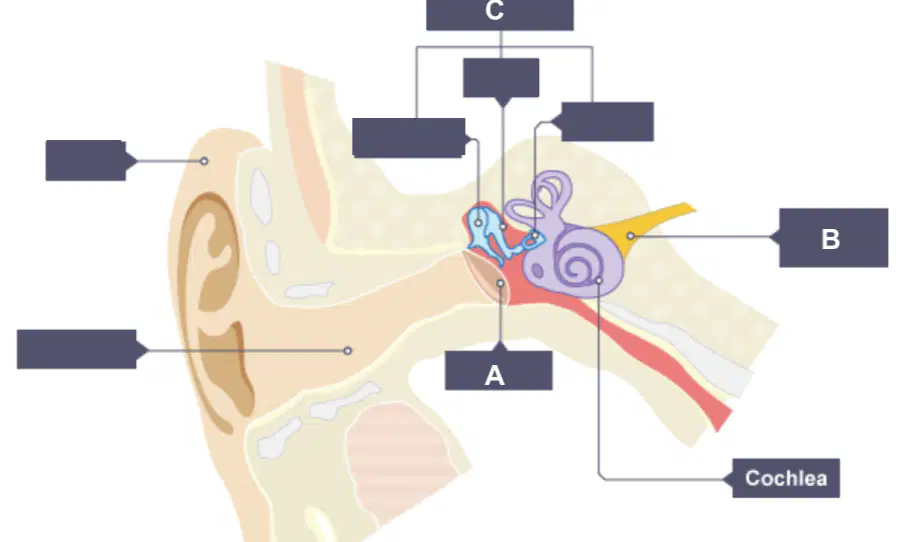
19 (b) Label B is........
a)
Ossicles
b)
Ear drum
c)
Auditory nerve
d)
Large bones
e)
Pinkyponk
21.
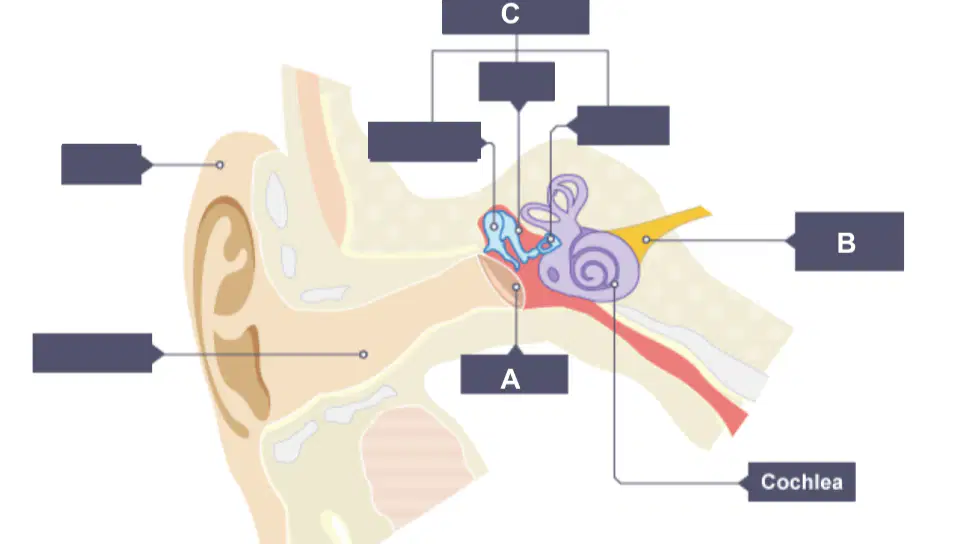
19 (c) Label C is........
a)
Ossicles
b)
Ear drum
c)
Auditory nerve
d)
Large bones
e)
Wattingers
22.
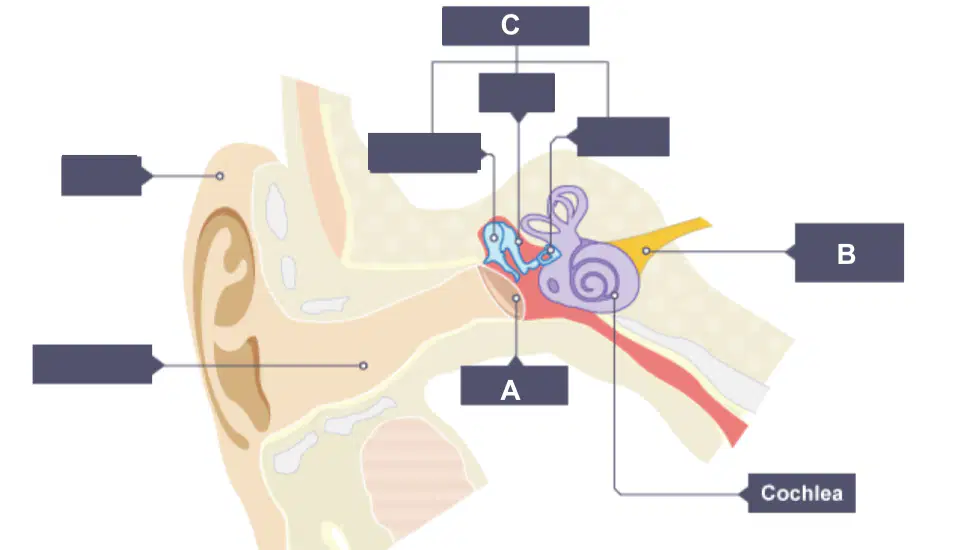
19 (d) Which of the following best describes the job of the cochlea?
a)
It converts vibrations into electrical signals
b)
It converts electrical signals into vibrations
c)
It converts electrical signals into electrical pulses
d)
It converts ninkynonk signals into pinkyponk pulses
23.
20. From low to high frequency, what is the range of human hearing?
a)
20Hz to 20,000Hz
b)
20kHz to 20,000Hz
c)
20,000Hz to 20Hz
d)
There are no lower or upper limits
e)
Badgers can hear squeaks
24.
21. Which of these is a symptom of hearing loss?
a)
You find it difficult to catch sounds like 't', 'd' and 's', so you confuse similar words
b)
You can't read letters like t, d and s very well
c)
You need glasses
d)
Age
e)
You can't find the cheese in the fridge
25.
22. One of the causes of hearing loss is age. The highest frequency you hear starts getting lower after the age of 20. It’s reduced, on average, by how much?
a)
800Hz every 5 years
b)
500Hz every 8 years
c)
You stop hearing ultrasound
d)
You stop hearing infrasound
e)
You start hearing the voices in your head more
100 %

