
 Worksheets
World Geo Spring Final Review
Total questions: 59
Worksheet time: 36mins
In a traditional economy, what determines the production of goods and services?
Market trends
Government
Individuals
Traditions and customs
With whom does the ultimate power lie in a market economy?
Bankers
The state
Consumers
The military
Which forces play the greatest role in determining the distribution of goods and services in a
free enterprise economic system?
Court rulings and expert opinions
Government officials and military needs
Producer supply and consumer demand
Village elders and community tradition
John lives in a country where the government has total control of the economy. The
government decides what to produce, how to produce it, and who to produce it for. What
economic system does he live in?
Market
Command
Traditional
None of the above
Which factor of production is essential for a small-scale, home-based craft business?
Machinery
Solar energy
Labor
Wages
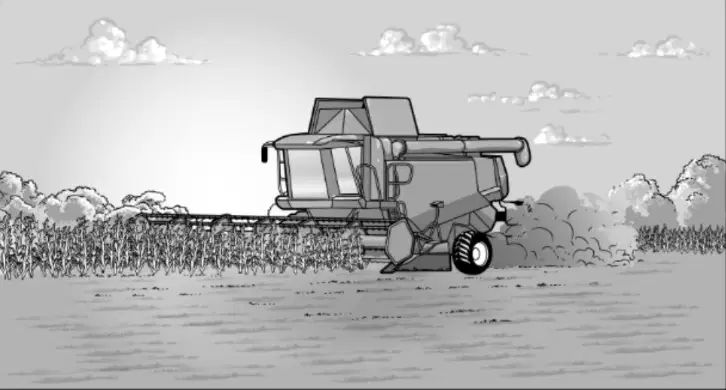
Which of the following economic activities is displayed in this illustration?
Cottage industry
Commercial farming
No-till farming
Residential development
Which of the following terms do the characteristics define?
● Large-scale farming
● Cash crops
● Raising livestock for sale
● Use of modern farming equipment
Cottage industry
Commercial agriculture
Subsistence agriculture
Commercial industry
Commercial industries
are factory-based and employ many workers. Commercial industries often use assembly-line manufacturing to increase production. The purpose of a commercial industry is large-scale production and sales. These industries often use new technologies to increase production and lower prices.
Cottage industries
are usually home-based and may have only one or two employees. The worker usually makes a product from start to finish. Cottage industries usually use more traditional or hand-made production techniques that often are less cost-effective. Products of cottage industries are often more expensive.
Which of the following states the major similarities and differences between cottage and
commercial industries?
Both cottage and commercial industries employ workers; however, the workers in
commercial industries work harder than those in cottage industries.
Although both cottage and commercial industries make hand-made products, the
workers in cottage industries complete a product from start to finish.
While both cottage and commercial industries manufacture goods, commercial
industries are more efficient than cottage industries and generally produce lower-priced goods.
Commercial and cottage industries use new technologies to produce goods; however, they differ in the ways they distribute and sell products.
Which of the following is a factor that favors the development of primary economic activities?
A location for industrial manufacturing operations
The presence of natural resources
The availability of neighbors willing to trade
An economy based on communist ideals
-Because Saudi Arabia has vast oil reserves, it produces and refines oil.
-Because of its climate and soils, Colombia grows coffee beans.
-Because Japan consists of islands, many of its people engage in fishing.
Which conclusion is best supported by the information in these examples?
Major urban centers are usually found only along rivers.
Technology has little effect on economic activities
The physical geography of an area often affects its economic activities.
Natural resources are more important than climate to economic activities.

Company A is thinking about locating its lumbering processing facility on the nation of Islandia.
Which new location would be the best place for Company A to build their factory?
Location A
Location B
Location C
Location D
Where on the nation of Islandia would be the best location to build a port for large ships to
arrive?
Location A
Location B
Location C
Location D
Which of the following measures the total output of a country divided by the number of people
in the country?
Per capita gross domestic product (GDP)
Consumer price index (CPI)
Real gross domestic product (RGDP)
Producer Price Index (PPP) per capita
The gross domestic product (GDP) of the United States is $50,859, which is much higher than most countries.
Why is the GDP per capita often used as a sign of a country’s standard of living?
The higher a country’s GDP per capita, the higher the incomes of most people in the
country.
The higher a country’s GDP per capita, the lower the cost of goods and services in the
country.
The higher a country’s GDP per capita, the more income the nation has to meet the
needs of the people.
The higher a country’s GDP per capita, the higher the number of people living in comfort and wealth in the country.
● High literacy rate
● Low infant mortality
● High life expectancy
● Low risk of disease
● High levels of income
Which of the following would be the best title for the bulleted list?
Economic indicators for a Newly Industrialized Country (NIC)
Characteristics of a More Developed Country (HDC)
Economic indicators for a Low Standard of Living Country (LSLC)
Characteristics of a Less Developed Country (LDC)
Russian Federation
● 9th most populous nation in the world
● 73% of population lives in urban areas
● 99.4% literacy rate
● 7th in GDP purchasing power in the world
● 7.6% unemployment rate in 2010
Based on this description, which conclusion can be made about the Russian Federation?
It has a highly developed economy.
It leads the world in computer technology.
It promotes free trade in the global economy.
It is a global leader in environmental affairs.
What factors affect life expectancy?
Access to healthcare
Diet and nutrition
Poverty
All of the above

Based on the information in the table, which country is more developed than the others?
1
2
3
4
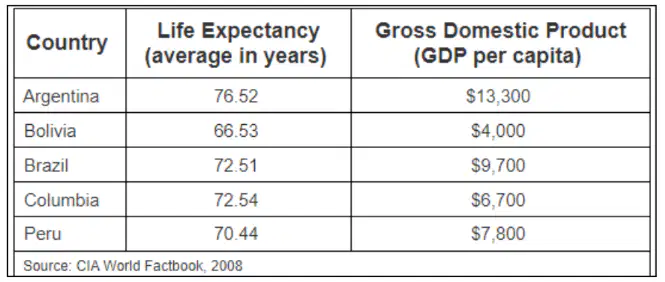
Which of these nations has the highest standard of living?
Argentina
Bolivia
Brazil
Columbia

Based on the table, which of the following statements describes the country with the highest
standard of living?
Egypt, because it has the largest population, a high birth rate, a relatively low death rate
and life expectancy, and a moderate per capita purchasing power when compared to other nations.
Sudan, because it has a relatively high population, a high birth and death rate, a low life expectancy, and a low per capita purchasing power compared to other nations in the region.
Tunisia, because it has the lowest birth rate, a relatively low death rate, a high life
expectancy, and a higher per capita purchasing power when compared to other nations in the region.
Morocco, because it has a moderate population, a relatively high birth rate, a similar death and life expectancy rate, and a moderate per capita purchasing power rate compared to other nations.

Based on the information in the table, which of the following countries has the highest standard of living?
Australia
Canada
United Arab Emirates
Saudi Arabia
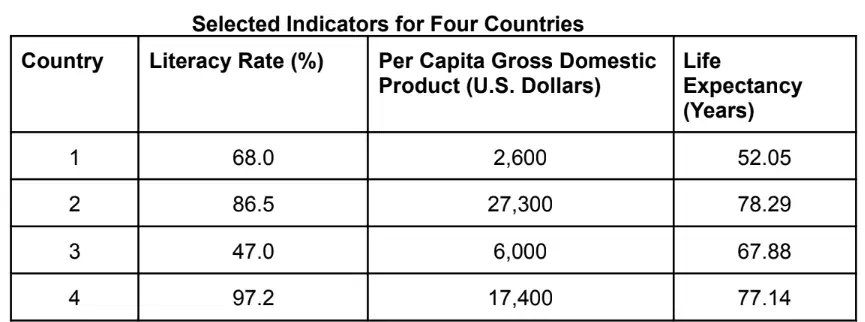
Which statement is correct based on the information in the table?
Country 1 is the least developed nation because of its life expectancy and literacy rate.
Country 2 is the most developed nation because of its life expectancy and GDP.
Country 3 is the least developed nation because of its life expectancy.
Country 4 is the most developed nation because of its literacy rate and GDP.
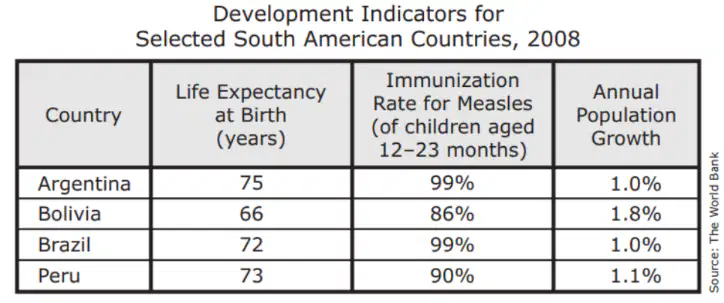
Which conclusion is best supported by the data in this table?
Health care was more expensive in Argentina than in Brazil.
The quality of life was better in Peru than in Brazil.
Peru had a greater number of young people than Bolivia.
Bolivia had a lower standard of living than Argentina.

Which of these nations is the least economically developed?
Argentina
Bolivia
Brazil
Peru
Which challenge of globalization is demonstrated by the rapid spread of SARS in 2003 and the H1N1
flu in 2009?
Cultural movements that limit vaccinations for children
Health problems caused by the decreased government funding
Accelerated transmission of viruses due to increased travel
Improved sanitation resulting in resistant strains of viruses
Which statement about the impact of twentieth-century technology is correct?
Technology has eliminated famine throughout the world.
Technology has accelerated the pace of cultural diffusion.
Technology has led to the rapid deregulation of the global economy.
Technology has hindered the economic development of many nations.
Life in my village is rapidly changing. In the 1960s, a road was built through the center of the
village to carry iron ore from the mines to ports some 50 miles away. Soon we were
introduced to new products and eventually electricity. Today, we drink soda out of plastic
cups, watch television with our families, and go to the cinema.
What conclusion can be drawn from this statement?
Job opportunities are scarce in villages.
Technology eliminates cultural traditions.
Modernization often significantly alters village life.
Transportation technology has little effect on villages.

Which of the following played a significant role in the trend illustrated in this graph?
The fall of communism in Eastern Europe
A decline in the standard of living in many developing countries due to political and
economic instability
Increasing global interdependence resulting from technological innovation and
expanded trade agreements
The growing global influence of oil cartel
As a country develops, a decreasing percentage of its workers are involved in —
Primary economic activities
Secondary economic activities
Tertiary economic activities
Quaternary economic activities
Which of these would most likely be shown on a map of a more-developed country’s
quaternary economic sector?
Locations of natural resources
Major universities and research institutions
Transportation networks
Centers of manufacturing and processing
Four countries along with their main economic activities:
Country A: engineering, manufacturing
Country B: education, research
Country C: agriculture, mining
Country D: retail sales, tourism
Which country is most likely the least developed?
A
B
C
D

Which statement is BEST supported by this economic information about Australia?
Australia’s economy depends primarily on farming and livestock.
Exports are a major sector of Australia’s economy.
Australia’s service sector is larger than its manufacturing sector.
Most of Australia’s economic output comes from mining.

How do these visuals represent differing perceptions of political and social opportunities for
women in Afghanistan?
Political and social opportunities are denied to all Afghan women; therefore, many women rebel against the government and refuse to obey laws.
Women in Afghanistan can be active in politics; however, many, especially in rural areas, lack
access to a political voice and are often socially segregated.
The belief is generally that all Afghan women have access to both political and social power
within the government, these visuals prove that belief.
Women throughout Afghanistan enjoy political and social equality with men; therefore, many
women are elected to the Afghan General Assembly.

From these headlines, one can conclude that —
Equality in education has been achieved by women worldwide.
Equal rights for women remains a significant global concern.
Women typically avoid involvement in political matters.
Women enjoy equal rights in most communist nations.

Which of the following is most likely to cause the negative effects described in the excerpt?
Protective tariffs
Global climate change
A global economic recession
A political coup

Which statement BEST supports the information in this excerpt?
Young women are more likely to find employment than women who have reached
middle age.
Nations with larger female populations are more likely to offer employment to female
citizens.
Women in most economically developed nations are not permitted to receive enough
education to seek employment.
Nations that do not offer adequate employment opportunities to women may endanger
the overall economy.

What is one conclusion about why the shaded areas on the map constitute a region?
Countries having the same language, culture, and government systems help make
Europe a formal region.
Similar geographic features are shared by most of the countries in the European Union
and these geographic factors unite the countries.
The countries share a military alliance that contributes to their unification as a military and political union.
These independent countries share a common interest in trade and economic cooperation, which helps constitute this area as a functional region
Which of the following accurately lists physical factors that help constitute a region?
Political units, climate regions, and river systems
Vegetation, climate, and land and water forms
Trade networks, religions practiced, and language
Climate zones, language, and trade networks

Which characteristic is common to all the countries located in the shaded region on this map?
Coniferous forests
The widespread practice of Hinduism
The use of a Romance language
A warm climate
Which of the following are examples of environmental factors?
Select THREE correct answers.
Climate patterns in a region
Availability of natural resources
Landforms such as mountains and rivers
Language and customs
Population density
Which of the following is an economic system in which economic decisions are made
according to social roles and culture?
Market economy
Command economy
Traditional economy
Mixed economy
In North Korea, all economic decisions are made by the country’s supreme leader, Kim Jong Un.
What type of economy does North Korea have?
Traditional
Command
Market
Political
Natural Resources in Russia
● Oil
● Natural gas
● Coal
Which statement correctly describes a problem associated with the resources in this list?
Declining demand has reduced incentives for companies to extract these natural
resources.
Competition among corporations and industries deter best use of resources.
Obstacles in climate, distance, and terrain hinder full development of resources.
Government support for agriculture has diverted investment away from natural resource
extraction.
Sawyer is comparing different economic systems throughout history for a social studies project. During his research, he learns about a system in which all economic decisions are made by a group of planners. This group is responsible for assigning resources to the production of specific goods and services, and determining how to produce and distribute those goods and services.
Which of the following is Sawyer most likely studying?
The manorial economy of feudal Europe
The market economy of the United States
The command economy of the Soviet Union
The mercantile economy of eighteenth-century Europe

What common factors unite the countries of Latin America?
Location on a single continent
Governments and cost of living
Proximity to the United States
Similar culture and language

When comparing these texts from two religious traditions and regions, what appears to be a
similar characteristic of these cultures?
Both cultures value the importance of the individual, individual achievement, and
attending formal religious services.
Meditation and closeness to nature and the world around you are important cultural
values in both of these regions.
These two cultural traditions center on the importance, love, and lasting influence of a supreme being.
Both of these religious and cultural traditions believe that God is good, never gets
angry, and forgives any wrongdoing.

Which of these regions BEST replaces the question mark in the title?
Central America
West Africa
Southwest Asia
Eastern Europe
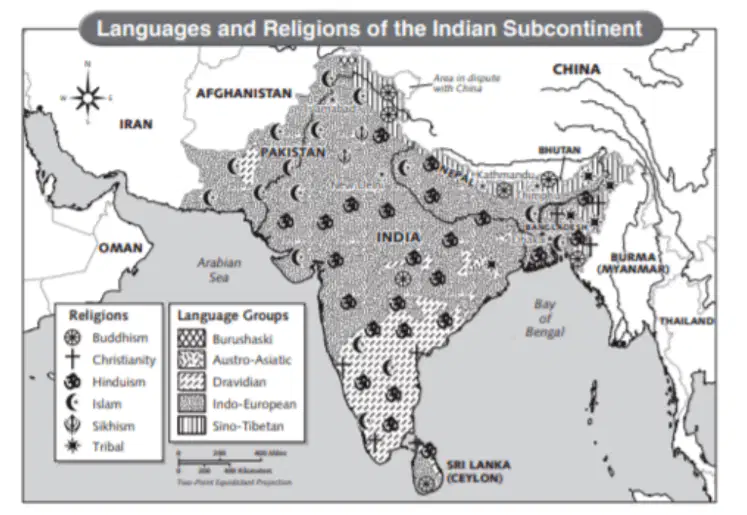
According to the map, what is the relationship between culture and religion on the Indian subcontinent?
Most people in India practice the same religion their entire lives.
The major religions practiced in India seem to have links to one language.
Religions practiced by the people of India are part of other cultures.
For many in India, the Hindu religion is a core element of their culture.
Which factor helps define the extent of a political region’s territory?
Economy
Language
Boundaries
Culture
Of the following, which is a key characteristic that helps distinguish political regions from one
another?
Form of government
Population size
Geographical location
Climate conditions
Which type of government is characterized by power being concentrated in the hands of a
single leader?
Dictatorship
Democracy
Monarchy
Oligarchy
“Today is the first Tuesday in November. Today is Election Day! Everyone who is over
eighteen years old has the right to vote for the leader of his/her country.”
Which type of government is being described?
Democracy
Dictatorship
Monarchy
Oligarchy
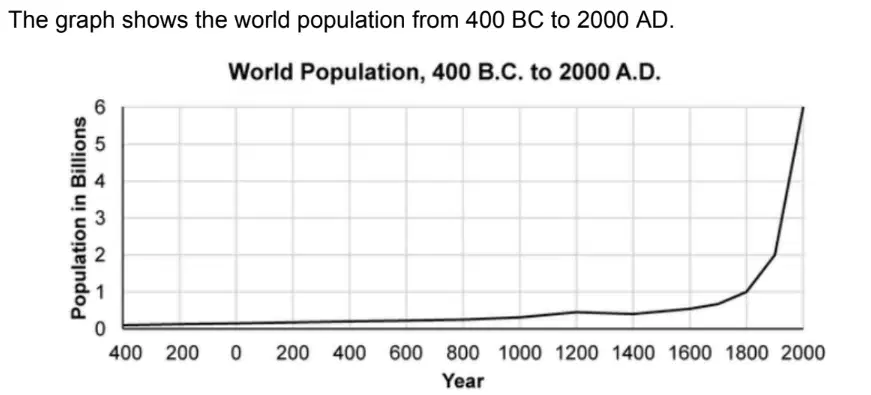
Based on the information in this graph, one can conclude that the world’s population?
Grew slowly until around 1700 AD and then increased rapidly
Fell slowly until around 1800 AD and then decreased rapidly
Fell sharply between 400 and 200 BC
Increased steadily since 200 BC

Based on the information presented in this chart, one can conclude that —
the population in developed nations is expected to double by 2025.
the percentage of the world’s population living in developed nations is rising.
the population in developing nations is increasing faster than it is in developed nations.
the percentage of the world’s population living in developing countries is expected to
double by 2025.

Which of the following conclusions can be drawn regarding the populations of Latin America
and North America based on the information provided in this graph?
The population of Latin America was expected to be approximately twice that of North
America in the year 2000.
Latin America and North America have experienced extremely different rates of
population growth since 1900.
By 1960, Latin America had overtaken North America in terms of population.
The population of Latin America was equal to that of North America in 1940.
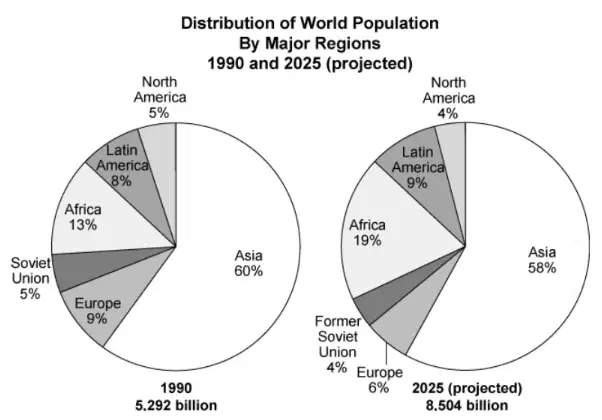
Which of the following conclusions can be drawn based on the information presented in these pie charts?
The world’s population is expected to double between 1999 and 2025.
By 2025, there will be a major shift in population from Africa to North America.
Little change is expected in the distribution of the world’s population between 1990 and
2025.
By 2025, Africa’s percentage of the world’s population will increase more than that of
any other region.
Which economic activity would be much more common in a less developed country than in a
more developed country?
Service sector jobs
Agricultural industry jobs
Computer programming jobs
Information technology jobs
Definition: The manufacture or processing of finished goods such as metal working and
smelting, automobile production, textile production, chemical and engineering industries,
energy utilities, construction, or shipbuilding.
Which of the following terms best matches the definition above?
Primary economic activities
Secondary economic activities
Tertiary economic activities
Quaternary economic activities

Based on the reading, which of the following BEST characterizes the type of economic activity
and the level of development in India?
This reading mostly describes various types of construction, trade, and transportation,
showing that India is a Highly Developed Country (HDC).
This passage describes a shift from manufacturing to agriculture, showing that India is a
Less Developed Country (LDC).
Due to the descriptions of increased financing, insurance, and real estate, this passage
shows that India is a Developing Economy (DE).
This excerpt mostly describes manufacturing and business activities, showing that India
is a Newly Industrialized Country (NIC).

Which statement BEST explains the information in this table?
Developing countries place great emphasis on economic growth.
Countries with industrialized economies have lower literacy rates.
Highly developed economies are able to fund public education systems.
Countries with agricultural economies have difficulty distributing wealth equitably.

