
 Worksheets
Geo9.1 Coordinate Geometry- Triangles and Quadrilaterals
Total questions: 100
Worksheet time: 5hrs 0mins
Given the points A(1,2) , B(4,6) , and C(7,2) , what type of triangle is △ABC based on its side lengths?
Equilateral
Isosceles
Scalene
Right-angled
The vertices of a triangle are A(0,0) , B(4,0) , and C(2,3) . What is the classification of △ABC ?
Right-angled triangle
Equilateral triangle
Isosceles triangle
Scalene triangle
Given the points A(1,1) , B(5,1) , C(5,4) , and D(1,4) , what type of quadrilateral is ABCD ?
Parallelogram
Rectangle
Rhombus
Trapezium
Which of the following sets of points forms an isosceles triangle?
A(0,0) , B(2,0) , C(1,2)
A(0,0) , B(3,0) , C(1.5,2)
A(0,0) , B(2,0) , C(2,2)
A(0,0) , B(1,1) , C(2,0)
The points A(2,3) , B(6,3) , C(6,7) , and D(2,7) are the vertices of a quadrilateral. What is the most specific name for this quadrilateral?
Square
Rectangle
Parallelogram
Rhombus
Given A(0,0) , B(4,0) , C(2,23) , what type of triangle is △ABC ?
Equilateral
Isosceles
Scalene
Right-angled
Which of the following quadrilaterals has only one pair of parallel sides?
Rectangle
Parallelogram
Trapezium
Rhombus
The points A(1,2) , B(4,6) , C(7,2) , and D(4,−2) form a quadrilateral. What is the most specific classification for ABCD ?
Square
Rectangle
Rhombus
Parallelogram
If the slopes of two sides of a triangle are negative reciprocals, what does this indicate about the triangle?
It is equilateral
It is isosceles
It has a right angle
It is scalene
Given A(0,0) , B(2,2) , C(4,0) , what type of triangle is △ABC ?
Right-angled
Isosceles
Equilateral
Scalene
Which of the following sets of points forms a square?
A(0,0) , B(2,0) , C(2,2) , D(0,2)
A(0,0) , B(3,0) , C(3,2) , D(0,2)
A(1,1) , B(4,1) , C(4,5) , D(1,5)
A(0,0) , B(1,2) , C(3,2) , D(2,0)
The points A(0,0) , B(2,2) , C(4,0) , and D(2,−2) form which type of quadrilateral?
Rectangle
Rhombus
Square
Parallelogram
If the diagonals of a quadrilateral bisect each other, what type of quadrilateral is it?
Trapezium
Parallelogram
Kite
Rectangle
Given A(0,0) , B(4,0) , C(2,2) , what is the area of △ABC ?
4
6
8
2
Which property is true for all rectangles but not for all parallelograms?
Opposite sides are equal
Diagonals bisect each other
All angles are right angles
Opposite sides are parallel
The points A(0,0) , B(2,3) , C(5,3) , and D(7,0) form a quadrilateral. What is the most specific classification for ABCD ?
Parallelogram
Rectangle
Trapezium
Rhombus
1. How is a coordinate proof different from other types of proofs you have studied?
You do not need to write a plan for a coordinate proof.
You do not have a Given or Prove statement.
You have to assign coordinates to vertices and write expressions for the side lengths and slopes of segments.
You can only do coordinate proofs with triangles.

2. Explain why it is convenient to place a right triangle on the grid as shown when writing a coordinate proof.
The hypotenuse of the right triangle is easy to identify.
The side lengths are often easier to find because you are using zeros in your expressions.
It is easier to dilate the figure on the coordinate plane.
Both legs have the same length when you place the triangle on the x- and y-axes.
Select the graph that represents an isosceles right triangle with leg length p in the most convenient way.
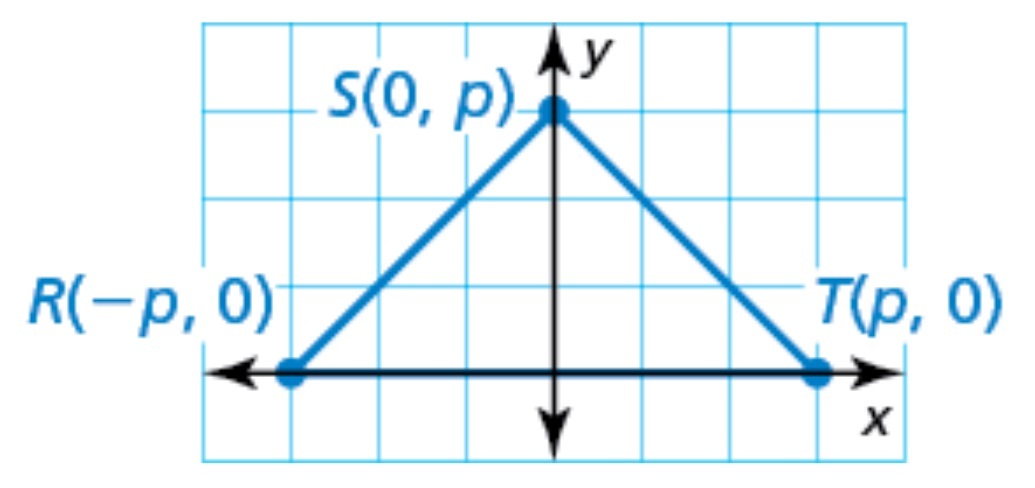
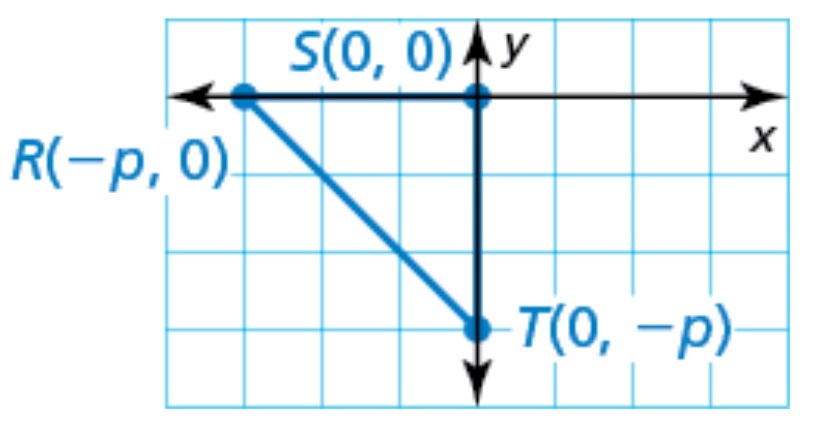
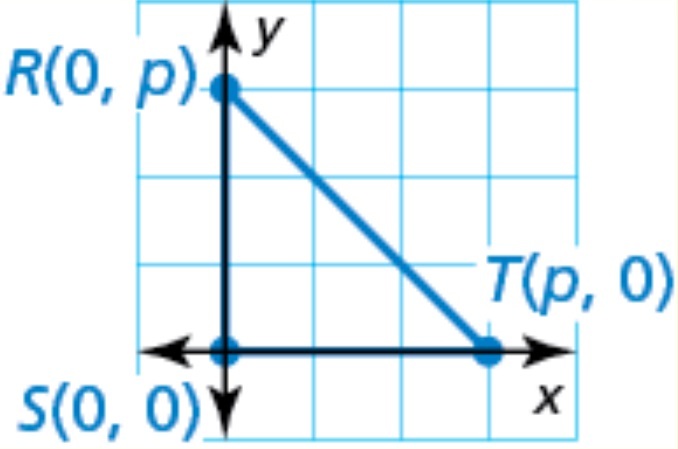
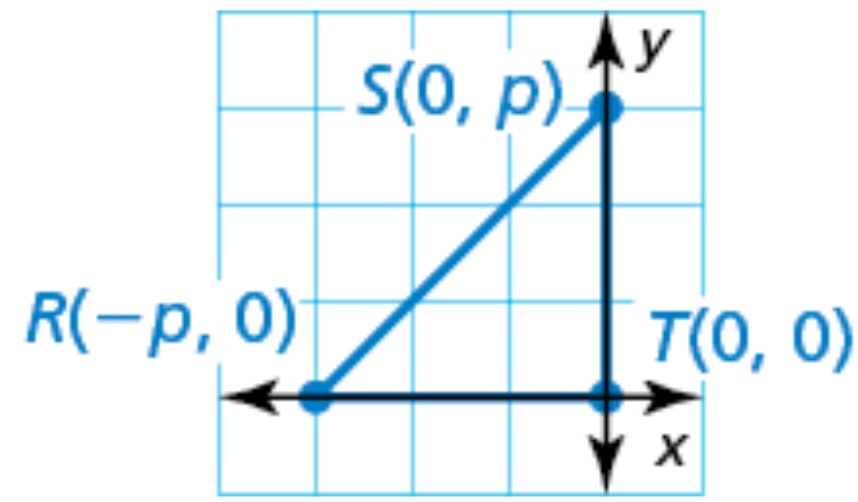
Select the most convenient graph to represent a scalene triangle with one side length of 2m.
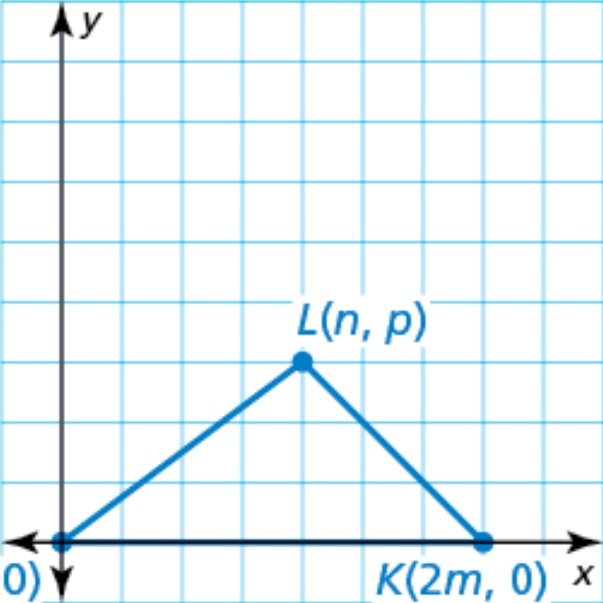
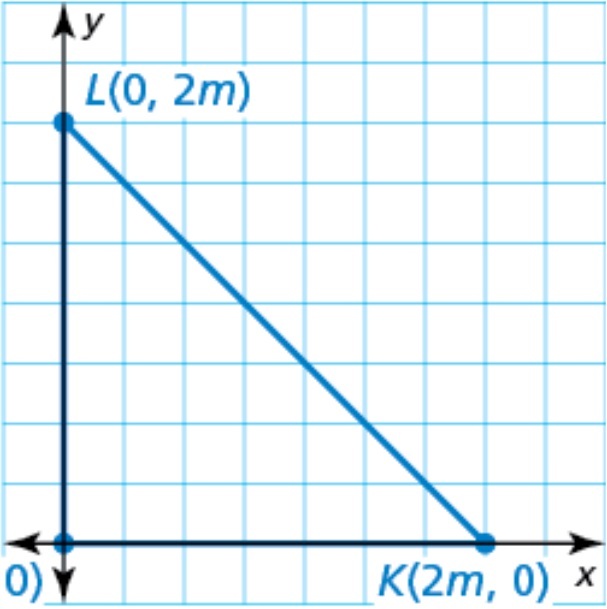
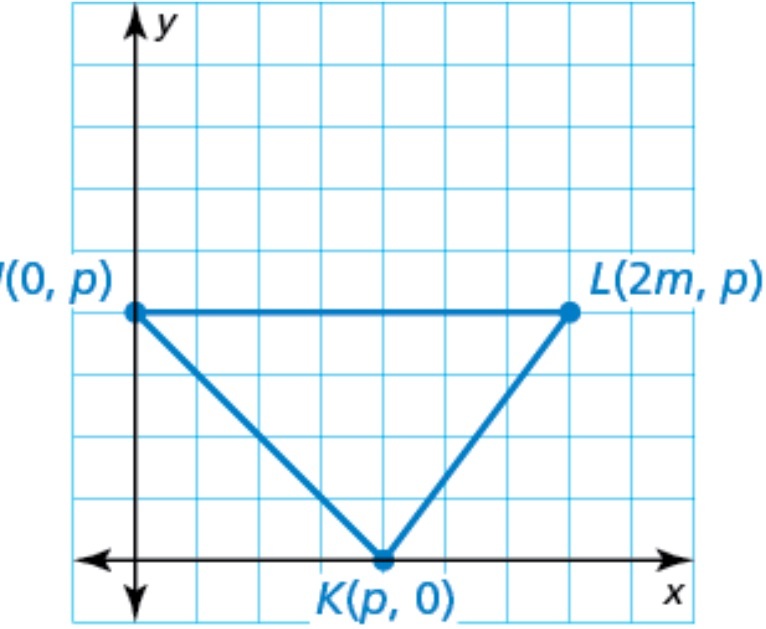
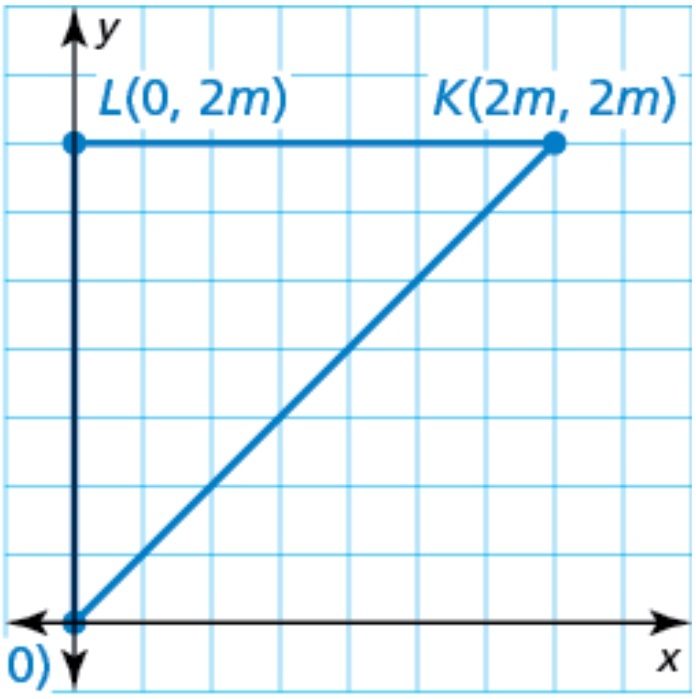

Write a plan for the proof.
Given Coordinates of vertices of △OPM and △ONM
Prove △OPM and △ONM are isosceles triangles
Find the lengths of OP, PM, MN, NO and OM using the distance formula to show that △OMP≅△OMN by the SSS Congruence Theorem.
Find the lengths of OP, PM, MN, and NO using the distance formula to show that OP ≅ PM and MN ≅ NO.

Write a plan for the proof.
Given: G is the midpoint of HF
Prove: △GHJ≅△GFO
Find the coordinates of G using the Midpoint Formula
Use these coordinates and the Distance formula to show that OG ≅ JG.
Show that HG≅ FG by the definition of midpoint and ∠HGJ ≅ ∠FGO by the Vertical Angles Congruence Theorem.
Find the coordinates of G using the Distance Formula
Use these coordinates and the Midpoint formula to show that OG ≅ JG.
Show that HG≅ FG by the definition of midpoint and ∠HGJ ≅ ∠FGO by the Vertical Angles Congruence Theorem.
Then, use the SAS Congruence Theorem to conclude that △GHJ ≅ △GFO.
Then, use the SSS Congruence Theorem to conclude that △GHJ ≅ △GFO.

Find the coordinates of the vertex O.
(a)

Find the coordinates of the vertex U.
(k, 0)
(0, k)
(k, 2k)
(2k, k)
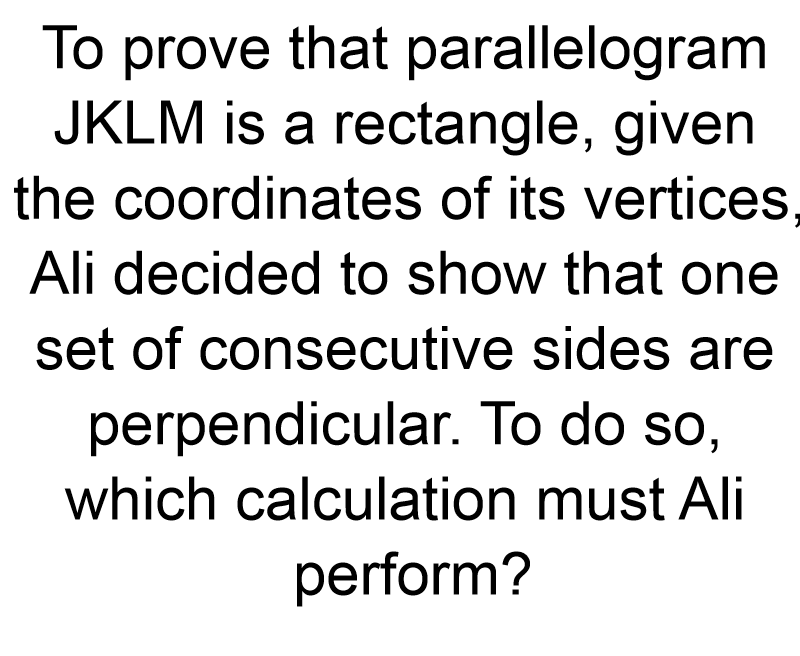
Find the slope of two consecutive sides.
Find the slope of all 4 sides.
Find the slope of the diagonals.
Find the length of two consecutive sides.
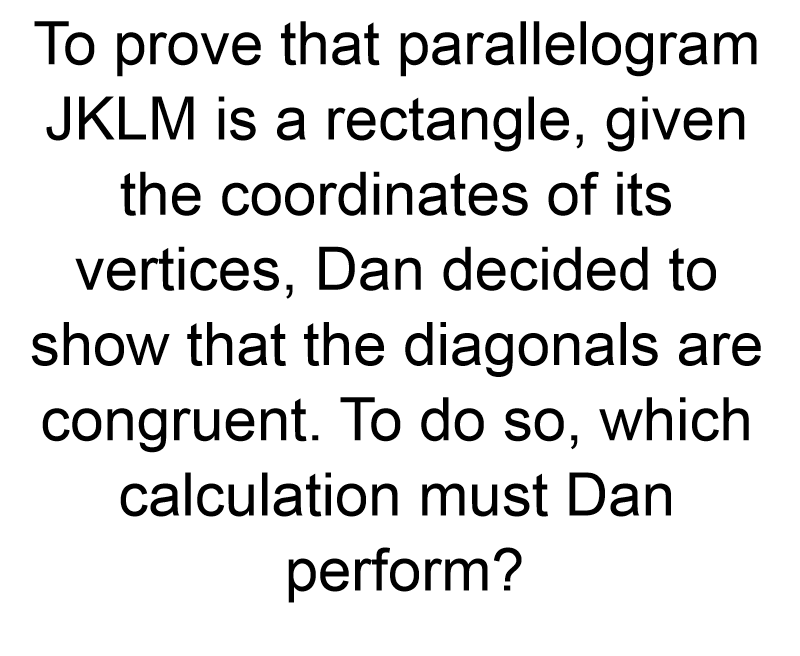
Find the length of all 4 sides.
Find the length of both diagonals.
Find the slope of both diagonals
Find the slope of all 4 sides.
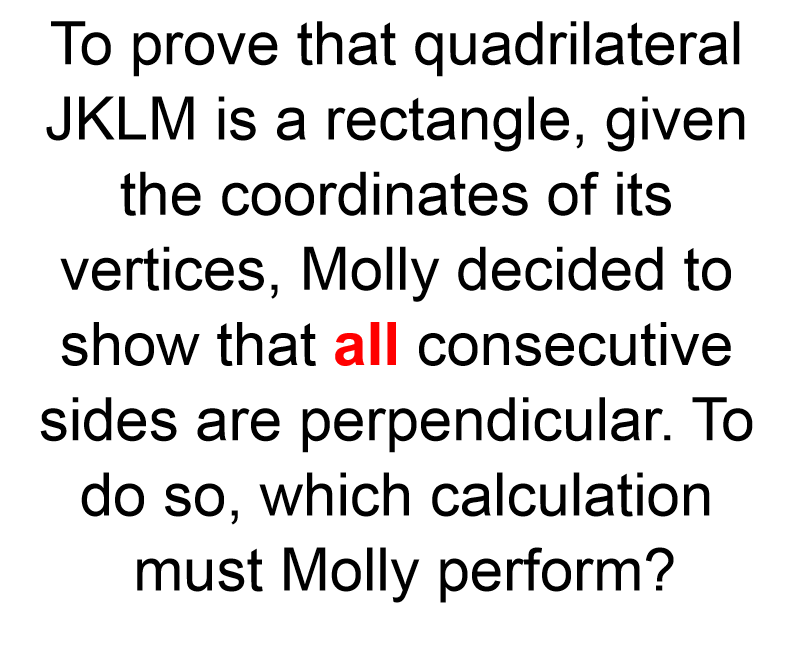
Find the slope of any 2 consecutive sides.
Find the length of all 4 sides.
Find the slope of all 4 sides.
Find the midpoint of all 4 sides.
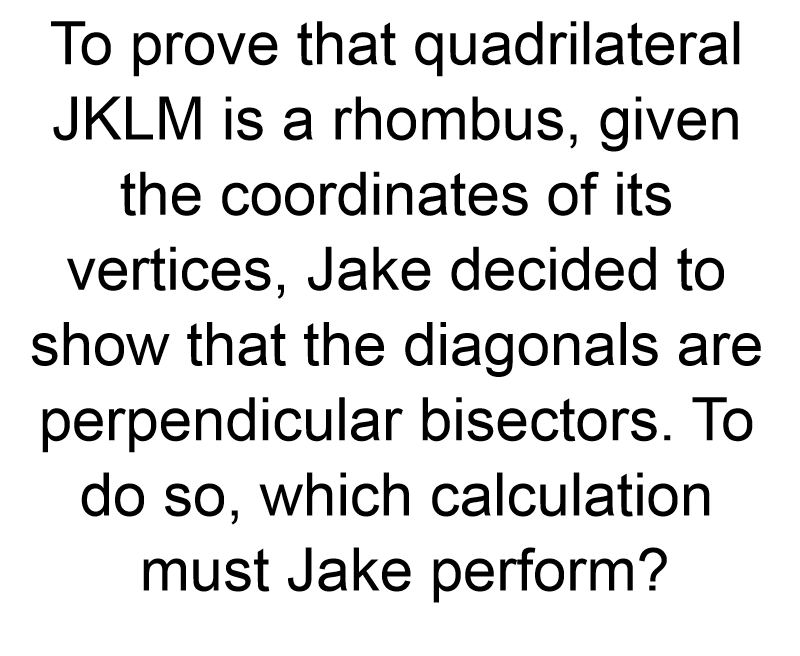
Find the midpoint of the diagonals.
Find the length of the diagonals.
Find the slope of the diagonals.
Diagonals in a rhombus are not perpendicular, so this is not a good method.
If given the coordinates of a quadrilateral, using the distance formula to find the lengths of the diagonals will allow you to prove if it is a parallelogram.
True, if they're congruent then it's a parallelogram
True, if they're congruent then it's a rectangle
False, you should find the opposite sides' slopes for it to be a parallelogram
False, you should find the opposite sides' slopes for it to be a rhoombus
Which statement is sufficient to prove that quadrilateral ABCD is a parallelogram?
One pair of sides is congruent
One pair of sides is parallel
The diagonals are perpendicular
The diagonals bisect each other

Julia proved ETNU is a parallelogram. She notices that side ET has a slope of 1/2 and EN has a slope of -2. What does this mean?
Side ET and EN are parallel
Side ET and EN form a right angle
Side ET and EN are congruent
Nothing Specific
Determine the type of quadrilateral formed by the points (0, 0), (4, 0), (4, 4), and (0, 4).
Square
Trapezoid
Rhombus
Rectangle
Identify the properties of a parallelogram using the coordinates of its vertices.
Sum of all angles is 180 degrees
Distance and slope of opposite sides are equal
Opposite sides are congruent
Diagonals are perpendicular
Find the coordinates of the midpoint of the line segment with endpoints (-3, 5) and (7, -3).
(-3, 5)
(7, -3)
(5, -3)
(2, 1)


What is the area of the figure plotted on the coordinate grid?
20 units2
14 units2
10 units2
15 units2

Which statement best explains why ABCD is a parallelogram?
slope of AB = slope of CD = 0; slope of BC = slope of AD = 5/3.
BC = AD = 8; AB = CD = 14
slope of AB = slope of CD = 0; slope of BC = slope of AD = 2
BC = AD = 10; AB = CD = 18

What is the perimeter of the rectangle?
9.75 units
13.5 units
16 units
60 units

What is the perimeter of the composite figure?
78 units
90 units
114.75 units
125.5 units

Which statement is true about this polygon? Select all that apply.
The polygon has a perimeter of 22 units.
The polygon has a perimeter of 88 units.
The polygon has 2 pairs of parallel sides.
The polygon has 4 congruent sides.

Quadrilateral ABCD is shown on the grid. Jonah finds the length of the sides of the quadrilateral before finding the perimeter. Which statement is true about the length of the sides of quadrilateral ABCD?
Side CD has a length of 5 units.
Side BC has a length of 10 units.
Side DA has a length of 5 units.
Side AB has a length of 6 units.

Jerome found the lengths of each side of triangle QRS as shown, but did not simplify his answers. Simplify the lengths of each side to answer the question. Which statement about triangle QRS is true?
Triangle QRS is an equilateral triangle because QR = RS.
Triangle QRS is an isosceles triangle because QR = QS.
Triangle QRS is a scalene triangle because all sides have different lengths.
Triangle QRS is an isosceles triangle because QR = RS.

Point A has an x coordinate of −2 and lies in a circle with a center at (0, 0) and a radius of 5. To the nearest tenth, what is the y-coordinate for point A?
4.5
4.6
4.7
4.8

HIJK is a parallelogram because the midpoint of both diagonals is __________, which means the diagonals bisect each other.
(1, -1)
(1, 1)
(1, 0)
(0, 1)

Which statement proves that PQRS is a parallelogram?
The slopes of SP and RQ are both –2 and SP = RQ = 45 .
The slopes of RS and QP are both 3 and SP = RQ = 45 .
The midpoint of RP is (4, 5 1/2) and the slope of RP is -9/2.
The midpoint of SQ is (4, 5 1/2) and SQ = 5.

What is the perimeter of kite KLMN?
2+5 units
14 units
22+25 units
45 units

What is the perimeter of parallelogram WXYZ?
5+ 17 units
25+ 217 units
16 units
22 units

In the diagram, WZ = 26 . What is the perimeter of parallelogram WXYZ?
226+ 2 units
226+ 4 units
226+ 6 units
226+ 8 units

What is the perimeter of square ABCD?
37 units
437 units
28 units
37 units
Find the coordinates of the midpoint of the line segment with endpoints (2, 4) and (6, 8).
(3, 5)
(5, 10)
(1, 3)
(4, 6)
Identify the type of triangle formed by the points (-1, 0), (3, 4), and (5, 2).
Isosceles triangle
Right-angled triangle
Equilateral triangle
Scalene triangle
Determine the type of quadrilateral formed by the points (0, 0), (4, 0), (4, 4), and (0, 4).
Square
Trapezoid
Rhombus
Rectangle
Identify the properties of a parallelogram using the coordinates of its vertices.
Sum of all angles is 180 degrees
Distance and slope of opposite sides are equal
Opposite sides are congruent
Diagonals are perpendicular

Give the most precise classification for the quadrilateral.
parallelogram
rhombus
square
rectangle
kite

Give the most precise classification for the quadrilateral.
parallelogram
rhombus
kite
rectangle

If the lines are parallel to each other and the slope of the blue line is 1/4, what is the slope of the purple line?
4
-4
−41
41

If the lines are perpendicular to each other and the slope of the blue line is 21 , what is the slope of the purple line?
2
-2
−21
21
Slopes of parallel lines are...
opposite reciprocals
the same
opposites
always 7
Point (0 , -7) lies______
Point (1 , -1) and (-1 , 1) lies in the same quadrant

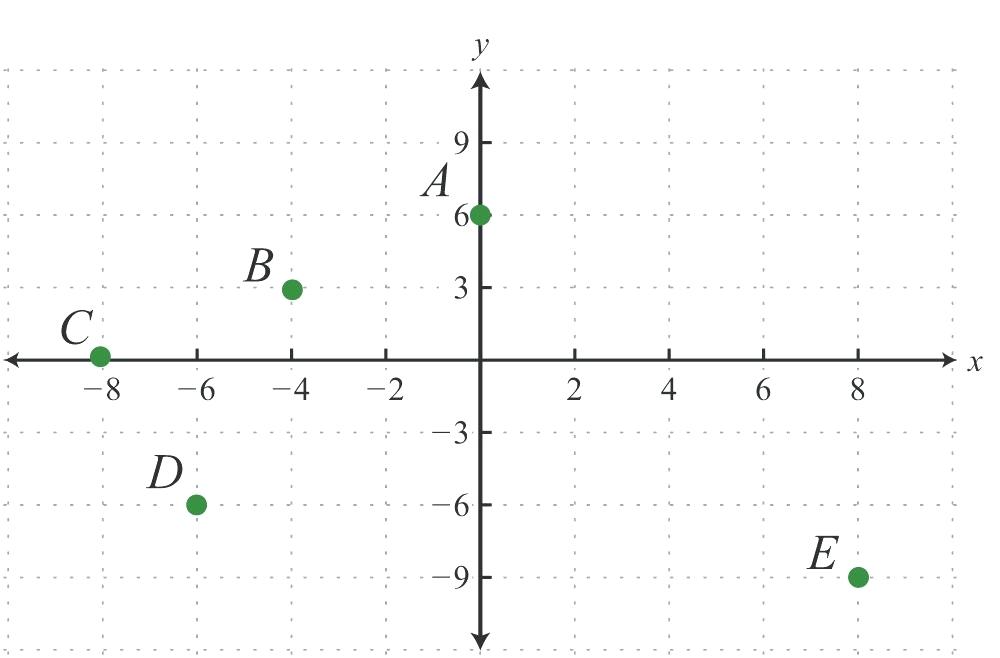
Which point has the coordinates (0,6)
A
B
C
D
Point (-3,5) lies in the
First quadrant
Second quadrant
Third quadrant
Fourth quadrant
Point (0,-11) lies
In the third quadrant
On the negative y-axis
On the positive x-axis
On the fourth quadrant
Sign of abscissa and ordinate of a point in the fourth quadrant are respectively
+ , -
- , -
- , +
+ , +
Coordinate of origin is _______
(0,0.1)
(0,-6)
(0,0)
(-1,-1)

What is the coordinate of P?
(2 , -2)
(4 ,3)
(-2 ,3)
(-4 , -2)
What is the coordinate of R?
(2 , -2)
(4 ,3)
(-2 ,3)
(-4 , -2)
What is the coordinate of S?
(2 , -2)
(4 ,3)
(-2 ,3)
(-4 , -2)
What is the coordinate of Q?
(2 , -2)
(4 ,3)
(-2 ,3)
(-4 , -2)
If abscissa is negative and ordinate is zero it will lie on third quadrant?
True
False
The perpendicular distance of point (-4, 8) from x-axis is ?
-8
7
8
9
Horizontal distance of point (5, 7) from origin is ?
9
6
5
7
What shape is form when we join point (0,7) , ( 0,0) , (8,0)?
Rectangle
Triangle
Square
Parallelogram
If (a ,8) lies on y-axis , then what is the value of a?
8
1
0
-8
There are two point P(2,5) and Q(0,8) on the Cartesian plane, the longest perpendicular distance from x-axis will be the point
Q
Both have same distance
P
Suppose there are three points on cartesian plane if two points have abscissa negative and ordinate positive and the other point has ordinate positive and abscissa positive . Then how many point lies on second quadrant?
One
Two
Zero
Three
Suppose there are three points on cartesian plane if two points have abscissa negative and ordinate positive and the other point has ordinate positive and abscissa positive . Then how many point lies on first quadrant?
One
Two
Zero
Three
Suppose there are three points on cartesian plane if two points have abscissa negative and ordinate positive and the other point has ordinate positive and abscissa positive . Then how many point lies on fourth quadrant?
One
Two
Zero
Three

Identify this person, who is also known as father of Geometry?
Alexander Grothendieck
René Descartes
Évariste Galois
Archimedes
Signs of abscissa and ordinate of a point in the fourth quadrant are respectively
+ , -
- , -
- , +
+ , +
A point lies on y-axis at a distance of 2 units from the x-axis .Its coordinates are (2,0)
True
False

What error did the student make when plotting the point (3, 4) according to the picture?
The student moved left along the x-axis when he should have moved right
The student plotted the y-coordinate in place of the x-coordinate
The student didn't make a mistake


The rectangle shown has coordinates (3, 2), (-2, 2), (-2, -1), (3, -1)
What is the length of the longest side of the rectangle?
4 units
5 units
6 units
8 units


What type of reflection does this picture show?
reflection over the x-axis
reflection over the x-axis, then the y-axis
reflection over the y-axis
reflection over the origin

What is the reflection of F (3, 4) over the x-axis?
F' (-3, -4)
F' (3, -4)
F' (-3, 4)
F' (4, 3)

If you reflect this point (-3, 1) across the x-axis then the y-axis, where would it be?
(-3, -1)
(3, -1)
(3, 1)
(1, -3)
Use absolute value to find the distance between C(-4, 5) and E(-4,-1) ?
5
4
6
1

What is the perimeter of the shape?
20
22
24
25

