
 Worksheets
African Geography & Empire
Total questions: 49
Worksheet time: 29mins
What is the world's second largest continent?
Asia
Africa
Europe
North America
How many countries are in Africa?
45
52
60
48
What percentage of the world's population lives in Africa?
5%
10%
15%
20%
What are the major physical features of Africa?
Mountains, rivers, lakes
Deserts, forests, plains
Sahara, Sahel, savannahs, tropical rain forests
Valleys, plateaus, hills
What is the Sahara?
A large mountain range
The world's largest hot desert
A vast ocean
A dense forest
How much of Africa does the Sahara cover?
1/4
1/3
1/2
2/3
What are the living conditions like in the Sahara?
Many people live there comfortably
Very few people live there due to harsh conditions
It is a popular tourist destination
It is densely populated
What does the word 'Sahel' mean?
Desert
Forest
Border or margin
River
What is the Sahel?
A large river
A strip of dry grassland located south of the Sahara
A mountain range
A tropical rainforest located north of the Sahara
What is the climate like in the Sahel?
Wet and tropical
Dry, semi-arid with 6-20 inches of rainfall
Cold and snowy
Humid and rainy 15-20 inches of rainfall
What are the characteristics of the African savanna?
Cold, icy plains
Hot, dry grasslands with diverse wildlife
Dense, tropical forests with a great deal of wildlife
Mountainous regions
Where is Africa's tropical rain forest located?
Northern Africa
Along the central coast of Africa, near the Equator
Along the coast of Southern Africa near the Cape of Good Hope
Eastern Africa
What is the Congo River?
A large desert in North Africa
A mountain range
A river in west central Africa, over 3,000 miles long
A tropical rainforest
What is the Nile River known for?
It is the world's longest river at 4,150 miles.
It is the largest river in Asia.
It is the shortest river in Africa with over a billion cubic feet of water
It is the widest river in the world.
What is Lake Victoria?
The largest lake in Africa and the second largest freshwater lake in the world.
The smallest lake in Africa but the third largest fresh water lake in the world.
A saltwater lake in Europe.
A desert in Africa.
What is the Great Rift Valley?
A giant dip in the Earth's surface, created by tectonic plate separation.
A mountain range in Asia that reaches over 20,000 feet all along its mountain tops.
A river in South America.
A desert in Australia.
What is Mt. Kilimanjaro?
The tallest mountain in Africa, rising 19,340 feet above sea level.
The longest river in Africa.
A desert in Africa over 4,000 miles long
A lake in Europe.
What are the Atlas Mountains?
A mountain range in North Africa extending from Morocco to Tunisia.
A river in South America.
A mountain range in Southern Africa extending from The Congo to Mozambique .
A lake in North America.
What is the Kalahari Desert?
A large arid to semi-arid sandy area located in southwestern Africa.
A mountain range in Europe.
A large arid to semi-arid sandy area located in northwestern Africa.
A river in Asia.
How much rain does the Kalahari Desert receive?
3-10 inches of rain per year.
50-60 inches of rain per year.
100-150 inches of rain per year.
200-250 inches of rain per year.
What is unique about the vegetation in the Kalahari Desert?
It supports grass, shrubs, and wild animals due to underground water supplies.
It has no vegetation at all.
It is covered with dense forests.
It is home to only aquatic plants.
What are some major rivers in Africa?
Congo River, Niger River, Nile River.
Amazon River, Mississippi River, Yangtze River.
Thames River, Seine River, Danube River.
Ganges River, Indus River, Brahmaputra River.
What is the significance of the Nile River for Sudan and Egypt?
It provides water, transportation, and irrigation for agriculture.
It is a major tourist attraction.
It is a source of gold and diamonds.
It is a natural barrier against invasions.
What is the climate of Africa's tropical rain forest?
Hot and humid with over 17 feet of annual rainfall.
Cold and dry with little rainfall.
Mild and temperate with moderate rainfall.
Hot and arid with no rainfall.
What is the impact of deforestation on Africa's tropical rain forest?
About 90% of the rain forest has shrunk due to deforestation.
About 50% of the rain forest has shrunk due to deforestation.
About 30% of the rain forest has shrunk due to deforestation.
About 10% of the rain forest has shrunk due to deforestation.
What types of wildlife can be found in the African savanna?
Lions, zebras, elephants.
Tigers, pandas, kangaroos.
Penguins, polar bears, seals.
Koalas, emus, dingoes.
What is the geographical significance of the Sahara Desert?
It divides Africa into North Africa and sub-Saharan Africa.
It is the largest desert in the world.
It is home to the largest population of camels.
It is the hottest place on Earth.
What is the vegetation like in the Sahel?
Sparse, with unevenly distributed grasses and shrubs.
Dense, with thick forests and jungles.
Lush, with abundant tropical plants.
Barren, with no vegetation at all.
This African Empire in Ethiopia was known for its powerful navy and trade system.
Aksum
Mali
Ghana
Benin
This African Empire in Nigeria was known for its production of Brass and its trade network on the Niger River.
Benin
Kush
Aksum
Mali
This African Empire was known for its massive wealth due primarily to the resource of gold.
Ghana
Aksum
Kush
Benin
This African Empire was known for the Lion King and King Mansa Musa. Other than Solomon, king Mansa Musa may have been the second richest man in history (supposedly worth 400 billion dollars).
Mali
Ghana
Aksum
Kush
This African Empire in the Sudan was known to be very similar to Egypt. This kingdom built pyramids.
Kush
Mali
Benin
Ghana
Which African Empire of West Africa was known for its strong centralized government and a mighty 200,000 man army?
Zulu
Carthage
Songhai
Punt
Which African Empire in Somalia was known as the Atlantis of Africa due to its homes being built on stilts over water?
Zulu
Punt
Songhai
Carthage
Which African Empire in South Africa had a very fierce and well-trained army that defeated the first British attempt to take them over?
Carthage
Songhai
Zulu
Punt
Which African Empire in Tunisia had a constitution with a system of checks and balances and fought major wars with Rome known as the Punic Wars?
Songhai
Zulu
Punt
Carthage
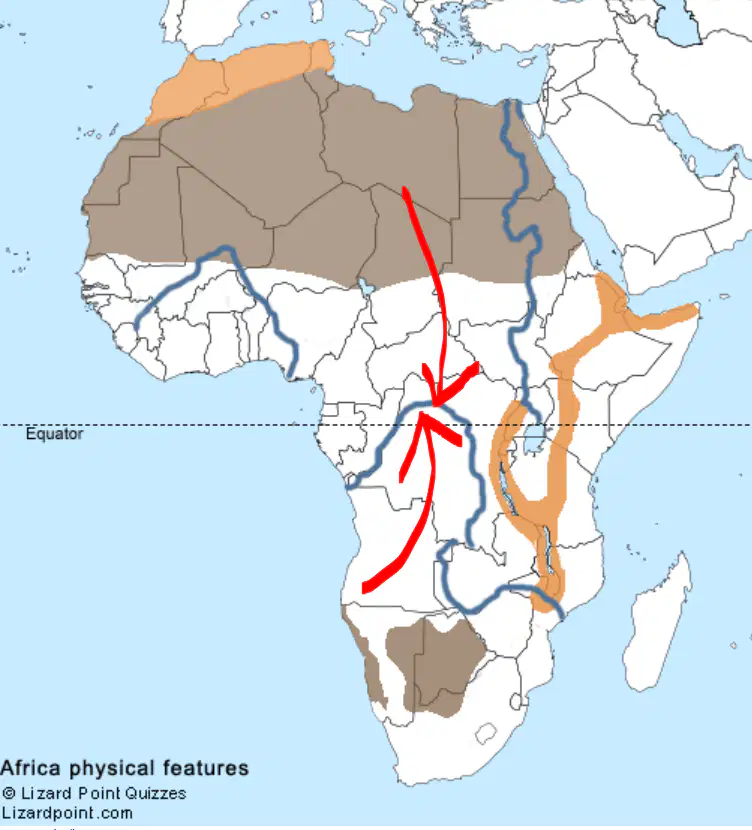
What river is labeled on this map?
Zambezi River
Nile River
Congo River
Niger River
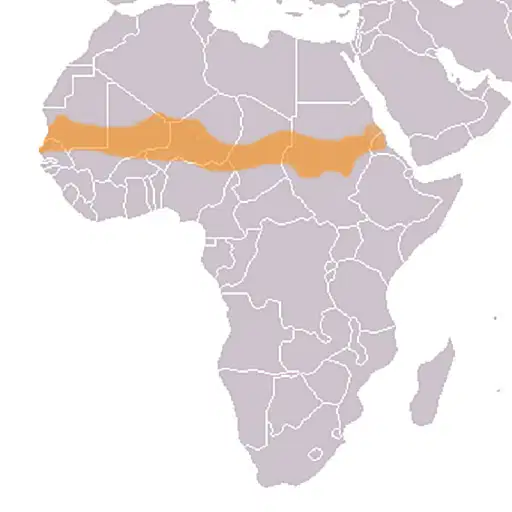
What is the name of the yellow zone found approximately in the center of this map of Africa?
Congo
Sahara
Kalahari
Sahel
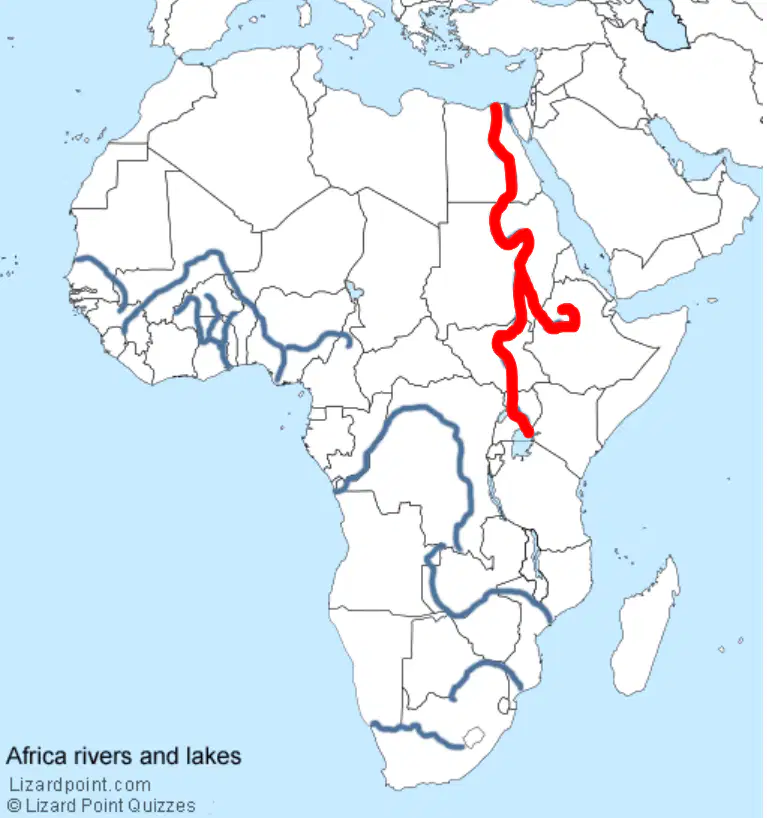
The red line on this map represents what major river?
Amazon
Nile
Euphrates
Tigris
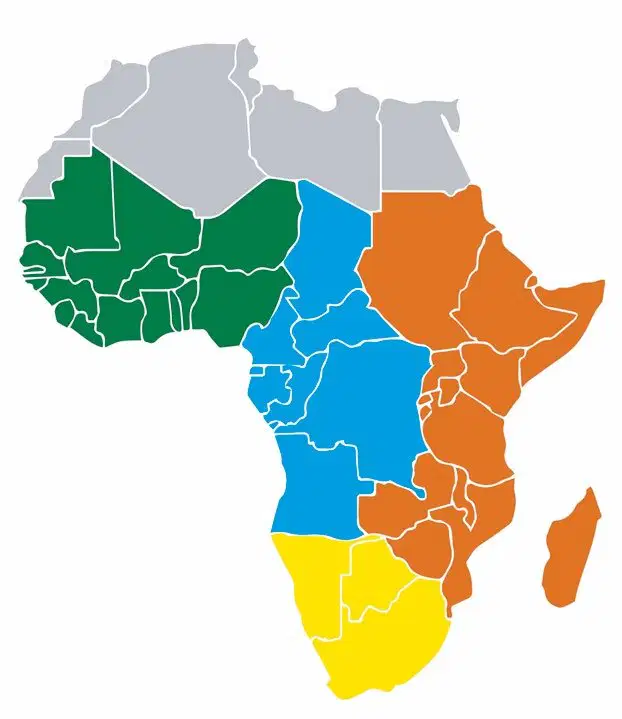
Which region of Africa is GREY on the map?
Northern Africa
Southern Africa
Eastern Africa
Central Africa
Which region of Africa is BLUE on the map?
Northern Africa
Southern Africa
Eastern Africa
Central Africa
Which region of Africa is GREEN on the map?
Northern Africa
Western Africa
Eastern Africa
Central Africa
Which region of Africa is YELLOW on the map?
Northern Africa
Western Africa
Eastern Africa
South Africa
Which region of Africa is ORANGE on the map?
Northern Africa
Western Africa
Eastern Africa
South Africa
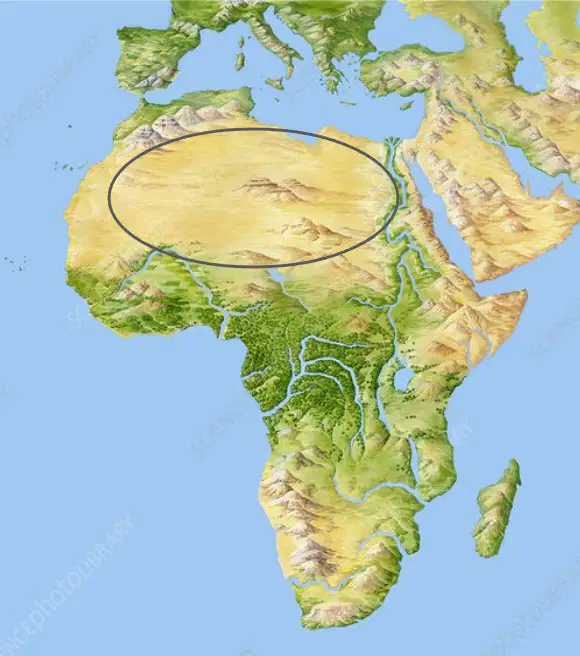
What geographic feature is circled on the map?
Kalahari Desert
Congo River
Congo Basin or Congo Rainforest
Sahara Desert
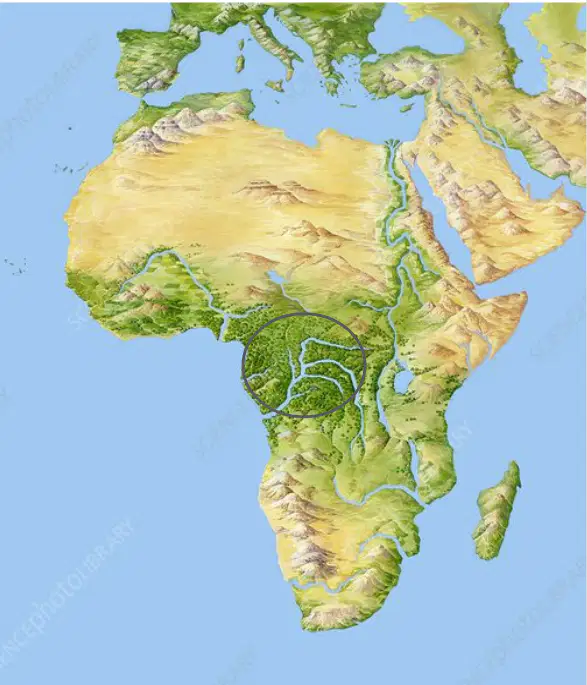
What geographic feature is circled on the map?
Kalahari Desert
Congo River
Congo Basin or Congo Rainforest
Sahara Desert
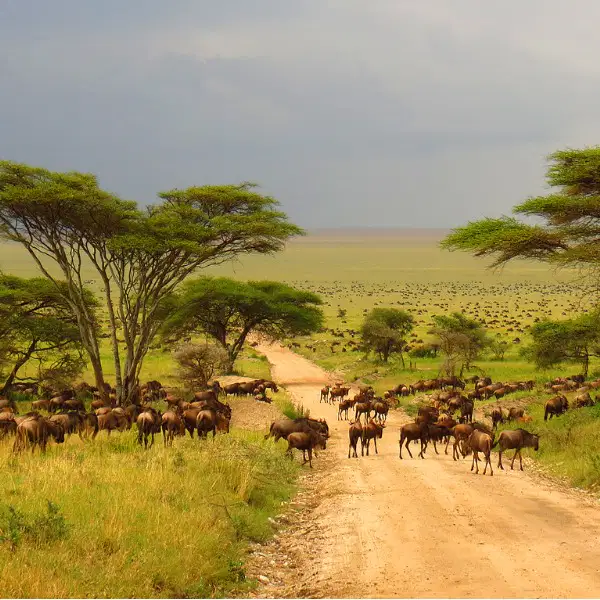
What does this picture show?
Savanna
Desert
Sahel
Tropical Rainforest
Exploring Ancient African Kingdoms
The Mali Empire was one of the most powerful and wealthy kingdoms in ancient Africa. It was located in West Africa and was known for its rich culture and trade. The empire was famous for its gold, which attracted traders from all over the world. Mansa Musa, one of its greatest rulers, was known for his pilgrimage to Mecca, where he displayed the empire's wealth. The Mali Empire played a significant role in spreading Islam in Africa.
The Ghana Empire, not to be confused with the modern country of Ghana, was another influential kingdom in West Africa. It existed before the Mali Empire and was known for its strong economy. The empire's wealth came from controlling trade routes and taxing goods like gold and salt. The Ghana Empire was a center of trade and culture, attracting merchants from different regions. It eventually declined due to invasions and internal conflicts.
The Kingdom of Axum was located in what is now Ethiopia and Eritrea. It was a powerful trading empire that connected Africa with Asia and Europe. Axum was known for its impressive architecture, including tall stone obelisks. The kingdom adopted Christianity in the 4th century, making it one of the earliest Christian states in the world. Axum's strategic location helped it become a major center of trade and culture.
These ancient African kingdoms were known for their rich cultures and contributions to world history. They were centers of trade, religion, and learning, influencing regions far beyond their borders. The wealth and power of these kingdoms were built on trade, especially in gold and other valuable resources. Their legacies continue to be studied and admired today. Understanding these kingdoms helps us appreciate the diverse history of Africa.
Learning about the Mali Empire, Ghana Empire, and Axum Kingdom gives us insight into the past. These kingdoms show us how advanced and interconnected ancient African societies were. They remind us of the importance of trade, culture, and religion in shaping history. By studying these kingdoms, we can better understand the rich heritage of Africa. These stories inspire us to learn more about the world and its history.
What was the Mali Empire known for?
Its rich culture and trade
Its military conquests
Its isolation from other regions
Its lack of resources
Who was one of the greatest rulers of the Mali Empire?
Mansa Musa
Sundiata Keita
Askia the Great
Sunni Ali
What was the main source of wealth for the Ghana Empire?
Controlling trade routes and taxing goods
Agriculture and farming
Mining silver
Fishing and maritime trade
Which kingdom was known for its impressive architecture, including tall stone obelisks?
The Kingdom of Axum
The Mali Empire
The Ghana Empire
The Songhai Empire
In which century did the Kingdom of Axum adopt Christianity?
4th century
5th century
6th century
7th century

