
 Worksheets
Geometry B.E.S.T. EOC - Mixed Review
Total questions: 43
Worksheet time: 29mins
Points D, H, and W are collinear. Point W is between D and H.
HD = 8x + 11, HW = 7x - 29 and WD = 4x - 8.
Determine the value of x.
(a)
A statement is shown. “If you have been to Sea World, then you have seen a stingray”
Which is the converse of the given statement?
If you have seen a stingray, then you have been to Sea World.
If you have not been to Sea World, then you have seen a stingray.
If you have not seen a stingray, then you have not been to Sea World.
If you have not been to Sea World, then you have not seen a stingray.
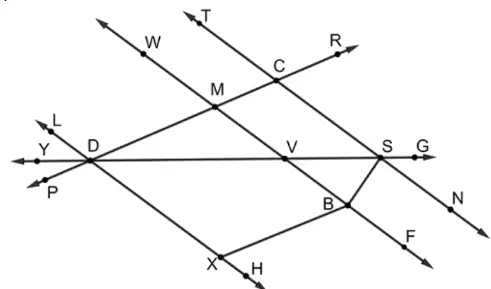
A diagram is shown where TS || WB || LH, m∠VSC = 37°, m∠HXB = 59°, m∠NSB = 88°, and m∠WMR = 120°. Determine the measure, in degrees, of m∠MDV.
(a)
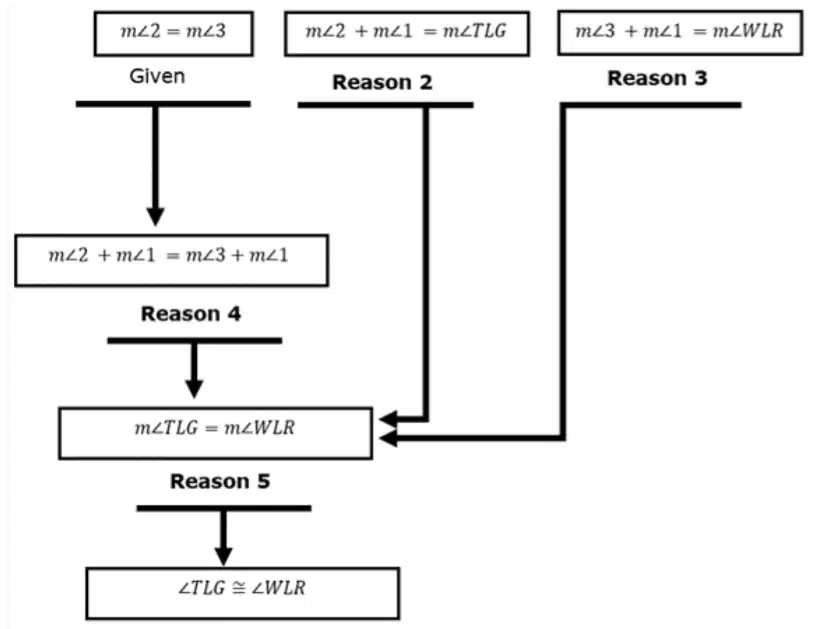
Angles WLT, RLT, and RLG are shown. Given: m∠2 = m∠3. Prove: ∠WLR ≅ ∠TLG. An incomplete flowchart proof is shown (see diagram). What definition, postulate, or theorem should be used for reasons 2 and 3?
Angle Addition Postulate
Definition of Supplementary Angles
Supplements of congruent angles are congruent
If two lines intersect, then vertical angles are congruent.
A conditional statement is shown. "If Jamal has visited the Everglades, then he has ridden on an airboat." Complete the statement. The Conclusion of the conditional statement is
he has ridden on an airboat.
he has visited the Everglades.
he has not visited the Everglades.
he has not ridden on an airboat.
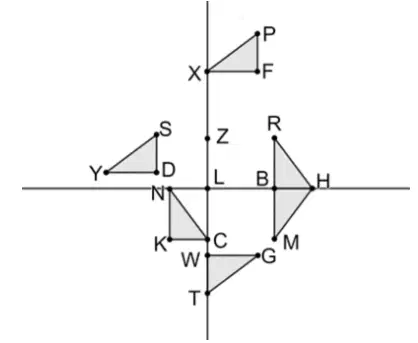
The diagram shows triangles FXP, DYS, KNC, BMH and WGT as single transformations of ΔBRH. Select all statements that are true.
ΔWGT is the result of rotating ΔBRH 90° clockwise about point L.
ΔKNC is the result of rotating ΔBRH 180° clockwise about point L.
ΔFXP is the result of rotating ΔBRH 90° counterclockwise about point Z.
ΔDYS is the result of rotating ΔBRH 90° counterclockwise about point C.
ΔBMH is the result of rotating ΔBRH 180° clockwise about point H.
A statement is shown. The product of any real number and itself will always be larger than the number itself.
Select all the numbers that when multiplied by itself would be a counterexample to the given statement.
-3
1/3
1
0
-15/2
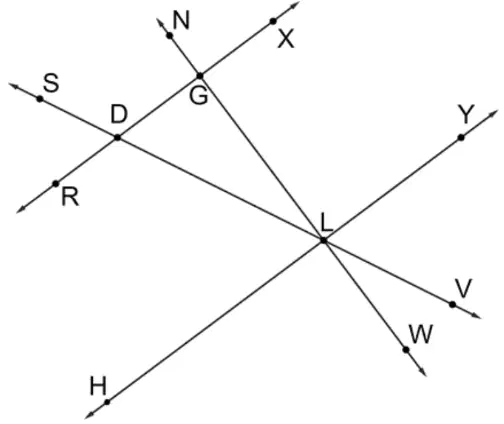
A diagram is shown where m∠RDS = 63° and RX || HY. Select all of the statements that are true.
∠GLH = ∠XGL
∠YLV = ∠DGL
∠NLY = ∠DGN
∠RDL = ∠YLD
m∠HLD = 127°
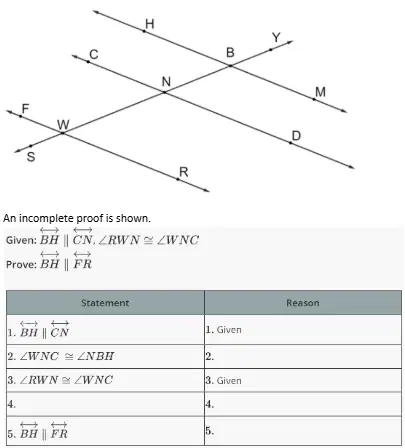
A diagram is shown where WY intersects lines BH, CN, and RF. An incomplete proof is shown.
What is the reason for step 5 of the proof?
If corresponding angles are congruent, then the two lines that are intersected by a transversal are parallel.
If alternate interior angles are congruent, then the two lines that are intersected by a transversal are parallel.
If consecutive interior angles are supplementary, then the two lines that are intersected by a transversal are parallel.
If alternate exterior angles are congruent, then the two lines that are intersected by a transversal are parallel.
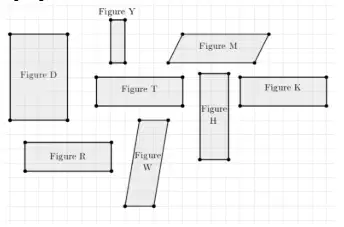
Eight figures are shown. Given that figure T is the original figure, select all figures that are the result of a transformation that preserves distance.
Figure K
Figure H
Figure R
Figure M
Figure D
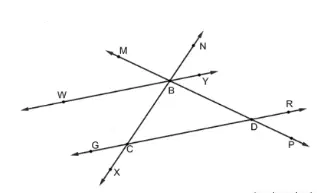
Lines WY, MP, and GR, where m∠YBD = (2x + 0.6)°, m∠MBN = (5x + 7)°, and m∠XCD = (9x − 28.8)° are shown.
Determine the value of x that will show WY ∥ GR. Write your answer as a decimal and if necessary, round your answer to the nearest thousandth.
(a)
Which graph shows a correct mapping of the translation of polygon WMKRD?


Graph C

Graph D
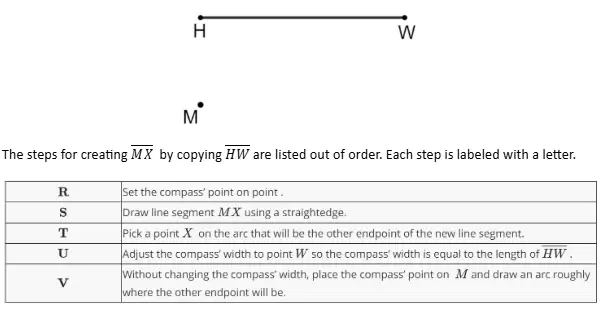
Line segment HW and point M are shown. What list of steps is in the correct order?
S, R, V, U, T
R, U, S, V, T
R, U, V, T, S
S, R, V, T, U
Which diagram shows the construction of the angle bisectors of ∠WRC?

Diagram A

Diagram B


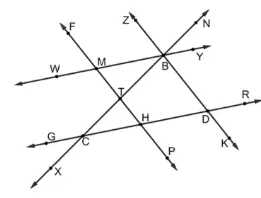
Lines FP, ZK, WY and GR are shown. Select all the statements that are true.
If WY || GR then ∠FMB ≅ ∠THD.
If FP || ZK then m∠WMF + m∠ZBY = 180°.
If m∠WMT + m∠THC = 180° then WY || GR.
If FP || ZK then ∠PHD ≅ ∠YBD.
If ∠MTB ≅ ∠ZBM then FP || ZK.
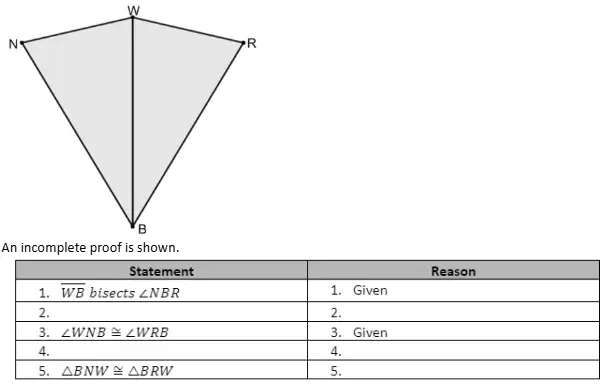
Quadrilateral NWRB is shown where WB bisects ∠NBR and ∠WNB ≅ ∠WRB. An incomplete proof is shown.
What is the reason for step 5 of the proof?
AAS congruence
ASA congruence
SAS congruence
SSS congruence
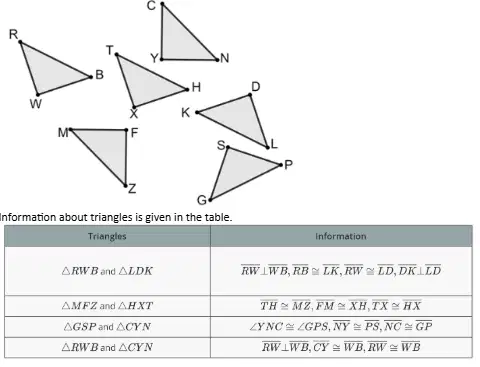
Complete the statement. There is sufficient information to show that △RWB ≅ △LDK using ______ congruence and that △GSP ≅ △CYN using ______ congruence.
1) SAS 2) HL
1) ASA 2) SAS
1) HL 2) SSS
1) AAS ) SAS
1) HL 2) SAS
Select all of the transformations that will not preserve distance:
(x, y) → (−x, −y)
(x, y) → (0.5x, 0.5y)
(x, y) → (x + 0.8, y + 0.8)
(x, y) → (x, −y)
(x, y) → (11/2 x, 11/2 y)
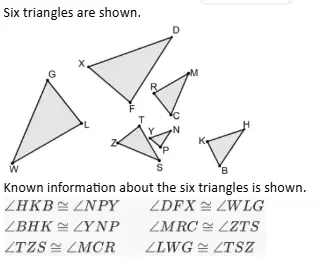
Based on the given information, select the statements that are true.
ΔGLW ~ ΔTZS
ΔBKH ≅ ΔZTS
ΔMCR ~ ΔSZT
ΔLWG ≅ ΔFDX
ΔHKB ~ ΔNPY
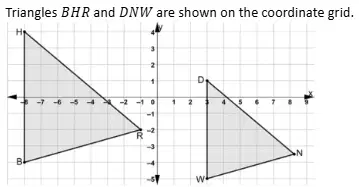
Triangles BHR and DNW are shown on the coordinate grid. Complete the statements. The sequence of transformations that maps ΔHRB to Triangle DNW is a ________ of scale factor 3/4 centered at the origin then a ________ of right 9 down 2. Because this sequence includes a dilation, the mapping will show that the sides of the triangles are ________ with the same scale factor as the dilation and the angles of the triangles are ________.
dilation; translation; proportional; congruent
translation; rotation; congruent; proportional
rotation; reflection; equal; different
reflection; dilation; congruent; proportional

A children’s book illustrator used drawing software to draw a boat. He used two similar quadrilaterals, as shown, where BRYL ~ WNKH. The illustrator used the scale factor WNBR=31 . To be able to recreate the drawing later, the illustrator recorded some of the dimensions and relationships, in millimeters (mm), as shown in the table.
HK: 20x + 19
HW: 78.75
BL: 5x - 31.25
BR: 4x - 4.5
NK: 12x - 13.5
Determine the perimeter, in mm, of quadrilateral BRYL. Round your answer to the nearest hundredth.
(a)
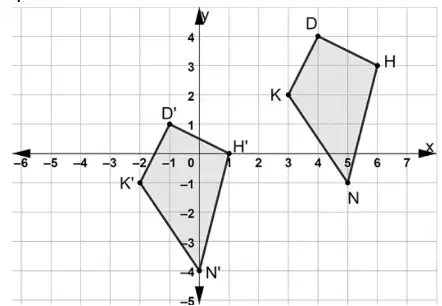
Quadrilaterals HDKN and H'D'K'N' are shown on the coordinate grid where quadrilateral H'D'K'N' is a transformation of quadrilateral HDKN. What algebraic description describes the transformation?
(x, y) → (x – 5, y – 3)
(x, y) → (x – 2, y – 2)
(x, y) → (x + 2, y + 2)
(x, y) → (x + 5, y + 3)
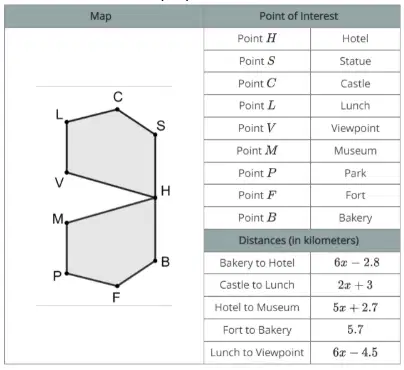
While planning a two-day bicycle trip, Chantelle marked points of interest on a map. When she finished, she discovered that both days created congruent pentagons. Her map, points of interest, and some expressions that represent distances, in kilometers (km) are shown in the table. The total distance Chantelle rode during the trip was 76.6 km. Determine the value of x.
(a)
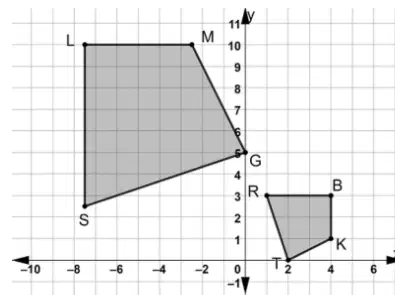
Quadrilaterals LSGM and BRTK are shown on the coordinate grid where LSGM ~ BRTK. Complete the statement.
a dilation centered at the origin with a scale factor of 5/2 then a rotation of 90 degrees counterclockwise about the origin
a translation 3 units up and 2 units right
a reflection over the y-axis followed by a dilation with a scale factor of 2
a rotation of 180 degrees about the origin followed by a translation 4 units left
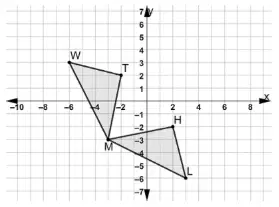
Triangles WTM and LHM are shown on the coordinate grid where ΔWTM was transformed to create ΔLHM. What algebraic description describes the transformation(s)?
(x, y) → (−x, −y)
(x, y) → (x + 4, y − 4)
(x, y) → (−x, y) then (x, y) → (x, −y)
(x, y) → (y, −x) then (x, y) → (x, −y)
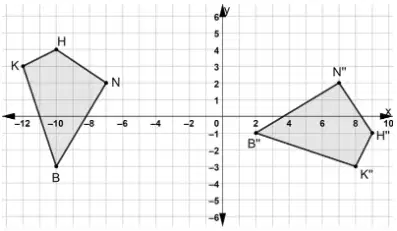
Complete the statements. The sequence of transformations that will map quadrilateral KHNB onto quadrilateral K''H''N''B'' is
rotate 90 degrees counterclockwise about point N then reflect across the y-axis
reflect across the x-axis then rotate 90 degrees clockwise about point N
translate 5 units right then reflect across the y-axis
rotate 180 degrees about the origin then reflect across the x-axis
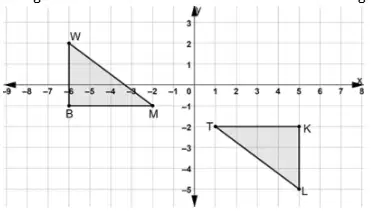
Triangles MBW and TKL are shown on the coordinate grid. ΔTKL is the result of two transformations of ΔMBW. Select all sequences of transformations of ΔMBW that would result in ΔTKL.
Reflect across the line y = 1 then translate right 3 and down 1.
Rotate 180° counterclockwise about point M then translate right 3 and down 1.
Rotate 180° counterclockwise about the origin then translate left 1 and down 3.
Reflect across the y-axis then reflect across the x-axis then translate left 1 and down 3.
Reflect across the line x = -2 then across the line y = -1 then translate right 3 and down 1.
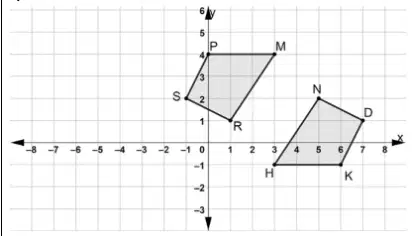
Quadrilaterals PMRS and NDKH are shown on the coordinate grid. Complete the statements. The sequence of transformations that maps HKND to PMRS is a rotation of 180 degrees counterclockwise about the origin, then a translation of right 6 then up 3. This sequence will show that corresponding sides and angles of NDKH and RSPM are congruent.
A rotation of 180 degrees counterclockwise about the origin, then a translation of right 6 then up 3.
A reflection over the y-axis, then a translation of left 4 and down 2.
A rotation of 90 degrees clockwise about the origin, then a translation of right 3 and up 5.
A reflection over the x-axis, then a translation of right 6 and down 3.
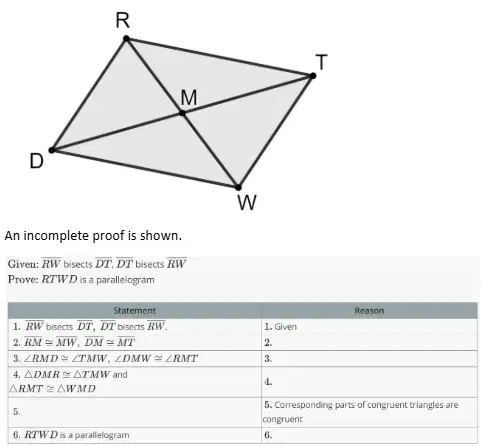
A quadrilateral is shown where RW bisects DT and DT bisects RW. An incomplete proof is shown.
Given: RW bisects DT, DT bisects RW Prove: RTWD is a parallelogram
What is the reason for step 6 of the proof?
If a quadrilateral has two pairs of parallel sides, then it is a parallelogram.
If a diagonal divides a quadrilateral into two congruent triangles, then it is a parallelogram.
If a quadrilateral has two sets of opposite angles that are congruent then it is a parallelogram.
If a quadrilateral has two sets of opposite sides that are congruent then it is a parallelogram.
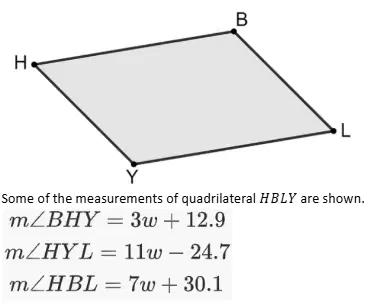
Quadrilateral HBLY is shown.
Some of the measurements of quadrilateral HBLY are shown.
Determine the value of x that will show that quadrilateral HBLY is a parallelogram.
(a)
Four quadrilaterals are described.
Quadrilateral K has four congruent sides and diagonals that are not congruent.
Quadrilateral M has exactly one pair of parallel sides that are not congruent. The other pair of sides are congruent.
Quadrilateral T has four congruent sides and four right angles.
Quadrilateral W has two pairs of parallel sides.
Quadrilateral T is a square
Quadrilateral K is a rhombus
Quadrilateral M is a rhombus
Quadrilateral W is a trapezoid
Quadrilateral W is a parallelogram

Quadrilateral TN l l XR is shown where L is the midpoint of TR, and F is the midpoint of NX.
Determine the value of x.
(a)
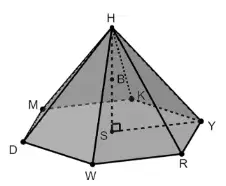
A prism is shown. The base of the prism is a regular hexagon MKYRWD. The altitude of the prism is HS
What is the cross section when a plane that is parallel to the base passes through point B?
Hexagon
Rectangle
Right Triangle
Isosceles Triangle

White Squirrels are found in Brevard, North Carolina. These squirrels are a color variant of the Eastern Gray Squirrel. The White Squirrel Institute in Brevard monitors the population of white squirrels within the town of Brevard. To count the number of squirrels the town is divided into sectors. Sector 13 is in the shape of a trapezoid as shown.
Some of the information about sector 13 is shown.
Researchers approximate that 40 white squirrels live in sector 13.
What is the population density in terms of squirrels per square mile?
14197641
4769510
7475320
196105
A spherical bird feeder is made of mesh wire which provides the perfect feeding area for a variety of clinging birds. The diameter of the bird feeder is 5.7 inches (in).
What is the volume of the bird feeder? Round to the nearest thousandth of a cubic inch.
(a)
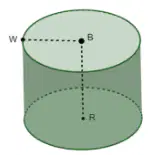
A cylinder is shown where WB=42 millimeters (mm) and BR=65.6 mm.
What is the surface area, rounded to the nearest thousandth, of the cylinder?
22,853.202 square millimeters
28,394.971 square millimeters
39,478.51 square millimeters
363,540.075 square millimeters

Triangle HKB with ray BN is shown.
Some of the angle measurements are shown.
Determine the value of k.
(a)

The Toblerone chocolate bar is known for its distinctive triangular prism shape. It is believed that the two Swiss man who created the unique chocolate bar used the Swiss mountain, The Matterhorn, for inspiration.
Toblerone sells a giant version of the candy bar which is represented by the triangular prism shown, with dimensions in inches (in).
WC=31.38 in.
CL=5.75 in.
RD=5.12 in.
The volume of the giant Toblerone bar is approximately (a) cubic inches. Round your answer to the nearest thousandth.

Circle H is shown where points N, R, T, and W are on the circle. Some of the measurements are shown.
Determine the value of x.
(a)

Circle R is shown where points P, H, M, and Y are on the circle. Rays KM and KP are tangent to circle R and intersect outside the circle at point K.
Some of the measurements of circle R are shown.
Determine the measure, in degrees, of ∠PKM?
(a)
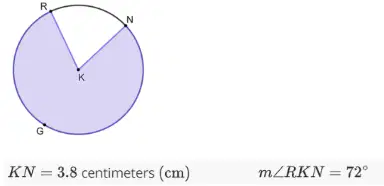
Circle K is shown where points G, R, and N are on the circle.
Some of the measurements of circle K are shown.
What is the area, in square centimeters, of the purple sector RGN? Round the answer to the nearest thousandth.
9.073
36.292
45.365
3266.251

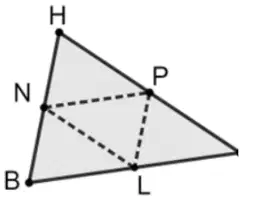
Triangle HRB is shown.
Which diagram shows a step in the construction of the inscribed circle of
HRB?



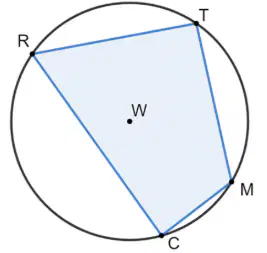
Quadrilateral RTMC is shown inscribed in Circle W where m∠TRC = 65°.
Find the m∠CMT .
(a)

