
 Worksheets
AP AAS 4.1-4.5
Total questions: 99
Worksheet time: 57mins
Based on the quote above, Cesare means “Negritude” as:
A movement celebrating Black culture and identity
A political party in France
A type of French literature
A scientific theory
What does Cesare mean when he says “Africa lives within me”? What does this quote reflect about his ideas about Black identity and cultural heritage?
It shows he rejects his African roots.
It reflects a deep connection to African heritage and Black identity.
It means he wants to forget his past.
It suggests he is indifferent to his culture.
Cesaire’s message could apply to contemporary discussions on racial and cultural identity in which of the following ways?
By encouraging the rejection of colonial influences and embracing cultural heritage.
By promoting the erasure of all cultural differences.
By discouraging any discussion of racial identity.
By supporting cultural assimilation into dominant groups.
The context of and connections between Negritude and Negrismo movements in the first half of the 20th Century can best be described as:
Both movements emerged as responses to colonialism and sought to affirm Black identity and culture.
Negritude focused on European art, while Negrismo rejected all forms of cultural expression.
Negrismo was a political movement, while Negritude was purely literary.
Both movements originated in Asia and promoted economic independence.
Proponents of Negritude and Negrismo critique colonialism because:
They support European domination.
They believe colonialism suppresses African and Caribbean identity.
They want to promote colonial languages.
They reject all forms of cultural expression.
What is Negritude? Fill in the blank: Negritude is a literary and cultural movement developed by Black intellectuals, poets and politicians in the Francophone world that both celebrated African Heritage and _________
resisted colonial oppression
promoted European traditions
ignored African identity
supported colonial rule
What is Negrismo? Fill in the blank: Negrismo is a literary and artistic movement in Latin America and the Caribbean that embraced African cultural influences often focusing on ________, music and followers.
rhythm
painting
architecture
science
Which of the following statements is true about the emergence of the Negritude and Negrismo movements?
They rejected African heritage and cultural aesthetics.
They affirmed the influence of African heritage and cultural aesthetics on many Afro-descendants throughout the African diaspora.
They were not influenced by any other movements.
They only focused on political liberation.
Which of the following best describes a similarity and a difference between the Negritude and Negrismo movements in their vision of Blackness or relationships to Africa?
Both movements celebrated Black culture, but Negritude emphasized a direct connection to Africa while Negrismo focused more on Caribbean identity.
Both movements rejected African heritage, but Negritude was more political than Negrismo.
Negritude and Negrismo were identical in their views on Blackness and Africa.
Negrismo emphasized African roots more than Negritude did.
Both Negritude and Negrismo challenged the idea that European culture was superior and sought to affirm the value of which identities?
Only European identities
Both African and Afro-Caribbean identities
Only African identities
Only Afro-Caribbean identities
Proponents of Negritude and Negrismo argued that racial ideologies underpinned colonial exploitation, violent intervention, and systems of _________?
coerced labor
free trade
democratic governance
technological innovation
Both Negritude and Negrismo argued that Colonizers imposed Eurocentric histories and actively ignored or distorted which cultural contributions?
Asian and European
African and Afro-Caribbean
Native American and European
African and Asian
Negrismo writers highlighted how African heritage shaped Caribbean identity despite colonial attempts to erase or minimize it.
True
False
According to the passage, colonial economies depended on the exploitation of Black labor in which sectors?
While Negrismo and Negritude were often more focused on cultural expression, they both laid the foundation for later political activism against racial and colonial oppression.
True
False
1) Dr. King argues that Ghana’s independence was symbolically significant for other freedom movements (like the Civil Rights Movement) because:
It showed that colonial rule could be peacefully overthrown and inspired hope for oppressed people everywhere.
It was the first time a European country gained independence from Africa.
It led directly to the end of segregation in the United States.
It was the only independence movement in the 20th century.
The anti-colonial struggles in Africa and the fight for Civil Rights in the US both demonstrate the importance of global solidarity, as highlighted by King’s quote. What connection is emphasized between these movements?
They were isolated events with no influence on each other.
Both movements sought justice and equality, inspiring each other through shared struggles.
The Civil Rights movement opposed global solidarity.
African anti-colonial struggles were unrelated to civil rights.
3) “Injustice anywhere is a threat to justice everywhere”: Is this perspective still valid for today’s social movements?
Yes, because injustice in one place can affect justice everywhere.
No, because social movements are now isolated.
No, because justice is only local.
Yes, but only for historical movements.
Describe the Black Freedom Movement in the 20th century.
A movement for civil rights and equality for African Americans.
A movement for women's suffrage.
A movement for environmental protection.
A movement for economic reform.
Examples of diasporic solidarity that emerged across the African diaspora in the 20th century include:
The Harlem Renaissance and Pan-African Congresses
The Industrial Revolution in Europe
The signing of the Magna Carta
The Meiji Restoration in Japan
Diasporic solidarity between African Americans and Africans impacted Black politics in the 20th century and beyond by:
Fostering transnational activism and strengthening global Black political movements
Limiting political engagement to local communities only
Discouraging collaboration between different Black communities
Reducing the influence of Black leaders on the world stage
The phrase 'Year of return' is significant because it marks:
A celebration of Ghana's independence.
A commemoration of the 400th anniversary of the first enslaved Africans arriving in America.
A festival of African music and dance.
A political movement for African unity.
Lakeisha Ford describes her identity as a Black woman in Ghana compared to her experience in the United States as:
More accepted and less defined by race in Ghana
More isolated in Ghana
The same in both countries
Less significant in Ghana
Explain how Angela feels in terms of her racial and cultural identity after her trip to Ghana.
She feels more connected to her roots and proud of her heritage.
She feels confused and disconnected from her identity.
She feels unchanged and indifferent about her identity.
She feels ashamed of her cultural background.
Compare and contrast the perceptions of safety between Ghana and Chicago as portrayed in the video.
Ghana is perceived as safer than Chicago.
Chicago is perceived as safer than Ghana.
Both are perceived as equally safe.
Neither is perceived as safe.
The video and the experiences of these women convey what message to other Black individuals about the African diaspora (and specifically about visiting Africa)?
That visiting Africa can be a powerful and affirming experience for Black individuals.
That the African diaspora is disconnected from Africa.
That visiting Africa is not important for Black individuals.
That the experiences of these women are not relevant to others.
What period does the Black Freedom Movement encompass?
1920s to 1940s
Mid-1940s to the 1970s
1980s to 2000s
1900s to 1920s
Which two movements marked the Black Freedom Movement?
Civil Rights Movement and Black Power Movement
Women's Rights Movement and Labor Movement
Anti-War Movement and Environmental Movement
Suffrage Movement and Temperance Movement
Fill in the blank: The Civil Rights Movement worked to dismantle ______ laws and practices through the 1950s and 60s.
Jim Crow
Monroe Doctrine
Emancipation Proclamation
New Deal
The Black Power Movement heightened Black consciousness and racial pride in the U.S. and abroad in which decades?
1960s and 70s
1920s and 30s
1980s and 90s
2000s and 2010s
Who were two leaders that inspired anti-colonial struggles in Africa and the Caribbean, as mentioned in the Black Freedom Movement?
Martin Luther King Jr. and Rosa Parks
Kwame Nkrumah (Ghana) and Frantz Fanon (Algeria)
Malcolm X and Harriet Tubman
Nelson Mandela and Frederick Douglass
The fight against apartheid in South Africa mirrored civil rights struggles with leaders like ______ advocating for racial justice.
Nelson Mandela
Mahatma Gandhi
Martin Luther King Jr.
Winston Churchill
The Black Freedom Movement was connected to global anti-colonial struggles because:
It was inspired by and supported other movements against colonialism worldwide.
It focused only on local issues in the United States.
It opposed all forms of international cooperation.
It was unrelated to any global events.
In the 1950’s and 1960’s, African American writers, leaders, and activists visited Africa to express diasporic solidarity and support for Africa’s decolonization.
True
False
Which country’s independence from British colonial rule in 1957 inspired visits from African American activists such as Martin Luther King Jr., Malcolm X, Maya Angelou, lawyer Pauli Murray, and W.E.B. DuBois?
Nigeria
Republic of Ghana
Kenya
South Africa
Who traveled with a predominately African American delegation to Cuba in 1960 as a tourist destination for African Americans to escape the prevalence of Jim Crow discrimination and segregation?
Martin Luther King Jr.
Joe Louis
Malcolm X
W.E.B. DuBois
Some embraced pan-Africanism and advocated for the political and cultural unity of all people of African descent.
True
False
Fill in the blank: The Republic of Ghana’s independence from _______ colonial rule in 1957 inspired visits from African American activists.
British
French
Portuguese
Dutch
As African Americans and Africans acknowledged their struggles against anti-Black racism and oppression, what did diasporic solidarity between them bolster?
The end of apartheid in South Africa
The global reach of the Black Freedom movement
The election of African leaders
The fall of the US Black Power movement
African Americans played a critical role in the global fight against apartheid in which country?
South Africa
Brazil
India
Australia
Diasporic Solidarity and Black Politics in the 20th Century: Who was an activist mentioned as pressuring the US to impose sanctions on South Africa?
Stokely Carmichael
Randall Robinson
Kwame Nkrumah
Sekou Toure
The Comprehensive Anti-Apartheid Act of 1986 was vetoed by which US president?
Reagan
Carter
Bush
Clinton
Diasporic Solidarity and Black Politics in the 20th Century: Stokely Carmichael, also known as ________, was a leader in the US Black Power movement who moved to Guinea in 1969.
Kwame Ture
Marcus Garvey
Malcolm X
Huey P. Newton
Diasporic Solidarity and Black Politics in the 20th Century: Which leaders worked closely with Stokely Carmichael (Kwame Ture) to promote Pan-Africanism?
A) Nelson Mandela and Desmond Tutu
B) Kwame Nkrumah and Sekou Toure
C) Martin Luther King Jr. and Malcolm X
D) Julius Nyerere and Patrice Lumumba
The significance of the student protests in Soweto on June 16, 1976 was:
They marked the beginning of the end of apartheid in South Africa.
They were a celebration of South African independence.
They were protests against British colonial rule.
They led to the immediate abolition of apartheid laws.
The apartheid policy impacted the daily lives of Black South Africans by:
Providing equal opportunities for all races.
Segregating public facilities and restricting movement.
Allowing free and fair elections for everyone.
Promoting racial harmony and integration.
Discuss the role of international pressure in the fight against Apartheid, particularly after the Soweto Massacre.
International pressure increased significantly after the Soweto Massacre, leading to sanctions and global condemnation of Apartheid.
International pressure decreased after the Soweto Massacre, with most countries supporting Apartheid.
There was no change in international pressure after the Soweto Massacre.
International pressure focused only on economic aid to South Africa after the Soweto Massacre.
The decision to end Apartheid in 1990 was influenced by:
International pressure and internal resistance
Economic prosperity and political stability
Expansion of Apartheid policies
Lack of opposition to Apartheid
Reflect on the long-term effects of Apartheid on South African society today.
Apartheid has had no lasting impact on South African society.
Apartheid has led to ongoing social and economic inequalities in South Africa.
Apartheid resulted in immediate equality for all South Africans.
Apartheid only affected South Africa's international relations.
Which of the following best describes a similarity between the experiences of Black South Africans and Black Americans?
Both faced institutionalized racial segregation and discrimination.
Both achieved equality without any resistance.
Both were never subjected to any form of segregation.
Both had identical political systems.
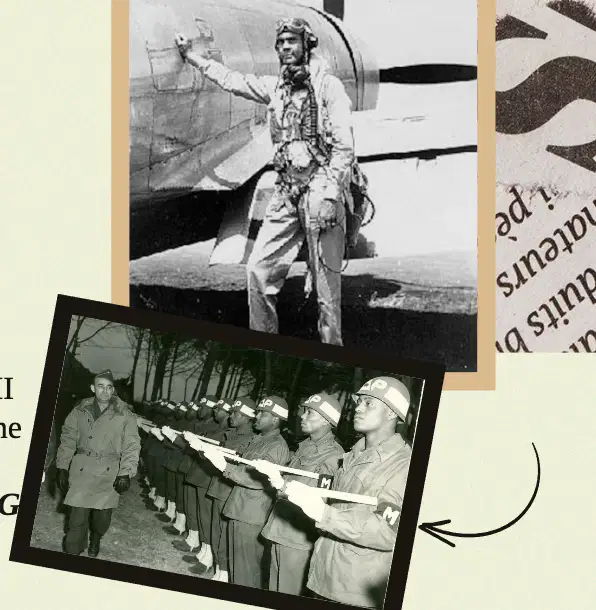
African Americans’ involvement in WWII included:
Serving in segregated military units and contributing to the war effort both at home and abroad.
Remaining uninvolved in the war effort.
Only working in factories, not serving in the military.
Leading the Allied forces in Europe.
The Double V Campaign emerged during the Second World War as a movement that:
Sought victory against fascism abroad and racial discrimination at home
Promoted women’s suffrage in the United States
Encouraged economic reforms in Europe
Advocated for the end of the Vietnam War
African Americans’ access to the benefits of the G.I Bill after WWII was:
Equal to that of white veterans
Limited due to discrimination and segregation
Unrestricted and fully supported by the government
Better than that of white veterans
African Americans played a crucial role in World War II, contributing both on the battlefield and on the home front. How many African Americans registered for the draft or voluntarily enlisted and served in every single branch of the US Military?
Over 500,000
Over 1 Million
Over 2 Million
Over 3 Million
Who were the Tuskegee Airmen?
An all-black tank battalion
An all-black fighter pilot group trained at the Tuskegee Institute in Alabama
A group of mess attendants in the Navy
A group of infantry soldiers
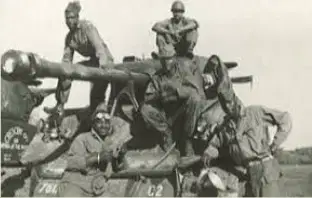
The 761st Tank Battalion, also known as the 'Black Panthers,' fought in key battles during WWII. What honor did their combat effectiveness earn them?
Medal of Honor
Purple Heart
Presidential Unit Citation
Silver Star
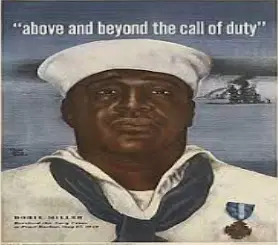
Dorie Miller was awarded a Navy Cross for his heroism during which event?
Battle of the Bulge
Attack on Pearl Harbor
D-Day
Battle of Midway
Fill in the blank: The Tuskegee Airmen flew over ______ sorties in Europe, protecting bombers and challenging racist beliefs about Black military capability.
15,000
5,000
50,000
1,500
What was the main contradiction that led to the emergence of the Double V Campaign during WWII?
Who inspired the 'Double Victory' campaign with a letter to the Pittsburgh Courier in 1942?
A. Philip Randolph
B. James G. Thompson
C. Franklin D. Roosevelt
D. Martin Luther King Jr.
The Double Victory stood for 'Victory Abroad' against fascism and 'Victory at Home' against _______.
racism
communism
poverty
inflation
Which civil rights activist threatened a March on Washington in 1941 to protest racial discrimination in war industries and the military?
James G. Thompson
A. Philip Randolph
Franklin D. Roosevelt
Rosa Parks
President Franklin D. Roosevelt issued Executive Order 8802 to ban discrimination in which area?
Public schools
Defense jobs
Voting rights
Public transportation
The Double V Campaign symbolized African Americans’ determination to claim full citizenship and equality.
True
False
What was the primary purpose of the GI Bill of 1944?
To provide healthcare to veterans
To provide funds for college tuition, low cost home mortgages, and low-interest business start-up loans to American veterans returning from WWII
To create new military jobs
To end segregation in schools
The GI Bill of 1944 was designed as a race-neutral gesture of gratitude toward American Veterans returning from WWII, including 1.2 million Black veterans.
True
False
Although the GI Bill was a federal program, Black veterans often did not receive the same benefits as white veterans because:
they were not eligible for the program.
local and state officials discriminated against them.
they did not serve in the military.
the program ended before they could apply.
Fill in the blank: Many Black Colleges and Universities (HBCUs) were ________ and could not accommodate the influx of Black veterans.
underfunded
overcrowded
well-funded
segregated
Which of the following was NOT a challenge faced by Black veterans under the GI Bill?
Redlining and segregationist housing policies
Easy access to home loans
Denial of admission to predominantly white institutions
Exclusion from job training programs
The Federal Housing Administration (FHA) frequently denied loans to Black applicants and restricted them to purchasing in segregated neighborhoods.
True
False
Fill in the blank: Many job training programs funded by the GI Bill excluded African Americans or steered them into ________ jobs.
low-wage, low-skill
high-paying, executive
technical, specialized
creative, artistic
Enduring forms of segregation and discrimination in daily life that African Americans faced in the first half of the 20th Century included:
Equal access to public facilities
Segregated schools and public spaces
Unrestricted voting rights
Full economic opportunities
The rationale for the Brown v Board of Education decision to overturn 'separate but equal' was:
It was determined that separate educational facilities are inherently unequal.
It was believed that segregation improved educational outcomes.
It was decided that states could choose their own policies on segregation.
It was found that 'separate but equal' was never implemented.
Different groups responded to school integration as a result of the Brown v. Board of Education Decision in which of the following ways?
All groups immediately supported integration without resistance.
Some groups supported integration, while others resisted it, sometimes with protests or legal challenges.
No groups responded to the decision.
All groups ignored the decision and continued as before.
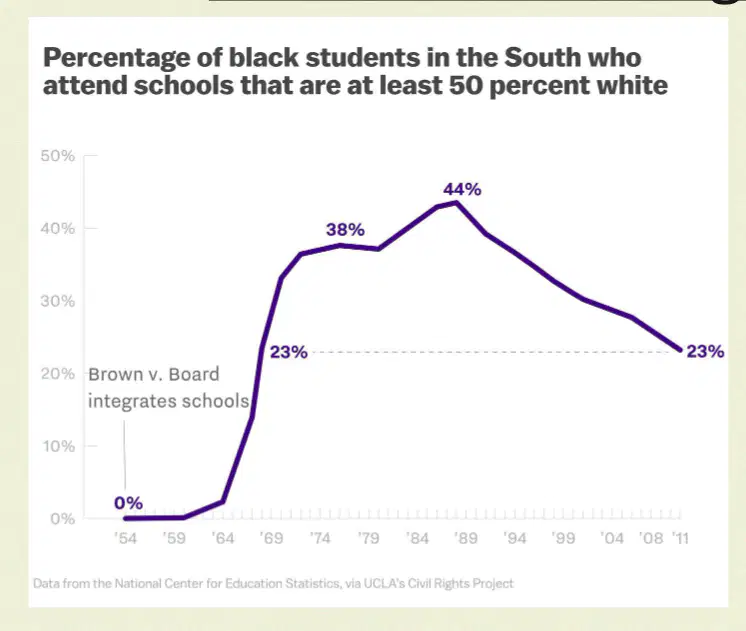
Summarize what the chart is trying to say.
The chart shows a trend or pattern.
The chart lists random data points.
The chart is unrelated to any topic.
The chart is a blank image.
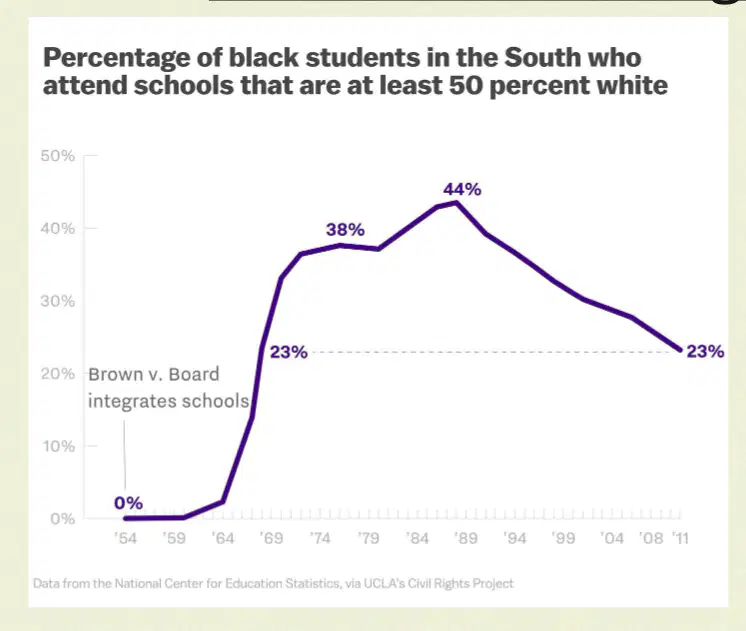
Analyze the historical context at three different points in the graph (1954, 1984, 2011). Why is it that the graph looks the way it does at each of these intervals?
Because of significant historical events affecting the data at each interval.
Because the graph was randomly generated.
Because the intervals were chosen arbitrarily.
Because the data was not collected during those years.
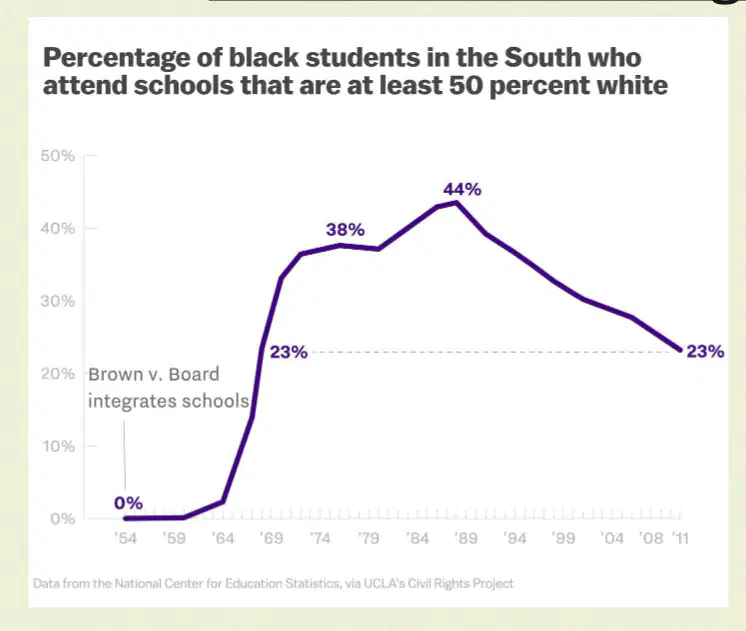
Interpret: What does this graph tell us about racial segregation and education in the United States? Is there anything that can be done to change the current (2011) data? Explain your answer.
The graph shows that racial segregation in education remains significant in the United States as of 2011, and policy changes or increased funding for diverse schools could help address this issue.
The graph shows that racial segregation in education has been completely eliminated in the United States as of 2011, and no further action is needed.
The graph shows that racial segregation in education is only a minor issue in the United States as of 2011, and little can be done to change it.
The graph shows that racial segregation in education is unrelated to policy or funding, and nothing can be done to change the current data.
What were African Americans legally required to use under Jim Crow Laws in the first half of the 20th century?
The same facilities as white Americans
Separate and inferior facilities including schools, restrooms, water fountains, restaurants, hotels, and transportation
Only private facilities
No public facilities
Fill in the blank: Signs reading "________ Only" and "Colored" reinforced racial hierarchy during the era of legalized segregation.
Whites
Men
Children
Employees
Which of the following best describes redlining?
Allowing all families equal access to home loans
Denying home loans to Black families or restricting them to high-risk, segregated areas
Providing extra resources to Black neighborhoods
Integrating schools and neighborhoods
Black children attended well-funded schools with the same resources as white students during the era of legalized segregation.
True
False
What was the impact of housing discrimination and redlining on African American families in the 20th century?
It led to increased wealth and homeownership for African American families.
It resulted in limited access to quality housing and generational wealth for African American families.
It had no significant effect on African American families.
It improved educational opportunities for African American families.
Outline the different racial segregation problem in schools in 2016 according to John Oliver.
There was a resurgence of racial segregation in schools in 2016, as highlighted by John Oliver.
Schools were completely integrated in 2016, according to John Oliver.
John Oliver stated that racial segregation was not an issue in 2016.
John Oliver focused only on economic segregation in schools in 2016.
The region(s) in the United States with the most segregated schools are:
Northeast
Midwest
South
West
Brown v Board of Education affected Northern Cities differently than Southern Cities. How did the impact in Northern Cities compare to that in Southern Cities?
Northern cities immediately desegregated schools, while Southern cities resisted.
Both Northern and Southern cities resisted desegregation equally.
Northern cities faced de facto segregation, while Southern cities had de jure segregation.
Northern cities were unaffected by the ruling.
One argument in the video AGAINST racial diversity in schools is:
It can lead to social tension and discomfort among students.
It improves academic performance for all students.
It encourages cultural understanding.
It increases access to resources.
What happened in St Louis when the Riverview School District attempted to send students into St. Charles county schools, and what does this say about education equality in our own town?
The students were welcomed and integrated, showing strong education equality.
The students were denied entry, highlighting ongoing issues with education equality.
The students were given scholarships to attend private schools, showing support for education equality.
The students were sent to schools in another state, indicating a lack of local education equality.
Do you agree with the arguments made in this video? Are these things you have seen/experienced in real life? Describe your own experiences with educational inequality.
Yes, I agree and have experienced educational inequality.
Yes, I agree but have not experienced educational inequality.
No, I do not agree but have seen educational inequality.
No, I do not agree and have not seen educational inequality.
What year did the Brown vs Board of Education decision take place?
1896
1954
1964
1974
Which earlier Supreme Court case did Brown vs Board of Education overturn?
Roe v. Wade
Plessy v. Ferguson
Marbury v. Madison
Miranda v. Arizona
Who was the Chief Justice that led the Supreme Court in the Brown vs Board of Education decision?
John Marshall
Earl Warren
Thurgood Marshall
Warren Burger
The Supreme Court ruled that racial segregation in schools was unconstitutional because it violated the ________ Clause of the 14th Amendment.
Equal Protection
Due Process
Commerce
Establishment
The Doll Test, which showed that segregation harmed Black children's self-esteem and development, was conducted by which psychologists?
Sigmund Freud and Carl Jung
Kenneth and Mamie Clark
B.F. Skinner and John Watson
Jean Piaget and Lev Vygotsky
The Supreme Court recognized that separate educational facilities created a sense of inferiority that negatively impacted Black students' ability to learn and succeed.
True
False
The court stated that 'separate educational facilities are inherently ________', rejecting the premise that segregation could ever provide true equality.
unequal
equal
fair
acceptable
According to the Brown vs Board of Education rationale, how did the Court view America in 1954 compared to 1896 when Plessy v Ferguson was decided?
The same
Different
More advanced
Less advanced
Why did denying Black children access to integrated schools perpetuate racial inequality and second-class citizenship, according to the Brown vs Board of Education rationale?
What was one major impact of the Brown vs Board of Education decision on public schools?
Segregation of schools
Desegregation of schools
No change
More funding for schools
The Brown vs Board of Education decision served as a catalyst for which major movement?
Women's Rights Movement
Civil Rights Movement
Labor Movement
Environmental Movement

