
 Worksheets
Physical Science and Earth Science
Total questions: 39
Worksheet time: 20mins
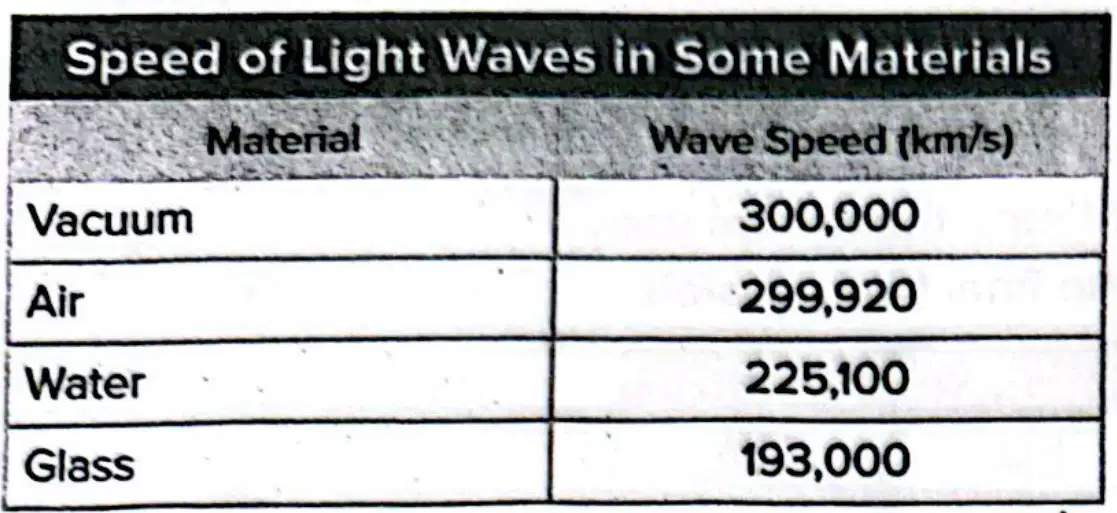
Using the table above, through which material will light waves travel the slowest?
glass
vacuum
air
water
What happens to the energy of a kicked soccer ball as it slows down and stops?
Kinetic energy increases, and potential energy decreases.
Potential energy remains constant.
Kinetic energy remains constant.
Friction transforms kinetic energy into thermal energy.

How is energy being transformed?
Light energy converts to potential energy.
Light energy converts to heat energy.
Chemical energy converts to mechanical energy.
Chemical energy converts to light energy.
What causes volcanoes?
a continental plate releasing energy at a transform boundary
an oceanic plate becoming larger at a divergent boundary
a plate being subducted at a convergent boundary
a plate being pushed up at a convergent boundary
What is the law of superposition?
In undisturbed rock layers, the oldest rock layers are on the top.
In undisturbed rock layers, the oldest rock layers are on the bottom.
In disturbed rock layers, the oldest rock layers are on the bottom.
In undisturbed rock layers, ages cannot be determined.
Which is NOT a process of the rock cycle?
crystallization
uplift
eruption
deposition
What happens to the temperature of a block of ice as it melts?
It goes up.
It goes down.
It remains constant.
It varies depending on conditions.
How are electromagnetic waves, including light waves, classified? SC.7.P.10.1
by their wavelength
by their color
by their sound
by their reflection

In the diagram above, a roller-coaster car starts from rest at point A and moves along the track. At which point does the roller coaster car have the greatest kinetic energy?
A
B
C
D
What term is used to describe melted, flowing rocks in the asthenosphere?
plastic
viscous
folding
pliable

Which diagram below shows a situation that would result in the formation of mountains formed from the collision of two tectonic plates?
A) [Diagram A]
B) [Diagram B]
C) [Diagram C]
D) [Diagram D]
What kind of changes are caused by transform plate boundaries?
earthquakes
volcanic eruptions
plate subduction
mid-ocean ridges
What method do scientists use to more accurately determine the age of fossils?
spectrum analysis
geologic time scale
micro-age dating
absolute-age dating
Which is NOT a likely component of a physics experiment?
developing a mathematical description of the experiment
conducting a public opinion poll on the topic of the experiment
repeating the same procedure a large number of times
speculating about what the outcome of the experiment might be
How can an extinction occur quickly?
Species are hunted to extinction.
A natural disaster wipes out an entire species.
Mountains create a geographic divide separating a species from its resources.
Climate changes eliminate the food sources of a species.
Why is the inner core of Earth a solid?
The pressure on the inner core is so great that even substances at 6,000°C remain solid.
The temperature of the inner core is very cold so it remains a solid.
The pressure of the inner core pushing against the mantle keeps it solid.
The inner core is made of solid metal and is impossible to melt.

The illustration shows simple smog-collecting disks at four different locations. Why did scientists choose four different locations instead of a single location?
They wanted to see which disk collected the most smog.
They wanted to collect smog under many different conditions.
They wanted to get consistent results from each location.
They wanted to prove that the most smog is collected in a city.
What kind of climate clues provide evidence Pangaea once existed?
Glacial grooves exist across multiple continents where they once fit together.
Mountain ranges exist on several continents where they once fit together.
Fossil evidence is similar on continents where they once fit together.
Similar animal species exist on multiple continents where they once fit together.
A geologist is trying to determine the relative age of rock layers in a certain area, but he or she cannot rely only on the law of superposition. Which clue will help the geologist determine whether a rock layer has been overturned?
Igneous rock usually forms below sedimentary rock.
Rock layers erode at an average rate of 1.5 m per year.
The largest sediment particles usually are deposited near the bottom of a rock layer.
Metamorphic rocks are the lightest type of rock, so they are located at the top of a rock layer.
To determine the boiling point of an unknown liquid, a student heats 10 mL of the liquid in a test tube and records the temperature every minute for 20 min. What is time in this example?
control
dependent variable
independent variable
hypothesis
As air in Earth's atmosphere is heated by the Sun, the warmer air expands and becomes less dense than the cooler air. As a result, the warmer air rises and the cooler air sinks. What is the cycle of warm air rising and cool air sinking called?
tidal current
surface current
deep current
convection current
If the mass of two objects increases and the distance between them stays the same, what happens to the gravitational force between the two objects?
It decreases.
It remains the same.
It fluctuates.
It increases.
What does the phenomenon called El Niño cause?
precipitation in South America
cold water upwelling
strong trade winds
cold, rising air masses
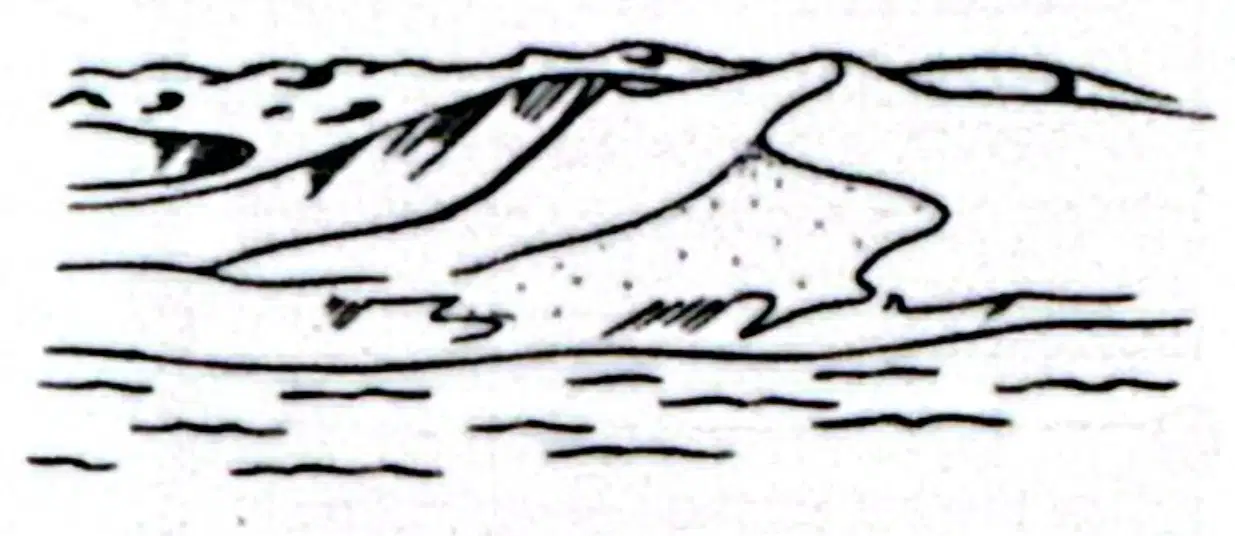
Which is probably most responsible for the formation of this landform?
wind
water
plants
animals
What is the definition of climate?
the short-term average weather conditions that occur in a particular region
the atmospheric conditions and short-term changes of a certain place at a certain time
the atmospheric conditions and long-term changes of a certain place at a certain time
the long-term average weather conditions that occur in a particular region
What kind of water do hurricanes form over?
warm, tropical ocean water
cool, arctic ocean water
warm, tropical lake water
cool, arctic river water
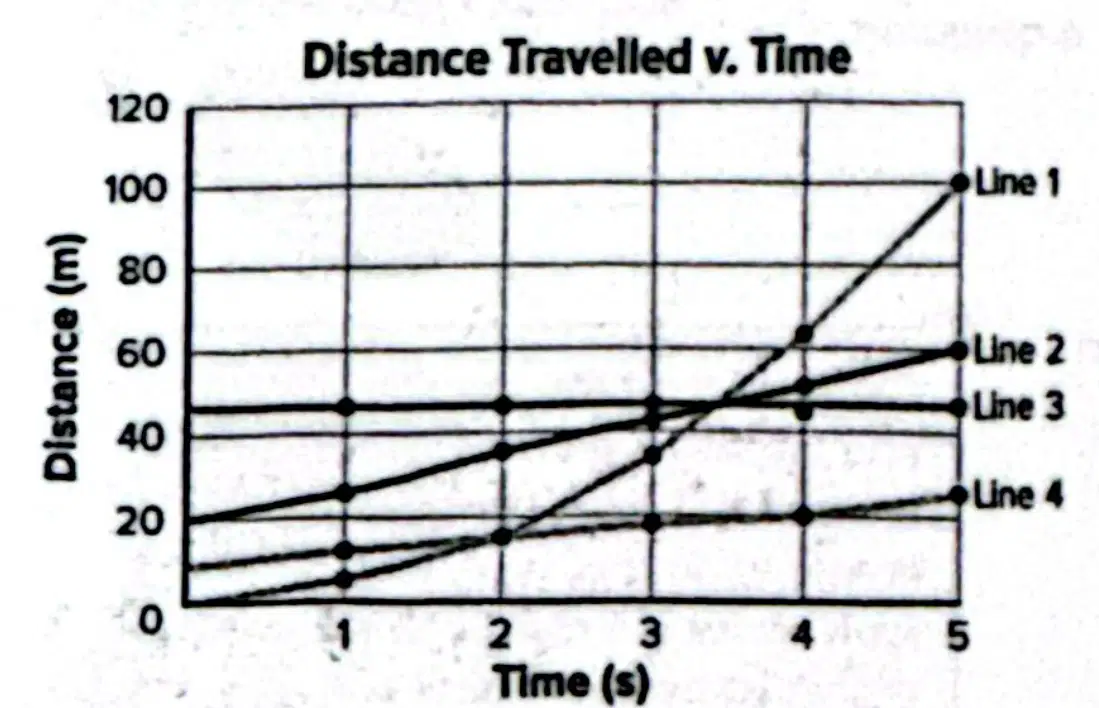
Based on the graph, which describes a linear relationship?
line 1
line 2
line 3
line 4
An object moves at a constant speed. What would the graph of the object's distance versus time look like?
U-shaped
W-shaped
curved line
straight line
Which does not transfer thermal energy from a warmer object to a cooler one?
conduction
convection
insulation
radiation
What forms as a result of water vapor in the air condensing in the atmosphere?
snow
clouds
hurricanes
hail
Which molecules in the atmosphere protect Earth from ultraviolet rays?
ozone (O3)
oxygen (O2)
nitrogen (N2)
carbon dioxide (CO2)
Coastlines are continually eroded by what process?
longshore currents
parallel shore currents
shortshore currents
perpendicular shore currents
Which process is most responsible for the formation of sand dunes?
water erosion
volcanism
wind erosion
glaciation
If you pick up a book from the floor and place it on a shelf, energy is transferred to the book. What kind of energy is stored in the book?
kinetic
potential
chemical
electric

These children are playing tug-of-war, a contest in which each team tugs on a rope to pull the other team across a line. Why does the rope move to the left?
because the net force of the two teams is zero
because the team on the left creates an unbalanced force
because the team on the right does not create enough friction
because the team on the right creates a balanced force
What is the system Carolus Linnaeus created to name living things?
systematics
dichotomous key
binomial nomenclature
trinomial nomenclature

How does the above image help human beings protect themselves from hazardous weather or sun exposure?
It indicates potential severe snow storms.
It indicates potential wind damage from a hurricane.
It indicates potential high temperatures.
It indicates potential severe radiation exposure from the Sun.
What is the best way to demonstrate that the north ends of two magnets repel each other? SC.6.P.13.1
Place the north end of one magnet near the south end of another.
Place the north ends of two magnets near each other.
Place the north end of one magnet near an unmagnetized object.
Place the north ends of each magnet in an electric field.
An automobile is moving forward. If all the forces on the automobile are balanced by equal and opposite forces, what must be true about the motion of the automobile?
The automobile increases speed in the forward direction.
The automobile decreases speed in the forward direction.
The automobile continues to move forward at constant speed.
The automobile slows, then stops.

