
 Worksheets
Flashcard Quiz Part 1
Total questions: 77
Worksheet time: 39mins
Fill in the blank: sin(π/2) = ____
0
1
-1
1/2
Fill in the blank: sin(3π/2) = ___
-1
0
1
√3/2
Fill in the blank: cos(π/2) = ______
0
1
-1
√2/2
Fill in the blank: cos(3π/2) = ______
0
1
-1
√3/2
Fill in the blank: tan θ (in terms of sine and/or cosine) = ______
cos θ / sin θ
sin θ / cos θ
1 / (sin θ × cos θ)
sin θ × cos θ
Fill in the blank: sec θ (in terms of sine and/or cosine) = ______
1 / cos θ
cos θ / sin θ
sin θ
1 / sin θ

Which function is pictured in the graph?
Graph of y = cos x
Graph of y = sin x
Graph of y = sec x
Graph of y = tan x

Which function is pictured in the graph?
Graph of y = cos x
Graph of y = tan x
Graph of y = sec x
Graph of y = sin x

Which function is pictured in the graph?
Graph of y = tan x
Graph of y = sec x
Graph of y = cos x
Graph of y = sin x

Pick the equation graphed.
Graph of y = ln(x)
Graph of y = |x|
Graph of y = x1
Graph of y = sqrt(x)
Graph of y = 1−x2

Pick the equation graphed.
Graph of y = ln(x)
Graph of y = |x|
Graph of y = x
Graph of y = x1
Graph of y = 1−x2
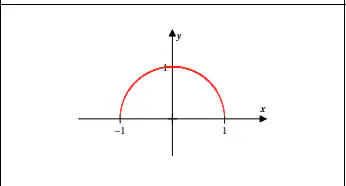
Pick the equation graphed.
Graph of y = |x|
Graph of y = x1
Graph of y = 1−x2
Graph of y = ln(x)
Graph of y = x

Pick the equation graphed.
Graph of y = |x|
Graph of y = ln(x)
Graph of y = x
Graph of y = ex
Graph of y = 1−x2

Pick the equation graphed.
Graph of y = |x|
Graph of y = ex
Graph of y = x
Graph of y = ln(x)
Graph of y = 1−x2
An even function is symmetric with respect to the ____
y-axis
x-axis
z-axis
origin
An odd function is symmetric with respect to the ____
y-axis
x-axis
z-axis
origin
Fill in the blank: The formula for the circumference of a circle is C = ____.
2πr
πr²
πd
r²
Fill in the blank: The formula for the volume of a cylinder is _______.
V = 2πrh
V = 4/3πr3
V=πr2h
V = πr2/3
Fill in the blank: The formula for the volume of a cone is _______.
V = (1/3)πr2h
V=πr2h
V = (4/3)πr3
V = (1/2)πr2h
Fill in the blank: The formula for the volume of a sphere is _______.
V = (1/3)πr2h
V = (4/3)πr3
V=πr2h
V=2πr2
Fill in the blank: The formula for the surface area of a sphere is _______.
A=4πr2
2πr2
A=4πr3
A = πr2
Fill in the blank: The point-slope form of a linear equation is _______.
y = mx + b
y - y₁ = m(x - x₁)
x - x₁ = m(y - y₁)
y = m(x + x₁)

0
1
DNE
∞
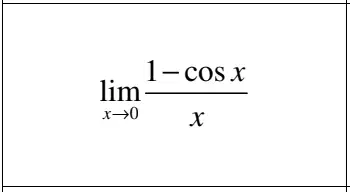
0
1
DNE
∞
The line through a point on a curve with slope equal to the slope of the curve at that point.
Normal Line
Tangent Line
Secant Line
The line connecting two point on a curve.
Tangent Line
Secant Line
Normal Line
The line perpendicular to the tangent line at the point of tangency.
Tangent Line
Secant Line
Normal Line
f(x) is continuous at x = c when
II. x→climf(x) exists
I. f(c) exists
III. x→climf(x)=f(c)
I. and II.
II. and III.
All the above
Fill in the blank: The limit definition of the derivative of f(x) is f'(x) = _________.
lim_{Δx→0} (f(x+Δx) - f(x)) / Δx
lim_{Δx→∞} (f(x+Δx) - f(x)) / Δx
lim_{Δx→0} (f(x) - f(x+Δx)) / Δx
lim_{Δx→0} (f(x+Δx) + f(x)) / Δx
Fill in the blank: The alternate definition of the derivative of f at x = c is f'(c) = _________.
lim_{x→c} (f(x) - f(c)) / (x - c)
lim_{h→0} (f(x+h) - f(x)) / h
lim_{x→0} (f(x) - f(0)) / (x - 0)
lim_{x→c} (f(c) - f(x)) / (c - x)
What does f'(x) tell you about a function?
slope of tangent line
instantaneous rate of change
slope of curve at a point
All the above
Fill in the blank: The definition of average rate of change is _________.
Δy/Δx = (f(b) - f(a)) / (b - a)
Δx/Δy = (f(a) - f(b)) / (a - b)
Δy/Δx = (f(a) + f(b)) / (b - a)
Δy/Δx = (f(b) + f(a)) / (b + a)
Power rule for derivatives: dxd(xn)= _______
nxn−1
nxn
xn−1
nxn+1
Product rule for derivatives: dxd(f(x)g(x))= _______
f(x)g(x)
f'(x)g(x) + g'(x)f(x)
f(x)g'(x) - f'(x)g(x)
f'(x)g'(x)
Quotient rule for derivatives: dxd(g(x)f(x))= _______
(g(x))2f(x)g′(x)−g(x)f′(x)
(g(x))2g(x)f′(x)−f(x)g′(x)
g(x)f′(x)g′(x)
g′(x)f′(x)
Chain rule for derivatives: dxd(f(g(x)))= _______
f′(g(x))⋅g(x)
f′(g(x))⋅g′(x)
f(g(x))⋅g′(x)
f′(x)⋅g′(x)
Fill in the blank: The derivative of cos(x) with respect to x is _______.
-sin(x)
sin(x)
cos(x)
-cos(x)
Fill in the blank: The derivative of sin(x) with respect to x is _______.
-sin(x)
sin(x)
cos(x)
-cos(x)
Fill in the blank: The derivative of tan(x) with respect to x is _______.
sec2(x)
sin(x)
tan(x)
cos2(x)
Fill in the blank: The derivative of cot(x) with respect to x is _______.
sec2(x)
−csc2(x)
tan(x)
csc2(x)
Fill in the blank: The derivative of sec(x) with respect to x is _______.
sec(x) tan(x)
sec(x) cot(x)
sec(x) sin(x)
sec(x) + tan(x)
Fill in the blank: The derivative of csc(x) with respect to x is _______.
-csc(x) cot(x)
csc(x) tan(x)
sec(x) cot(x)
-sec(x) tan(x)
Fill in the blank: The derivative of arcsin(x) with respect to x is _____.
1+x21
1−x21
arcsin(x)∗sqrt(1−x2)
x/1−x2
Fill in the blank: The derivative of arccos(x) with respect to x is _____.
1−x21
−1/1−x2
1+x21
−1/(1+x2)
Fill in the blank: The derivative of arctan(x) with respect to x is _____.
1−x21
1+x21
arctan(x)
2x/(1+x2)
Fill in the blank: The derivative of arccot(x) with respect to x is _____.
1+x21
−1+x21
2x/(1+x2)
arctan(x)
Fill in the blank: The derivative of arcsec(x) with respect to x is _____
x2−1x
x2+11
(∣x∣x2−1)1
1−x21
The derivative of arccsc(x) with respect to x is
−∣x∣x2−11
∣x∣x2−11
−xx2+11
xx2−11
Fill in the blank: Derivative of natural log: dxd(lnx)=
x1
x
\ln x
ex
Fill in the blank: Derivative of log base a : dxd(logax)=
xa1
xlna1
lna⋅x
xa
Fill in the blank: Derivative of natural exponential function: dxd(ex)=
xex
ex
xe
ex+1
Fill in the blank: Derivative of exponential function of any base: dxd(ax)=
axlnx
axlna
xalna
ax
Derivative of an inverse function: What is dxd(f−1(x))= ?
f′(f−1(x))1
\( f'(x) \)
f−1(x)
f′(x)1
Rolle’s Theorem: If f is continuous on [a, b], differentiable on (a, b), and…
…f(a) = f(b), then there exists c ∈ (a, b) such that f'(c) = 0.
…f(a) ≠ f(b), then there exists c ∈ (a, b) such that f'(c) = 0.
…f(a) = f(b), then there exists c ∈ (a, b) such that f'(c) ≠ 0.
…f(a) = f(b), then there exists c ∈ (a, b) such that f(c) = 0.
Mean Value Theorem for Derivatives: If f is continuous on [a, b] and differentiable on (a, b), then… (complete the statement)
Extreme Value Theorem: If f is continuous on a closed interval, then… (complete the statement)
…f must have both an absolute maximum and an absolute minimum on the interval.
…f must be differentiable everywhere on the interval.
…f must be increasing on the interval.
…f must have a local maximum at the endpoints of the interval.
Intermediate Value Theorem: If f is continuous on [a, b], then… (complete the statement)
…f must be differentiable on [a, b].
…f must have a maximum at either a or b.
…f must take on every y-value between f(a) and f(b).
…f must be constant on [a, b].
If a function is differentiable at a point, then _________.
it must be continuous at that point. (Differentiability implies continuity.)
it must be discontinuous at that point.
it must be non-differentiable at that point.
it must have a jump at that point.
List four ways in which a function can fail to be differentiable at a point.
Oscillation, Periodicity, Symmetry, Translation
Discontinuity, Corner, Cusp, Vertical tangent line
Continuous everywhere, Smooth curve, No inflection, Horizontal tangent
Constant function, Linear function, Quadratic function, Cubic function
A critical number (also known as a critical point or critical value) of f(x) is _________.
a value of x where f(x) is always increasing.
a value of x where f(x) is undefined for all x.
a value of x where f''(x) = 0 always.
a value of x in the domain of f at which either f'(x) = 0 or f'(x) does not exist.
If f'(x) > 0, then _________
f(x) is increasing.
f(x) is decreasing.
f(x) is constant.
f(x) has a maximum.
If f'(x) < 0, then _________.
f(x) is decreasing.
f(x) is increasing.
f(x) is constant.
f(x) has a maximum.
If f'(x) = 0, then _________.
f(x) is always increasing.
f(x) has a vertical tangent.
f(x) has a horizontal tangent.
f(x) is always decreasing.
Definition: f(x) is concave up when _________.
f'(x) is increasing.
f'(x) is constant.
f(x) is decreasing.
f''(x) is negative.
Definition: f(x) is concave down when _________.
f'(x) is decreasing.
f'(x) is constant.
f'(x) is increasing.
f(x) is linear.
f''(x) > 0 means that f(x) is __________.
concave up (like a cup)
concave down (like a frown)
increasing everywhere
decreasing everywhere
f''(x) < 0 means that f(x) is __________.
concave down (like a frown)
concave up (like a cup)
increasing everywhere
a linear function
Definition: A point of inflection is a point on the curve where _________.
concavity changes.
the slope is always zero.
the function is undefined.
the curve has a maximum value.
To find a point of inflection, _________.
look for where f'' changes signs, or, equivalently, where f' changes direction.
look for where f' is zero and f'' is positive.
look for where f is increasing and f' is negative.
look for where f'' is always positive.
To find extreme values of a function, look for where _________.
By the First Derivative Test, when the derivative changes from positive to negative
there is a maximum
there is a minimum
there is a zero
the function is undefined
By the First Derivative Test, when the derivative changes from negative to positive
there is a maximum
there is a minimum
there is a zero
the function is undefined
The Second Derivative Test: If f'(x) = 0 and ________, then f has a maximum; if ________, then f has a minimum.
f''(x) < 0; f''(x) > 0
f''(x) > 0; f''(x) < 0
f''(x) = 0; f''(x) > 0
f''(x) > 0; f''(x) = 0
Position function s(t) = ________, the antiderivative of velocity.
∫v(t)dt
v(t) + C
d/dt v(t)
v(t) - C
Velocity function v(t) = s'(t), the derivative of position, as well as ________, antiderivative of acceleration.
∫a(t)dt
a(t) + C
s(t) - v(t)
d/dt a(t)
Acceleration function a(t) = v'(t), the derivative of velocity, as well as ________, the second derivative of position.
s''(t)
s'(t)
v(t)
a'(t)
A particle is moving to the left when ________.
v(t) < 0
v(t) > 0
a(t) < 0
s(t) > 0

