
 Worksheets
The Reagan Revolution & Reaganomics
Total questions: 17
Worksheet time: 9mins
Name
Class
Date
1.

Why was the election of Ronald Reagan in 1980 a turning point during this period of U.S. history?
a)
It marked a major realignment in political ideology toward conservatism and smaller government
b)
It marked the expansion of New Deal policies
c)
It brought about a stronger federal role in welfare and civil rights enforcement
d)
It signaled the end of Cold War tensions with the USSR
2.
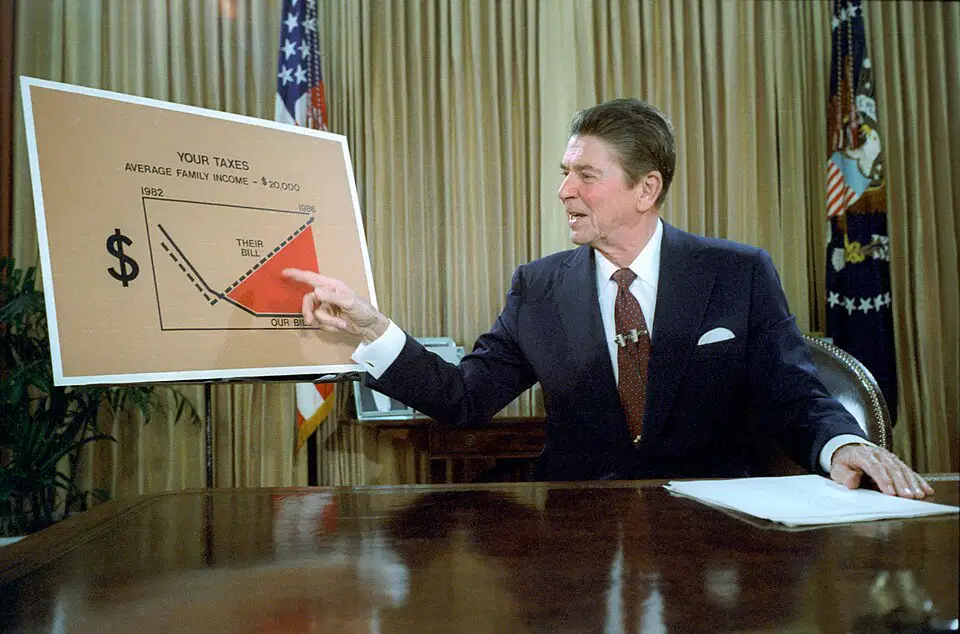
How did Reaganomics reflect the political and economic characteristics of the new conservative era?
a)
It emphasized lower taxes, deregulation, and reduced social spending
b)
It promoted federal jobs programs and higher income taxes on the wealthy
c)
It increased environmental regulations and federal oversight
d)
It expanded the federal welfare system
3.

What social characteristics of Reagan’s conservative coalition contributed to a new political era?
a)
Support from religious conservatives who promoted traditional family values
b)
Urban voters who demanded expanded federal programs
c)
Civil rights activists advocating for expanded affirmative action
d)
Young liberals protesting deregulation policies
4.

Why was Reagan’s presidency a turning point in the ideological balance of the Supreme Court?
a)
He appointed conservative justices who favored law and order over civil liberties
b)
He expanded the Court with liberal justices who defended social welfare rights
c)
He reduced the Court’s influence by limiting judicial review of key cases
d)
He promoted a centrist approach that weakened party divisions on the Court
5.
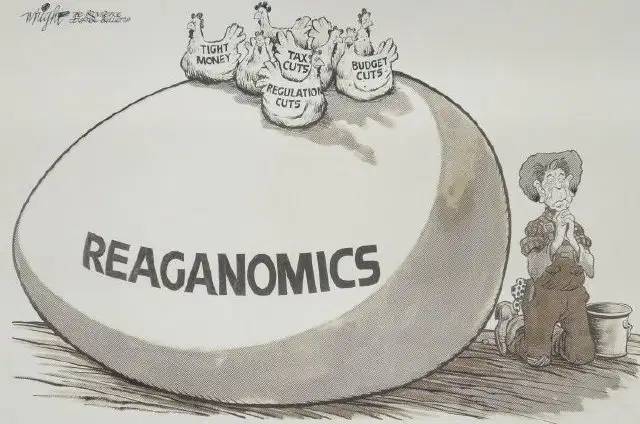
What theme best summarizes the economic philosophy of Reaganomics?
a)
Growth would come through tax cuts, investment, and less government control
b)
Prosperity required strong regulation, union support, and higher minimum wages
c)
Stability depended on balanced budgets, tariffs, and limited international trade
d)
Fairness was based on wealth redistribution and guaranteed social services
6.

What was the result of Reagan’s tax policies
a)
Wealth inequality increased, and national debt rose due to tax and spending changes
b)
Federal deficits fell sharply due to major cuts in military and welfare spending
c)
The middle class expanded rapidly because of aggressive government hiring
d)
Most economic sectors slowed as interest rates and inflation remained high
7.

What label is commonly applied to the coalition that emerged during Reagan’s presidency?
a)
The New Right combined social, economic, and religious conservatives
b)
The Progressive Bloc promoted equality, education, and universal healthcare
c)
The Fair Deal Group focused on labor rights and New Deal-era programs
d)
The National Unity Coalition encouraged bipartisan compromise and reform
8.

What circumstances in the 1970s contributed to Reagan’s election and the shift in political power?
a)
Stagnant wages, inflation, and distrust in federal programs shaped voter concerns
b)
Expanding welfare programs and growing union strength led to national unity
c)
Widespread civil rights gains and education reform improved social stability
d)
Low unemployment and steady economic growth reduced public frustration
9.

How did Reagan’s defense policy reflect the political circumstances of the Cold War era?
a)
He increased military spending to pressure the Soviet Union and project U.S. strength
b)
He reduced the defense budget to allow for domestic economic programs
c)
He encouraged peace by promoting nuclear disarmament agreements early in his term
d)
He relied primarily on the United Nations to resolve military conflicts
10.

What was a consequence of Reagan-era deregulation policies in major U.S. industries?
a)
Environmental and safety rules were loosened to promote competition and investment
b)
Government agencies increased oversight of industries like oil and coal
c)
Consumer protections were expanded through federal regulations
d)
New labor standards were introduced to protect industrial workers
11.
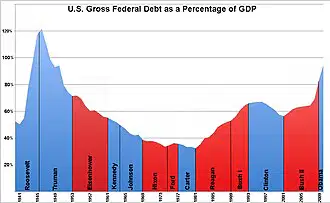
What was one long-term criticism of Reagan’s economic policies?
a)
They increased national debt and widened the gap between rich and poor
b)
They eliminated budget deficits by reducing military spending
c)
They created equal opportunities for all Americans through wealth redistribution
d)
They had minimal impact on U.S. economic growth during the decade
12.

How did Reagan’s public image contribute to his political success during this period?
a)
His optimistic messaging and communication skills earned him broad support
b)
His aggressive debate tactics alienated moderate and independent voters
c)
His complex speeches focused on economic theory and legal language
d)
His focus on technocratic policy details appealed to academic elites
13.

What was the nickname given to Reagan’s economic policy?
a)
Reaganomics
b)
Fair Deal
c)
Great Society
d)
New Federalism
14.

What did Reagan believe was the main problem in America?
a)
The government was too large and involved
b)
The public schools lacked proper funding
c)
The military had become too powerful
d)
The United Nations limited U.S. freedom
15.

Who was the first woman appointed to the U.S. Supreme Court by Reagan?
a)
Sandra Day O’Connor
b)
Ruth Bader Ginsburg
c)
Sonia Sotomayor
d)
Eleanor Roosevelt
16.

What was the name for Reagan’s economic plan used by his opponents?
a)
Trickle-down economics
b)
Supply-side capitalism
c)
Middle-class stimulus
d)
Bottom-up tax policy
17.

What was the main goal of supply-side economics during Reagan’s presidency?
a)
To encourage investment and economic growth through tax cuts
b)
To increase federal revenue by raising corporate taxes
c)
To expand government programs for low-income Americans
d)
To reduce trade with foreign countries through higher tariffs
100 %

