
 Worksheets
REVIEW ASAT
Total questions: 60
Worksheet time: 3595secs
The main function of companies is to give work to the population.
True
False
In the circular flow of income there are two flows: one of money and another of goods and services and factors of production.
True
False
Companies calculate their business profits through the difference between income and expenses.
True
False
The amount of demand that is greater than the supply on the world market will encourage the exporting country...
withhold delivery of goods
lower the price of goods
raise the price of goods
cancel the purchase of goods

What is the barter system?
A system where goods and services are exchanged for money
A system where goods and services are exchanged directly without the use of money
A system where money is exchanged for goods and services
A system where goods and services are exchanged through a centralised market

Which of the following is an advantage of the barter system?
Difficulty in finding someone with the desired goods or services
Lack of a standardised measure of value
Limited options for exchanging goods and services
Exchange of physical goods; no "trust" required

What are the characteristics of money?
Durability, portability, divisibility, scarcity and responsibility
Durablility, portability, homogeneity, divisibility and acceptability
Durability, portability, scarcity, beauty and acceptability
Durability, divisibility, scarcity, homogeneity and acceptability
Which of the following is an example of commodity money?
Salt
Paper money
Credit cards
Digital currencies
What is the main advantage of using commodity money?
It is easily divisible
It is widely accepted
It has intrinsic (natural/in-built) value
It is easy to carry

“Fiat” money is currency trusted and valued by people because the government says so. Which of the following is an example of fiat money?
Gold coins
Silver bars
Paper money
Cryptocurrency

What is inflation?
A decrease in the overall level of prices in the economy
The rate at which the government prints money
An increase in the prices of goods and services over time
The total value of all goods and services produced in a country in a year
How does inflation affect the purchasing power of your money?
It makes your money buy less
It has no effect on your money
It makes your money buy more
It turns your money into coins

How does fractional reserve banking work?
Banks give a bonus to depositors for saving their money
Banks keep a portion of deposited money in reserve and lend out the rest
Banks lend out the full amount of money deposited in the accounts
Banks keep all deposited money in reserve, not using it for anything else

What is the main role of producers in the economy?
Regulate financial transactions
Consume goods and services
Create and supply goods and services
Set government policies
What do consumers do in the economy?
Create products and services
Buy and use goods and services
Manage banks
Collect taxes

Max visits her favourite store and picks out what she wants to buy with her allowance. What economic agent role is Max playing?
Bank
Government
Consumer
Producer
Max visits her favourite store and picks out what she wants to buy with her allowance. What economic agent role is Max playing?
Bank
Government
Consumer
Producer
At the local farmer's market, Anu brings his fresh, organically-grown fruits and vegetables to sell to the community. What economic agent role is Anu playing?
Bank
Government
Consumer
Producer
Why was money invented?
Because people needed valuable things that could last for a long time.
Because people traded.
Because people bartered things.
Where were the first coins appeared?
in modern-day Turkey
in the modern-day USA
in modern-dau China
Where was the firs true paper money used?
in Ancient Egypt
in Ancient France
in Ancient China
What was an effect of using cowrie shells for currency? Check all that apply.
It was more convenient to buy and sell merchandise.
People had a solution to bartering problems.
People bartered with goats more than ever.
Cowrie shells became worthless.
What was a benefit of using cowrie shells for currency?
They were worth more.
You only needed two of them.
They grew on trees.
They were easier to carry.
What is the best conclusion for why forms of money keep changing?
Shells are lighter than coins.
It changes as problems arise or as more convenient currencies are developed.
Saving money is important.
It changes as people get bored with the current form of money.
Easily transported from one place to another.
Portability
Immobility
Inaccessibility
Stability
Anything that serves to determine value during the exchange of goods and services.
Medium of exchange
Store of value
Unit of account
Standard of deferred payment
Can be broken down into smaller denominations or units of value.
Divisibility
Indivisibility
Uniformity
Complexity
Keeps its value if it is stored rather than used.
Store of value
Medium of exchange
Unit of account
Liquid asset


Farmers in California have had wonderful weather. They have produced the largest crop of watermelons in years. What will happen to the price of watermelons?
The price will go up.
The price will go down.


According to the laws of supply and demand, when will companies produce more of a product?
When the price people will pay for it goes down
When demand decreases
When they can sell it for a higher price
When the economy turns downward

Which of the scenarios below could cause a change in the quantity demanded for gas, to go from point A to point B?
The price of gas increased
The price of gas decreased
The law of supply says that as prices go _______________, producers will make ______________ or their product.
up ..... less
down ..... more
up ..... more

Take a look at the graph below. Label the curves by filling in the blanks. The supply curve is __________________ and the demand curve is _________________.
red ..... blue
blue .... red

Which scenario below could cause a change in the quantity supplied to go from point C to point D on the supply curve?
The demand decreased
The price decreased
The price increased
The amount of a good consumers are willing to pay at each possible price is called..
supply
opportunity cost
equilibrium price
demand
The amount of money exchanged for a good or service is called the ...
supply
demand
opportunity cost
price
The law of demand says that as prices go ________________, consumers buy _______________ of that product.
down .... less
down .... more
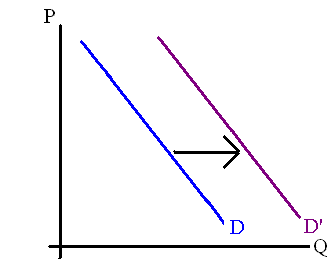
The diagram represents a
increase in demand
decrease in demand
change in quantity demand
none of the above

When there is a shortage the price will usually?
rise
fall
remain the same
equilibrium
The market equilibrium price is the price at which
surpluses depress the number of goods supplied
shortages and surpluses will have no effect on the market
the government will not intervene in the market
the quantity demanded is the same as the quantity supplied
What causes a shift in the demand curve?
A decrease in price
An increase in price
A change in an area other than price
A change in price and availability
Which is an example of the Law of Demand at work?
The price of the pizza goes up when the price of cheese goes up.
Demand for pizza goes down when tacos become more popular
The price of pizza falls when the demand for pizza falls
Demand for pizza rises when the price of pizza falls
Which explains why a supply line is upward sloping?
the Law of Demand states there is an indirect relationship between price and quantity
the Law of Supply states there is a direct relationship between price and quantity
the Law of Supply compares marginal costs and marginal benefits in a constant rate
the Law of Demand shows a positive relationship between two goods, creating the slope
Much less risky
saving
investing
Saving and investing provide opportunities to increase your wealth, leading to financial security
True
False
What is the role of a financial system in an economy?
To produce goods and services
To transfer resources from savers to borrowers
To control inflation rates
To set government tax policies
What does it mean to have a high-risk investment?
A high-risk investment is one that has a significant chance of loss but offers the potential for higher returns.
A high-risk investment guarantees high returns with no chance of loss.
A high-risk investment is always safe and secure.
A high-risk investment is one that has no potential for returns.
Heather goes to bank, makes a withdrawal, and goes to the store to buy a new pair of running shoes. What method of payment is this?
Cash
Credit card
Debit card
Online banking

A set payment that a person receives in exchange for work performed:
salary
debt
bill
will

a plan for spending and saving money is called...
tax
fixed expense
income
budget

Money that is put aside to use in the future is called...
tax or taxes
purchase
spend
save or savings
What is the importance of having an emergency fund?
An emergency fund is not necessary if you have insurance.
An emergency fund is only important for people with high-risk jobs.
An emergency fund is important to cover unexpected expenses or financial emergencies.
An emergency fund is only necessary for long-term financial planning.

