
 Worksheets
EE Ch. 8 Series Circuits Q
Total questions: 24
Worksheet time: 13mins
The ways an electrical circuit can be constructed are:
series
combination of both series and parallel
parallel
elctro-magnetic
A type of circuit that only has one path for electrons to flow through the devices wired in the circuit.
series
parallel
Electromagnetic
combination circuit

The total ________ applied to a series circuit is equal to the total number of individual _______ drops in a series circuit.
current
voltage
power
resistance
Kirchhoff's Voltage Law states that the sum of all voltage drops around a closed loop in a circuit equals ________. This means the sum of voltage sources equals the sum of voltage drops.
0
1
2
3
In simple terms, using Kirchhoff's voltage law, when you traverse a closed loop, the total voltage rise must equal the total voltage drop.
True
False
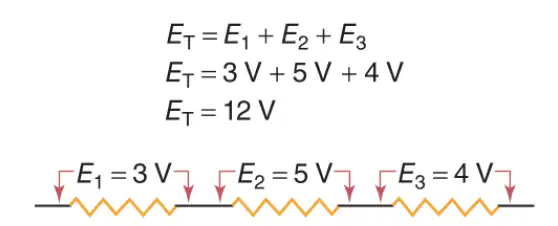
What law was applied to calculate the total voltage in the circuit attached.
Ohm's
Watt's
Kirchhoff's
Volta's
_______ drop refers to the decrease in electrical potential as current flows through a circuit due to resistance
Voltage
Resistance
Current
Electrical
Voltage drop primarily occurs due to resistance in electrical circuits, particularly in conductors like wires and cables. As current flows, it encounters resistance, which converts electrical energy into heat, causing a voltage reduction. Factors that contribute to resistance and therefore voltage drop are:
conductor length
conductor material
conductor guage
ambient temperature
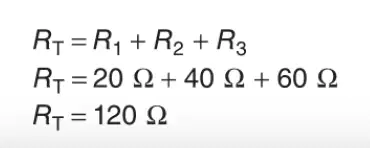
The current in a ________ circuit is _______ throughout the circuit.
series, equal
series, 0
parallel, equal
parallel, 0
The formula for series circuit current value is a mathematical way of expressing that a current value measured at any point in a series is equal to the current value at any other point in the same circuit.


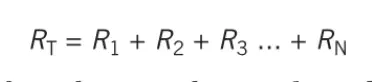
Total resistance in a series circuit is equal to the total circuit resistance combined. By adding the value of the individual resistor together, we find the total resistance of the circuit.
True
False
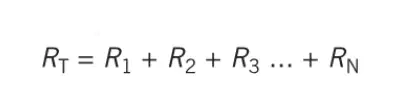
Equation for expressing voltage in a series circuit.


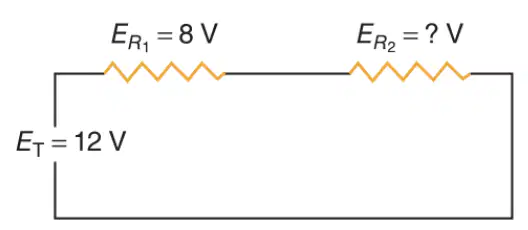
The circuit attached demonstrates two resistors that are wired in series. The value of R1 is 8 volts and the sources is equal to 12 volts. Apply the law of voltages in a series circuit to find the unknown voltage across R2. The voltage is ____?
+8 volts
0 volts
4 volts
12 volts
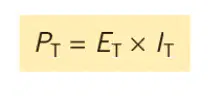
The total amount of ________ consumed in a series circuit is equal to the source voltage multiplied by the circuit current.
power
resistance
voltage
current
The wattage rating of a resistor is the amount of energy it uses.
True
False
The _______ rating of a resistor is the amount of energy, in the form of ________, the resistor can safely dissipate without being damaged.
wattage, heat
voltage, resistance
ampacity, current
resistance, electrons
A 2.2 kilo Ohm resistor rated at .25 watts does not consume .25 watts. The rating of .25 indicates the amount of _______ energy it can dissipate without damage.
heat
resistance
electric
light
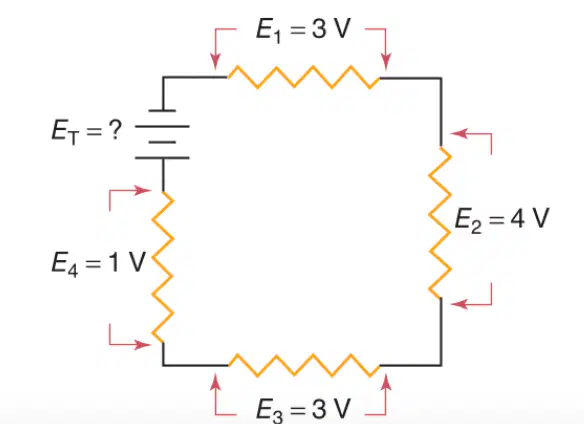
What is the value of the voltage source (Et) in the circuit attached?
10V
4 V
11 V
1 V
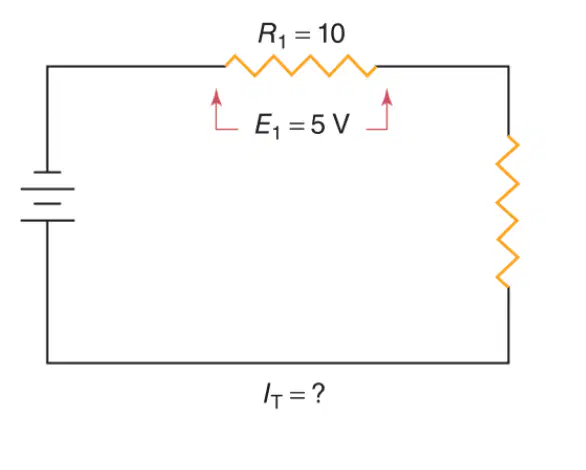
What is the value of the total current (It) in the circuit attached?
0.5 A
10 A
15 A
50 A
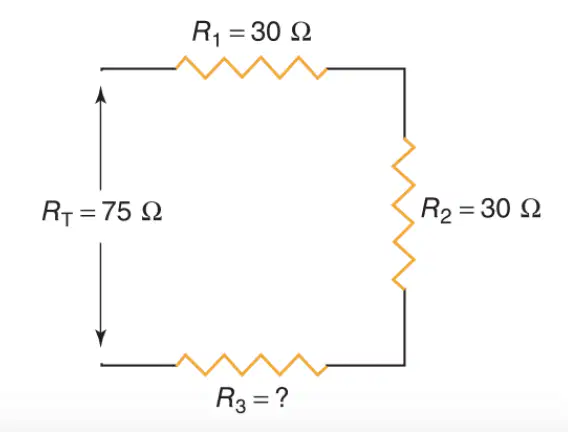
What is the missing resistance (R3) in the circuit attached?
5 ohms
15 ohms
30 ohms
45 ohms
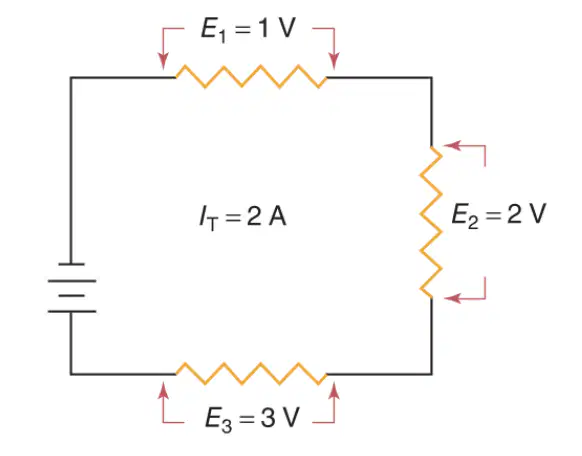
What is the power of the circuit (Pt) in the circuit attached?
2 W
6 W
12 W
24 W
Ohm's law can be applied to any individual component of a series circuit.
How much voltage will be found across a good fuse?
0 V
1 V
Infinite
Amount equal to the source voltage
How much voltage drop will be found across a blown fuse?
0 V
1 V
Infinite
Amount equal to the source voltage

