Wayground logo

Free Printable Worksheets

Font size

S
M
L
XL
Worksheets

Form 4 Hardware Revision

Total questions: 40

Worksheet time: 24mins

Name
Class
Date
1.
Monitor
a)
input devices
b)
output devices
c)
storage devices
d)
processor
2.
Mouse
a)
input devices
b)
output devices
c)
storage devices
d)
processor
3.
Keyboard
a)
input devices
b)
output devices
c)
storage devices
d)
processor
4.
Printer
a)
input devices
b)
output devices
c)
storage devices
d)
processor
5.
Scanner
a)
input devices
b)
output devices
c)
storage devices
d)
processor
6.
Webcam
a)
input devices
b)
output devices
c)
storage devices
d)
processor
7.
Pendrive
a)
input devices
b)
output devices
c)
storage devices
d)
processor
8.
Central Processing Unit (CPU)
a)
input devices
b)
output devices
c)
storage devices
d)
processor
9.
Hard disk
a)
input devices
b)
output devices
c)
storage devices
d)
processor
10.
Speaker
a)
input devices
b)
output devices
c)
storage devices
d)
processor
11.

The function of data storage is

a)

Send data or information to other people

b)

As a place to store information

c)

Receive data or information from outside sources

d)

Manipulate data quickly and precisely

12.

What is Random Access Memory (RAM)?

a)

Computers need a non-volatile memory to larger programs.

b)

A character is stored in the computer

c)

Volatile form of a computer memory

d)

Collection of unorganized facts

13.

What are the uses of Input Devices?

a)

Enter everything into the computer

b)

Enter data and programs into the computer

c)

Enter instruction and programs into the computer.

d)

Enter instruction and data into the computer.

14.

Which component is the brain of the computer?

a)

CPU

b)

RAM

c)

Hard drive

d)

Motherboard

15.
what does ROM stand for??
a)
Range of motion
b)
Realistic-only memory
c)
Random-only memory
d)
Read-only memory
16.
What is the name for the chip inside the computer that contains the startup instructions?
a)
Read Only Memory (ROM)
b)
Random Access Memory (RAM)
c)
Motherboard
d)
Hard Disk
17.

Why is the CPU important to the computer?

a)

It runs programs

b)

It's the computers work area

c)

Holds data for long periods of time

d)

It helps hold data collected from the outside world

18.

What part of the computer stores all the data on the computer even when it is off?

a)

RAM

b)

Processor

c)

Hard Drive

d)

Power Supply

19.

Boot-up program

a)

Cache

b)

RAM

c)

ROM

d)

Hard Disk

20.

What is output device?

a)

Any hardware component that allows users to enter data and instructions

b)

A part of computer system that has no physical or invisible form

c)

The core function of a computer.

d)

Any computer component capable of conveying information to a user.

21.
CPU stands for...
a)
Central Programming Unit
b)
Centrally Processing Universally
c)
Core Processing Unit
d)
Central Processing Unit
22.
ALU stands for
a)
Arithmetic Logic unit�
b)
Arithmetic Legal unit�
c)
Anti Logic unit�
d)
Arithmetic Logic undo
23.
What is the purpose of using the ALU?
a)
performing calculations on data
b)
controlling calculations on data
c)
controlling the speed of calculations
d)
save memory onto hard drive
24.
Clock speed is measured in
a)
Hertz
b)
Words
c)
Bits Per Second
d)
Metres Per Second
25.

The CPU fetches instructions from.... and executes those instructions.

a)

Memory

b)

ALU

c)

ROM

d)

Input Device

26.
Which of the following is not a register?
a)
CU
b)
MAR
c)
MDR
d)
PC
27.

The Program Counter

a)

Stores the address of the next instruction in memory

b)

Stores the address of where the next item will be fetched from

c)

Stores data fetched from memory, or waiting to be stored in memory

d)

Stores the result of arithmetic calculations

28.

Which of the following has the largest memory?

a)

RAM

b)

Cache

29.
How does a CPU process instructions?
a)
Using the Fetch Decode Execute cycle
b)
Linearly using parallel processing
c)
Using machine code
d)
Through the Control Bus
30.

This sensor is used for burglar alarms

a)

Temperature

b)

Humidity

c)

Movement/Motion

d)

PH

31.

Define the term 'sensor'. Choose the most appropriate definition.

a)

Used to capture and can measure physical quantities

b)

A hardware device that collects data and stores it.
32.
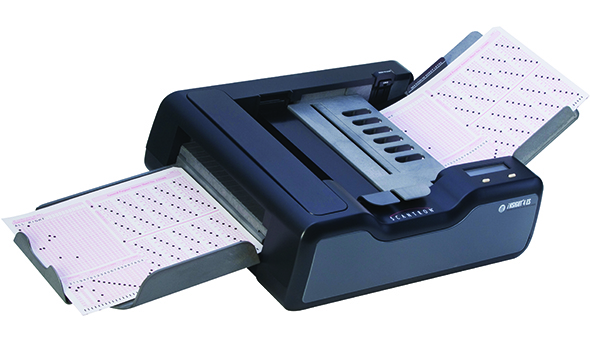
What does OMR stand for?
a)
Optical Mark Recognition
b)
Optical Meter Reader
c)
Operator Mark Recognition
d)
Online Meter Reader
33.
Which of these is OMR sometimes used for?
a)
Marking Exam Papers
b)
Controlling Characters in Computer Games
c)
Projecting a Presentation onto a big screen.
d)
Playing  an Audio File
34.
What does OCR stand for?
a)
Optical Character Reader
b)
Online Cloud Read
c)
Operating Command Recognition
d)
Online Cloud Recognition
35.
What does MICR stand for?
a)
Magnetic Ink Character Recognition
b)
Magnetic Ink Computer Recognition
c)
Multimedia Internet Computer Recognition
d)
Memory Internet Character Reader
36.
A printer that uses toner to burn text / images onto a page...
a)
Laser
b)
Plotter
c)
Inkjet
d)
Dot Matrix
37.
CD
a)
Input
b)
Output
c)
Storage
38.

What two input devices could be used with a VR flight training system?

a)

Steering wheel/joystick

b)

Motion sensor

c)

bar code reader

d)

OCR

e)

RFID

39.
Which of these would you use to digitise a paper photograph?
a)
Scanner
b)
 Joystick
c)
Touch screen
d)
None of the above
40.

It converts a live view into a digital signal which can then be streamed to another computer via the Internet.

a)

modem router

b)

printer

c)

scanner

d)

webcam