
 Worksheets
(Savvas Ch. 20-21) Electricity and Magnetism Review
Total questions: 135
Worksheet time: 2hrs 54mins
In an atom, negatively charged electrons surround a positively charged nucleus. True or False?
True
False
If a neutral atom gains one or more electrons, it becomes a positively charged ion. True or False?
True
False
What is the SI unit of electric charge?
coulomb
ampere
volt
ohm
What is the law of conservation of charge?
The total charge in an isolated system remains constant.
Charge can be created or destroyed.
Charge can be converted into energy.
Charge can be transferred without any loss.
Rubbing a balloon on your hair is an example of electric charging by _____.
friction
conduction
induction
radiation
The generation of a temporary charge by bringing a charged object near an uncharged object is called _____.
conduction
induction
radiation
insulation
Static discharge occurs when a pathway through which charges can move forms suddenly. True or false?
True
False
How does lightning occur?
Lightning occurs when there is a discharge of electricity in the atmosphere.
Lightning occurs due to the reflection of sunlight on clouds.
Lightning is caused by the moon's gravitational pull.
Lightning is a result of volcanic eruptions.
The strength of an electric field depends on which factors? (Mark all that apply.)
the direction of the field
whether the charge is positive or negative
the amount of charge that produces the field
the distance from the charge

+,+
+,-
-,+
-,-

Erin's electric field lines diagram is a correct representation for two positive charges. True or false?
True
False
The field is positive.
The field is negative.
The field is strong.
The field is weak.
The sudden loss of an unbalanced electric charge is an _____ .
electric force
electric field
electric discharge
The transfer of electric charge by friction produces ______ on the objects.
opposite charges
the same charge
temporary charges
The transfer of electric charge by contact produces ______ on the objects.
opposite charges
the same charges
temporary charges
The transfer of electric charge by induction produces ______ on the objects.
opposite charges
the same charge
temporary charges
Identify the true statement about the repulsion of electric charges. (Mark all that apply.)
A positive charge repels a positive charge.
A negative charge repels a negative charge.
A positive charge repels a negative charge.

Coulomb's Law describes the electrostatic force between two charges. The key variables in the formula are: the force (F), Coulomb's constant (k), the charges (q1 and q2), and the distance between them.
When the distance between two charges is tripled, the new electrical force between the charges is _____ than the original force.
three times larger
three times smaller
six times smaller
nine times smaller
Coulomb's Law describes the electrostatic force between two charges. The key variables in the formula are: the force (F), Coulomb's constant (k), the charges (q1 and q2), and the distance between them.
When the charge of the first object is tripled, the new electrical force between the charged objects is _____ than the original force.
three times larger
three times smaller
six times smaller
nine times smaller
Coulomb's Law describes the electrostatic force between two charges. The key variables in the formula are: the force (F), Coulomb's constant (k), the charges (q1 and q2), and the distance between them.
Coulomb's Law states that the electric force is _____ proportional to the charges of the objects.
directly
inversely
discreetly
indiscriminately
The potential differences in a battery cause electrons flow from a(n) ______ terminal to a(n) ______ terminal.
positive to negative
negative to positive
neutral to ground
ground to neutral
Is the following sentence true or false? Metals are good conductors because they do not have freely moving electrons.
True
False
What is the SI unit of resistance?
coulomb
volt
ampere
ohm
What is the SI unit of current?
coulomb
volt
ampere
ohm
What is the SI unit of potential difference?
coulomb
volt
ampere
ohm
Which wire has the lowest resistance?
a short thin wire
a short thick wire
a long thick wire
a long thin wire
Which answer best describes the voltage of a battery?
how long it will last for
how strongly it can push the current
how fast the current will be
how large the battery is
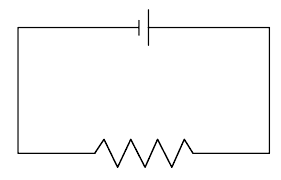
This circuit has a 12 volt battery and the resistor is 4 ohms. How many amps are running through the circuit?
3 amps
48 amps
16 amps
8 amps
An electric current that continually reverses direction over time is known as a(n)
fluctuating current
direct current
alternating current
simple current
An electric current flowing in one direction only
fluctuating current
direct current
alternating current
simple current

What does this symbol represent?
Which formula represents Ohm's law?
How many volts are in a circuit with a battery that has a resistance of 10 ohms and a current of 2 amps?
8 volts
5 volts
20 volts
12 volts

The lamp in this circuit will not turn on because it is missing...
a conducting path for the electricity.
a device to use the electricity.
a source of electricity.
a device to start and stop the flow of electricity.
A material that will allow a flow of current through it with very low resistance is called a(n)
insulator.
conductor.
semiconductor.

If the resistance increases two times, while the voltage remains constant,
the current will decrease two times.
the current will also increase two times.
the current will remain constant.
A battery is a device that converts
chemical energy to electrical energy.
electrical energy to mechanical energy.
mechanical energy to electrical energy.
electrical energy to chemical energy.
The resistance of a piece of wire does NOT depend on _________________.
wire temperature
wire mass
wire length
wire thickness (cross sectional area)
Is the following sentence true or false? In a series circuit, if one element stops functioning, then none of the elements can operate.
True
False
The bulbs shine less brightly when more bulbs are added to a series circuit because
the total resistance increases, reducing the current.
the total resistance decreases, increasing the current.
the voltage across each bulb increases.
the power supply increases.
Circuits in a home are rarely wired in parallel. True or False?
True
False
The rate at which electrical energy is converted to another form of energy is called _________________.
power
voltage
current
resistance
The SI unit of electric power is the joule per second, or _______________
watt
joule
ampere
volt
Electric power is calculated by multiplying current times voltage. True or false?
True
False
What could happen if the current in a wire exceeds the circuit’s safety limit? (Mark all that apply.)
The wire could overheat.
The wire could get cooler.
A fire could start.
A fuse could blow.
Explain how a fuse prevents current overload in a circuit.
A fuse melts when the current is too high, breaking the circuit.
A fuse increases the current flow to prevent overload.
A fuse stores excess current to prevent overload.
A fuse diverts excess current to the ground.
A switch that opens to prevent overloads when current in a circuit is too high is called a(n) ________________.
circuit breaker
resistor
capacitor
inductor
Explain why touching an electrical device with wet hands is dangerous.
Water is a good conductor of electricity, increasing the risk of electric shock.
Wet hands can cause the device to malfunction.
It can lead to short-circuiting the device.
It can cause the device to overheat.

What will happen if bulb B is removed?
Bulbs A and C will dim.
All of the bulbs will go out.
The other bulbs will remain lit.

This diagram represents
a series circuit.
a parallel circuit.
both a series circuit and a parallel circuit.

This diagram represents
a series circuit.
a parallel circuit.
both a series circuit and a parallel circuit.
In the equation, P=IV, what does I stand for?
Current
Incandescent
Impulse
Insulator
In the equation, E=Pt, what does t stand for?
time
temperature
thermal energy
If the electric power consumed by a device is 100W and the voltage is 20V, what is the current flowing through the device?
0.2A
5A
2000A
80A

Will this circuit light the bulbs?
Yes, both will light up
Yes, but only the one on the right
Yes, but only one on the left
No, neither of the bulbs will light up


If the voltage increases three times in a circuit, while the current is constant,
the power will increase three times.
the power will decrease three times.
the power will remain constant.
Which type of signal is usually used by an AM radio station?
Frequency Modulated signal
Amplitude Modulated signal
Digital signal
Pulse signal
Digital signals are more reliable than analog signals. True or false?
True
False
An image is produced in a cathode ray tube (CRT) when phosphors glow red, green, and blue in response to electron beams. True or false?
True
False
A semiconductor is a material that:
conducts electricity better than insulators but worse than conductors
does not conduct electricity at all
conducts electricity better than conductors
is a type of metal
Which type of semiconductor can be made by adding a trace amount of boron to silicon, which attracts electrons to positively charged holes on each boron atom?
p-type semiconductor
n-type semiconductor
Match each solid-state electronic component to its definition.
diode
A solid-state component that combines an n-type and p-type semiconductor
transistor
A solid-state component with three layers of semiconductors
integrated circuit
A thin slice of silicon that contains many solid-state components
Electronic signals carry information through patterns in the controlled flow of electrons through a circuit. Which type of electronic signal can be produced by pulsing current on and off?
analog signal
digital signal
Allows current to flow in only one direction
Resistor
Diode
Capacitor
An electronic device that can be a switch for current or an amplifier for voltage
Resistor
Diode
Capacitor
Transistor
What are examples of semiconductors?
Copper and aluminum
Silicon and germanium
Rubber and glass
Water and air
The area that is influenced by the magnetic field surrounding Earth is called the ____________________________.
magnetosphere
ionosphere
stratosphere
lithosphere
Which item would have the most randomized magnetic domains?
glass jar
steel nail
bar magnet
Which item would have the most aligned domains?
a pencil eraser
an iron railing
an aluminum can
Which of the following items would a magnet ATTRACT? (Mark all that apply.)
A copper penny
An iron nail
A piece of glass
A wood block
Magnetic force is strongest at
the north pole.
the south pole.
both poles.
the middle of the magnet.

In order to create these magnetic fields, what would the pole order have to be on the covered magnet?

North-South Order
It could be either order.
It is not a magnet - it has no poles.

South-North Order

What does this picture represent?
Magnetic forces between like poles
Magnetic forces between opposite poles
Magnetic forces between two metals

The picture below shows a piece of iron before it has become magnetized. What will the domains look like after it is magnetized?
The domains will be randomized.
The domains will all line up in the same direction.
Half of the domains will line up in one direction and the other half will line up in the other direction.
Permanent magnets can be made out of which materials?
Cobalt, Nickel, and Iron
Copper, Chromium, and Cobalt
Gold, Silver, and Platinum
Copper, Nickel, and Iron
Magnets are made of tiny sections of magnetic fields that are aligned to produce a larger magnetic field. These are called _____.
magnetic domains
magnetic fields
magnetic sections
electromagnets
The Earth's magnetic field is most useful for _____.
deflecting solar wind
keeping track of time
creating sunny weather
making it look cool in front of the other planets
Earth's geographic north pole (axis of rotation) is closest to which part of a magnetic field?
north magnetic pole
south magnetic pole
core of the magnetic field

Why does a compass needle point north?
Because the north end of the compass is attracted to Earth's magnetic north pole
Because it's magic
Because the north end of the compass is attracted to Earth's magnetic south pole
Earth's magnetosphere is responsible for creating...
northern and southern lights.
night and day.
seasons.
high and low tides.
What is the primary cause of Earth's magnetic field?
the rotation of the Earth on its axis
the flow of molten metals near the Earth's core
the alignment of magnetic domains in the Earth's crust
the gravitational pull of the moon
Lodestone is the strongest natural magnet. True or false?
True
False

Describe the magnetic field shown in this picture.
repulsive field of two magnets
magnetic field of one magnet
attractive field of two magnets
Which direction do the arrows point when representing the magnetic field around a magnet? (Mark two answers.)
into the north pole
out of the south pole
into the south pole
out of the north pole

Describe the magnetic field shown in this picture.
repulsive field of two magnets
attractive field of two magnets
magnetic field of one magnet
Which magnetic poles repel each other? (Mark all that apply.)
A north pole repels a north pole.
A south pole repels a south pole.
Magnetic poles never repel each other.
A north pole repels a south pole.

Which pair of magnets would result from cutting this magnet in half?
a.
b.
c.
d.
Electricity and magnetism are different aspects of a single force known as the __________ force.
electromagnetic
gravitational
nuclear
thermal
A coil of current-carrying wire that produces a magnetic field is called a(n) ____________.
solenoid
resistor
capacitor
diode
What types of solenoid cores make stronger electromagnets?
Plastic cores
Wooden cores
Iron cores
Glass cores
Electromagnetic devices change _______________ energy into _______________ energy.
electrical, mechanical
mechanical, electrical
thermal, chemical
chemical, thermal
Increasing the number of coils in an electromagnet will _________ the power of the magnet.
decrease
increase
not affect
Increasing the current in the wire of an electromagnet will _________ the power of the magnet.
decrease
increase
not affect
What are two ways to induce (begin) a current in a solenoid? (Mark all that apply.)
Moving a bar magnet inside a solenoid
Moving a solenoid inside a magnetic field
Setting a ferromagnetic material near a solenoid
Resting a magnet in a solenoid

Which factor will NOT affect the magnitude (size) of an induced electrical current?
The amount of coils used
The speed of the magnet movement
the strength of the magnet
The direction the magnet is moving
A ____________ is responsible for changing the direction of current in an electric motor.
Commutator
Solenoid
Ferromagnet
Electromagnet
Can you produce current in a wire with a magnet that is sitting still?
Yes; having a magnet near a wire is enough to excite the electrons
No; the magnetic field has to be changing to excite the electrons
No; magnets cannot create electricity
What can electromagnets do that regular magnets can't? (Mark all that apply.)
Switch their magnetic fields
Explode
Be turned off
They are both the same in every way
In order for the electromagnetic coil in the motor to keep turning, the current must ________.
continue in one direction
periodically increase in strength
change direction
be through an ammeter
When a current flows through a wire, it creates a _____ magnetic field.
circular
linear
spherical

Using the right-hand grip rule, "A" represents the direction of the
positive current
magnetic field
Using the right-hand rule, "B" represents the direction of the
positive current
magnetic field

Using the right-hand rule, if the positive current is flowing into the screen then the magnetic fields will flow from...
A to D to C to B and around
A to B to C to D and around
A to C to D to B and around
A to C to B to D and around
Using the right-hand rule, if the positive current is flowing towards you then the magnetic fields will flow from...
A to D to C to B and around
A to B to C to D and around
A to C to D to B and around
A to C to B to D and around
What is the purpose of a commutator in an electric motor?
To cool down the motor
To automatically switch the direction of current
To increase the motor's power
To reduce the motor's speed
A electric motor primarily converts _______________ energy into _______________ energy.
mechanical; electrical
electrical; mechanical
thermal; electrical
electrical; chemical
A magnetic field can be used to produce an electric current. True or false?
True
False
What is the name of the process of generating a current by moving an electrical conductor relative to a magnetic field?
electromagnetic force
electromagnetic field
electromagnetic induction
electromagnetic conduction
A generator converts _______________ energy into _______________ energy.
mechanical; electrical
electrical; mechanical
chemical; electrical
thermal; mechanical
A motor converts _______________ energy into _______________ energy.
mechanical; electrical
electrical; mechanical
chemical; electrical
thermal; mechanical
A device that increases or decreases voltage and current of two linked AC circuits is called a(n) _______________.
transformer
resistor
capacitor
generator
A transformer changes voltage and current by using
chemical reactions.
electromagnetic induction.
mechanical energy.
thermal energy.
Transformers are necessary for home electrical service because
they increase the voltage for home use.
they decrease the voltage to a safe level for home use.
they generate electricity for homes.
they store electrical energy for later use.
Voltage is decreased for long-distance transmission to prevent overheating wires. True or false?
True
False
A step-down transformer decreases voltage and increases current. True or false?
True
False

A device with fanlike blades that can turn the coils or magnets in a generator is called a _______________.
turbine
motor
battery
transformer
Which of the following electrical generators does NOT involve spinning a turbine?
coal
nuclear
wind
solar panel
What is the best energy chain for coal fired power plants?
chemical -> mechanical -> electrical
mechanical -> electrical
mechanical -> chemical -> electrical
What is the best energy chain for wind power plants?
chemical -> mechanical -> electrical
mechanical -> electrical
mechanical -> chemical -> electrical
What energy source has this energy chain?
light-> electrical

This picture shows a turbine generator used to produce electricity at a geothermal power plant.
Electricity is produced by using steam to _____________.

Match the following

Step Up Transformer

Step Down Transformer

Generator

Motor
In physics, what does it mean to "induce" something?
to make it more powerful
to cause something to happen
to turn it into something else
to reverse its direction

Which type of transformer is used in mobile charger?
step-down
step-up
In a transformer, assume the primary has 240 turns and secondary has 60 turns. Primary is connected with 120V AC power supply. What is the voltage on the secondary?
30 V
0.33 V
2 V
120V
A step-up transformer is used before electricity is transmitted by overhead cables. Which statement explains why the step-up transformer is used?
It increases the current to increase the speed at which the electricity travels.
It increases the current to reduce energy loss in the cables.
It increases the voltage to increase the speed at which the electricity travels.
It increases the voltage to reduce energy loss in the cables.
What are two ways to induce (begin) a current in a solenoid? (Mark all that apply.)
Moving a bar magnet inside a solenoid
Moving a solenoid inside a magnetic field
Setting a ferromagnetic material near a solenoid
Resting a magnet in a solenoid

Which factor will NOT affect the magnitude (size) of an induced electrical current?
The amount of coils used
The speed of the magnet movement
The strength of the magnet
The direction the magnet is moving
Can you produce current in a wire with a magnet that is sitting still?
Yes; having a magnet near a wire is enough to excite the electrons
No; the magnetic field has to be changing to excite the electrons
No; magnets cannot create electricity

