
 Worksheets
Chapter 1: What is Strategy?
Total questions: 98
Worksheet time: 52mins
What is strategy?
A set of goal-directed actions a firm takes to gain and sustain superior performance relative to competitors
A list of company goals
A marketing plan
A financial statement
Strategic management is an integrative management field that combines _______, formulation, and implementation in the quest for competitive advantage.
analysis
marketing
production
sales
What is competitive advantage?
Achieving superior performance relative to other competitors in the same industry or the industry average
Having the largest company size
Offering the lowest prices
None of the above
Sustainable competitive advantage means:
Outperforming competitors or the industry average over a prolonged period of time
Matching the industry average
Underperforming competitors
None of the above
Competitive disadvantage refers to underperformance relative to other competitors in the same industry for industry average.
True
False
What is competitive parity?
Performance of two or more firms at the same level
Performance of one firm above all others
Underperformance relative to competitors
None of the above
Which of the following is NOT a strategy?
Grandiose statements
A failure to face a competitive challenge
Operational effectiveness, competitive benchmarking, or other tactical tools
All of the above
About what percentage of a firm's profitability depends on the industry it's in?
10%
20%
50%
80%
Industry effects describe the underlying economic structure of the _______.
industry
company
market
government
What is considered a more important factor in determining firm performance: managerial actions or external environment forces?
Managerial actions
External environment forces
Both equally
Neither
According to the notes, a firm's strategy can explain up to what percentage of its performance?
55%
25%
70%
40%
Who are considered stakeholders in a firm?
Only employees
Only customers
Organizations, groups, and individuals
Only managers
Stakeholders can affect or are affected by a firm's actions.
True
False
List two examples of internal stakeholders for Apple mentioned in the notes.
Employees and managers
Customers and suppliers
Government and competitors
Shareholders and customers
Which of the following is NOT an external stakeholder for Ole Miss?
Students
Suppliers
Managers
Alliances (SEC, AACSB), Oxford
What are the three stakeholder attributes managers must note in Stakeholder Impact Analysis?
Power, Legitimacy, Urgency
Influence, Wealth, Popularity
Experience, Authority, Tenure
Responsibility, Accountability, Transparency
What are the three main elements of a good strategy according to the notes?
Analysis, Formulation, Implementation
Planning, Execution, Review
Vision, Mission, Goals
Leadership, Management, Control
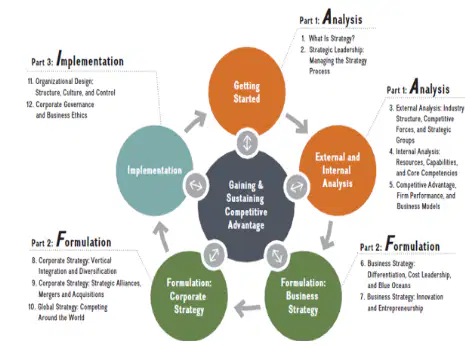
Refer to the diagram of The AFI Strategy Framework. Which part of the framework involves 'Guiding policy to address the competitive challenge'?
(a)
What do we want to accomplish? (future goals) Fill in the blank: The term for what we want to accomplish in the future is called _______.
Vision
Mission
Strategy
Plan
How do we accomplish our goals? (present purpose) Fill in the blank: The term for how we accomplish our goals, representing our present purpose, is called _______.
Mission
Vision
Strategy
Objective
What commitments do we make? (standards to live by) Fill in the blank: The term for the standards to live by, or the commitments we make, is called _______.
Values
Goals
Habits
Rules
Product-oriented statement defines a business in terms of:
Providing solutions to customer needs
A good or service provided
Achieving long-term goals
Leadership actions
Customer-oriented statement defines a business in terms of:
Providing solutions to customer needs
A good or service provided
Achieving long-term goals
Leadership actions
Strategic commitments are actions to achieve the mission that are:
Easy to reverse
Short-term oriented
Costly, long-term oriented, and difficult to reverse
Not related to the mission
Fill in the blank: The process put in place by leaders to help formulate and implement strategy, foundational for sustainable competitive advantage, is called the _______.
Strategic Management Process
Operational Planning Cycle
Resource Allocation Model
Performance Review System
Fill in the blank: The use of power and influence to direct the activities of others and pursue organizational goals is known as _______.
Strategic Leadership
Operational Management
Human Resource Planning
Financial Auditing
Fill in the blank: Organizational outcomes reflect the values of the top management team according to the _______ theory.
Upper Echelons Theory
Contingency Theory
Resource Dependence Theory
Institutional Theory
Fill in the blank: Strategy formulation answers the question of where and how to (a) .
Which of the following is NOT a level of strategy formulation mentioned in the notes?
Corporate Strategy
Business Strategy
Functional Strategy
Marketing Strategy
What is the main focus of Functional Strategy according to the notes?
How to implement a chosen business strategy
How to set the overall vision of the company
How to manage day-to-day operations only
How to expand into new markets
Which approach to strategize for competitive advantage is described as 'A formal, top-down planning approach'?
Top-down strategic planning
Emergent strategy
Scenario planning
Resource-based view
Which of the following is a pro of Top-down strategic planning?
Flexible
Organized
Rosy
Fluid
Which of the following is NOT a con of Top-down strategic planning?
Top heavy
One sided
Rigid
Creative
Scenario planning uses which company as an example in the notes?
(a)
Which of the following is NOT a scenario listed under Scenario planning?
A. New competitor → revisit cost/quality
B. Tariff → rethink our supply chain
C. Covid 2.0 → rethink supply chain/access
D. Market expansion → increase advertising
Which of the following is a pro of Scenario planning?
Rigid
Prepared
Top heavy
Unclear communication
Which of the following is NOT a con of Scenario planning?
Top down
Rosy
Misinvest
Efficient
Strategy as planned emergence begins with a strategic plan, but is less ________.
formal
rigid
expensive
predictable
Which of the following is a pro of Strategy as planned emergence?
Fluid
Two-way communication
Rigid
Top heavy
Which of the following is a con of Strategy as planned emergence?
Efficient
Creative
Fluid
Organized
Which of the following is a reason for the importance of analyzing the external environment?
A) Managers can mitigate threats
B) Managers can ignore opportunities
C) Gain an understanding of internal impacts
D) Understand the source/proximity of internal factors
The Pestel Model groups environmental factors into how many segments?
4
5
6
7
Fill in the blank: In the Pestel Model, tariffs and taxes are examples of (a) factors.
Which of the following is considered an economic factor in the Pestel Model?
Tech
Interest rates
AI
Waste
In the Pestel Model, green laws can be both an ecological and a legal factor.
True
False
At the firm level, larger/older firms tend to use which approach?
Emergent
Top-down
Dynamic
Stable
Fill in the blank: A group of incumbent companies that tend to offer similar products and services is called an ______.
Industry
Market
Corporation
Franchise
Which of the following is NOT one of the Five Forces in the Five Forces Model?
Threat of New Entrants
Bargaining Power of Buyers
Product Differentiation
Competitor Rivalry
In the Five Forces Model for Computers/Phones, what is the level of new competition and entry barriers?
High
Medium
Low
Not mentioned
Fill in the blank: In the Five Forces Model, the bargaining power of buyers is considered ______ when there are few buyers and standardization of product.
LOW/MED
HIGH
VERY HIGH
NEGLIGIBLE
Which force in the Five Forces Model is associated with alternatives and low switching costs?
Threat of New Entrants
Threat of Substitutes
Bargaining Power of Suppliers
Competitor Rivalry
What does SCP stand for in Industry Competitive Structures?
Structure, Conduct, Performance
Strategy, Competition, Performance
Structure, Competition, Profit
Strategy, Conduct, Profit
Industry growth affects the intensity of rivalry among competitors.
True
False
Which of the following is NOT a characteristic of strategic commitments?
Costly
Short-term oriented
Difficult to reverse
Long-term oriented
A complementor is:
A competitor in the same industry
A company that provides a good or service that leads customers to value your firm’s offering more when the two are combined
A supplier of raw materials
A buyer of products
Fill in the blank: Industry consolidation refers to the ______ of competitors within an industry.
Merging
Separation
Diversification
Expansion
Industry convergence refers to the ______ of industries.
Splitting
Merging
Decline
Growth
What are strategic groups?
A set of companies that pursue a similar strategy in a specific industry
A group of customers with similar needs
A set of unrelated businesses
A team of managers from different industries
List the steps to create a strategic group map.
1. Identify important strategic dimensions. 2. Choose two key dimensions (for horizontal and vertical axes). 3. Graph the firms in the strategic group (each firm's market share indicated by the size of the bubble).
1. Select random companies. 2. Assign arbitrary values to axes. 3. Draw lines connecting all companies.
1. Identify financial ratios. 2. Plot ratios on a pie chart. 3. Compare with industry average.
1. Choose product features. 2. Create a bar graph. 3. Rank firms based on sales volume.
Competition differs strongest within groups.
True
False
External environment and industry environment have the same impact on strategic groups.
True
False
What is a shortcoming of the models discussed in the notes?
They are static, just a snapshot, and information can become obsolete. Models don't fully explain why performance differences occur in an industry; internal analysis is required.
They always provide real-time data and never become outdated.
They fully explain all performance differences in every industry without the need for further analysis.
They are dynamic and automatically update with new information.
What are core competencies?
Core competencies allow a firm to differentiate its products and services from those of its rivals.
True
False
Resources are any assets that a firm can draw on.
True
False
Capabilities refer to organizational and managerial skills.
True
False
What are the four criteria of resources according to the Resource Based View (RBV) model?
Valuable, Rare, Costly to Imitate, Organized to Capture Value
Tangible, Intangible, Valuable, Rare
Product, Process, Design, Trademark
Secrecy, Appearance, Ambiguity, Complexity
According to the Resource Based View (RBV), resources fall into two categories: ________ and ________.
Tangible and Intangible
Physical and Financial
Internal and External
Short-term and Long-term
What are the two critical assumptions of the Resource Based View (RBV)?
Resource Heterogeneity and Resource Immobility
Patent and Trademark
Tangible and Intangible
Path Dependence and Social Complexity
Which of the following is NOT an isolating mechanism listed in the notes?
Barriers to imitation
Better expectations of future resource value
Product/process
Intellectual property (IP) protection
A ________ protects a product or process for 20 years.
Patent
Copyright
Trademark
Trade Secret
A trademark provides 10 year protection and is renewable.
True
False
Which of the following is a characteristic of a trade secret?
14 year protection
Non-public info
Logo/design
Path dependence
What is the duration of copyright protection for art/writing after the creator's death?
70 years after the creator's death
20 years after the creator's death
100 years after the creator's death
50 years after the creator's death
Dynamic capabilities refer to a firm's ability to:
Create, deploy, modify, reconfigure, upgrade, and leverage its resources over time
Only create new products
Only reduce costs
Only hire new employees
What does a value chain represent in a firm?
Internal activities a firm engages in when transforming inputs into outputs
The external market forces affecting a firm's profitability
The financial statements used to assess a firm's performance
The legal framework within which a firm operates
Primary activities in the value chain directly add value.
True
False
SWOT Analysis is a framework that allows managers to synthesize insights obtained from an internal and external analysis to derive strategic implications.
True
False
Name the three primary legal forms of organization.
Sole Proprietorship, Partnership, Corporation
Sole Proprietorship, Franchise, Cooperative
Corporation, LLC, S Corporation
Partnership, Cooperative, Nonprofit
Which of the following is NOT a benefit of a public stock company?
Limited liability for investors
Transferability of investor ownership
Unlimited liability for investors
Legal personality
What is Milton Friedman's philosophy regarding the social responsibility of business?
The social responsibility of business is to increase its profits.
The social responsibility of business is to maximize employee welfare.
The social responsibility of business is to support charitable causes.
The social responsibility of business is to prioritize environmental sustainability.
Porter’s Creating Shared Value includes: 1. Creating economic value for shareholders 2. Creating social value by addressing society’s needs and challenges.
True
False
Porter’s Creating Shared Value can be achieved through:
Expanding customer base
Expanding value chain
Both a and b
None of the above
What is the difference between quantitative and qualitative analysis?
Quantitative uses numbers, qualitative uses descriptives
Quantitative uses descriptives, qualitative uses numbers
Both use only numbers
Both use only descriptives
Fill in the blank: Standardized accounting metrics and profitability ratios help assess ________ profitability.
accounting
operational
market
strategic
Who are the legal owners of public companies?
Employees
Shareholders
Managers
Customers
Fill in the blank: Risk capital is money provided for an equity share in a company and cannot be recovered if the firm goes ________.
bankrupt
public
profitable
international
Fill in the blank: Total return to shareholders is calculated as stock price appreciation plus ________.
dividends
interest payments
operating income
capital expenditures
Fill in the blank: Market capitalization is the dollar value of total shares outstanding or the number of outstanding shares times ________.
share price
dividend yield
net income
total assets
What is the difference between value (V) and cost (C) called in economic value creation?
Producer surplus
Consumer surplus
Economic value created
Market capitalization
Competitive advantage can be based on which of the following?
Superior product differentiation
Relative cost advantage over rivals
Both A and B
Neither A nor B
Fill in the blank: Producer surplus is the difference between the price charged (P) and the cost to produce (C).
the cost to produce (C)
the total revenue (TR)
the market demand (D)
the equilibrium price (EP)
Fill in the blank: Consumer surplus is the difference between what you would have been willing to pay (V) and what you paid (P).
what you paid (P)
the market price (M)
the cost of production (C)
the equilibrium price (E)
What are the three dimensions fundamental to sustainable strategy according to the Triple Bottom Line?
Profits, People, Planet
Profits, Products, Processes
People, Products, Performance
Planet, Performance, Profit
The Balanced Scorecard helps managers achieve their strategic objectives more effectively by using internal and external performance metrics and balancing both financial and strategic goals.
True
False
Fill in the blank: Competitive advantage is best measured by criteria that reflect overall ________ performance, not the performance of specific departments.
business unit
marketing
financial
operational
Which of the following is NOT a dimension of the Triple Bottom Line?
Economic
Social
Technological
Ecological
What is the main purpose of trade-offs in business strategy?
To increase costs
To maximize the firm’s economic value creation and profit margin
To minimize customer satisfaction
To reduce product quality

