
 Worksheets
2025 PS Practice Final 2
Total questions: 224
Worksheet time: 2hrs 1mins
Motion is described with respect to a
graph
displacement
slope
frame of reference
Displacement is distance combined with
direction
speed
velocity
magnitude
Displacement vectors of 3m and 5m in the same direction combine to make a displacement vector that is
2m
0m
8m
15m
Average speed is the total distance divided by the
average distance
average acceleration
total time
slope

The slope of a position-time graph is equal to the
velocity
displacement
acceleration
motion
Velocity is
the slope of a linear graph
acceleration divided by displacement
speed with direction
the same in all reference frames
Two or more velocities can be combined by
graphing the slope
using vector addition
calculating the instantaneous velocity
determining the rate

A ball just dropped is an example of
constant speed
instantaneous velocity
combining displacements
free fall

Jamie jogs each morning before work. She starts at 7:00 am and jogs 1 mile to the park and 1 mile back to her apartment. It takes her 24 minutes to complete her workout. What is her displacement during each of her morning jogs?
2 miles
24 minutes
0 miles
12 min / mile
Movement in relation to a frame of reference is called
instantaneous speed
average speed
relative motion
displacement

Hannah biked 12 miles in 1 hour, 10 miles the next hour, and 20 miles the next 2 hours. What was her average speed?
12 mi/hr
10.5 mi/hr
14 mi/hr
10.7 mi/hr

The line on this position-time graph indicates that the object is
speeding up
slowing down
moving at a constant speed
not moving
The rate at which velocity changes is called
(a)
Which of the following answers is an example of an object that is accelerating (there may be more than one answer)
A ball falling from a height
A person jogging on a treadmill at 3 mi/hr.
A ball moving at a constant speed in a straight line
A person riding a motorcycle at a constant speed in a circle
Which of the following is NOT true about an object in free fall?
it speeds up as it falls
it accelerates at -9.8 m/s2
it has constant acceleration
it has constant velocity

What does the slope of a velocity-time graph tell you?
velocity
displacement
acceleration
position
An object moving at 15 m/s2 comes to a stop in 5 seconds. What is the object's acceleration?
a = Δtvf − vi
5 m/s2
75 m/s2
3 m/s2
-3 m/s2
Which of the following is NOT acceleration?
speeding up
slowing down
changing direction
standing still
How fast a velocity is changing at a specific instant is called
instantaneous velocity
instantaneous speed
instantaneous acceleration
linear
acceleration
Velocity means both speed and _____.
direction
acceleration
position
distance

This graph indicates that the object is
not moving
moving with constant speed
accelerating
slowing down
Which of the following v-t graphs shows positive acceleration?
(there may be more than one possible answer)


Which of the following v-t graphs shows positive velocity?
(there may be more than one possible answer)
Which of the following v-t graphs shows slowing down?
(there may be more than one possible answer)
What is required for an object to start moving, stop moving, speed up, slow down, or change directions?
(a)
The sum of all the forces acting on an object.
(a)
When forces are balanced, it means that net force =
(a)
Unbalanced forces acting on an object cause the object to
move
stop
accelerate
stay at rest
When the net force acting on an object is zero, the object will
stop moving
speed up
not accelerate
slow down
Which of the following is NOT one of the four main types of friction?
rolling friction
static friction
fluid friction
sliding friction
standing friction
The constant velocity of a falling object when the force of air resistance equals the force of gravity.
(a)
A falling object's motion after it is given a forward velocity. (also known as 2D motion)
(a)
Which is true of an object dropped vs. an object thrown horizontally at the same time?
the object dropped will reach the ground first
the object thrown forward will reach the ground first
they will reach the ground at the same time
only the object dropped is in free fall
A force that acts between any two masses. It causes objects to accelerate downward.
(a)
A 10-kg brick and a 1-kg brick are dropped in a vacuum. The force of gravity on the 10-kg brick is
the same as the force on the 1-kg brick
10 times as much
1/10 as much
zero
An object is propelled along a straight-line path in space by a force. If the object sweeps up extra particles and its mass becomes twice as much, its acceleration
quadruples
doubles
stays the same
halves
A 10-N falling object encounters 10-N of air resistance. The net force on the object is...
0 N
4 N
6 N
10 N
An apple weighs 1 N. When held at rest above your head, what is the net force on the apple?
(a)
When the net force on an object is zero, the acceleration of the object is
constant
zero
less than zero
more than zero
An object following a straight-line path at constant speed has
a net force acting on it in the direction of motion
zero acceleration
no forces acting on it
constant acceleration
What is the weight of a 100-kg object if g= 9.8 N/kg?
Fg = m × g
100 N
9.8 N
98 N
980 N
What is the mass of an object that weighs 44.1 N if g = 9.8 N/kg?
(in kg - don't include units).
Fg = m × g
(a)
If an object has a mass of 300 kg and accelerates at 1.5 m/s2, what is the net force acting on the object? (in N, don't include units in your answer).
F = m × a
(a)
A boy pulls a 20-kg wagon with a constant force of 44 N. What is the acceleration of the wagon in m/s2? (don't include units in your answer).
F = m × a
(a)
A large boy and a small girl run into each other in the hallway. Which one experiences the greatest amount of force?
the small girl
the large boy
the forces are the same
A baseball bat exerts a force of 1000 N on a baseball. The force that the ball exerts on the bat is
less than 1000 N
more than 1000 N
exactly 1000 N
0 N
Newton's third law states that action-reaction forces are equal in magnitude and (a) in direction.
Which of the following is NOT true of Newton's third law of motion?
All forces occur in pairs.
Force pairs are equal in magnitude and opposite in direction
Force pairs act on two different objects.
Force pairs always act on the same object.
The product of an object's mass and it's velocity.
m × v
(a)
What is the momentum of a golf ball if it weighs 0.05 kg and is moving at a velocity of 60 m/s?
20 kg⋅sm
1200 kg⋅sm
3 kg⋅sm
60 kg⋅sm
In a closed system, the amount of momentum before a collision is _____ the amount of momentum after a collision.
equal to
greater than
less than
States that if no net force acts on a system, then the total momentum of the system does not change.
law of conservation of mass
law of conservation of energy
law of conservation of momentum
law of conservation of velocity
The force associated with charged particles
electromagnetic force
strong nuclear force
gravitational force
weak nuclear force
Like charges repel, and opposite charges (a) .
A powerful force of attraction that acts only on the neutrons and protons in the nucleus of an atom, holding them together.
strong nuclear force
weak nuclear
force
gravitational
force
electromagnetic force
Which is the weakest universal force?
gravitational
force
strong nuclear force
weak nuclear
force
electromagnetic force
An attractive force that acts between any two masses.
electromagnetic force
gravitational
force
strong nuclear force
weak nuclear
force
What factors affect gravitational force?
mass and distance
velocity and mass
distance and time
mass and volume
You tie a rock to a string and whirl it in a circle above your head. The force the string exerts on the rock is called (a) force.
Which universal force can repel as well as attract?
(a)
What force is responsible for the orbits of the planets in the solar system?
(a)
Newton's law of universal gravitation states that every object in the universe attracts every other object.
true
false
In order to calculate pressure exerted on a surface, what quantity is divided by the surface area?
altitude
force
mass
volume
The SI unit of pressure is the
(a)
If the air inside a balloon exerts a force of 2N on an area of 0.5 m2, what is the pressure inside the balloon?
2 N/m2
4 N/m2
1 N/m2
0.25 N/m2
A pressure of 70 N/m2 equals
7 Pa
70 Pa
700 Pa
7000 Pa
A substance that assumes the shape of its container.
(a)
As altitude increases, air pressure (a) .
Which of the following is NOT a fluid?
oxygen
ice
water
oil
Atmospheric pressure is caused by
air currents
the weight of the atmosphere above a particular location
clouds
altitude above sea level
The pressure of air at sea level is approximately
0 kPa
10 kPa
101 kPa
1000 kPa
Where would fluid pressure be the greatest in a swimming pool?
30 cm below the surface
1 m below the surface
2 m below the surface
the pressure is the same at all depths
The upward force acting on an object submerged in a fluid is called
buoyant force
drag
pressure
weight
A brick weighs 26N. Measured underwater, it weighs 11N. What is the size of the buoyant force exerted by the water on the brick?
37N
26N
11N
15N
The strength of the buoyant force acting on an object in a fluid depends on the object's
mass
surface area
volume
weight
The buoyant force on an object in a fluid is equal to the weight of the
fluid
fluid surrounding the object
fluid displaced by the object
object
The relationship between buoyant force and weight of a displaced fluid was first stated by
Archimedes
Bernoulli
Newton
Pascal
Why does a hot air balloon float?
the shape of the balloon provides lift
the volume of air displaced by the balloon is less than the volume of the balloon
the weight of the air displaced by the balloon is less than the volume of the balloon
the weight of the balloon is less than the weight of the air displaced by the balloon
Which of the following substances will float in corn syrup? (The density of corn syrup is 1.38 g/cm3)
copper
8.9 g/cm3
silver
10.5 g/cm3
iron
7.8 g/cm3
glycerin
1.26 g/cm3
A submerged submarine alters its (a) to rise or fall in the water.
The direction of the buoyant force on an object placed in a fluid is (a) .
The unit g/cm3 is often used to express (a) .
Which principle states that a change in the pressure at any point in a fluid in a closed container is transmitted equally and unchanged in all directions throughout the fluid?
Archimedes' principle
Bernoulli's
principle
Newton's
principle
Pascal's
principle
The operation of a hydraulic lift system is explained by
Archimedes' principle
Bernoulli's
principle
Newton's
principle
Pascal's
principle
The hydraulic lift system of a dump truck is designed to multiply
distance
force
pressure
speed
As the speed of a fluid increases, the pressure within the fluid decreases.
Archimedes' principle
Bernoulli's
principle
Newton's
principle
Pascal's
principle
The upward force acting on the wind of an airplane in flight.
(a)
Which of the following statements is true about an airplane wing during flight?
air above the wing travels faster than air below the wing
air below the wing travels faster than air above the wing
the wing exerts pressure equally in all directions
the lift acting on the wing reduces the weight of the wing
Wings are sometimes used to create a downward force.
true
false
In a hydraulic lift system, an increased output force is produced because a constant fluid pressure is exerted on the larger area of the output piston.
true
false
A force acting on an object does no work if
a machine is used to move the object
the force is not in the direction of the object's motion
the force is greater than the force of friction
the object accelerates
In which of the following is no work done?
climbing stairs
lifting a book
pushing a shopping cart
pushing on a brick wall
What is the unit of work?
(a)
If you exert a force of 10.0 N to lift a box a distance of 0.9 m, how much work do you do?
0.1 J
9.0 J
10.9 J
90.0 J
The SI unit of power is the
(a)
The power of a machine measures
its rate of doing work
its strength
the force it produces
the work it does
If you exert a force of 600 N to walk 6 m up a flight of stairs in 5 seconds, how much power do you use?
720 W
500 W
18,000 W
20 W
A 750-W motor might also be rated as a
0.5 horsepower motor
1 horsepower motor
2 horsepower motor
10 horsepower motor
A machine is a device that can multiply
(a)
When a machine does work, it cannot do which of the following?
change the direction of a force
increase a force and change the distance a force moves
increase the distance a force moves and change the direction of a force
increase a force and increase the distance a force moves an object
Output work is always less than input work because of friction
true
false
The only way to increase the work output is to increase the amount of work you put into a machine.
true
false
The actual mechanical advantage of a machine
cannot be less than 1
increases with greater friction
is always less that the ideal mechanical advantage
is always equal to the ideal mechanical advantage
If you have to apply 40 N of force on a crowbar to lift a rock that weighs 400 N, what is the actual mechanical advantage of the crowbar?
(a)
Reducing friction in a machine
decreases the actual mechanical advantage
decreases the work output
increases its efficiency
increases its ideal mechanical advantage
The efficiency of a machine is always less than 100% because
a machine cannot have an ideal mechanical advantage greater than 1
some work input is lost to friction
the work input is too small
the work output is too great
The (a) of a machine is the number of times that the machine increases the input force.
The mechanical efficiency of any machine is always (a) than 100 percent.
The percentage of work input that becomes work output is the (a) of a machine.
The (a) mechanical advantage of a machine is the mechanical advantage in the absence of friction.
An inclined plane reduces the effort force by
increasing the distance over which the force is applied
increasing the work
reducing the distance over which the force is applied
reducing the
work
An axe is an example of a(n)
inclined plane
lever
wedge
wheel and axle
Which of the following is an example of a wheel and axle?
a hammer
a steering wheel
a jar lid
a pencil
The ideal mechanical advantage of a pulley system is equal to
the distance the load moves
the length of the rope
the number of ropes supporting the load
the weight of the object being lifted
An example of a compound machine is a
crowbar
bicycle
ramp
seesaw
The ideal mechanical advantage of a wheel and axle is found by
multiplying the circumference of the wheel by the radius of the axle
dividing the radius of the wheel by the radius of the axle
dividing the radius of the axle by the radius of the wheel
multiplying the radius of the wheel by the radius of the axle
A machine is classified as a compound machine if it
has moving parts
has an ideal mechanical advantage greater than 1
is made up of two or more simple machines that operate together
is 100% efficient
A(n) (a) can be described as an inclined plane wrapped around a cylinder.
The fulcrum is always BETWEEN the effort force and the resistance force in a(n) (a) -class lever.
The ideal mechanical advantage of a third-class lever is always (a) than 1.
Work is a transfer of
energy
force
mass
motion

The energy of motion is called _____.
kinetic energy
potential energy
thermal energy
work

A small 20-kilogram canoe is floating downriver at a speed of 2 m/s. What is the canoe's kinetic energy?
22 J
40 J
80 J
400 J
An object's gravitational potential energy is NOT directly related to which of the following?
its height
its mass
its velocity
the acceleration due to gravity (g)

A 4-kilogram cat is resting on top of a bookshelf that is 3 meters high. What is the cat's gravitational potential energy if g=9.8 m/s2?
7 J
12 J
29 J
118 J
Which of the following increases when an object gets warmer?
chemical energy
elastic potential energy
nuclear energy
thermal energy

The energy stored in gasoline is _____.
chemical energy
thermal energy
mechanical energy
nuclear energy
Energy and work are measured in the SI unit called the (a) .

Energy that is stored due to position or shape is called (a) energy.
The sum of the kinetic and potential energy of an object is called its (a) energy.
Solar cells convert what type of energy into electrical energy?
chemical
electromagnetic
nuclear
thermal
Choose the true statements according to the law of conservation of energy.
energy cannot be created
energy cannot be destroyed
energy can be converted from one form to another
energy cannot be transferred
The mechanical energy of an object equals its
chemical energy plus its nuclear energy
kinetic energy plus its potential energy
nuclear energy
thermal energy

The kinetic energy of the pendulum bob in the picture increases the most between
1 and 2
1 and 3
1 and 4
1 and 5
The equation E = mc2 relates energy and
force
gravity
mass
work
Wind turbines convert (a) energy into electrical energy.
The process of changing energy from one form to another is called energy (a) .
In the equation E=mc2 , c is the speed of (a) .
What is biomass energy?
chemical energy stored in living things
electromagnetic energy stored in living things
nuclear energy stored in living things
thermal energy stored in living things
Fossil fuels currently account for the majority of the world's energy use because they are
distributed evenly throughout the world
nonpolluting
relatively inexpensive and readily available
renewable energy resources
A drawback of solar energy is that it
cannot be converted directly into electrical energy
depends on the climate
produces water pollution
is not a renewable resource
A benefit of a hydrogen fuel cell is that its byproduct is
carbon dioxide
oxygen
water
uranium
Energy resources that exist in limited amounts and, once used, cannot be replaced are called (a) resources.
Turning off unused lights are appliances is an example of energy (a) .

Which of the following is a unit of temperature?
Celsius degree
joule
kilogram
calorie
Heat is the transfer of thermal energy from one object to another because of a difference in
specific heat
phase
temperature
waste heat
What property of an object is related to the average kinetic energy of the particles in that object?
specific heat
mass
conductivity
temperature

As the temperature of an object rises, so does the
kinetic energy
of the object
mass
of the object
thermal energy
of the object
potential energy of the object
Which of the following devices is based on the property of thermal expansion?
balance
calorimeter
convection oven
thermometer
Thermal energy depends on an object's
mass
phase
(solid, liquid, gas)
temperature
all of these
What does a calorimeter directly measure?
change in temperature
kinetic energy
specific heat
radiation
(a) is the transfer of thermal energy because of a temperature change.
The increase in volume of a material due to a temperature increase is called (a) .
Energy from the sun reaches Earth mostly by
conduction
convection
radiation
thermal expansion
Matter is needed to transfer thermal energy by
conduction
convection
radiation
conduction and convection
Which of the following materials conducts heat well?
glass
plastic
metal
wood
The transfer of thermal energy in matter with no overall transfer of matter is called (a) .
The transfer of energy as waves moving through space is called (a) .
The type of thermal energy transfer that takes place in fluids is mostly (a) .
A material that conducts thermal energy well is called a thermal (a) .
The study of the conversion between heat and other forms of energy is called (a) .
Which statement is the best example of energy transfer by conduction?
a pan heating up on the stove
air in your room heated by moving air
Earth being warmed by the Sun
water coming to a rolling boil on the stove
In what direction does heat flow on its own spontaneously?
from cold to hot
from hot to cold
from the more dense object to the less dense object
from solid to liquid
An instrument that is used to measure specific heat (changes in temperature).
(a)
T or F: The two main types of heat engines are the internal combustion engine and the solar combustion engine.
true
false
A heat engine in which the fuel burns inside the engine.
internal combustion engine
external combustion engine
steam engine
heat pump
In a four-stroke engine, the stroke in which the spark plug ignites the fuel-air mixture, the gas expands and drives the piston down.
intake stroke
compression stroke
power stroke
exhaust stroke
In a four-stroke engine, the stroke in which a mixture of air and gasoline vapor enters the cylinder.
intake stroke
compression stroke
power stroke
exhaust stroke
How much of the fuel energy in a gasoline engine is converted to work?
33%
75%
90%
100%
Most heating systems use (a) to distribute thermal energy
A device that reverses the normal flow of thermal enregy.
heat pump
baseboard heater
central heating system
forced-air heating system
T or F: Heat pumps must do work on a refrigerant in order to reverse the normal flow of thermal energy.
true
false
A fluid that vaporizes and condenses inside the tubing of a heat pump.
steam
refrigerant
gasoline
water
A (a) heating system heats many rooms from one central location.
When a drill is used to bore a hole in an object,
no useful work is done
no energy is lost due to friction
the drill is 100 percent efficient
friction causes the object to heat up
Why does liquid rise in a thermometer
convection
thermal expansion
condensation
radiation
To heat 1 g of water by 1 degree C requires
1 calorie
1 joule
1 Calorie
1 watt
The best thermal insulators
conduct heat well
are gases
are metals
have free electrons
A blow dryer transfers thermal energy mainly by
conduction
radiation
convection
specific heat
Which statement is NOT true about radiation?
all objects radiate
hot objects radiate faster than cold objects
radiation only transfers energy in matter
the sun's energy reaches Earth by radiation
Energy added to a system
does work or increases thermal energy
cannot heat the environment
is converted to radiation
reduces the kinetic energy of a system
All engines operate at less than 100 percent efficiency because they
absorb heat
burn gasoline
conduct heat
emit heat
Which occurs just before ignition?
intake stroke
exhaust stroke
compression stroke
power stroke
Which of the following is a FALSE statement about a heat pump?
it requires no work
it moves heat from a cold to a hot area
it uses a refrigerant
air conditioners are heat pumps
The material through which a wave travels.
medium
vibration
crest
water
A repeating back-and-forth motion.
vibration
wave
medium
trough
Mechanical waves carry ____ from one place to another.
energy
matter
frequency
amplitude
A wave that causes the medium to vibrate at right angles to the direction in which the wave travels.
transverse wave
longitudinal wave
surface wave
ocean wave
A wave in which the vibration of the medium is parallel to the direction the wave travels.
transverse wave
longitudinal wave
surface wave
electromagnetic wave
An area where the particles in a medium are spaced close together.
compression
rarefaction
crest
trough
An ocean wave is an example of which kind of wave?
surface wave
transverse wave
longitudinal wave
complex wave
The highest point of the wave above the rest position.
crest
trough
amplitude
wavelength
The lowest point of the wave below the rest position.
trough
crest
compression
rarefaction
An area where the particles in a medium are spread out.
compression
crest
trough
rarefaction
A wave's (a) equals the frequency of the vibrating source producing the wave.
The time required for one cycle, a complete motion that returns to its starting point.
period
frequency
wavelength
amplitude
Frequency is measured in cycles per second, or _____.
hertz
meters
meters / sec
joules
The _____ of a transverse wave is the distance from one crest or trough to the next.
speed
wavelength
amplitude
frequency
The more energy a wave has, the greater its (a)
The maximum displacement of the medium from its rest position.
amplitude
wavelength
frequency
wave speed
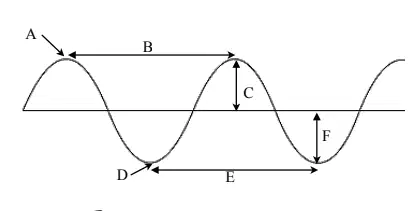
Which wave property is shown by letter B?
frequency
wavelength
amplitude
wave speed
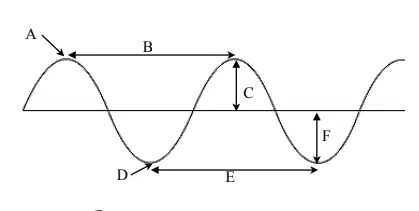
Which wave property is shown by letter C?
amplitude
wavelength
frequency
period
Which wave property is shown by letter A?
crest
wavelength
trough
period
Which wave property is shown by letter D?
crest
wavelength
trough
period
Occurs when a wave bounces off a surface that it cannot pass through.
reflection
refraction
diffraction
interference
The bending of a wave as it enters a new medium at an angle.
reflection
refraction
diffraction
interference
The bending of a wave as it moves around an obstacle or passes through a narrow opening.
reflection
refraction
diffraction
interference
Occurs when two or more waves overlap and combine together.
reflection
refraction
diffraction
interference
Occurs when two or more waves combine to produce a wave with a larger displacement.
constructive interference
destructive
interference
diffraction
refraction
When two or more waves combine to produce a wave with smaller displacement.
constructive interference
destructive
interference
diffraction
refraction
A wave that appears to stay in one place.
standing wave
node
antinode
diffracting wave
A point on a standing wave that has no displacement from the rest position.
node
antinode
standing node
constructive node
A point where a crest or trough occurs midway between two nodes.
mid-node
antinode
standing node
constructive node
When a wave enters a medium at an angle (a) occurs because one side of the wave moves more slowly than the other side.
Which type of wave are sound waves?
longitudinal waves
surface waves
transverse waves
The speed of sound is
20 m/s
342 m/s
5280 m/s
1600 m/s
Sound waves travel fastest in _____
solids
liquids
gases
a vacuum
Sound intensity is measured in
hertz
meters/second
decibels
seconds
The frequency of sound as you perceive it.
pitch
amplitude
intensity
speed

The change in sound frequency caused by the motion of the sound source, motion of the listener, or both.
Doppler effect
ultrasound effect
sonar effect
loudness effect
Match the parts of the ear to their function.
outer ear
gathers and focuses sound
middle ear
3 tiny bones sense vibrations
inner ear
sends impulses to the brain
eardrum
membrane that vibrates
The response of a standing wave to a wave of the same frequency, often producing a dramatic increase in amplitude.
resonance
ultrasound
sonar
pitch
A technique for determining the distance to an object underwater.
resonance
ultrasound
radar
sonar
As a source of sound approaches, an observer hears a (a) frequency. When the sound source moves away, the observer hears a (b) frequency.

