
 Worksheets
Types of evolution
Total questions: 224
Worksheet time: 4hrs 48mins
What event is considered the earliest example of ecology at work?
The Cambrian Explosion
The Permian-Triassic Extinction Event
The rise of oxygen in the atmosphere due to cyanobacteria
The evolution of eukaryotes
What is the primary process by which the first oxygen in the atmosphere was produced?
Photosynthesis
Endosymbiosis
Volcanic activity
Methane release from the sea floor
What is the term used to describe the first appearance of life on Earth?
Abiogenesis
Biogenesis
Evolution
Adaptation
What is the primary process by which the first nitrogen in the atmosphere was produced?
Photosynthesis
Endosymbiosis
Volcanic activity
Nitrogen fixation by bacteria
How does oxygen allow for larger organism?
O2 mixes with our cells to create energy.
N2 mixes with our cells to create energy.
O2 mixes with our blood to create larger blood cells.
H2 mixes with our cells to create energy.
How much oxygen does one tree in the Amazon rainforest produce?
Enough to support all of Brazil.
Enough to support all of the people on Earth.
Enough to support 2 people.
Enough to support 1 million people.
Why doesn't the oxygen leave the Amazon rainforest?
What is being sucked up from the Amazon rainforest floor?
What is the secret to Earth's supply of oxygen?
Diatoms
How does the diatom population change daily?
What is hypoxia?
Match the following images to the correct answer:

Acidophiles (acid loving bacteria)

Marine Snow (dead diatoms)

Early Earth (with too much O2)

Amazon Rainforest

Diatoms
What is rust formed by?
water, iron, and oxygen
carbon dioxide, water, and oxygen
water, oxygen, and bacteria
Rocks containing layers of iron oxide formed before oxygen was released into the atmosphere by living things.
true
false
The oxygen that entered Earth's atmosphere was produced by
clouds
plants
cyanobacteria

Stromatolites are piles of cyanobacteria that have been secreting a lime substance and hardening over time so that they resemble rocks?
true
false

Iron oxide is also known as rust?
true
false
an organism that grows without air, or requires oxygen-free conditions to live.
Anaerobes
aerobes
a microorganism that grows in the presence of air or requires oxygen for growth.
anaerobes
aerobes

Single-celled organisms without a nucleus are called a
prokaryote
eukaryote
an organism consisting of a cell or cells in which the genetic material is DNA in the form of chromosomes contained within a distinct nucleus.
prokaryote
eukaryote
Oxidation is the process where a substance combines with oxygen.
true
false
What best describes the term succession?
rapid changes that create an ecosystem overnight
gradual changes over time to fully create or restore and ecosystem
forest with the tallest trees
the rate species produce offspring
Which of the following best describes primary succession?
Volcano wipes out ecosystem that gradually grows back from ash covered soil
Volcano creates a new island of rock that must break down to form an ecosystem
Forest fire burns down forest that must bounce back over time
Tornado destroys a crop that must slowly grow back over time.
Breaking News! A new island has formed off of Hawaii! What must occur for it to become an ecosystem?
Secondary Succession
Aquatic succession
Primary Succession
Ferns must grow

Which would result in primary succession?
volcano destroying habitat leaving only soil and ash
Tornado destroying a crop leaving very little soil
Glacier retreating exposing bare rock
limiting factors
Primary succession occurs in areas with:
very little soil
lots of soil
no soil
soil that has been disturbed
An example of typical pioneer species, that is one that appears in the earliest stages of ecological succession is:
Oak Trees
Spiders
Weeds
Small Conifer Trees
How do pioneer species compare in primary and secondary succession?
primary starts with grass and weeds, secondary starts with mosses
primary starts with forest fire, secondary starts with volcano
primary starts with a volcano, secondary starts with a forest fire
Lichens and moss in primary, and grasses/ ferns in secondary
What is coevolution?
The study of prehistoric life.
The study of the structures of organisms.
When two or more species affect each other's evolution through the process of natural selection.
Over generations, organisms evolve a variety of characteristics that allow them to survive in different environments.
What is gene mutation?
Favorable traits chosen
Alteration of DNA that could be helpful or harmful.
(could cause evolution)
Movement of genes into and out of a population
An elimination of a species after a change in their DNA.
Which of the following means "genetic changes in a species over time"
natural selection
speciation
evolution
fitness

Occurs when two or more species reciprocally affect each other's evolution
macroevolution
microevolution
coevolution
parallel evolution

The grinding away of rock by other rock particles carried in water, ice, or wind
limestone
abrasion
climate
dissolving
The process that breaks down rock through chemical changes
chemical weathering
mechanical weathering
frost wedging
rusting
Chemical weathering of minerals into clay.
sandstone
shale
frost wedging
clay formation
The average weather conditions in an area over a long period of time.
rusting
sediments
erosion
climate
a physical change in which particles of a substance are separated by water particles.
dissolving
rusting
sandstone
weathering
The mechanical breakup of rock caused by the expansion of freezing water in cracks and crevices.
chemical weathering
erostion
fusion
frost wedging
A usually light-colored rock that is found in continental crust
shale
sandstone
granite
limestone
a sedimentary rock consisting mainly of calcium that was deposited by the remains of marine animals
sandstone
limestone
granite
shale
The type of weathering in which rock is physically broken into smaller pieces
chemical weathering
mechanical weathering
condensation
precipitation
The change of a substance from a liquid to a gas
evaporation
condensation
precipitation
interception
The change of state from a gas to a liquid
evaporation
limestone
condensation
precipitation
a long period without rain
flood
drought
storm
evaporation
the red or orange coating that forms on the surface of iron when exposed to air and moisture
clay formation
climate
sediments
rusting
A sedimentary rock formed by cementing grains of sand over time.
clay formation
granite
sandstone
shale
Any form of water that falls from clouds and reaches Earth's surface.
precipitation
irrigation
interception
condensation
Water being prevented from reaching the surface by trees or grass
drought
interception
condensation
evaporation
The continual movement of water among Earth's atmosphere, oceans, and land surface through evaporation, condensation, and precipitation
oxygen cycle
flow cycle
water cycle
rock cycle
the study of water and its effects on and in the earth and in the atmosphere
astrology
microbiology
geology
hydrology
water held underground in the soil or in pores and crevices in rock.
discharge
mountain shed
ground water
frost wedging
the quantity of water in a stream that passes a given point in a period of time
discharge
sediments
interception
slope
The breaking down of rocks and other materials on the Earth's surface.
weathering
erosion
deposition
condensation
The process by which wind, water, ice, or gravity transports soil and sediment from one location to another
erosion
deposition
weathering
sedimentary
Loose materials such as rock fragments, mineral grains, and bits of shell that have been moved by wind, water, ice, or gravity
sediments
sand
transportation
deposition
the steepness of a mountain, hill, or channel
water cycle
stream
slope
flow

What is the title of this graph? What do you think that means, and what ideas do you think this graph is showing (in your own words)?

Look at the image closely. What is the independent variable on this graph?
Generation
Population

Look at the image closely. What is the dependent variable on this graph?
Generation
Population

What does the blue line stand for?
Host population
Parasite population

What does the red line stand for?
Host population
Parasite population

What is happening to the host population AND parasite population over many generations?

At generation 100, which is increasing: the host population or the parasite population? (Look at the lines on the graph above generation 100).
Host populations
Parasite population

Around generation 100, what happens to parasite population soon after there is an increase in the host population?
It increases as well.
It decreases in response.
It remains constant.

Why does the parasite population increase soon after the host population increases?

Around generation 180, which population is larger? Host or parasite?
Host
Parasite

Around generation 180, what do you notice ends up happening to the host population when the parasite population is large?
It increases as well.
It decreases in response.
It remains constant.
Why do you think the host population decreases in response when the parasite population is high?
What event is considered the earliest example of ecology at work?
The Cambrian Explosion
The Permian-Triassic Extinction Event
The rise of oxygen in the atmosphere due to cyanobacteria
The evolution of eukaryotes
What is the primary process by which the first oxygen in the atmosphere was produced?
Photosynthesis
Endosymbiosis
Volcanic activity
Methane release from the sea floor
What is the term used to describe the first appearance of life on Earth?
Abiogenesis
Biogenesis
Evolution
Adaptation
What is the primary process by which the first nitrogen in the atmosphere was produced?
Photosynthesis
Endosymbiosis
Volcanic activity
Nitrogen fixation by bacteria
How does oxygen allow for larger organism?
O2 mixes with our cells to create energy.
N2 mixes with our cells to create energy.
O2 mixes with our blood to create larger blood cells.
H2 mixes with our cells to create energy.
How much oxygen does one tree in the Amazon rainforest produce?
Enough to support all of Brazil.
Enough to support all of the people on Earth.
Enough to support 2 people.
Enough to support 1 million people.
Why doesn't the oxygen leave the Amazon rainforest?
What is being sucked up from the Amazon rainforest floor?
What is the secret to Earth's supply of oxygen?
Diatoms
How does the diatom population change daily?
What is hypoxia?
Match the following images to the correct answer:
Acidophiles (acid loving bacteria)
Marine Snow (dead diatoms)
Early Earth (with too much O2)
Amazon Rainforest
Diatoms
Hummingbirds have a beak just the right length to reach the nectar in a cardinal flower and as they feed their foreheads bump into the pollen structure. Cardinal flowers are red which hummingbirds can see but bees can’t. Cardinal flower’s pollen structure is just the right length for the hummingbird to pick up pollen as it feeds
Convergent
Divergent
Coevolution
Bees don’t see red, but do see yellow, blue, and ultra-violet light. Thus, bee-pollinated flowers are mostly yellow or blue with UV nectar guides (landing patterns) to guide the bee. They usually have a small, narrow floral tube to fit the tongue-length of that species of bee.
Convergent Evolution
Divergent Evolution
Coevolution
In the ocean surrounding Antarctica, there are fish that survive the cold water by using a molecule made of glycoproteins that circulates the blood and keeps it from freezing. Certain kinds of worms that live in the Arctic ocean also make antifreeze proteins that help them live in icy water.
Convergent Evolution
Divergent Evolution
Coevolution
The beaver in North America and the capybara in South America share a common ancestor, but have evolved over time to look different
Convergent Evolution
Divergent
Coevolution
Ants are the correct size and weight needed to open the flowers for the peony plant. The peony plant provides food for the ant and the ant fertilizes the peony’s flowers
Convergent
Divergent
Coevolution
The Galápagos tortoises share a common ancestor, but have necks of different lengths to best reach the food they need in their environment.
Convergent
Divergent
Coevolution
Whales, sharks, and penguins all have streamlined bodies and fins/flippers for moving in water even though they belong in different classes of animals (mammals, fish, and birds)
Convergent
Divergent
Coevolution
The Galápagos finches evolved through natural selection from a common ancestor into a wide variety of different looking species.
Convergent Evolution
Divergent Evolution
Coevolution
This kind of evolution is proven by DNA analysis and results in organisms with different ancestors becoming more alike as they adapt to similar environments.
Convergent Evolution
Divergent Evolution
Coevolution
The Galloti atlantica and Galloti galloti lizards evolved through natural selection from a common ancestor into a wide variety of different looking lizards.
Convergent
Divergent
Coevolution
gradual formation of life from nonliving chemicals...primordial soup
chemical evolution
natural selection
fossils
divergent evolution
requires oxygen to release energy
aerobic heterotroph
photosynthetic autotroph
gene homology
adaptation
Wrote origin of species, study finches in the Galapagos Islands, father of evolution
Charles Darwin
Isaac Newton
Gregor Mendel
Urey Miller
evolution of organisms based on who is better adapted to the environment
natural selection
artificial selection
speciation
coevoluion
analogous structures
similar function but not related
homologous structures
same structure just in different species
coevolution
two species evolve in response to each other
fossils
preserved remnants of once-living organisms
vestigial structures
served functions in ancestors but not needed now

This picture shows
Embryological similarities
Fossils
Coevolution
Adaptations

directional selection

Stabilizing selection

Disruptive Selection

Bottleneck Effect

Founder Effect
a trait that helps an organism survive and reproduce
adaptation
coevolution
artificial selection
gene homology

According to this diagram, is the pig more closely related to the dog or kangaroo?
(a)

Which species are extinct? (Check all that apply.)
A
D
E
H
J

Which species is a common ancestor for species B and D?
C
F
G
H
K
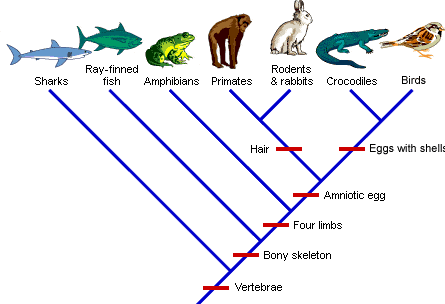
According to this cladogram, primates are most closely related to....
Amphibians
Rodents & rabbits
Crocodiles
Birds
one of the first organisms to use sunlight to produce food and oxygen
photosynthetic autotrophs
aerobic heterotrophs
speciation
geographic isolation

Survival of the fittest. The organism that is best able to survive and passes on its genes in the gene pool.
Natural Selection
Evolution
Adaptation
Law of Superposition

Similar DNA sequence between different organisms indicating a common ancestry or evolutionary origin.
Speciation
Embryology
Gene Homology
Adaptation
What are analogous structures in the context of convergent evolution?
They are structures that perform similar functions but do not share a common ancestor, they arise from convergent evolution.
They are structures that arise from divergent evolution.
They are structures that share a common ancestor but perform different functions.
They are structures that have no relation to convergent evolution.
How are organisms classified in the Linnaean classification?
Primary, secondary, tertiary, quaternary, quinary, senary, septenary
A, B, C, D, E, F, G
Kingdoms, divisions, classes, orders, families, genera, species
Colors, sizes, shapes, textures
What is a scientific name and why is it important in the classification of organisms?
A scientific name is a name that varies according to the geographical region of the organism
A scientific name is a name that is only used in the classification of plants
A scientific name is a name that is randomly assigned to an organism
A scientific name is a binomial name composed of a genus and a species, and it is important in the classification of organisms because it provides a standardized and universal system to uniquely identify and refer to each species.
Can two different species have analogous structures?
Yes
Depends
Maybe
No
What is the main purpose of Linnaean classification in biology?
Create new plant species
Determine the age of fossils
Classify chemical elements in the periodic table
Organize and categorize the diversity of living beings into hierarchical groups.
Why are analogous structures considered an example of convergent evolution?
Analog structures are considered an example of convergent evolution because they arise in different evolutionary lineages but share similar functions due to adaptations to similar environments, demonstrating that natural selection favors similar solutions to common environmental challenges.
Analog structures are considered an example of convergent evolution because they share a common ancestor
Analog structures are considered an example of convergent evolution since they are identical in all aspects
Analog structures are considered an example of convergent evolution due to genetic drift
What information can be inferred from a scientific name in terms of biological classification?
What information can be inferred from a scientific name in terms of biological classification?
A scientific name indicates the preferred habitat of an organism in terms of biological classification
A scientific name only indicates the kingdom to which an organism belongs
A scientific name provides information about the genus and species to which an organism belongs in terms of biological classification.
A scientific name reveals the age of an organism in terms of biological classification
What role does convergent evolution play in biodiversity?
Contributes to functional diversity by generating similarities in species that do not share a common ancestor.
Increases genetic diversity by limiting similarities between species
Reduces competition between species by generating marked differences
Promotes specialization in a single ecological niche
How do analogous structures relate to the adaptation of organisms?
Analogous structures are the result of an organism adapting to multiple different environments
Analogous structures demonstrate that organisms share a common ancestor
Analogous structures show independent adaptations to similar environments, demonstrating how different species have evolved to occupy similar ecological niches through analogous solutions to environmental challenges.
Analogous structures are the result of an organism adapting to a single specific environment
What importance does Linnaean classification have in current scientific research?
The Linnaean classification is important because it provides a universally accepted system of organization and nomenclature to describe and classify the diversity of life on Earth.
The Linnaean classification is only used in botanical research
The Linnaean classification is just an outdated theory in modern science
The Linnaean classification is not relevant in current scientific research
What is the difference between a homologous structure and an analogous structure in terms of evolution?
The difference lies in the fact that homologous structures share a common ancestor, while analogous structures do not.
Homologous structures are evolutionary adaptations, while analogous structures are the result of natural selection.
Homologous structures are not evolutionarily related, unlike analogous structures.
Homologous structures are completely different from each other, while analogous structures are similar in all aspects.
How is the scientific name of an organism determined according to binomial classification?
The scientific name of an organism is determined by the binomial classification, which consists of the genus and species of the organism.
The scientific name of an organism is determined by the color of the organism and its size.
The scientific name of an organism is determined by the habitat of the organism and its diet.
The scientific name of an organism is determined by the number of legs of the organism and its speed of movement.
The science of classification is called
taxonomy
botany
astronomy
chemistry
In binomial nomenclature, the name of any organism is made up of its
kingdom and phylum
family and genus
class and order
genus and species
The method of scientific classification used today is based on the classification system developed by
Carolus Linnaeus
M. Courtney Latimer
John Ray
Charles Darwin
A group of similar organisms that can mate with each other and produce offspring is called a
kingdom
phylum
species
genus
A classification system
groups animals according to the way they move
consists of only one species of organism
groups living things according to similar characteristics
The study of how animals have change over time is called
biology
evolution
taxonomy
astrology
The scientist who first understood that animals change over time to adapt to their environment was
Socrates
Galileo
Carolus Linnacus
Charles Darwin
The process by which unrelated organism evolve similar characteristics is called
biology
convergent evolution
ordering
classification

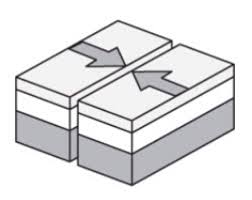
What geological feature would an oceanic-oceanic convergent boundary create?
volcanic mountains
mountains
volcanic islands

What geological feature would an oceanic-continental convergent boundary create?
volcanic mountains
mountains
volcanic islands

What geological feature would an continental-continental convergent boundary create?
volcanic mountains
mountains
volcanic islands

When one plate forces it's way under another plate.
convection
boundary
subduction

The edges of plates are called....
convection
boundaries
subduction

At plate boundaries, plates interact, the results would be
geologic features
earthquakes
a country's border

Convergent boundaries are plates
colliding or smashing into each other.
sliding past each other.
separating or pulling apart from each other.


A subduction zone is formed...
when the oceanic crust sinks below the continental crust
at every type of convergent plate boundary
at every type of divergent plate boundary
at transform boundaries
The process by which one plate is forced under another
Radiation
Convection
Conduction
Subduction


The adaptations of wasps, flying fish, flying birds, and bats that allow them to fly are examples of:
punctuated evolution
convergent evolution
divergent evolution
gradual evolution

A bumble bee has just enough mass to pull down and open up the snapdragon flower to get to the nectar inside. Other insects cannot do this. This adaptation is an example of:
convergent evolution
co-evolution
divergent evolution
speciation
The rapid speciation of one ancestral species into many descendant species is called
Adaptive radiation
Punctuated equilibrium
Coevolution
Divergent evolution
Which best describes punctuated equilibrium?
Speciation occurs due to natural selection
Speciation occurs due to isolation
Speciation occurs slowly in geologic time, followed by long periods with very fast evolutionary change.
Speciation occurs suddenly and rapidly in geologic time, followed by long periods with little evolutionary change.
The large-scale events of speciation that happen over hundreds or thousands of generations are called...
macroevolution
simplification
adaptation
microevolution


Evolution occurring gradually and slowly over long periods of time
Homeostasis
Stasis
Punctuated Equilibrium
Gradualism
When two species evolve because of how they influence eath other, which usually results in a symbiotic relationship, this is called:
extinction
coevolution
symbiosis
mutualism
Select the best definition for Macroevolution.
Select all types of evolutionary patterns.
Extinction
Convergent and Divergent Evolution
Gradualism
Coevolution
Select the best description of the term Extinction.
Why do species go extinct?
Select the best definition for Divergent Evolution.
Darwin's finches are an example of:
Coevolution
Extinction
Divergent Evolution
Convergent Evolution
Select the best definition for Convergent Evolution.
Select the best definition for Coevolution.
Which of the following is an example of Coevolution?
Select the best definition of gradualism as it relates to evolution.
Select the best definition for Punctuated Equilibrium.
Ostriches are native to the Savannahs of Africa, while penguins live in the polar regions. Although penguins and ostriches are closed related, they look very different. This is an example of:
Divergent Evolution
Convergent Evolution
Coevolution
Punctuated Equillibrum
Ostriches (birds) and giraffes (mammals) are both native to the Savannahs of Africa. They share the same characteristic of a very long neck. This is an example of:
Divergent Evolution
Convergent Evolution
Coevolution
Punctuated Equillibrum
Horse evolution shows long stable periods of little evolution interrupted by brief periods of rapid change. This is an example of:
Divergent Evolution
Convergent Evolution
Coevolution
Punctuated Equilibrium
The formation of new and distinct species in the course of evolution
artificial selection
speciation
breeding
non-random mating
Who is credited with the discovery of Natural Selection?
Charles Darwin
Charles Xavier
Charles Dickens
How did the turtles change over time?
They grew longer necks to get food
Over years only the ones more equipped to get food survived to reproduce
A random mutation enabled survival
Select all answers that influence Evolution of organisms.
Gene Flow
Natural Selection
Genetic Drift
Aliens
Father of Evolution
Gregor Mendel
Charles Darwin
Adam Smith
Pea plants
Evolution is defined as a(n)
Idea that organisms better suited for their environment will survive and reproduce
Any physical or behavioral characteristic that helps an organism to better survive
Theory that organisms have changed gradually over a long period of time to form mew organisms
Natural Selection is the idea that
Organisms better suited for their environment will survive and reproduce
Any physical or behavioral characteristic that helps an organism to better survive
Theory that organisms have changed gradually over a long period of time to form mew organisms
An adaptation is
Organisms better suited for their environment will survive and reproduce
Any physical or behavioral characteristic that helps an organism to better survive
Theory that organisms have changed gradually over a long period of time to form mew organisms
Mutations are
Long Time evolutionary events
Short time evolutionary events
Mistakes in the genetic code
When an organism looks very similar win physical resemblance to other objects
Mimicry is
Long Time evolutionary events
Short time evolutionary events
Mistakes in the genetic code
When an organism looks very similar win physical resemblance to other objects
An example of high fitness (the ability to survive and reproduce) is
A man with 1 child and 10 grandchildren
A man with 10 children ad 80 grandchildren
Natural selection is the process that passes down ____________________ traits.
Same
Old
Useless
Favorable
The process in which an animal cannot reproduce any more and dies out is known as _________________________.
Speciation
Extinction
Evolution
Natural Selection
When there is a difference in population based on genes, it is said to be a _______________.
Mutation
Speciation
Extinction
Genetic Variation
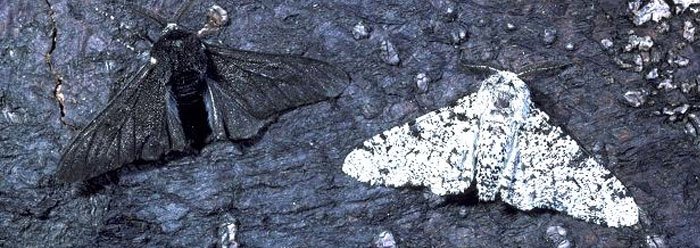
Quite often we see organisms that have similar characteristics, not because they have arisen from a common ancestor, but because they have adapted to similar environments. Which type of evolution is this?
Divergent evolution
Convergent evolution
Punctuated equilibrium
Coevolution

The flower developed a long flower to hold its nectar are the hummingbird in turn developed a long beak to get the nectar. This is an example of
convergent evolution
divergent evolution
coevolution
SELECT ALL THAT APPLY: Which of the following must be true in order for organisms to be considered the same species?
They must be able to mate
They must be able to produce viable offspring
They must have structural similaries
They must have the same bone structure
Ostriches (birds) and giraffes (mammals) are both native to the savannahs of Africa. They eat food that is high off the ground and share the same characteristic of an elongated neck.
divergent evolution
convergent evolution
coevolution
The kit fox lives in the desert and has large ears with greater surface area that keep the fox from getting overheated. The red fox lives in the forest and has a red coat that keeps it camouflaged.
divergent evolution
convergent evolution
coevolution
Ants are the correct size and weight needed to open the flowers for the peony plant. The peony plant provides food for the ant and the ant fertilizes the peony’s flowers
divergent evolution
convergent evolution
coevolution

The three species pictured share a common ancestor and have adapted so that each lives in a different environment. This is an example of
Law of Superposition
Evolutionary Arms Race
Divergent Evolution
Convergent Evolution
Some scientists suggest that the mass extinction of dinosaurs resulted from sudden global weather changes caused by the impact of an asteroid on Earth. This event most likely promoted the evolution of new species of animals. What concept is best supported by these ideas?
Punctuated equilibrium
Use and disuse
Gradualism
Convergent evolution

The last Tasmanian tiger died in captivity in 1939. What pattern of evolution occurred in the Tasmanian tiger's population?
Extinction
Gradualism
Divergent Evolution
Coevolution
This pattern of evolution describes short bursts of evolutionary change in a population of organisms, followed by periods of stability (no change).
Gradualism
Coevolution
Punctuated Equilibrium
Speciation

Birds, bats, and pterosaurs are unrelated, but they all developed wings to fly. This is an example of
convergent evolution
divergent evolution
coevolution

All of these finches are related and came from a common ancestor, but they all developed different beak types based on what food was available. This is an example of
convergent evolution
divergent evolution
coevolution
The beaver in North America and the capybara in South America share a common ancestor, but have evolved over time to look different
Convergent Evolution
Divergent Evolution
Coevolution

