wayground logo

Free Printable Worksheets

Font size

S
M
L
XL
Worksheets

✅Nuclear Energy Unit Study Guide

Total questions: 146

Worksheet time: 4hrs 3mins

Name
Class
Date
1.

What is a beta particle made of?

a)

One proton

b)

A helium particle

c)

One electron

d)

One proton and one neutron

2.

Which of these processes describes a nuclear fusion reaction?

a)

A nucleus absorbs energy to produce lighter nuclei.

b)

A nucleus splits to produce energy and lighter nuclei

c)

Two nuclei bind together to produce energy and heavier nuclei.

d)

Two nuclei bind together to produce energy and a lighter nuclei.

3.

Of the main types of radiation emitted from naturally radioactive isotopes, which is the hardest to block?

a)

Alpha deca

b)

Gamma Decay

c)

Beta decay

d)

They are all blocked using the same method
4.
What is emitted during Beta Radiation?
a)
A high-energy Electron.
b)
Protons.
c)
Neutrons.
d)
Nuclei
5.
TRUE or FALSE: gamma changes the atomic number.
a)
True
b)
False
6.
What is emitted during Alpha Radiation?
a)
A helium nuclei.
b)
A helium atom
c)
Gamma Rays.
d)
Positrons
7.
What is radioactive decay?
a)
The spontaneous breakdown of an atomic nucleus resulting in only energy release
b)
The spontaneous breakdown of an atomic nucleus resulting in only matter release
c)
The spontaneous breakdown of an atomic nucleus resulting in a release of energy and matter
d)
The decay of the use of radios and the increased use of televisions.
8.
Which type of nuclear radiation is being emitted here?
a)
Alpha
b)
beta
c)
gamma 
d)
none
9.
When does radioactive decay occur?
a)
When the nucleus of an isotope is unstable
b)
When the nucleus of an isotope is stable
c)
When the electrons of an isotope are spinning
d)
When the electrons of an isotope are shared with another isotope
10.
Isotopes of the same element have different ____________. 
a)
 numbers of protons  
b)
numbers of electrons
c)
 symbols 
d)
numbers of neutrons
11.
This is an example of...
a)
Fission  reaction
b)
Fusion reaction
c)
Decomposition reaction
d)
Decay
12.
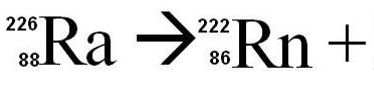
Complete the nuclear equation and determine the type of decay that is occurring in this reaction. 
a)
alpha
b)
beta
c)
gamma
d)
none
13.
How many protons does gold atom have?
a)
197
b)
79
c)
118
d)
276
14.
What is the mass of an alpha particle?
a)
1
b)
2
c)
3
d)
4
15.
What is the definition of an isotope?
a)
An atom with different electron number to proton number
b)
An atom with different proton number from neutron number
c)
An atom with different number of protons from the periodic table
d)
An atom with a different number of neutrons from the periodic table
16.

Neutrons ......

a)

has positive electric charge with equal magnitude to that of an electron.

b)

has no net electric charge.

c)

has negative electric charge.

d)

orbiting the nucleus.

17.

What kind of force holds the nucleus together?

a)

Strong Nuclear Force

b)

Weak Nuclear Force

c)

Gravitational Force

d)

Electromagnetic Force

18.

What is the number of neutrons in Cesium?

a)

55 neutrons

b)

76 neutrons

c)

84 neutrons

d)

106 neutrons

e)

139 neutrons

19.

The atomic number of a given element is

equivalent to which of the following?

a)

Proton number in the nucleus

b)

Neutron number in the nucleus

c)

Sum of the protons and neutrons in the

nucleus

d)

Sum of the protons, neutrons and electrons

20.

If there are 146 neutrons in 238U, how many neutrons

are found in the nucleus of 235U?

a)

141

b)

143

c)

145

d)

147

21.

What is an Isotope?

a)
A variant of an element with the same number of protons but a different number of neutrons.
b)
A variant of an element with the same number of neutrons but a different number of protons.
c)
A variant of an element with the same number of electrons but a different number of protons.
22.

What elements are radioactive?

a)

All Elements with Atomic number more than 83

b)

All elements with atomic number under 83

23.

Why are elements over 83 atomic number radioactive?

a)
They have too many electrons
b)

In big atoms with a lot of protons repulsion causes instabilty.

c)
They are too heavy
24.

What is a radioisotope?

a)
A radioisotope is a type of radio wave.
b)
A radioisotope is a radioactive isotope.
c)
A radioisotope is a type of musical instrument.
25.

Three types of radioactive decay

a)
nuclear decay, electron decay, photon decay
b)
alpha decay, beta decay, gamma decay
c)
decay type A, decay type B, decay type C
26.

Which type of radioactive decay has electron symbol?

a)
alpha decay
b)
gamma decay
c)
beta decay
27.

Which type of radioactive decay has the helium symbol?

a)
alpha decay
b)
gamma decay
c)
beta decay
28.

Which nuclear decay has no mass or charge?

a)
alpha decay
b)
gamma decay
c)
beta decay
29.

Least penetrating nuclear decay?

a)
Gamma decay
b)
Beta decay
c)
Alpha decay
30.

Most damaging Nuclear decay to the human body?

a)
Beta decay
b)
Gamma decay
c)
Alpha decay
31.

What stops alpha decay?

a)

Paper.

b)

concrete.

c)

aluminum foil

32.

What nuclear decay can be stopped by aluminum?

a)
Beta decay
b)
Alpha decay
c)
Gamma decay
33.

What stops gamma decay?

a)
Vacuum
b)
Thin layers of paper or cloth
c)
Thick layers of dense materials such as lead or concrete
34.

What is the difference between fusion and fission reactions?

a)
Fusion reactions combine heavy atomic nuclei, while fission reactions split light atomic nuclei.
b)
Fusion reactions release energy, while fission reactions absorb energy.
c)
Fusion reactions combine light atomic nuclei, while fission reactions split heavy atomic nuclei.
35.

What type of nuclear reaction produces radioactive waste?

a)
Nuclear fusion
b)
Chemical reaction
c)
Nuclear fission
36.

What type of nuclear reaction is used in power plants?

a)
nuclear fission
b)
chemical reaction
c)
nuclear fusion
37.

Which type of nuclear reaction is used in stars?

a)
nuclear fission
b)
nuclear decay
c)
nuclear fusion
38.

What is a half-life?

a)
A half-life is the time it takes for half of the atoms in a radioactive substance to decay.
b)
A half-life is the time it takes for one-fourth of the atoms in a radioactive substance to decay.
c)
A half-life is the time it takes for all of the atoms in a radioactive substance to decay.
39.

Does a half-life ever change?

a)
Yes, it changes every hour
b)
No
c)
Only on leap years
40.

What is difference between parent isotope and daughter isotope?

a)
The parent isotope is the isotope that is formed as a result of the decay process, while the daughter isotope is the original radioactive isotope.
b)
The parent isotope and daughter isotope are the same isotope but in different states.
c)
The parent isotope is the original radioactive isotope that undergoes radioactive decay, while the daughter isotope is the new isotope formed as a result of the decay process.
41.

How many half-lives do the number of parent isotopes equal the number of daughter isotopes?

a)
2
b)
1
c)
0
42.

What is half life of this atom?

a)

20 days

b)

5 days

c)

15 days

43.

How many atoms left after 2 half-lives?

a)

450,000

b)

250,000

44.

How do you find the number of neutrons in an isotope?

a)
Subtract the atomic number from the atomic mass.
b)
Add the atomic number to the atomic mass.
c)
Multiply the atomic number by the atomic mass.
45.

How do you find the number of electrons in an isotope?

a)
The number of electrons in an isotope is equal to the atomic mass of the element.
b)
The number of electrons in an isotope is equal to the number of neutrons in the element.
c)

The number of electrons in an isotope is equal to the number of protons

46.

How do you find the number of protons in an isotope?

a)
The number of protons in an isotope is equal to the number of neutrons in the element.
b)
The number of protons in an isotope is equal to the atomic mass of the element.
c)
The number of protons in an isotope is equal to the atomic number of the element.
47.

What is a beta particle made of?

a)

One proton

b)

A helium particle

c)

One electron

d)

One proton and one neutron

48.

Which of these processes describes a nuclear fusion reaction?

a)

A nucleus absorbs energy to produce lighter nuclei.

b)

A nucleus splits to produce energy and lighter nuclei

c)

Two nuclei bind together to produce energy and heavier nuclei.

d)

Two nuclei bind together to produce energy and a lighter nuclei.

49.

Of the main types of radiation emitted from naturally radioactive isotopes, which is the hardest to block?

a)

Alpha deca

b)

Gamma Decay

c)

Beta decay

d)

They are all blocked using the same method
50.
What is emitted during Beta Radiation?
a)
A high-energy Electron.
b)
Protons.
c)
Neutrons.
d)
Nuclei
51.
TRUE or FALSE: gamma changes the atomic number.
a)
True
b)
False
52.
What is emitted during Alpha Radiation?
a)
A helium nuclei.
b)
A helium atom
c)
Gamma Rays.
d)
Positrons
53.
What is radioactive decay?
a)
The spontaneous breakdown of an atomic nucleus resulting in only energy release
b)
The spontaneous breakdown of an atomic nucleus resulting in only matter release
c)
The spontaneous breakdown of an atomic nucleus resulting in a release of energy and matter
d)
The decay of the use of radios and the increased use of televisions.
54.
Which type of nuclear radiation is being emitted here?
a)
Alpha
b)
beta
c)
gamma 
d)
none
55.
When does radioactive decay occur?
a)
When the nucleus of an isotope is unstable
b)
When the nucleus of an isotope is stable
c)
When the electrons of an isotope are spinning
d)
When the electrons of an isotope are shared with another isotope
56.
Isotopes of the same element have different ____________. 
a)
 numbers of protons  
b)
numbers of electrons
c)
 symbols 
d)
numbers of neutrons
57.
Complete the nuclear equation and determine the type of decay that is occurring in this reaction. 
a)
alpha
b)
beta
c)
gamma
d)
none
58.
What is the mass of an alpha particle?
a)
1
b)
2
c)
3
d)
4
59.

What is the number of neutrons in Cesium?

a)

55 neutrons

b)

76 neutrons

c)

84 neutrons

d)

106 neutrons

e)

139 neutrons

60.

If there are 146 neutrons in 238U, how many neutrons

are found in the nucleus of 235U?

a)

141

b)

143

c)

145

d)

147

61.
If radiation is detected through paper, which 2 types could it be?
a)
Alpha & beta
b)
Beta & gamma
c)
Alpha & gamma
62.
Which is the most highly ionizing?
a)
Alpha
b)
Beta
c)
Gamma
63.
A certain element emits 1 alpha particle.  The atomic number of the resulting element is changed by...
a)
zero
b)
minus 1
c)
minus 2
d)
minus 4
64.
How do nuclear power-plants work?
a)
Fusion
b)
Half-life
c)
Fission
d)
Fusion or fission
65.

Which atoms combine together during fusion reaction on the sun?

a)

Helium and Hydrogen atoms

b)

Hydrogen atoms

c)

Hydrogen and Lithium atoms

d)

Hydrogen and Carbon atoms

66.

Very high temperature and pressure is require for:

a)

Fission

b)

Fusion

c)

Radioactive Decay

67.
Takes two small nuclei and combines them into a larger nucleus
a)
fission
b)
fusion
68.
The splitting of a nucleus into smaller nuclei is
a)
fusion
b)
fission
c)
half-life
d)
gamma radiation
69.
How do nuclear power-plants work?
a)
Fusion
b)
Half-life
c)
Fission
d)
Fusion or fission
70.
This is an example of...
a)
Fission  reaction
b)
Fusion reaction
c)
Decomposition reaction
d)
Decay
71.
Where does fusion occur naturally?
a)
Underwater
b)
All around us
c)
In the radioactive waste
d)
On the sun
72.
Which atoms combine together during fusion reaction on the sun?
a)
Helium and Hydrogen atoms
b)
Hydrogen atoms
c)
Hydrogen and Lithium atoms
d)
Hydrogen and Carbon atoms
73.
An example of an uncontrolled fission reaction is _______________
a)
Nuclear power plants
b)
Radio active decay
c)
Atomic Bomb
d)
On the surface of the sun
74.
What does it mean that fusion is a "chain reaction?"
a)
many steps or mini-reactions in the process
b)
long chains of elements form in a row
75.
Do all stars make energy through fusion?
a)
Yes
b)
No
c)
Just our sun
d)
Only large stars
76.
Very high temperature and pressure is required for:
a)
Fission
b)
 Fusion
c)
Radioactive Decay
77.
One disadvantage of nuclear energy is ___.
a)
it is a fossil fuel
b)
it leaves behind radioactive waste
c)
it emits large amounts of pollution into the atmosphere
d)
there are no disadvantages
78.
Requires temperatures of millions of degrees?
a)
Fission
b)
Fusion
79.
Nuclear fusion releases energy when:
a)
heavy ions fuse together
b)
very light nuclei fuse together
c)
uranium splits into two fragments
d)
uranium emits a neutron
80.
The splitting of a nucleus into smaller nuclei is
a)
fusion
b)
fission
c)
decay
d)
gamma radiation
81.

In the equation E=mc2, which of the following correctly represents one or constants?

a)

M=the sum of the masses

b)

E= the amount of energy absorbed

c)

C2= the speed of light

d)

All of the above

82.

The following is what type of equation?

a)

Fission

b)

Fusion

c)

Alpha Decay

d)

Beta Decay

83.

How many neutrons are released in the above equation?

a)

1

b)

2

c)

3

d)

4

84.

What is the missing element?

a)

Rubidium 89

b)

Rubidium 90

c)

Cesium 144

d)

Cesium 145

85.

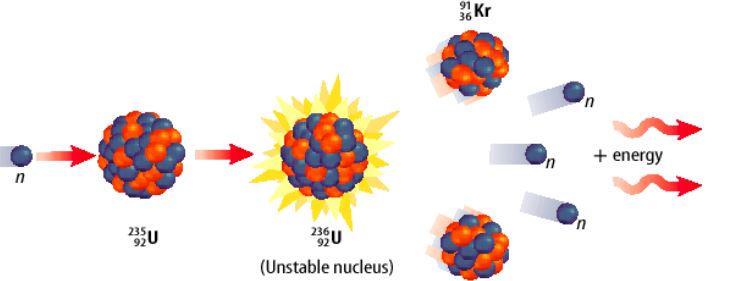
What is briefly created from this reaction?

a)

Uranium 234

b)

Uranium 235

c)

Uranium 236

d)

Uranium 237

86.

How many neutrons are going to be released from the barium and krypton part of this equation

a)

1

b)

2

c)

3

d)

unknown

87.

How many neutrons are going to be released from the Xenon and Strontium part of this equation?

a)

1

b)

2

c)

3

d)

unknown

88.

How many neutrons are going to be released from the Cesium and Rubidium part of this equation?

a)

1

b)

2

c)

3

d)

unknown

89.

The three main types of nuclear radiation are alpha, beta, and gamma. Which of the following lists these types of radiation from highest penetrating power to lowest penetrating power?

a)

alpha, gamma, beta

b)

beta, alpha, gamma

c)

beta, gamma, alpha

d)

gamma, beta, alpha

90.

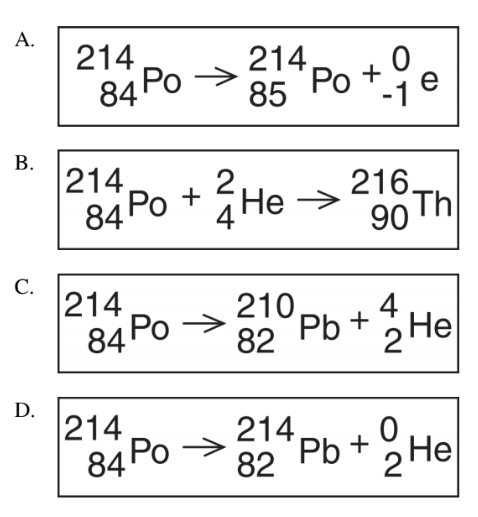
Which equation correctly represents the alpha decay of polonium-214?

a)

A

b)

B

c)

C

d)

D

91.

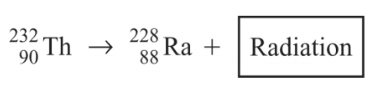
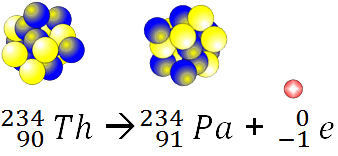
This equation shows the radioactive decay of thorium (Th). Which of the following particles is released in this reaction?

a)

alpha

b)

beta

c)

neutron

d)

gamma

92.
a)

alpha particle

b)

beta particle

c)

neutron

d)

proton

93.
a)

A

b)

B

c)

C

d)

D

94.
a)

A

b)

B

c)

C

d)

D

95.
a)

it's 88 because element X gains 2 protons

b)

it's 218 because element X loses 2 protons and 2 neutrons

c)

it's 220 because element X loses 2 neutrons

d)

it's 226 because element X gains 2 protons and 2 neutrons

96.
What particle completes this reaction?
a)
alpha particle
b)
beta particle
c)
gamma particle
d)
neutron
97.

Which of these atoms is most likely to undergo some form of radiation? (you can choose more than 1)

a)

Uranium

b)

Platinum

c)

Plutonium

d)

Cesium

e)

Hafnium

98.

finish the equation


18173Ta --> ____ + 18174W

a)

42He

b)

0-1e

c)

y

99.

finish the equation


22688Ra --> ____ + 22688Ra

a)

42He

b)

0-1e

c)

y

100.

Identify the type of nuclear decay shown here

21483Bi 0-1e + 21484Po

a)

alpha

b)

beta

c)

gamma

101.

Solve this equation.

85209At = ___ + 24He

a)

83205Bi

b)

86209Rn

c)

81207Tl

d)

85208At

102.

Finish this equation

20983Bi--> _______ + 20581Tl

a)

42He

b)

0-1e

c)

y

103.

What type of nuclear decay is shown here

13756Ba →→ 13756Ba + γ rays

a)

alpha

b)

beta

c)

gamma

104.

What type of decay is shown here

23892U ---> 23490Th + 42He.

a)

alpha

b)

beta

c)

gamma

105.

Solve this equation for.

614C = ___ + -10e

a)

410Be

b)

714N

c)

210He

d)

613C

106.

Solve this equation.

88226Ra = ___ + 24He

a)

86222Rn

b)

89226Ac

c)

84224Po

d)

88225Ra

107.

What type of particle has the symbol shown?

a)

alpha

b)

beta

c)

positron

d)

electron

e)

gamma

108.

What type of decay does this symbol represent?

a)

beta decay

b)

alpha decay

c)

fission

d)

fusion

109.
What is emitted during Alpha Radiation?
a)
A helium nuclei.
b)
A helium atom
c)
Gamma Rays.
d)
Positrons
110.

In alpha decay when the top number decreases by 4, what are you actually losing?

a)

2 protons & 2 neutrons

b)

4 protons

c)

2 protons & 2 electrons

d)

2 electrons & 2 neutrons

111.
The type of radioactive particle that can be stopped by a sheet of paper is the ____.
a)
alpha particle
b)
beta particle
c)
gamma ray
d)
uranium
112.

Gamma rays _________.

a)

have no mass and no charge

b)

have mass but no charge

c)

have no mass but have charge

d)

have mass and charge

113.
A helium nucleus with two protons and two neutrons is called a(n) ____.  
a)
alpha particle
b)
electroscope
c)
beta particle
d)
gamma ray
114.
The most penetrating type of radiation is the ____.  
a)
alpha particle
b)
gamma ray
c)
beta particle
d)
uranium
115.

List the three types of nuclear radiation in increasing order of penetrating power.  

a)
  alpha, beta, gamma 
b)
X ray, beta, gamma
c)

gamma, beta, alpha

d)
X ray, gamma, beta 
116.

Which choice is the correct alpha decay of uranium-238?

a)
b)
c)
d)
117.
What is Half-life?
a)
The amount of time it takes for some of the nuclei in a sample of the isotope to decay
b)
The amount of time it takes for half the electrons in a sample of the isotope to decay
c)
The amount of time it takes for half the nuclei in a sample of the isotope to decay
d)
the amount of time it takes to double the nuclei in a sample of the isotope to decay
118.
The half-life of Zn-71 is 2.4 minutes. If one had 100.0 g at the beginning, how many grams would be left after 7.2 minutes has elapsed?
a)
100.0g
b)
50.0g
c)
12.5g
d)
8.5g
119.
Pd-100 has a half-life of 3.6 days. If one had 620,310,740 atoms at the start, how many atoms would be present after 21.6 days?
a)
9.7x10⁶ atoms remain
b)
97.0x10⁶ atoms remain
c)
0.97x10⁶ atoms remain
d)
9.7x10⁵ atoms remain
120.
 Fermium-253 has a half-life of 0.334 seconds. A radioactive sample is considered to be completely decayed after 10 half-lives. How much time will elapse for this sample to be considered gone?
a)
0.334 seconds
b)
3.34 seconds
c)
1.77 seconds
d)
13.4 seconds
121.
After the third half-life, how much of the sample is left?
a)
1/2
b)
1/3
c)
1/16
d)
1/8
122.
The half life of iodine-131 is 8.040 days. What percentage of an iodine-131 sample will remain after 40.20 days?
a)
312.5%
b)
31.25%
c)
.3125%
d)
3.125%
123.
Barium-122 has a half-life of 2 minutes. A fresh sample weighing 80 g was obtained. If it takes 10 minutes to set up an experiment using barium-122, how much barium-122 will be left when the experiment begins?
a)
0.25g
b)
2.5g
c)
25g
d)
80g
124.
If 10 mg of iodine 131 is given to a patient, how much is left after 24 days? The half-life of iodine-131 is 8 days.
a)
1.25mg
b)
1.25g
c)
10g
d)
10mg
125.
The half-life of strontium-90 is 25 years. How much strontium-90 will remain after 100 years if the initial amount is 4.0 g?
a)
3.0g
b)
0.25mg
c)
0.3g
d)
0.25g
126.
If the half-life of uranium-232 is 70 years, how many half-lives will it take for 10 g of it to be reduced to 1.25 g?
a)
1 half-life
b)
2 half-lives
c)
3 half-lives
d)
4 half-lives
127.
Nuclear Power's source comes from _________________.
a)
Uranium or Plutonium
b)
Coal
c)
Natural Gas
d)
Oil and/or Coal
128.
When moving neutrons hit the nuclei of certain other atoms thereby causing them to disintegrate, and this happens repeatedly, it is said to be a _______________________.
a)
nuclear chain reaction
b)
alpha radiation
c)
nuclear half-life
d)
control rod
129.
At a nuclear power plant, these are referred to as __________________.
a)
cooling towers
b)
reactor towers
c)
smoke stacks
d)
vapor chambers
130.
What product does a nuclear power plant produce for its customers?
a)
electricity
b)
a turbine
c)
hot water
d)
steam
131.

A fission reaction starts when _________

a)

A neutron collides with a nucleus

b)

2 Nucleus collides with one another

c)

2 Neutrons collide with one another

d)

2 Neutrons collide with a single nucleus

132.

The components of an atom are? (More than one answer)

a)

Protons

b)

Neutrons

c)

Electrons

d)

Bosons

133.

Nucluear Fission is ...

a)

the splitting of atoms

b)

the combining of atoms

c)

the stripping of atoms of their electrons.

134.

Where in a Nuclear plant is the water heated?

a)

Steam Generator

b)

Reactor Chamber

c)

Generator

d)

Cooling tower

135.

What part of a nuclear reactor produces the heat that drives the nuclear reaction?

a)

turbine

b)

generator

c)

fuel rods

d)

control rods

e)

containment shell

136.

What part of a nuclear reactor is spun around by the heated water?

a)

turbine

b)

generator

c)

fuel rods

d)

control rods

e)

containment shell

137.

What part of a nuclear reactor converts mechanical energy to electrical energy?

a)

turbine

b)

generator

c)

fuel rods

d)

control rods

e)

containment shell

138.

What part of a nuclear reactor keeps the fuel from overheating?

a)

turbine

b)

generator

c)

fuel rods

d)

control rods

e)

containment shell

139.

What part of a nuclear reactor encloses it to prevent the release of products into the neighboring environment?

a)

turbine

b)

generator

c)

fuel rods

d)

control rods

e)

containment shell

140.

What substance is released from the cooling tower of a nuclear power plant?

a)

water vapor

b)

uranium

c)

plutonium

d)

deuterium

e)

tritium

141.
Takes two small nuclei and combines them into a larger nucleus
a)
fission
b)
fusion
142.
Where does fusion occur naturally?
a)
Underwater
b)
All around us
c)
In the radioactive waste
d)
On the sun
143.
One disadvantage of nuclear energy is ___.
a)
it is a fossil fuel
b)
it leaves behind radioactive waste
c)
it emits large amounts of pollution into the atmosphere
d)
there are no disadvantages
144.
Which of the following is true about nuclear fusion?
a)
It is easy to implement.
b)
It produces less energy than nuclear fission.
c)
It produces more energy than nuclear fission.
d)
It has the ability to occur easily in everyday life.
145.
What is Half-life?
a)
The amount of time it takes for some of the nuclei in a sample of the isotope to decay
b)
The amount of time it takes for half the electrons in a sample of the isotope to decay
c)
The amount of time it takes for half the nuclei in a sample of the isotope to decay
d)
the amount of time it takes to double the nuclei in a sample of the isotope to decay
146.
Barium-122 has a half-life of 2 minutes. A fresh sample weighing 80 g was obtained. If it takes 10 minutes to set up an experiment using barium-122, how much barium-122 will be left when the experiment begins?
a)
0.25g
b)
2.5g
c)
25g
d)
80g