
 Worksheets
Yr 12 CS - Data Transmission
Total questions: 97
Worksheet time: 59mins
Which of the following statements correctly describes serial and parallel transmission?
Serial transmission sends data one bit at a time, while parallel transmission sends multiple bits simultaneously.
Serial transmission sends multiple bits simultaneously, while parallel transmission sends data one bit at a time.
Both serial and parallel transmission send data one bit at a time.
Both serial and parallel transmission send multiple bits simultaneously.
Simplex, half duplex, and full duplex are types of:
Transmission methods
Network topologies
Data encryption techniques
Error correction codes
The need for multiplexing and switching is to:
Increase the speed of individual data streams
Allow multiple signals to share the same communication channel efficiently
Reduce the number of devices in a network
Eliminate the need for network protocols
Describe, using appropriate network protocols, such as TCP/IP, the typical contents of a packet.
A packet typically contains a header, payload, and trailer.
A packet only contains a header.
A packet only contains a payload.
A packet contains only a trailer.
Network collision occurs when two devices send data on the same network segment simultaneously. What is the process called that detects these collisions and how are they typically handled?
Collision detection; devices stop transmitting and resend after a random delay
Packet switching; devices ignore the collision
Error correction; devices automatically fix the data
Load balancing; devices reroute the data
Methods of routing traffic on a network include:
Static routing and dynamic routing
Only static routing
Only dynamic routing
Manual switching
Fill in the blank: Serial Transmission is when data is sent _______ at a time along the same data line/single wire from source to destination.
one bit
two bytes
one word
four bits
Which of the following best describes serial data transmission?
Data is sent in parallel along multiple wires
Data is sent one bit at a time along the same data line
Data is sent wirelessly
Data is sent in packets of 8 bits at a time

Refer to the diagram showing the binary sequence '0 0 1 0 1 1 0 1' being sent along a wire. What type of data transmission is being illustrated?
Serial data transmission
Parallel data transmission
Analog data transmission
Wireless data transmission
Which type of data transmission can travel longer distances?
Serial
Parallel
Fill in the blank: Serial transmission requires ______ wires compared with 8 or 16 in parallel.
single
multiple
double
triple
Serial transmission typically requires more wires than parallel transmission.
True
False
Which is typically cheaper and easier to set up: serial or parallel transmission?
Serial
Parallel
Fill in the blank: Serial transmission is less prone to ______ over long distances, making it more reliable.
interference
delay
attenuation
distortion
Serial transmission is better for long-distance communication than parallel transmission.
True
False
Which type of transmission is less susceptible to crosstalk and electromagnetic interference?
Serial
Parallel
Fill in the blank: Serial transmission can send and receive data simultaneously in both directions. This is called ______ capability.
Full-duplex
Half-duplex
Simplex
Parallel
Serial transmission can operate at higher frequencies compared to parallel transmission.
True
False
One disadvantage of serial data transmission is:
It is slower than parallel transmission
It is more expensive than parallel transmission
It requires more wires than parallel transmission
It is less reliable than parallel transmission
Fill in the blank: Serial communication typically has higher (a) than parallel communication.
Serial transmission is between two computers or from a computer to an external device located some distance away. One type of cable that uses serial data transport is:
Coaxial cable
Twisted pair cable
Fiber optic cable
Parallel cable
What is parallel data transmission?
Sending data bits one after another down a single wire
Sending data bits simultaneously down multiple wires, one bit per wire
Sending data bits wirelessly
Sending data bits using optical fibers
State one advantage of parallel data transmission.
Parallel data transmission is faster than serial transmission as multiple bits are sent at the same time, so transmission is completed in a shorter time.
Parallel data transmission is more reliable over long distances than serial transmission.
Parallel data transmission uses fewer wires than serial transmission.
Parallel data transmission is less expensive to implement than serial transmission.
State one disadvantage of parallel data transmission.
Hardware for parallel transmission is typically more expensive, and it is unreliable over long distances due to skew and interference.
It is slower than serial transmission for short distances.
It requires less power than serial transmission.
It is more secure than serial transmission.
Parallel data transmission is very reliable over long distances (more than 10 meters).
True
False
What is the problem known as 'skew' in parallel data transmission?
Typically, where is parallel data transmission used inside a computer system? Fill in the blank: Parallel data transmission is typically used inside a computer system, for example, in integrated circuits and within the _________?
Random Access Memory (RAM)
Hard Disk Drive (HDD)
Optical Drive
Network Interface Card (NIC)
Parallel transmission can either take place within a computer system (on a computer bus) or to an external device located a close distance away, such as ________.
internal buses
satellite links
fiber optic cables over long distances
wireless networks
Why is parallel data transmission reserved for connecting devices that use a high volume of data but are close to the computer? Fill in the blank: Parallel data transmission is reserved for connecting devices that use a high volume of data but are close to the computer, like ________ and ________.
printers and scanners
monitors and keyboards
routers and modems
speakers and microphones
What is simplex data transmission?
Data transmission in both directions simultaneously
Data transmission in one direction only
Data transmission in both directions, but not at the same time
Data transmission with error correction
Which of the following is an example of simplex data transmission?
A) Telephone conversation
B) Sending sound to a speaker system
C) Instant messaging
D) Video call
Fill in the blank: Satellite connections for TV use (a) mode, as satellite dishes can only receive data from a satellite and cannot send messages back.
In simplex data transmission, data can be sent and received in both directions at the same time.
True
False
The old teletext service on TVs is a classic example of which type of data transmission?
Simplex data transmission
Duplex data transmission
Half-duplex data transmission
Serial data transmission
What is 'half duplex communication'?
Communication that can happen in both directions at the same time
Communication that can happen in both directions but not at the same time
One-way communication only
Communication that cannot happen in any direction
Fill in the blank: The classic example of half duplex communication is a set of _________
walkie-talkies
telephones
fax machines
cell phones
Which of the following statements about half duplex transmission is correct?
Data transmission is possible in both directions at the same time
Data transmission is possible in both directions, but only in one direction at a time
Data transmission is only possible in one direction
Data transmission is not possible at all

A pair of two-way radios (walkie-talkies) can send and receive data, but not send and receive simultaneously.
True
False
What is full duplex data transmission?
Data transmission in one direction only
Data transmission in both directions, but not at the same time
Data transmission in both directions simultaneously
Data transmission with no direction
Fill in the blank: A telephone conversation is an example of ________ data transmission, where a user can send and receive a signal at the same time.
full duplex
half duplex
simplex
asynchronous

Which of the following is an example of full duplex data transmission?
Sending a letter by mail
A video conferencing call
Watching a movie in a theater
Listening to the radio

Full duplex data transmission allows both video and sound to be transmitted to all members of a conference at the same time.
True
False
What is multiplexing?
Where several independent data sources are combined
Where a single data source is split into several routes
Where data is encrypted for security
Where data is stored in a database
Fill in the blank: Multiplexing allows several independent data sources to be sent along a ________ to a specific destination.
single route
multiple cables
random path
separate channel
In telecommunications, several telephone calls may be carried using one wire due to multiplexing.
True
False
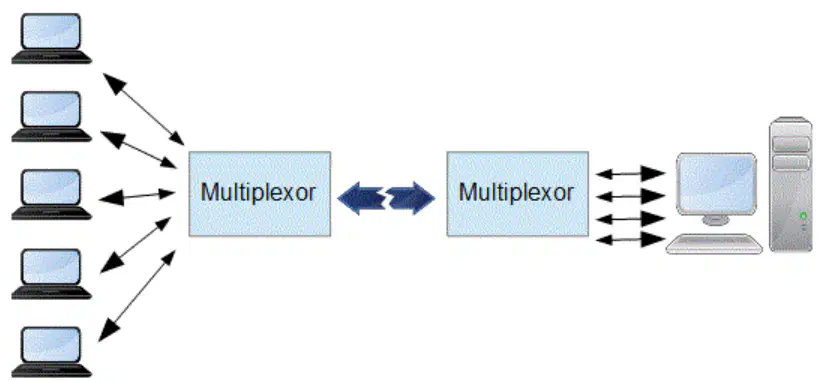
Multiplexers are used in computer networks because:
They allow multiple signals to share a single communication channel.
They increase the number of physical cables required.
They reduce the speed of data transmission.
They prevent data from being transmitted.
What is switching? Fill in the blank: Switching is the process of _______ packets and routing data to a specific destination.
examining
discarding
encrypting
compressing
What is the purpose of a switch in a network?
To slow down the network
To make multiple, simultaneous connections around a network and reduce network collisions
To increase the number of collisions
To broadcast packets to all computers
A communications protocol needs to specify what _______ rate will be used before successful communication can take place.
baud
bit
error
signal
A communications protocol needs to specify what _______ checking will be used before successful communication can take place.
parity
frequency
timing
address
A communications protocol needs to specify whether software or hardware _______ is to be used before successful communication can take place.
handshaking
encryption
compression
routing
A communications protocol needs to specify what _______ set is to be used before successful communication can take place.
character
color
number
signal
A communications protocol needs to specify how many _______ will be used for data before successful communication can take place.
bits
wires
ports
signals
A communications protocol needs to specify how many _______ bits will be used to control data transfer before successful communication can take place.
control
data
error
address
According to the passage, why are standards important in communication between computers?
They make computers faster
They describe accurately and unambiguously how information is transmitted
They increase the cost of products
They make computers look better
Fill in the blank: A manufacturer's products will work successfully with other manufacturer's products if they all follow the ______ standards.
same
different
random
unique
Which of the following is NOT a reason for setting standards in computer communication?
Providing a framework for manufacturers to design new products
Making products incompatible with each other
Breaking down complex ideas into smaller, easier-to-understand components
Describing how information is transmitted
What does TCP/IP stand for?
Transmission Control Protocol/Internet Protocol
Total Communication Protocol/Internet Protocol
Transfer Control Process/Internet Program
Telecommunication Control Protocol/Internal Protocol
Which protocol is used for sending email over the Internet?
FTP
HTTP
SMTP
TCP/IP
The International Telecommunications Union (ITU) is responsible for laying down the exact detail in the standards that everyone will use.
True
False
Fill in the blank: When files are transferred over the Internet, the ______ protocol is used.
FTP (File Transfer Protocol)
HTTP (HyperText Transfer Protocol)
SMTP (Simple Mail Transfer Protocol)
POP3 (Post Office Protocol 3)
What are some common terms used when discussing networks?
Packets, IP addresses, routers
Printers, monitors, keyboards
Files, folders, icons
Windows, Linux, MacOS
When you send or receive information across a computer network, the information is broken up into fixed-sized ______ of information before being sent.
packets
blocks
nodes
frames
Which of the following is NOT included in a packet's extra 'helping' information?
Address of the sender
Destination of the packet
Email reassembling information
Printer driver installation
A check sum in a packet is used for:
Addressing
Error detection
Routing
Encryption
If one route is not working, a packet can automatically be redirected via another route.
True
False
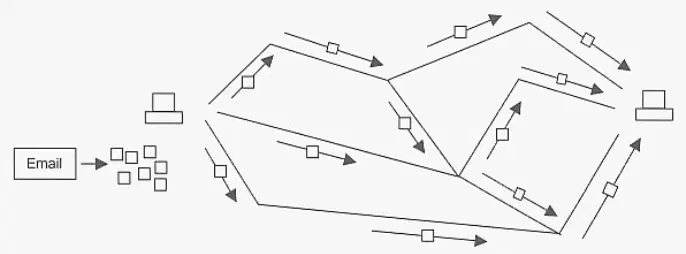
It is beneficial for packets to have multiple possible routes across a network because:
It increases the chances of packet loss.
It allows for faster and more reliable data delivery.
It limits the network's flexibility.
It reduces the number of available paths.
What is a typical format of an IP address as described in the passage?
123.101.10.114
1234:5678:9abc:def0
www.example.com
10-20-30-40
What is the function of routers on the Internet according to the passage?
When you use the 'tracert' DOS command, what information can you see?
All the routers used in transferring a packet between the site and yourself
The times a packet takes to travel between your computer and the router
The name of the network router
The IP address of the network router
All of the above
What is the purpose of splitting a web page request into packets on the Internet?
To allow the web server to send the message in smaller parts, each with information on how to reassemble the message, sender's address, and destination address.
To increase the size of the message being sent over the network.
To ensure that only one device can access the web page at a time.
To make the web page request slower and less efficient.
Each packet in a message must arrive at the destination by the same route.
True
False
What does TCP/IP stand for?
A) Transmission Control Protocol / Internet Protocol
B) Transfer Communication Protocol / Internal Protocol
C) Transmission Communication Protocol / Internet Process
D) Transfer Control Process / Internet Protocol
Which layer of the TCP/IP protocol is responsible for encoding data?
Application layer
Transport layer
Network layer
Data Link layer
Which layer of the TCP/IP protocol splits data into packets and adds port number information?
Application layer
Transport layer
Network layer
Data Link layer
Which layer of the TCP/IP protocol adds the IP address to each packet?
Application layer
Transport layer
Network layer
Data Link layer
Which layer of the TCP/IP protocol adds the MAC address information?
Application layer
Transport layer
Network layer
Data Link layer
Match the TCP/IP protocol layer to its function:
Adds the MAC address information
Adds the IP address
Data is encoded
Splits data into packets and adds port number information
Adds the IP address
Adds the MAC address information
Splits data into packets and adds port number information
Data is encoded
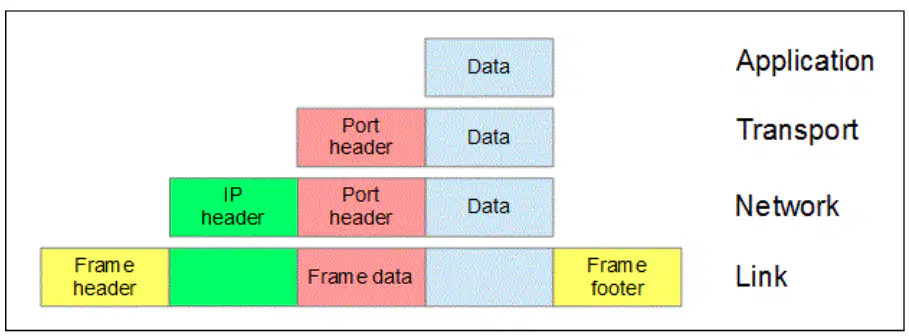
Which layer is at the bottom of the stack?
Application
Transport
Network
Link
According to the example, what is the correct XML format for sending the words 'apple', 'banana', 'orange', and 'grape' in the Application layer?
Refer to the table under the Transport layer. What is the transport header for the packet containing
80 3/4
22 1/2
443 2/3
53 1/4
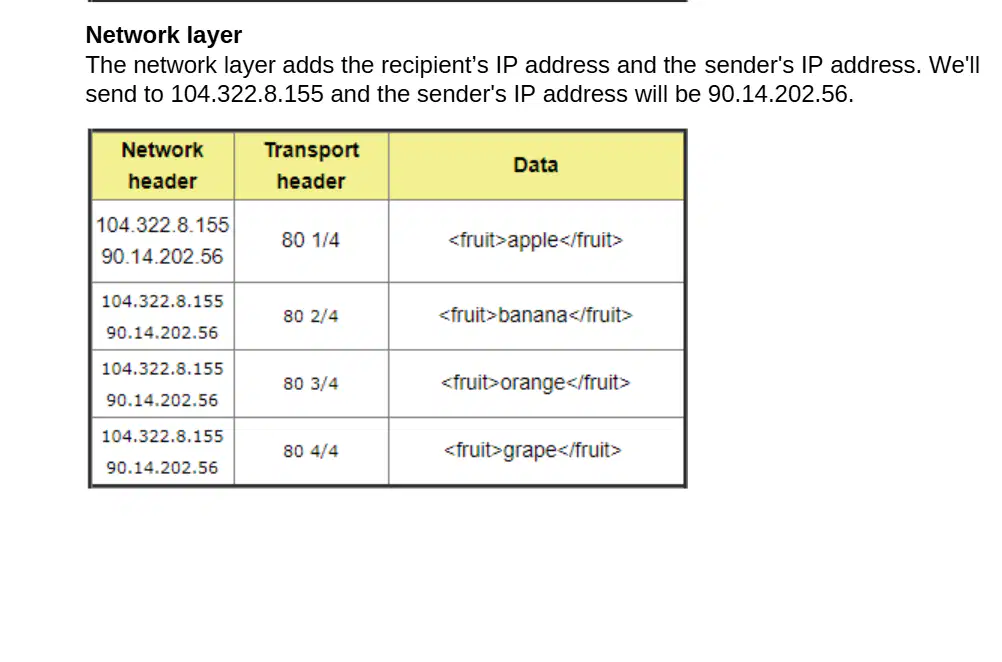
In the Network layer, what are the recipient's and sender's IP addresses used in the example?
104.322.8.155 (recipient), 90.14.202.56 (sender)
90.14.202.56 (recipient), 104.322.8.155 (sender)
80.1/4 (recipient), 80.2/4 (sender)
104.322.8.155 (recipient), 80.1/4 (sender)
Fill in the blank: In the Transport layer, the port number used is _____
80
21
443
25
Which layer is responsible for adding the recipient's and sender's IP addresses in the TCP/IP stack example?
Application layer
Transport layer
Network layer
Data Link layer
What is the MAC address of the recipient as mentioned in the passage?
What is the MAC address of the sender as mentioned in the passage?
4a:22:5a:cb:b2:1d
00:1a:2b:3c:4d:5e
aa:bb:cc:dd:ee:ff
12:34:56:78:9a:bc

Refer to the table. What is the data value in the row where the transport header is '80 3/4'?
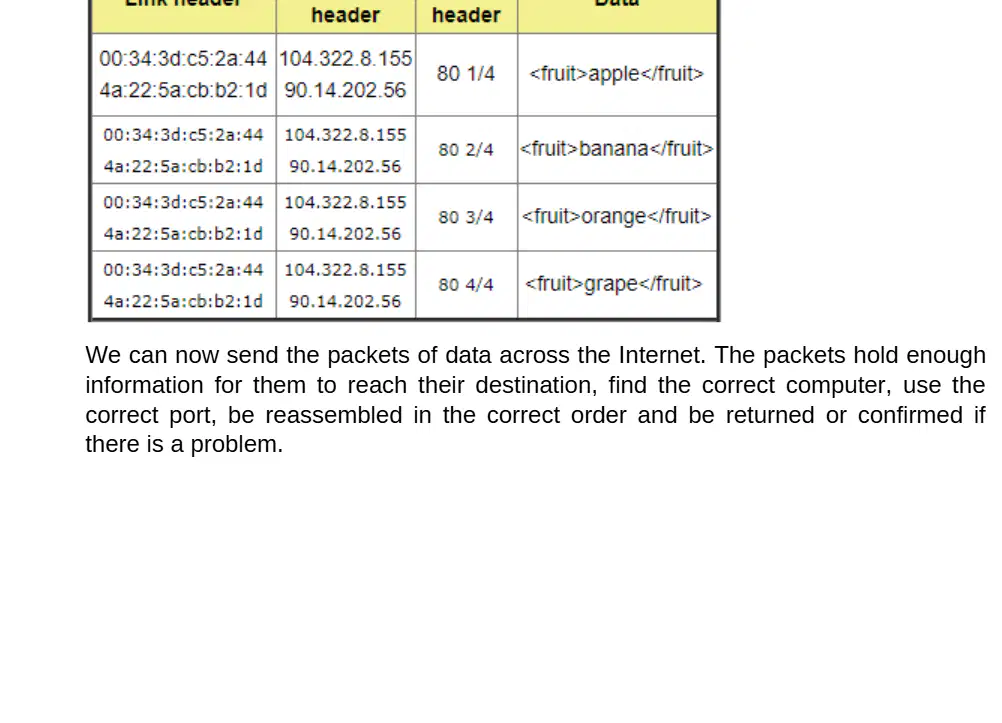
What is the network header value in the row where the link header is '00:34:3d:c5:2a:44' and the data is '
104.322.8.155
192.168.1.1
10.0.0.2
172.16.0.5

Refer to the table. Match the following transport headers to their corresponding data values:
80 1/4
80 2/4
80 3/4
80 4/4
How is data transmitted on a packet switched network?
Data is sent as a single large block
Data is split into packets
Data is sent only to the nearest node
Data is not split at all
Each packet in a packet switched network has a ________ address.
destination
source
physical
broadcast
Packets are reassembled at their ________.
destination
source
router
switch
Match the items contained within a TCP/IP Packet to their purpose:
Source Address
Allows tracing of sender
Destination Address
Allows packet to be routed to destination
Re-Assembly information/packet number
Allows packets to be assembled in correct order
Tracking Information
Allows route taken to be traced
The data itself
Required as packet can contain meaningful information
What is the purpose of the Source Address in a TCP/IP packet?
Allows tracing of sender
Specifies the packet's destination
Encrypts the packet data
Indicates the protocol used
What is the purpose of the Destination Address in a TCP/IP packet?
Allows packet to be routed to destination
Identifies the protocol used in the packet
Specifies the size of the packet
Indicates the source of the packet
What is the purpose of the Checksum in a TCP/IP packet?
What is required in a TCP/IP packet so that it can contain meaningful information?
The data itself
The source MAC address
The destination port number only
The packet size

