
 Worksheets
Direitos Humanos - Worksheet Quiz
Total questions: 48
Worksheet time: 24mins

What is the main topic of the learning material shown in the image?
Leadership and Ethics
Mathematics and Science
Art and Music
Sports and Games
Which government is mentioned in the image?
Paraná
São Paulo
Rio de Janeiro
Brasília
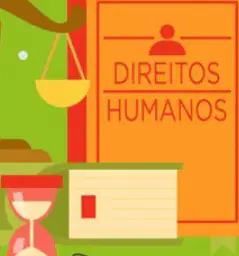
What does the book in the image say?
Direitos Humanos
Matemática
Ciências
História
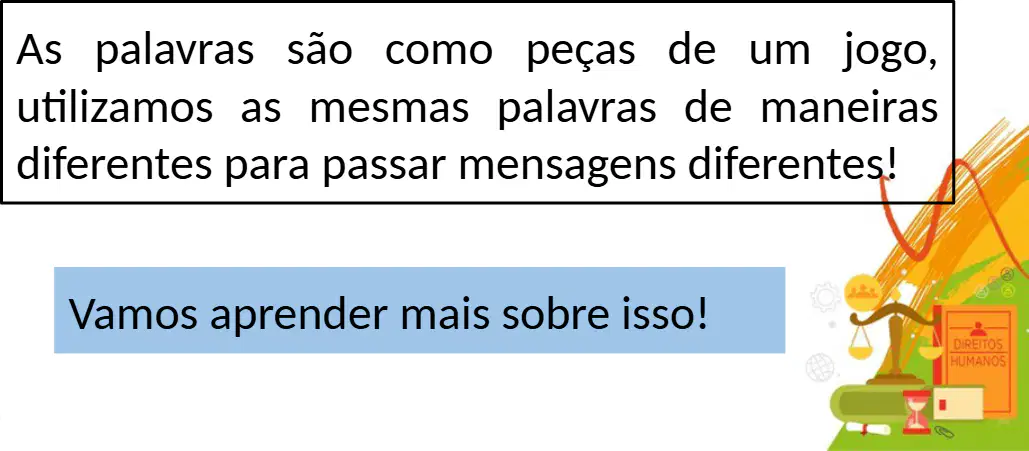
What are words compared to in the text?
Pieces of a game
Pieces of a puzzle
Pieces of a cake
Pieces of a book
Why do we use the same words in different ways?
To pass different messages
To make words longer
To make words rhyme
To make words disappear
If you use the same word in a different way, what can happen?
The meaning can change
The word gets bigger
The word becomes a number
The word turns into a color
What does our language do according to the context?
It changes meaning
It stays the same
It becomes a different language
It disappears
Who was the Austrian philosopher mentioned in the text?
Wittgenstein
Einstein
Newton
Darwin
What is one question Wittgenstein investigated?
How do we communicate and why do communication errors happen?
What is the capital of France?
How do plants grow?
Why do animals sleep?
If two people speak the same language, can they still misunderstand each other?
Yes
No
Only sometimes
Never
What is the main topic discussed in the text?
Language
Mathematics
Science
Geography
Why do we create problems, according to the philosopher mentioned in the text?
Because we do not understand each other
Because we do not like to talk
Because we forget things
Because we are always happy
What did the philosopher say about things that can be said?
They can be said clearly
They should not be said
They are always confusing
They are hard to remember
What do scientists usually agree on when talking about math, physics, or chemistry?
The formulas and their results
The color of the classroom
The type of food they like
The games they play
Which of the following questions might be harder for a group to agree on?
What is freedom?
What is 2 + 2?
What is the color red?
What is a triangle?
Why might it be easier for scientists to agree on math formulas than on questions like "What is justice?"
Because math formulas have clear answers
Because everyone likes math
Because justice is a number
Because math is not important
What is the main difference between talking about ethics and talking about science, according to the philosopher in the text?
Ethics talks about things we can see, science does not.
Science talks about things we can observe and calculate, ethics does not.
Both talk about things we can touch.
Ethics is easier to understand than science.
According to the text, what does language do in our world?
It makes us laugh.
It represents the facts of our world.
It helps us run fast.
It teaches us to draw.
Can you see or show things like freedom or ethics, according to the philosopher?
Yes, you can see them everywhere.
No, you cannot see or show them.
Only on special days.
Only in books.
What does "linguagem não verbal" mean?
Non-verbal language
Written language
Mathematical language
Animal language
Who thought that language was like a strict mathematical formula at first?
Wittgenstein
Einstein
Newton
Darwin
What did Wittgenstein later compare language to?
A box of tools
A book
A tree
A car
Why did Wittgenstein change his mind about language?
He became more flexible about how language is used
He stopped using language
He thought language was only for math
He wanted to write a book
If language is like a box of tools, what does that mean?
We use language in many different ways, like using different tools
Language is only for building things
Language is always the same
Language is only for talking
What is the character in the picture doing?
Thinking
Running
Sleeping
Eating
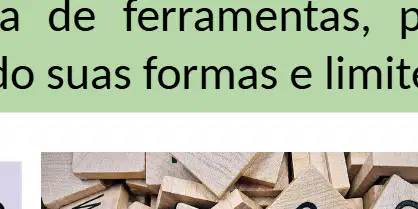
What does the philosopher compare language to?
A box of tools
A box of toys
A basket of fruits
A bag of books
Why do we need to know how to use language, according to the philosopher?
To recognize its forms and limits
To play games
To write stories
To draw pictures
How is speaking described in the text?
Like playing a game
Like running a race
Like cooking food
Like painting a picture
What determines the meaning of each word in the language game?
Its social use
Its color
Its length
Its sound
What can happen to the meaning of a word depending on the context in which it is used?
It can have different meanings.
It always means the same thing.
It becomes a number.
It disappears.
What should you do after thinking of words that have different meanings in different contexts?
Make a list of those words.
Draw a picture.
Sing a song.
Write a story.
Why does the teacher ask students to share and explain the different meanings of words?
To help everyone understand how words can change meaning.
To make the class longer.
To see who can write the most words.
To choose a favorite word.
What is the person in the picture doing?
Writing in a notebook.
Eating lunch.
Playing with toys.
Sleeping.
What do we use language for?
To express feelings, give orders, apologize, and imagine things.
To run fast.
To cook food.
To play outside.
What does the word "azul" mean when someone says "Tudo azul" in Portuguese?
It means the person is feeling good.
It means the person is sad.
It means the person is hungry.
It means the person is tired.
In English, what does the word "blue" sometimes mean?
Sadness and melancholy.
Happiness and joy.
Excitement and fun.
Anger and frustration.
Is there always a fixed meaning for a word?
No, it depends on how the word is used.
Yes, every word has only one meaning.
No, words never have any meaning.
Yes, words always mean the same thing in every language.
Why is it important to know the rules of language games?
Because the meaning of words can change depending on how we use them.
Because we need to play sports.
Because we need to eat food.
Because we need to sleep early.
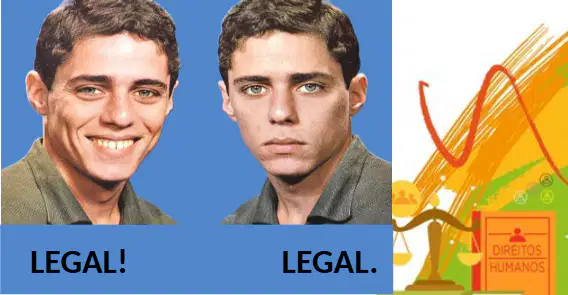
Look at the two faces in the picture labeled "LEGAL!" and "LEGAL." How does the meaning of the word "legal" change?
The meaning changes depending on the person's expression and how the word is used.
The meaning always stays the same.
The word "legal" means the same thing in every situation.
The word "legal" is only used for happy faces.
What does the meaning of the expression "Que semana!" depend on?
The context in which it is used
The day of the week
The weather
The color of the text
If someone says "Que semana!" after a wonderful week, what might they mean?
They had a great week
They are talking about food
They are asking for help
They are going to school
Why is it important to know the context when someone uses an expression?
Because the meaning can change depending on the situation
Because the words are always the same
Because context is not important
Because it is always about the weather
What does Wittgenstein think philosophy should focus on?
Describing, analyzing, and clarifying language
Studying animals
Learning about numbers
Drawing pictures
According to the text, what should the clarification in philosophy be about?
The rules of language use
The colors of the rainbow
The names of animals
The shapes of objects
What does Wittgenstein move philosophy away from?
Abstractions
Mathematics
Science experiments
Sports
Who is the philosopher mentioned in the lesson about the philosophy of language?
Wittgenstein
Socrates
Plato
Aristotle
What did we learn about in Wittgenstein's philosophy of language?
What language is and its function
How to draw pictures
The history of mathematics
The rules of sports
According to the lesson, what else did we learn about besides Wittgenstein's ideas on language?
Language games
Animal habitats
Musical instruments
Weather patterns

