
 Worksheets
Physical Science CFE Practice Questions
Total questions: 55
Worksheet time: 55mins
Joshua pushes a block with a force of 20 Newtons along a surface for a distance of 5 meters. How much work did he do? Recall that: Work = Force · Distance
25 joules
100 joules
20 joules
4 joules

What is happening in the blue section?
A vehicle that is moving with constant speed.
A vehicle that is moving away from the origin.
A vehicle that is accelerating.
A vehicle that is not moving.

The famous scientist Ernest Rutherford and his team of researches is remembered for correctly describing how charge and mass is distributed in an atom. Which of the following statements correctly describes the distribution of mass in an atom?
Most of the mass of an atom is located in the electron cloud.
The mass of an atom is concentrated only in the neutrons.
The mass of an atom is evenly distributed throughout all regions of an atom.
Most of the mass of an atom is located in the nucleus.
Which of Newton's laws explains that an object in motion will continue moving unless acted upon by an outside unbalanced force?
Newton's Third Law
Newton's Law of Universal Gravitation
Newton's Second Law
Newton's First Law
Carmen conducted an experiment to determine if listening to different types of music would affect a person's pulse. Her hypothesis was that pulse rate would change with different types of music. Each person listened to seven different selections of music for 30 seconds each. Each person's pulse was taken before the music and then after each 30-second interval of music. The pulses were taken again after the music selections were completed. Based on her experiment, Carmen concluded that a person's pulse rate changed when the person listened to different types of music. Which component is missing from Carmen's experiment?
a question
a hypothesis
a control group
a description of the experiment

Which of these statements correctly explains why water is a good solvent for many ionic compounds?
Water is a polar compound.
Water is an ionic compound.
Water molecules are nonpolar.
Water molecules completely separate into ions in solution.
What happens to the gravitational force between two objects if their separation is doubled? The force of attraction is...
Doubled
Stays the same
1/4
1/2

What energy transformation is happening?
Heat energy from the steam generator is being transformed into mechanical energy in the turbine, then electrical energy in the generator.
Nothing the energy is staying the same.
Electrical energy is being transformed to mechanical energy, then to thermal energy.

A six volt battery is connected by a wire to a two ohm resistor. How many amps of current flow through the wire? Recall that Voltage (V) = Current (I) · Resistance (R)
4 amps
8 amps
0.33 amps
3 amps

A 100 kg cart is 10 meters off the ground on a roller coast track. The other side of the track goes up infinitely. Assume the track is a frictionless surface. If the cart starts rolling down the track, how far up will it go on the other side before it stops and falls back down again?
more than 10 meters
It's impossible to tell because you don't have enough information
less than 10 meters
exactly 10 meters

Which fundamental force is responsible for radioactive decay?
strong force
gravity
electromagnetic force
weak force

A sword is heated inside a blacksmith's forge until it glows red hot. What is happening to the molecules of iron inside the blade?
The iron atoms are hard now, and do not move.
The iron atoms are gaining mass.
The iron atoms are wiggling in place quickly.
Which type of reaction is this? CuCO₃ → CuO + CO₂
Radiation
Decomposition reaction.
Precipitate
Synthesis reaction.

Which of the following scenarios would be correctly represented by the graph?
A vehicle that is not moving.
Velocity (vectors must have direction)
Temperatures In New York have increased over a 6 day period.
A vehicle that is moving with constant speed. (Velocity vs time)

As an ambulance zooms away from Jill, the driver honks his horn. According to the Doppler effect, how would the sound of the horn seem like according to Jill, compared to the driver?
Jill would hear a sound wave with a shorter wavelength than the driver would hear.
Jill and the driver would hear the same sound.
Jill would hear a lower pitch sound than the driver would hear.
Jack would hear a higher pitch sound than the driver would hear.

Which type of nuclear reaction results in the formation of a new heavy nucleus from smaller, lighter nuclei that combine together?
nuclear fusion
radioactive decay
nuclear fission
radioactive fission

Which of the following statements correctly describes the net force? A diagram shows two people pulling a rope in opposite directions: one with 15 N to the left and one with 10 N to the right.
There is a net force of 5N left.
A vehicle that is not moving.
Velocity (vectors must have direction)
strong force

Which of the following explanations best describes why leaf appears to be green?
Temperatures in New York have increased over a 6 day period.
Heat energy from the steam generator is being transformed into mechanical energy in the turbine, then electrical energy in the generator.
White light from the sun hits the leaf, which then absorbs the green wavelengths from that white light.
The sun only shines green light at leaf, which is why leaves appears to be this color.
White light from the sun hits the leaf, which absorbs all wavelengths of light except green, which is the color that is reflected back to the eye.
A 2 kg object is pulled across the floor with a force of 10 N. What is the net acceleration on the object? Force = mass · acceleration
20 m/s²
0.10 m/s²
5 m/s²
200 m/s²

Xavier's team designed an experiment to answer the following question: How does the surface of a ramp affect how far a toy car rolls?
Which factor should Xavier keep the same in the experiment?
The type of car
The height of the ramp
The surface of the ramp
What is the factor that an experimenter intentionally changes?
Dependent Variable
Independent Variable
Constant
Control
What is the primary reason that metals are good conductors of electricity?
Metals have free electrons that can move easily.
Metals are shiny and reflective.
Metals have a high melting point.
Metals have a high density.
What happens to the pressure of a gas if its volume is decreased while the temperature remains constant?
The pressure fluctuates randomly.
The pressure remains the same.
The pressure increases.
The pressure decreases.

Transfers energy through waves
Radiation
Thermal Energy
Convection
Conduction

The starting point you choose to describe the location or position of an object
Terminal Velocity
Distance
Momentum
Reference Point

Quantities that are fully described by a magnitude (or numerical value) alone
Vector
Scalar
Mass
Weight
A measurement of distance divided by time no direction
Acceleration
Velocity
Gravity
Speed
The product of an object mass and velocity
Newton's 1st Law of Motion
Terminal Velocity
Momentum
Friction
The sum of Kinetic/potential energy of all the particles in an object
Terminal Velocity
Heat
Temperature
Thermal Energy

The average measurement of kinetic energy
Convection
Heat
Temperature
Specific Heat Capacity
The Law of Conservation of Energy states:
Energy can created or destroyed but not transformed
Energy cannot be created or destroyed, it can only transformed
Energy can't be created, destroyed or transformed

A study was done to find if different tire treads affect the braking distance of a car.
The height of bean plants depends on the amount of water they receive.


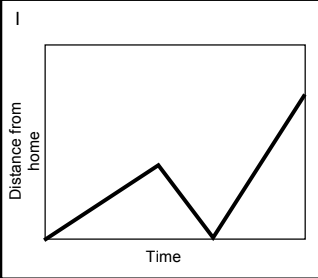
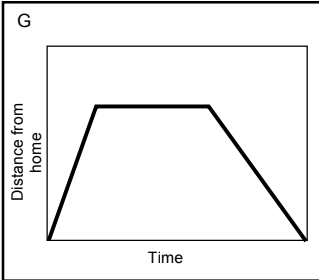
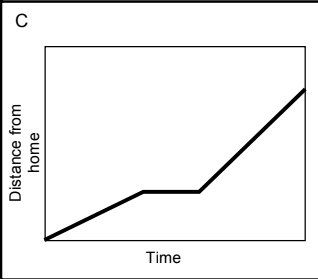
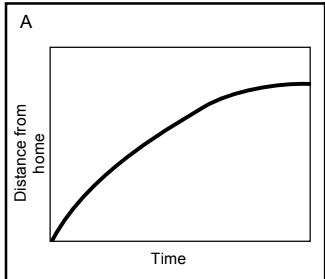
Susie went to the store, when she got there she realized that she forgot her wallet and returned home.
Which graph matches this motion?

Why does the egg not sink or float?
it is more dense than the water
it is less dense than the water
it has the same density as the water
it is light

In heat transfer, heat always flows from the _______________ substance to the _______________ substance.
Hotter to colder
Colder to hotter
Hotter to hotter
Colder to colder
True or False: The reactivity of metals tends to decrease as you move from left to right across the periodic table.
True
False

Which element has a lower electronegativity value?
Calcium
Barium
As you move across a period, the outer electrons are ________ to the nucleus, so the nucleus of the atom is ________ to attract electrons in a bond.
closer, more able
closer, less able
further, less able
further, more able
Which statement correctly and completely identifies a trend?
Atomic radius decreases across a period and increases down a group.
Electronegativity decreases across a period and decreases down a group.
Ionization energy increases across a period and increases down a group.
Ionic radius increases across a period and increases down a group.

Alkali metals (Group 1)
Halogens (Group 17)
Noble Gases (Group 18)
Transition metals (middle of table)
Weaker the pull by the protons
Stronger the pull by the protons
Put the following in order of increasing ionization energy:Neon (Ne), Lithium (Li), Carbon (C)

Lead (Pb)
Silicon (Si)
Tin (Sn)
Germanium (Ge)

If the one bulb burned out, what would happen to the other bulb?
stay lit
not light up
brighter
dimmer

Are the lights on in this circuit?
yes, the lights are on
no, the lights are off

