
 Worksheets
Microeconomics AP Vocabulary
Total questions: 93
Worksheet time: 2hrs 58mins
What does marginal mean in the language of economics?
Additional
Less
Satisfaction
I can't believe it's not Butter.
What does utility mean in the language of economics?
Additional
Less
Satisfaction
I can't believe it's not Butter.
If every consumers needs are being met perfectly and every good that is being made is being sold, what type of efficiency is being achieved?
Productive Efficiency
Allocative Efficiency
When there is only one seller of a good or service, they are said to have a?
Monopoly
Oligarchy
Monopolistic Competition
Perfect Competition
When there are only a few sellers of a type of produce, like Smart phones, there is said to be an?
Monopoly
Oligopoly
Monopolistic Competition
Perfect Competition
When there is lots of competition in a market because the barriers to entry are low and there are many substitutes that exist, this is called?
Monopoly
Oligopoly
Monopolistic Competition
Perfect Competition
Laws that are meant to stop monopolies from forming are called?
Anti-Monopoly Laws
Anti-Trust Laws
Which of the following is true about an imperfectly competitive firm’s marginal revenue (MR) curve if it has a linear and downward-sloping demand curve?
MR decreases at an increasing rate.
MR increases at first, then decreases.
MR is constant.
MR decreases and is less than demand.
MR is greater than demand.
Petunia’s Pears sells pear cider. There is only one other seller in the market.
monopoly
monopsony
monopolistic competition
perfectly competitive
oligopoly
The market for space travel has the possibility to be very profitable, but it is also likely to be imperfectly competitive.
Which of the following is the most likely reason that the space travel industry is imperfectly competitive?
having no control over price
low barriers to entry
high profits
high start-up costs
low minimum efficient scale relative to the size of the market
Which of the following is true about production in an imperfectly competitive market?
Choose 1 answer:
The amount produced minimizes marginal cost.
Less is produced than is socially optimal.
The amount produced minimizes average total cost.
More is produced than is socially optimal.
The amount produced is the same as in perfect competition.
Priya’s Party Supplies sells cake toppers in a market with many other sellers, but each seller has their own version of cake toppers.
Which of the following statements is true based on this information?
Priya produces a socially optimal quantity.
Priya produces in a perfectly competitive industry.
Priya’s marginal revenue curve is less than her demand curve.
Priya can charge whatever price she wants to for her cake toppers.
Priya’s average total cost curve is below her average variable cost curve.
All of the following are imperfectly competitive markets EXCEPT:
monopolistic competition
pure competition
monopoly
oligopoly
monopsony
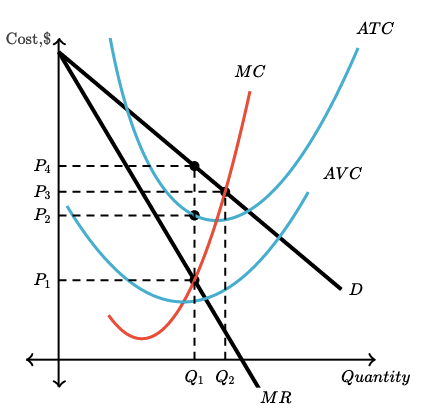
For the graph shown here, what quantity will this firm produce and what price will it charge?
Q2 ; P2
Q2 ; P3
Q1 ; P1
Q1 ; P2
Q1 ; P4
If a firm must lower its price to sell more of a good, which of the following must also be true?
Its marginal revenue curve is the same as its marginal cost curve.
Its marginal revenue curve is upward-sloping.
Its marginal revenue curve is lower than its demand curve.
Its marginal revenue curve is equal to its demand curve.
Its marginal revenue curve is higher than its average total cost curve.
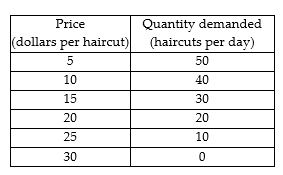
Christy's Haircuts, the sole supplier of haircuts in a small town, faces the demand schedule shown in the table above. What is Christy's marginal revenue from the 25th haircut?
zero
$5
$7
$5.50
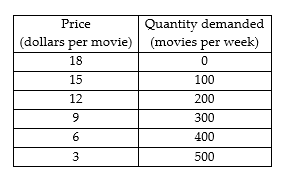
Roxie's Movie Theatre is the only one in town. The table above gives the demand schedule for movies. If Roxie's is a single-price monopoly and the marginal cost of a movie is $6, Roxie's will charge ________ a movie and will sell ________ movie tickets a week.
$15; 100
$12; 200
$6; 400
$9; 300
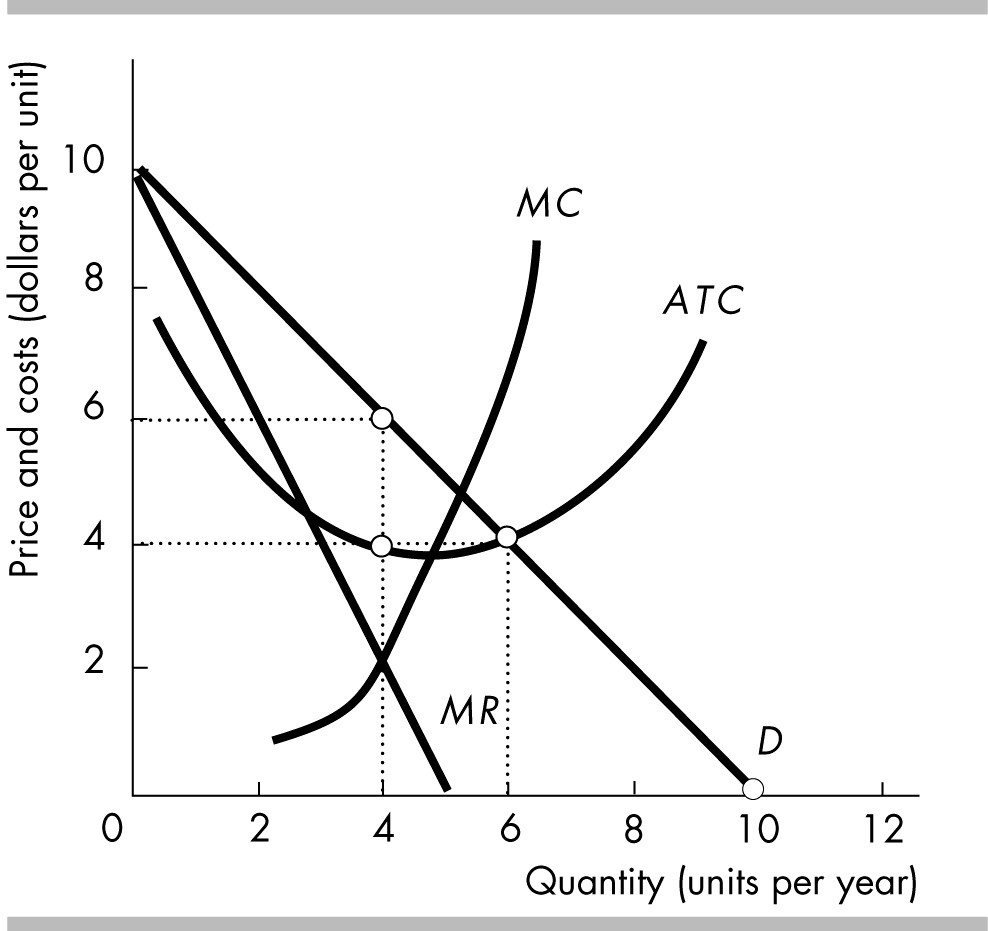
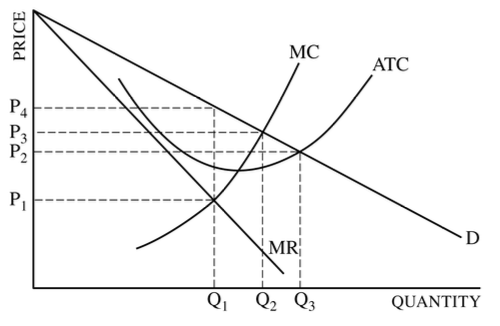
For the unregulated, single-price monopoly shown in the figure above, when its profit is maximized, output will be
4 units per year and the price will be $6.
4 units per year and the price will be $4.
6 units per year and the price will be $4.
None of the above answers is correct.
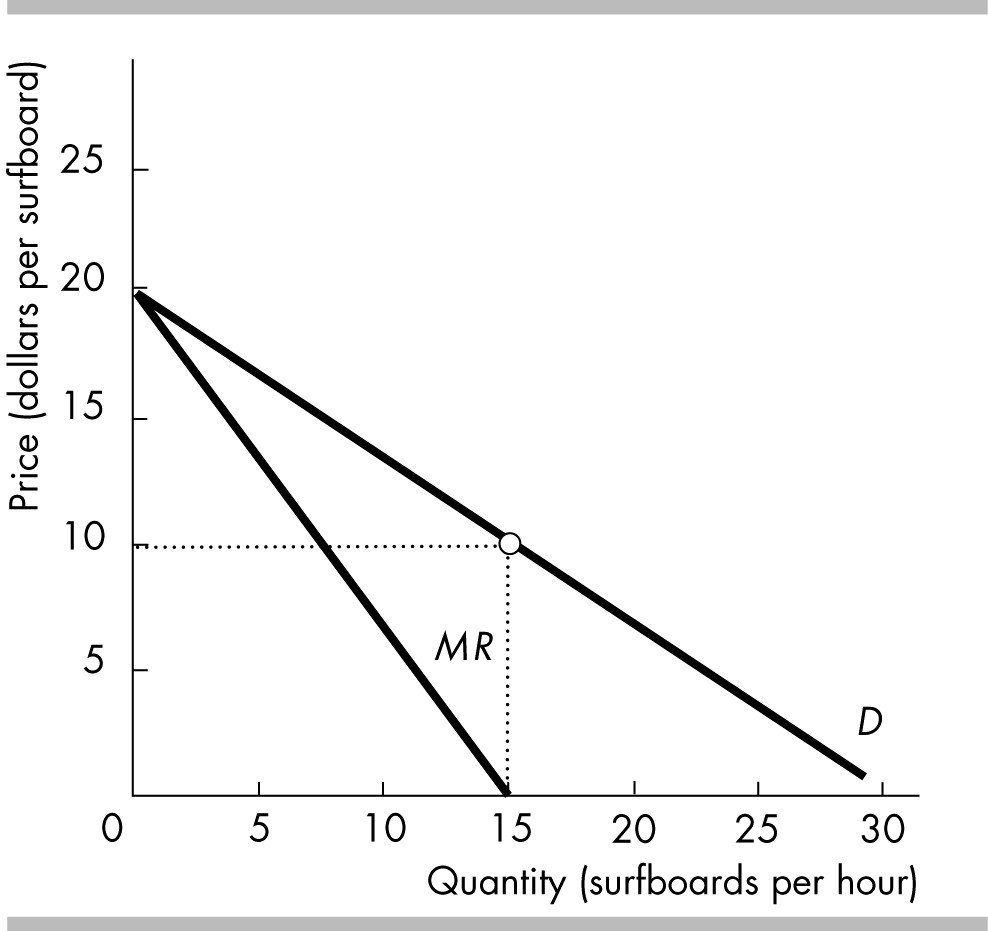
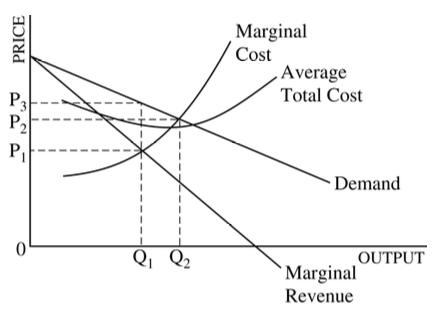
Sue's Surfboards is the sole renter of surfboards on Big Wave Island. Sues demand and marginal revenue curves are illustrated in the figure above. Sue's Surfboards currently rents 15 surfboards an hour. Sue's total revenue from the 15 surfboards is
$300
$220
$150
$100
Gene's Car Wash is a natural monopoly. To wash 100 cars a week, if Gene is unregulated, he would charge a price of $10. Gene's long-run average cost for washing 100 cars is $8, his average variable cost is $6, and his marginal cost is constant at $4. If Gene was regulated using a marginal cost pricing rule, the price he would be allowed to charge to wash 100 cars is
$10
$8
$6
$4
A monopoly can price discriminate between two groups of consumers if each group has
a large consumer surplus.
a different willingness to pay.
the same willingness to pay.
the ability to resell the good to the other group.
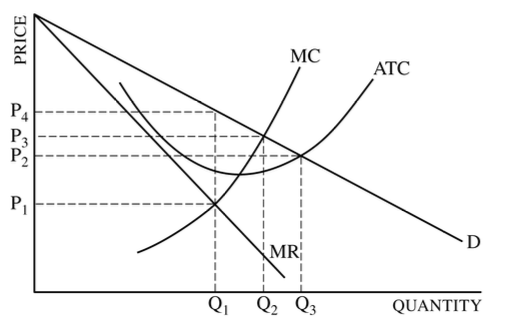
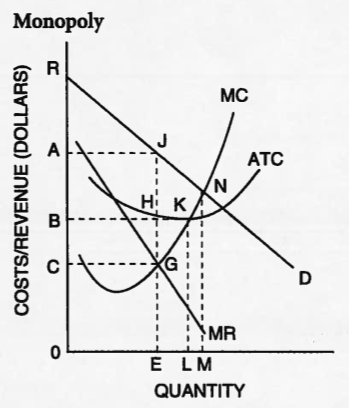
MC = marginal cost, and ATC = average total cost. In monopolistic competition, which of the following most accurately describes the long-run equilibrium conditions for a firm?
Product differentiation refers to
Features that make one product appear different from competing products in the same market.
The selling of identical products in different markets.

The above image is an example of...
Pure Competition
Monopolistic Competition
Oligopoly
Non-Price Competition
Define collusion
When two cars collide on the road
a secret agreement between two competing firms to sell their similar products at the same price

Neither company has a dominant strategy
Both companies have an incentive to reduce production by %10
Both companies have an incentive to reduce production by %20
Only UA have an incentive to reduce production by %20
Only UB have an incentive to reduce production by %20
Game theory is used to explain
why firms price discriminate
how monopolies evolve into oligopolies
strategic behavior of firms in oligopoly
profit maximization in monopoly
price leadership of monopolistic competition
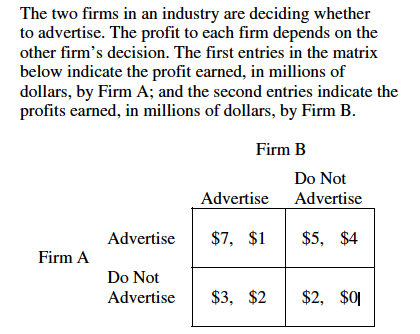
Based on the payoff matrix, which of the following is correct?
Firm A always gets a smaller share of the industry profits.
Firm A’s dominant strategy is to advertise.
Firm B’s dominant strategy is not to advertise.
The dominant strategy for both firms is not to advertise.
Neither firm has a dominant strategy.

The combination where Firm A advertises and Firm B does not advertise is Nash equilibrium because
it is best for each firm given what the other firm has chosen
the total industry profits are maximized
Firm A has an incentive to change its strategy and chooses not to advertise
it is the best outcome for Firm B regardless of what firm A does
advertising is always the best strategy for Firm A
Which value (in percentage form) of the four-firm concentration ratio is most likely to indicate a monopolistically competitive market?
2%
30%
60%
100%
The Herfindahl index is:
the sum of the squared percentage market shares of all firms in the industry.
the sum of the market shares for the top 10 firms in the industry.
a measure of product differentiation in the market.
a measure of how easy it is for new firms to enter the market.
In the long run, new firms will enter a monopolistically competitive industry:
provided economies of scale are being realized.
even though losses are incurred in the short run.
until minimum average total cost is achieved.
until economic profits are zero.
If profits are negative in a monopolistically competitive market, then:
new firms will enter until profit returns to the optimal positive level.
new firms will enter the market until economic profits are zero.
firms will exit the market until economic profit returns to the optimal positive level.
firms will exit the market until economic profit returns to zero.
Which of the following characterizes monopolistic competition?
Price leadership.
Zero long-run profit.
Retaliation.
Marginal cost pricing.
A monopolistically competitive firm maximizes profits or minimizes losses in the short run by
Setting price equal to marginal cost.
Producing at the output level where ATC is minimized.
Producing at the output level where MR equals MC.
Producing at the output level where MC equals ATC.
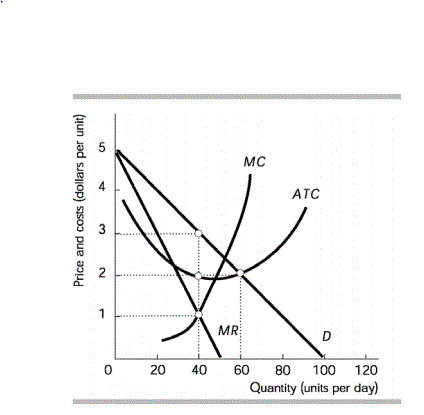
In the above figure, the monopolistically competitive will experience what change into the long run?
a right shift of it's demand curve.
a left shift of it's demand curve.
a right shift of it's supply curve.
a left shift of it's supply curve.
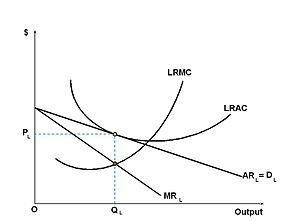
If this graph is for a monopolistically competitive firm, it best represents
short run economic loss.
short run extra-normal profit.
long run economic profit.
long run equilibrium at normal profit.
short run accounting loss.
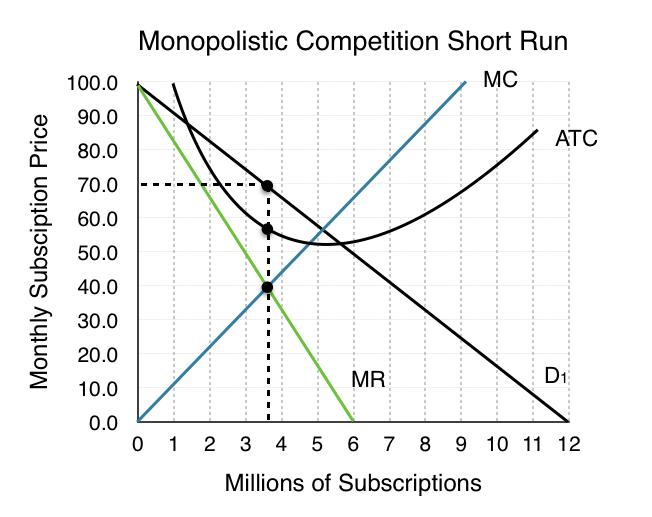
This firm will charge a price of _____ and make a per unit ___ of _____.
70; loss; 10.
60; normal profit; 0.
70; profit; 3.5.
60: profit; 10.
70; profit; 10.
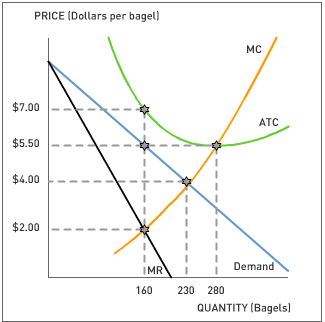
This firm will charge a price of _____ and make a per unit ___ of _____.
7; loss; 1.5.
7; normal profit; 0.
7; profit; 1.5.
5.5: loss; 1.5.
5.5; profit; 1.5.
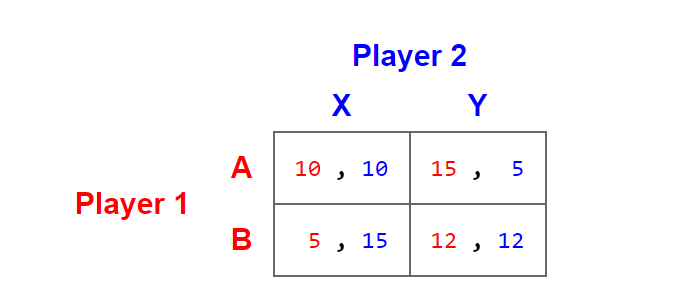
When firms openly agree on price, output, and other decisions aimed at achieving monopoly profits, those firms are practicing
overt collusion
tacit collusion
price leadership
price-taking behavior
price discrimination
The cartel model of oligopoly predicts that
all firms in the industry act in unison to set monopoly price
each producer acts independently of others
firms follow the low-price firm in the industry
differences in cost of production discourage individual firms from cheating
the markup on marginal cost should be the same for all firms
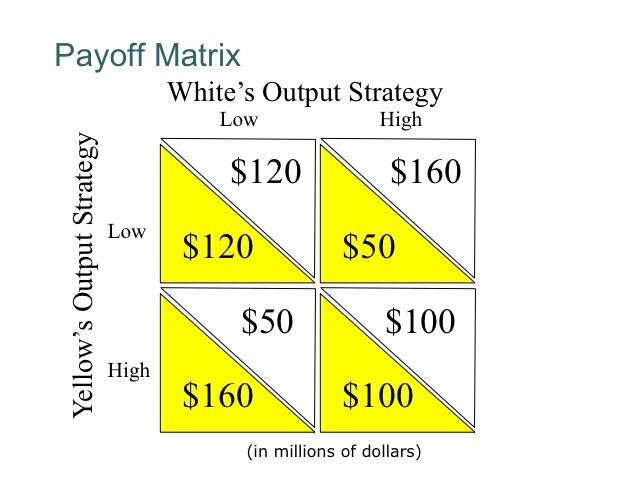
What would facilitate collusion between firms in an oligopolistic industry
An increase in the number of firms
large fluctuations in demand
rapid changes in technology
a standardised product
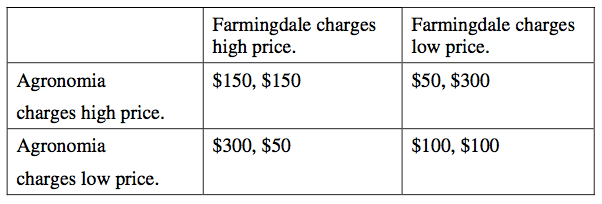
the soft-drink industry. The companies cannot cooperate. Each firm can follow a high-price strategy or a low-price strategy for pricing its product. In the payoff, the first entry in each cell shows the profits to E Soda and the second entry shows the profits to R Soda. It can be concluded that:
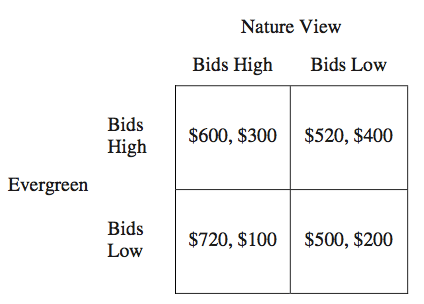
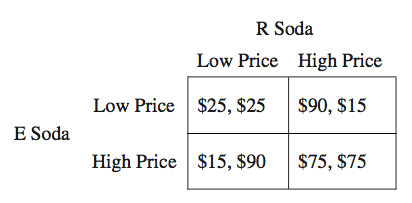
a landscaping contract. The payoff matrix shows what each firm’s total weekly profits from all its operations will be for each combination of bids. The first entry in each cell shows Evergreen’s profit, and the second entry in each cell shows Nature View’s profit. A Nash equilibrium results under which of the following conditions?
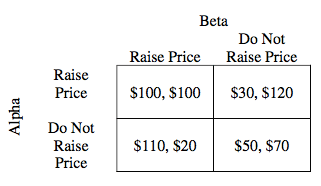


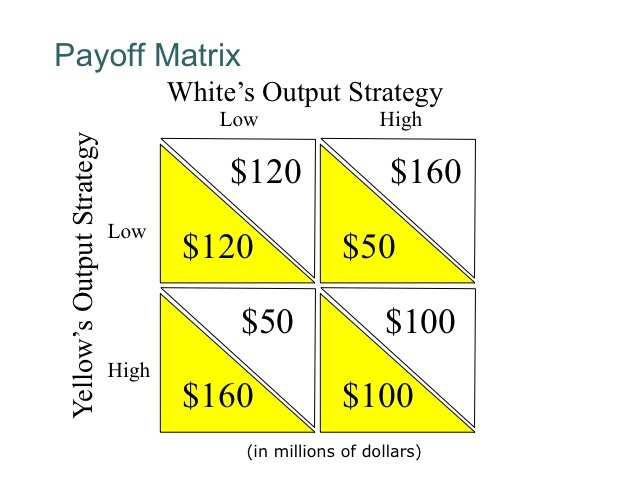
One of the assumptions underlying the kinked demand curve is that oligopolists
Sell to consumers who are less sensitive to price increases than price decreases
Expect their rivals to match any reduction in price
Leave their prices unchanged if a competitor reduces his price
Increase their prices in response to an increase in the price charged by a competitor
Markets like automobiles, cell phones, cable TV, and internet providers are examples of which market structure?
Monopoly
Oligopoly
Perfect competition
Monopolistic competition

In an oligopoly, firms will produce between quantities ____ and ____.
M;N
M;Q
N:R
N:Q
Q:R

