Wayground logo

Free Printable Worksheets

Font size

S
M
L
XL
Worksheets

Day #6: Evolution Review

Total questions: 65

Worksheet time: 1hrs 23mins

Name
Class
Date
1.

Why have many species become extinct in the past?

a)

They couldn't find a place to hibernate

b)

They couldn't migrate to warmer climates

c)

They couldn't reproduce

d)

They couldn't adapt to environmental changes

2.

When an organism develops a trait that helps it survive, it is know as ...

a)

A vestigial trait

b)

An adaptation

c)

A survival trait

d)

A mutation

3.

Where did Charles Darwin discover the differently evolved species of Finches?

a)

The Caribbean Islands

b)

Long Island

c)

The Greek Islands

d)

The Galapagos Islands

4.

Which word most closely describes the changes of this species over time?

a)

Evolution

b)

Succession

c)

Mutation

d)

Growth

5.

Which rock layer contains the oldest fossil?

a)

A

b)

B

c)

C

d)

D

6.

The definition of "evolution" is ...

a)

A change in body structures

b)

A process of change over a short time period

c)

A process of change over a long time period

d)

A process of growth in an organism

7.

Camouflage is an example of an organism ____________ to its environment over time.

a)

Belonging

b)

Conforming

c)

Adapting

d)

Not belonging

8.

In this unknown organisms evolutionary path, which species is most closely related to species G

a)

H

b)

J

c)

K

d)

L

9.

Which rock layer contain fossils of the most evolved organism?

a)

A

b)

B

c)

C

d)

D

10.

When one organism survives over another due to its adaptations, it is known as ___________.

a)

Favorability

b)

Natural Selection

c)

Darwinism

d)

Genetic Mutation

11.
Change over time...
a)
Evolution
b)
Nucleotide 
12.
Charles Darwin came up with this theory 
a)
Natural Selection
b)
Mutation
13.
To adjust to a changing environment
a)
Mutation
b)
Adapt
14.
Darwin wrote that organisms with traits that are best suited to the environment will ________________
a)
increase in number
b)
become extinct
15.
Another word for adapt is ____________.
a)
change
b)
create
16.
What characteristic did Darwin observe about the finches on the Galapagos Islands?
a)
Their feathers 
b)
Genotypes 
c)
Their beaks
d)
Their body sizes
17.
Which term refers to the process by which individuals that are better suited to the environment survive and reproduce therefore passing down their genes to their offspring? 
a)
Evolution 
b)
Variation 
c)
Adaptation
d)
Natural Selection 
18.
When an organism completely dies out, it is called.....
a)
Adaption
b)
Extinction
c)
Fossilization
d)
Mutation
19.
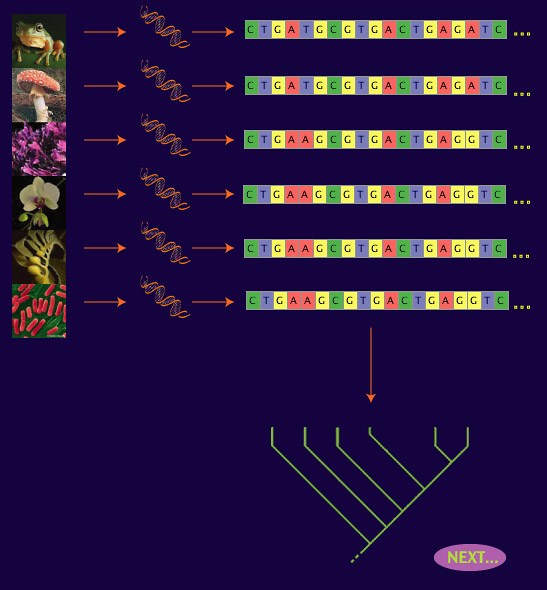
Two organisms that are closely related would have
a)
very similar DNA sequence
b)
exactly the same DNA sequences
c)
no proteins in common
d)
completely different DNA sequence
20.
 The diagram represents the relationship between beak structure and food in several species of finches found on the Galapagos Islands. The different beak structures observed in the diagram are evidence of
a)
 different species of finches adapting to different environments over many generations
b)
 finches changing their beak characteristics so that they could feed efficiently
c)
finch species with different beak structures coming to the Galapagos Islands from the mainland
d)
 finches mating with birds of other species and acquiring some of their traits
21.
Natural selection is best described as
a)
a change in an organism in response to a need of that organism
b)
a process of nearly constant improvement that leads to an organism that is nearly perfect
c)
differences in survival rates as a result of different inherited characteristics
d)
inheritance of characteristics acquired during the life of an organism
22.
Mutations are important because they bring about
a)
death of the organism in which they develop
b)
genetic variation needed for a population to evolve
c)
benefits for the individual, not for the population
d)
Hardey-Weinberg equilibrium within a population
23.
Finches on the Galapagos Islands had different beaks in order to help them do what?
a)
Build nests
b)
Fight off predators
c)
Collect food sources
d)
Compete with rivals
24.
This scientist came up with the idea of natural selection.
a)
Jean Baptiste Lamarck
b)
Gregor Mendel
c)
Charles Darwin
d)
Thomas Malthus
25.

A population of mice, some with light-colored fur

and some with dark-colored fur, is introduced into

a field with dark soil. A few generations later, the

majority of the mice have dark-colored fur. Which

of the following best explains this change?

a)

Light-colored mice can run faster.

b)

Dark-colored mice have fewer offspring.

c)

Dark-colored mice can hide easier from

predators.

d)

Light-colored mice have changed color over

generations.

26.

When organisms are better adapted to their environment they will survive and reproduce more successfully than organisms less adapted. This process is called what?

a)

Selective breeding

b)

Natural Selection

c)

Cloning

d)

Evolution of all species

27.

Which scientist visited the Galapagos Islands and came up with the theory of natural selection?

a)

Theodor Schwann

b)

Gregor Mendel

c)

Charles Darwin

d)

Rudolf Virchow

28.

A physical or behavioral trait that helps an organism survive and reproduce in its environment is called a what?

a)

An adaptation

b)

A response to a stimulus

c)

A mutation

d)

Evolution

29.

What most likely caused the finches on the Galapagos Islands to have beaks that were different from the finches on the mainland?

a)

There were different types of predators on the island.

b)

There were different types of food available on the island.

c)

The finches had no water to drink.

d)

The finches on the mainland could not fly high enough.

30.

When looking at two birds of the same species, you notice that one has darker feathers than the other one. You also notice that one has a beak that is just a little longer. These slight differences within members of the same species are called.....

a)

Fossils

b)

Extinction

c)

Meiosis

d)

Variations

31.

A mutation is defined as:

a)

A change in the cell's structure

b)

Anything that changes in an embryo

c)

Any change in the physical features of a human

d)

A change in the DNA sequence

32.
When an organism completely dies out, it is called.....
a)
Adaption
b)
Extinction
c)
Fossilization
d)
Mutation
33.
The diagram shows fossils in different rock layers. Which of these statements about the age of these fossils is most likely correct?
a)
Fossil A and C are the same age
b)
Fossil B is older than fossil C
c)
Fossils A is older than fossil B
d)
Fossil D is older than fossil C
34.

When organisms are better adapted to their environment they will survive and reproduce more successfully than organisms less adapted. This process is called what?

a)

Selective breeding

b)

Natural Selection

c)

Cloning

d)

Evolution of all species

35.
Which species’ DNA is most similar to the DNA of the toothed whale? 
a)
Hippopotamus 
b)
Baleen Whale
c)
Grazing Mammals
d)
Camels
36.

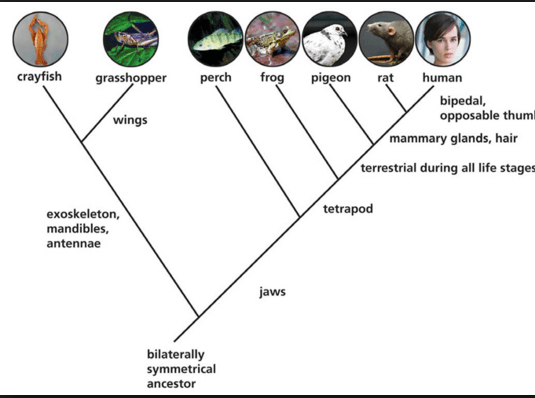
According to the diagram, which organism is most distantly related to the human?

a)

crayfish

b)

grasshopper

c)

perch

d)

frog

37.
A change in a trait or characteristic that increases an organism’s ability to survive and reproduce.
a)
extinction
b)
natural selection
c)
adaptation
d)
choice
38.
The theory that organisms best adapted to their environment are more likely to survive and reproduce.
"Survival of the fittest."
a)
Natural selection
b)
Adaptation
c)
Extinction
d)
Fossil
39.
WHY is this variation is best for survival?
a)
longer claws for fighting
b)
longer legs for running faster
c)
bigger ears for better hearing
d)
fur color that blends in to it's environment
40.
How will this mice population most likely change in the future?
a)
The white mice will go extinct.
b)
The grey mice will go extinct.
c)
All of the mice will grow longer fur.
d)
All of the mice will grow longer claws.
41.

The longnose butterfly fish has a dark spot near its tail that looks like an eye. Its "eyespot" makes predators think they are attacking the head rather than the tail. Why does the longnose butterfly fish have an evolutionary advantage over other fish?

a)

It is more effective at finding mates than other fish.

b)

It is more effective at catching shrimp and worms than other fish.

c)

It is likely to produce more offspring that survive to maturity.

d)

It uses less energy to swim than other fish.

42.

If scientists were to compare the fossil of a fern that lived millions of years ago with other fern fossils that were formed later, what would they most likely find?

a)

that plants had bones millions of years ago

b)

that plants change over time

c)

that ferns stopped evolving 25 million years ago

d)

that only animals evolve

43.
Ten brown mice and ten white mice are placed in a desert environment. What will happen to the white population over time?
a)
It will increase
b)
It will decrease
c)
It will stay the same
d)
There is no way to tell
44.

How would a warming climate affect the species in an ecosystem?

a)

individuals might die off but a species cannot disappear completely

b)

species would increase in number to offset the numbers killed by the heat

c)

species that have never been seen before would suddenly appear

d)

individuals best able to survive the heat would become more likely to reproduce

45.

The diagram below shows a portion of the fossil record in sedimentary rock. Different rock layers and fossils are clearly visible.

a)

Layer B contains the second-oldest fossils.

b)

Layer A contains the most recently formed fossils.

c)

The fossils in layer B are older than those in layer D.

46.
The praying mantis has few predators. Yet it is adapted to look just like the twigs and small branches where it is usually found. Explain how this adaptation helps the praying mantis survive. 
a)
It hides better in its environmet to be harder prey to find.
b)
It hides better in its environment to be a better predator.
c)
It eats twigs and you are what you eat.
d)
It wants to camouflage itself.
47.
What conclusion can be drawn from the diagram to the right about Troodontidae and Oviraptorosauria? 
a)
They all share the common ancestor Archaeopteryx.
b)
They all share the common ancestor Dromaeosauridae.
c)
They have all of the same traits in common with Archaeopteryx.
d)
There were no evolutionary changes between these two species.
48.
Look at the diagram to the right. Which species will have the greatest physical difference from its ancestor the Drosophila melanogaster? Explain how you determined your answer.
a)
Drosophilia equinoxalis caribbensis
b)
Drosphila melanogaster
c)
Drosophilia willstoni
d)
Drosophilia equinoxialis equinoxialis
49.
The diagram shows the beaks of four Finches that developed over time from one parent species. Explain why the beak shape of each species of Finch developed differently. 
a)
They adapted to look better, so they could reproduce and pass on traits.
b)
Their beaks adapted to help them hide from predators.
c)
They adapted to better eat the different foods available to them in the region they live in.
d)
They adapted so they could smell better.
50.
Which of the following most likely supports how giraffes evolved long necks?
a)
More long-necked giraffes survived to pass on their genes.
b)
More short-necked giraffes survived to pass on their genes.
c)
Short-necked giraffes grew longer necks to reach higher leaves.
d)
Short-necked giraffes modified their diets to evolve into a new species.
51.
The walking catfish is a species of fish that walks on land using its pectoral fins. During drought conditions, when there is little water in its habitat, the walking catfish can use its pectoral fins to get to areas with water.
a)
Walking catfish with small pectoral fins are more likely to survive a trip to distant areas of water. The population is likely to evolve to have smaller pectoral fins.
b)
Walking catfish with large pectoral fins are more likely to survive a trip to distant areas of water. The population is likely to evolve to have larger pectoral fins.
c)
Walking catfish with large pectoral fins and those with small pectoral fins are equally likely to survive a trip to distant areas of water. Both types of catfish  will then become extinct. 
d)
Walking catfish with large pectoral fins and those with small pectoral fins are equally likely to not survive the trip to distant areas of water. Both types of catfish will then become extinct.
52.
T - tall and t = short
In the punnett square below, what belongs in the missing square
a)
tt
b)
Tt
c)
Bb
d)
TT
53.
G = green, g = yellow
The genotype for a yellow plant is...
a)
GG
b)
Gg
c)
gg
d)
all of the choices result in yellow
54.
B = brown fur  b = white fur
In the punnett square, what is the probability for white fur? 
a)
0%
b)
25%
c)
50%
d)
75%
55.
Which of the following alleles is homozygous (purebred) recessive?
a)
Tt
b)
tt
c)
TT
d)
t
56.
Two brown eyed parents (Bb) have a baby. What is the chance the baby is blue eyed?
a)
0 %
b)
25%
c)
50%
d)
75%
57.
Dominant alleles are represented by a:
a)
Male gene
b)
lowercase letter
c)
recessive trait
d)
capital letter
58.

B = brown fur b = white fur

In the Punnett square, what is the probability for white fur?

a)

0%

b)

25%

c)

50%

d)

75%

59.

An organism's physical appearance or visible traits. (what it looks like)

a)

phenotype

b)

genotype

60.

An organism's genetic makeup, or allele combination. The letters we use to show the allele combination.

a)

phenotype

b)

genotype

61.

A chart that shows all the possible combinations of alleles that can result from a genetic cross

a)

dominant allele

b)

codominance

c)

probability

d)

Punnett Square

62.
What is the phenotype of the offspring? (A-Brown hair; a-blond hair) 
a)
50 % Brown Hair and 50% Blond Hair 
b)
25 % Brown Hair and 75% Blond Hair 
c)
75 % Brown Hair and 25% Blond Hair 
d)
0% Brown Hair and 100% Blond Hair 
63.
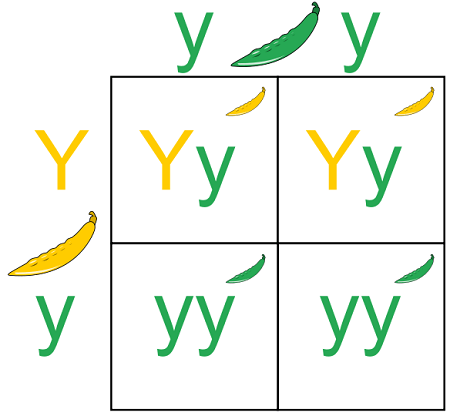
Which choice best represents the genotype of this cross?
a)
1 Yy: 2 yy: 0 YY
b)
2 Yy: 2 yy: 0 YY
c)
3 Yy: 1 yy: 0 YY
d)
1 Yy: 3 yy: 0 YY
64.
Each one of the boxes on the Punnett Square represents what probability of an offsprings' genotype?
a)
25%
b)
1%
c)
10%
d)
0%
65.
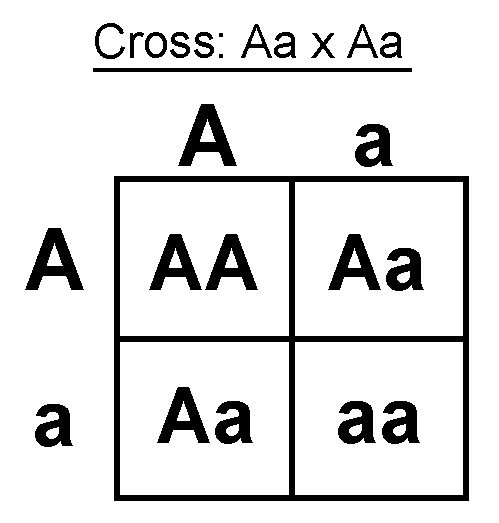
What allele combination should go in the missing box?
a)
AA
b)
Aa
c)
aa
d)
none of these