
 Worksheets
Basic Stair Layout Exam
Total questions: 20
Worksheet time: 10mins
The horizontal distance from the face of one riser to the face of the next riser is the _____
unit measure
unit run
unit rise
unit depth
Rule 2 for calculating rise-to-run ratio is stated as _____
Tread width + riser height = 17" to 18"
Tread width + (2 x riser height) = 24" to 25"
Tread width + (3 x riser height) = 34" to 35"
Tread width x riser height = 70" to 75"
Service stairs are the primary means of access in a two-story commercial building.
True
False
All of the following are parts of a balustrade except ____.
a baluster
a newel post
nosing
a handrail
The item placed between the building wall and stairway to prevent the wall from cracking created by settling is the _____
crown jabber
expansion joint
skirtboard
stringer
The maximum rise for a set of stairs without a landing is typically _____
9 feet
10 feet
12 feet
15 feet

Refer to Review Question Figure 1 to answer. The stair part marked A is the _____
nosing
platform
skirtboard
nosing return
Which of the following is used to establish the rise and run of a staircase?
Tread width + (2 x riser height) = 17" to 18"
Tread width x riser height = 24" to 25"
Tread width + (2 x riser height) = 24" to 25"
Tread width + (2 x riser height) = 70" to 75"
Tread width (unit run) is measured from the _____
face of one riser to the nosing of the next riser
face of one riser to the face of the next riser
top of one tread to the bottom of the next riser
subfloor to the top tread
Per the International Building Code®, maximum handrail height from top of rail to nosing is ____.
34"
38"
46"
50"
The most important concern in the design of any stairway is ____.
safety
choice of materials
appearance
material and labor cost
The handrail known as a wall rail is used on a(n) _____
closed stairway
winding stairway
open stairway
balustrade
Because it is difficult to build, which type of stairway is often fabricated off-site?
Straight-run stairway
Platform stairway
Double-L stairway
Winding stairway
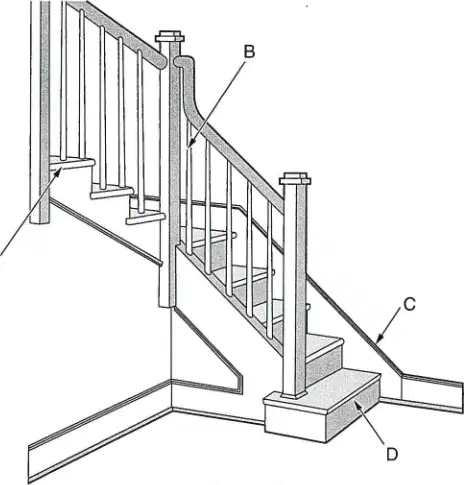
Refer to Review Question Figure 1 to answer. The stair part marked D is the _____
nosing
skirtboard
spindle
newel post
The vertical difference between a stair tread nosing and any structure or ceiling above the stairway is known as the _____
newel post
skirtboard
crown
headroom
The maximum stair riser height specified in the International Building Code is _____
6½"
7"
7¾"
8"

The stair part marked C is the _____
nosing
skirtboard
spindle
railing
Per the International Building Code®, minimum handrail height from top of rail to nosing is ____.
34"
36"
40"
44"
A series of steps that are straight and continuous without breaks is called a ____.
rise
flight
run
covey
The main support for a handrail at the bottom of a stairway is called a(n) ____.
baluster
main newel post
ending newel post
starting newel post

