
 Worksheets
Evaluation and Learning Aspects of Human Geography
Total questions: 45
Worksheet time: 23mins
What will be evaluated on May 12, 2025?
The experiences and contributions of diverse groups in multicultural societies
The history of ancient civilizations
The development of technology in the 21st century
The impact of climate change on wildlife
What subject will be read and written about to learn important aspects?
Human Geography
Marine Biology
Quantum Physics
Ancient History
What is one effect of the global population growing rapidly?
Decreased demand for food production
Increased demand for food production
More available jobs
Less need for immigration
What can negative population growth lead to in some countries?
Surplus of workers
Lack of workers
More food production
Decreased immigration
Why might people migrate from villages to cities?
For better economic opportunities
To find more food
To escape from wars
To reduce population growth
What is one reason people might move from country to country?
To find more jobs
To experience different cultures
Due to wars, food shortages, or lack of jobs
To reduce population growth
What is population distribution?
The number of people living in a city
The arrangement or spread of people living in a given area
The total population of a country
The number of people migrating each year
What often causes population distribution to vary?
Climate change
Migration for better economic opportunities
Natural disasters
Technological advancements
Why might people migrate from country to country?
To find better weather
Due to wars, food shortages, or lack of jobs
To explore new cultures
For educational purposes

Which states are more heavily populated according to the map?
States in the Midwest
States in the Northeast
States in the Southwest
States in the Northwest

Which states are less populated according to the map?
States in the Southeast
States in the Northeast
States in the Midwest
States in the Northwest

What does the map in the image represent?
Climate zones of the world
Population density of the world
Natural resources of the world
Political boundaries of the world

According to the map, which area has the highest population density?
Australia
Northern Canada
South Asia
Antarctica

What is the population density range for the darkest areas on the map?
0 persons per km²
1 - 4 persons per km²
250 - 999 persons per km²
1,000+ persons per km²
What do population pyramids show?
Trends in the birth and death rate for a particular country
The weather patterns of a country
The economic growth of a country
The cultural diversity of a country
What does it mean if a population pyramid is shaped like a pyramid?
It indicates a long lifespan for the population
It indicates a short lifespan for the population
It indicates a stable economy
It indicates a high level of education
How would a population pyramid look for a fully-developed, growing country?
Shaped like a pyramid
Straight up and down
Circular
Triangular

What does the population pyramid for Kenya in 2008 show about the age distribution?
There are more elderly people than young people.
The population is evenly distributed across all age groups.
There are more young people than elderly people.
The population is mostly middle-aged.
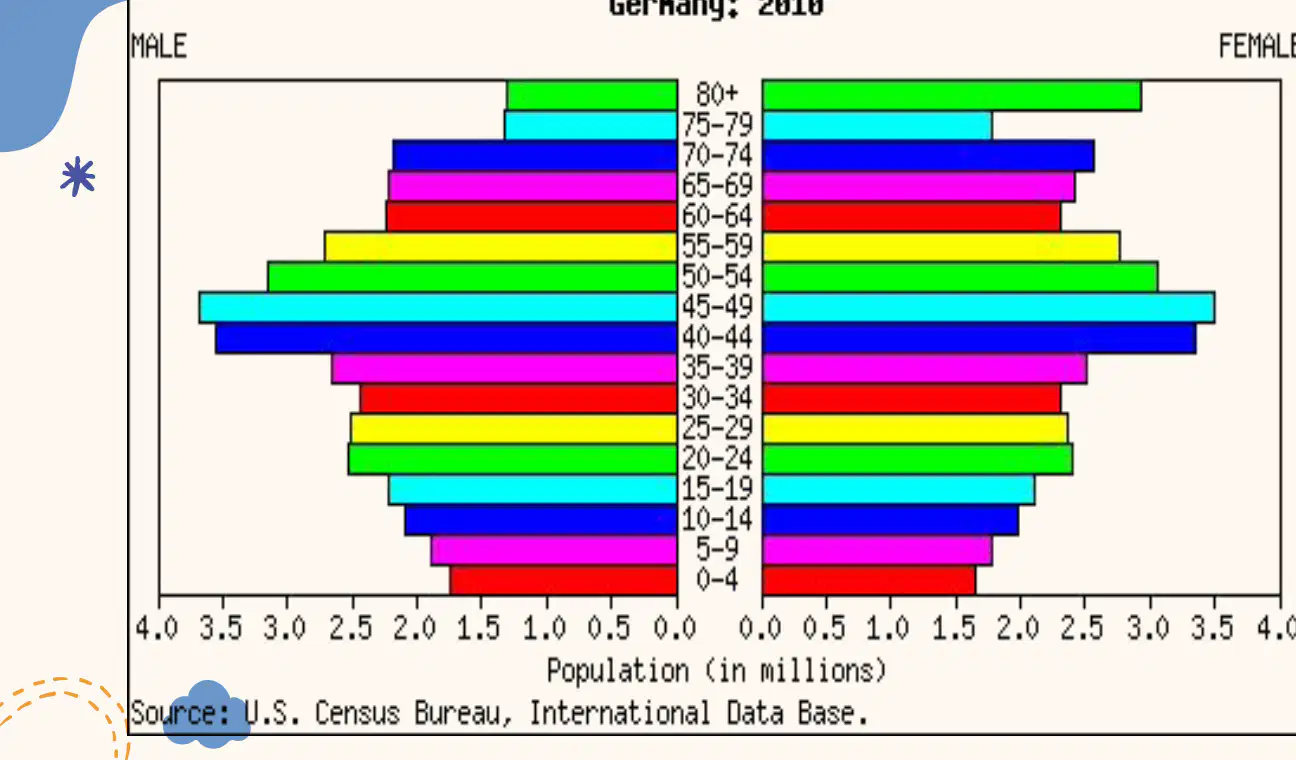
What does the diagram represent?
A map of Germany
A population pyramid of Germany in 2010
A weather chart of Germany
A timeline of German history

Which age group has the largest population according to the diagram?
0-4 years
50-54 years
25-29 years
80+ years

What is the source of the data used in the diagram?
German Government
U.S. Census Bureau, International Data Base
United Nations
European Union

What does the diagram represent?
A map of France
A population pyramid of France in 2010 showing age distribution by gender
A weather chart of France
A timeline of historical events in France
What is a strong unifying force in a society's culture?
Language
Religion
Government
Economy
What can provide a sense of identity but also be a source of conflict in a society's culture?
Language
Religion
Government
Economy
What helps geographers divide the earth into culture regions?
Language and religion
Governments and economic activities
Climate and weather
Art and music
What are some internal factors that can cause cultures to change?
New ideas and inventions
Trade and migration
War and conflict
Industrialization
Where did the first civilizations arise?
In deserts
In culture hearths
On mountains
In forests
What has increased cultural diffusion rapidly in modern times?
The Information Revolution
Farming settlements
Mountain exploration
Desert trade
What do the governments of the world manage?
Only their populations
Only their global relationships
Their individual territories, populations, and global relationships
Only their individual territories
How are governments organized?
In levels ranging from local to national
In levels ranging from international to global
In levels ranging from regional to continental
In levels ranging from state to city
In which type of government does power rest solely in the national government?
Federal
Unitary
Autocracy
Oligarchy
How is power divided in a federal system?
Between national and local governments
Solely in the national government
Among a small group
With the consent of citizens
Who holds the power to govern in an autocracy?
A small group
The citizens
A single individual
The national government
In an oligarchy, who holds the power?
The citizens
A single individual
A small group
The national government
In a democracy, how do leaders rule?
With the consent of citizens
By themselves
Through a small group
Solely by national power
What type of government does the United States have?
Monarchy
Republic
Dictatorship
Oligarchy
What type of government does the United States have?
Monarchy
Republic
Dictatorship
Oligarchy
What determines the rules in a traditional economy?
Government regulations
Habit and custom
Free enterprise
Market demand
What is a market economy based on?
Government control
Habit and custom
Free enterprise
Mixed regulations
In which type of economy does the government control decisions?
Market economy
Traditional economy
Command economy
Mixed economy
What do mixed economies combine?
Habit and custom with free enterprise
Free enterprise with government support and regulations
Government control with market demand
Traditional rules with modern technology
Which religion has the largest number of followers according to the image?
Islam
Hinduism
Christianity
Buddhism

How many followers does Judaism have according to the image?
14 million
900 million
376 million
1.5 billion
Which religion has 900 million followers according to the image?
Buddhism
Hinduism
Islam
Judaism
According to the image, which religion has the second largest number of followers?
Buddhism
Judaism
Islam
Hinduism

