
 Worksheets
Nervous System Quiz
Total questions: 15
Worksheet time: 23mins
Which of the following is considered the functional unit of the nervous system?
Melanocytes
Glial cells
Lymphocytes
Neurons
Which of the following parts of the neuron contains the nucleus?
Axon
Axon endings
Cell body
Dendrites
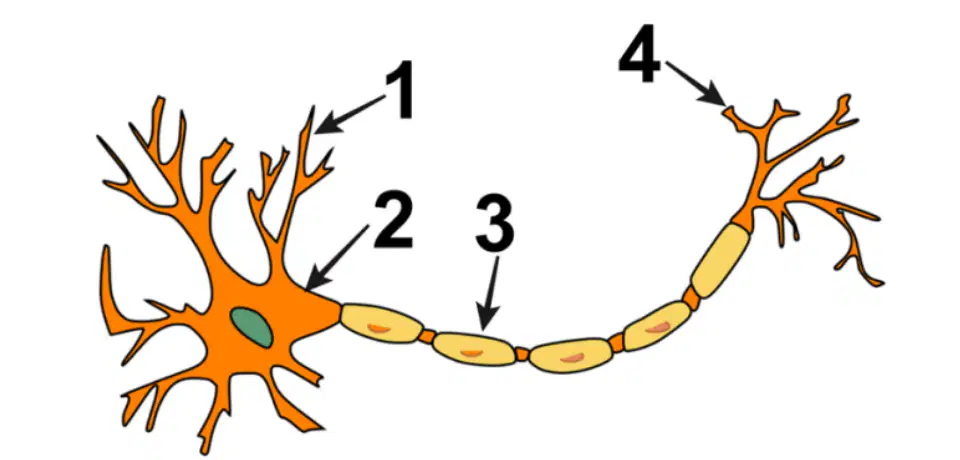
Based on the diagram below, which of the following is a correct match between the number and the name of the part?
1: Axon terminal
2: Nucleus
3: Axon
4: Dendrites

Which of the following shows the correct sequence for the flow of impulse through neuron number 3?
E→B→A
B→D→E
B→A→E
A→D→B

Neuron 2 is most likely to be a(n)_________________.
interneuron
efferent neuron
motor neuron
sensory neuron

Which type(s) of neurons is/are likely to have axons throughout the body and not only in the central nervous system?
1 only
1 and 2 only
1 and 3 only
2 and 3 only
Which of the following best describes the resting potential of a neuron?
The inside of the neuron is positively charged compared to the outside
The inside of the neuron is negatively charged compared to the outside
The inside and outside of the neuron have the same charge
The neuron is not active and has no charge difference
How does the sodium-potassium pump help maintain the resting potential of a neuron?
It moves more sodium ions into the cell than potassium ions out
It moves more potassium ions into the cell than sodium ions out
It pumps sodium ions out and potassium ions into the cell, keeping the inside negatively charged
It allows ions to move freely in and out of the cell without using energy
What is the role of the threshold in the transmission of a nerve impulse through a neuron?
It prevents any electrical signals from traveling through the neuron
It determines if the stimulus is strong enough to trigger an action potential
It allows ions to move freely in and out of the neuron at all times
It keeps the neuron permanently at resting potential
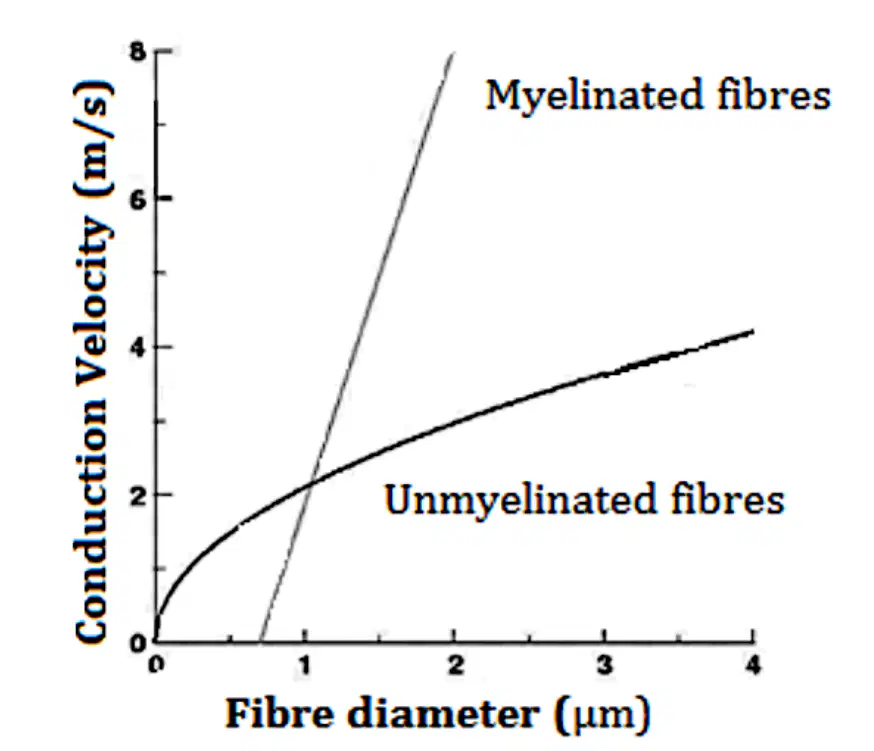
What can be concluded about the speed of conduction between myelinated and unmyelinated fibers with varying fiber diameters in the graph below?
As the diameter and myelination of the fiber increases, the speed of conduction increases
Conduction along unmyelinated fibers increases more rapidly than myelinated fibers
The diameter of the axon has no impact on conduction of myelinated/unmyelinated fibers
The velocity of conduction increases in narrow fibers
Which of the following correctly predicts the effect of the absence or reduction of myelin sheath in neurons?
Signals would not be transmitted through the neuron at all
Signals would be transmitted at a very low speed
Signals would be transmitted without the need to reach the threshold potential
Signals would not be able to reach the axon terminals
How is a nerve impulse transmitted across a synapse?
The impulse jumps directly from one neuron to the next without any chemicals
The synapse blocks the nerve impulse from continuing to the next neuron
The impulse travels through the synapse using only electrical signals
Neurotransmitters are released into the synapse, carrying the impulse to the next neuron

Use the diagram below to describe the role of the three types of neurons in the reflex arc.
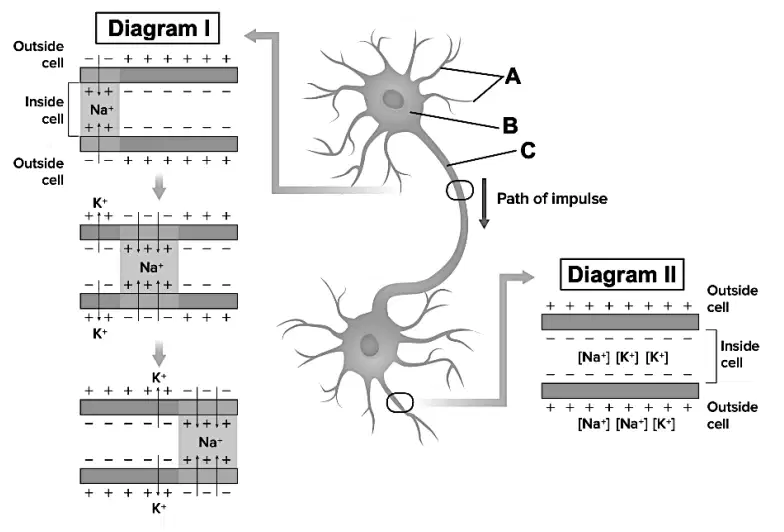
Complete the table below to identify the name of each labeled part of the neuron. Use the provided list for your answer. Each term must be used once only. Write them in the arrangement A, B, C
Axon - Cell body - Dendrites
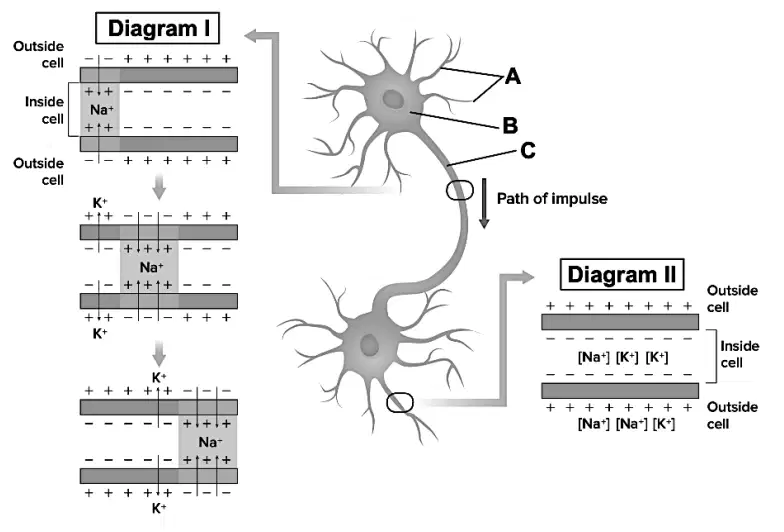
Complete the table below to identify the type of potential (action or resting) shown in diagrams I and II.

