
Font size
 Worksheets
Renewable Energy and Power Plant Considerations
Total questions: 73
Worksheet time: 47mins
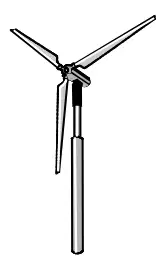
Which of the following lists two benefits and two drawbacks of installing wind turbines in an area near the Chesapeake Bay?
Benefits: Renewable energy, reduced air pollution. Drawbacks: Potential harm to wildlife, visual impact.
Benefits: Increased fossil fuel use, higher emissions. Drawbacks: Lower energy costs, improved air quality.
Benefits: More traffic, increased noise. Drawbacks: More jobs, cleaner water.
Benefits: Higher taxes, less tourism. Drawbacks: More recreation, better fishing.
Which of the following are important environmental factors to consider when selecting a location for a nuclear power plant?
Proximity to water sources, risk of natural disasters, impact on local wildlife
Availability of skilled labor, cost of construction materials, distance from city center
Access to highways, local tax incentives, proximity to shopping centers
Number of existing power plants in the area, local population's average income, amount of rainfall
Which of the following are things people living closest to a possible nuclear power plant site would most likely be concerned about?
Safety and risk of accidents, environmental impact, and health effects
Access to better jobs, improved local schools, and more shopping centers
Increased tourism, better weather, and more entertainment options
Lower electricity bills, more public parks, and faster internet speeds
If you were asked to recommend a renewable energy resource for use in a new community, which would you choose?
Solar energy
Coal
Natural gas
Nuclear energy
Water and hydrogen peroxide are:
Elements
Compounds
Mixtures
Both elements and mixtures
Which of the following are characteristic properties of water?
It is colorless and tasteless
It is a good conductor of electricity
It is a good solvent and has a high boiling point
It is magnetic
You have two small, unlabeled beakers each containing 10 mL of liquid. One contains hydrogen peroxide, and one contains water. Which of the following is a way to determine which liquid is in each beaker?
Add a small amount of potassium iodide to each beaker and observe which one bubbles.
Smell each beaker to identify hydrogen peroxide by its scent.
Taste each liquid to determine which is hydrogen peroxide.
Check the color of the liquids, as hydrogen peroxide is blue.
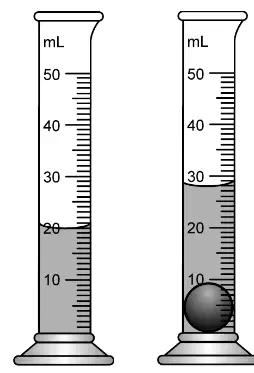
Ted’s teacher gave him a silver-colored metal ball and told him it was made of a pure substance. (a) Ted put some water in a graduated cylinder. He then put the ball in the same graduated cylinder with the water, as shown below. What did Ted learn about the ball?
The ball displaced some water, showing its volume.
The ball dissolved in water, showing it is soluble.
The ball changed color in water, showing a chemical reaction.
The ball floated on water, showing it is less dense than water.
What else would Ted have to do before he can calculate the density of the ball?
Measure the mass of the ball
Measure the color of the ball
Measure the temperature of the ball
Measure the speed of the ball
Ted should calculate the density of the ball by:
Dividing the mass of the ball by its volume
Multiplying the mass of the ball by its volume
Adding the mass and volume of the ball
Subtracting the volume from the mass of the ball
Knowing the density and other properties of the ball will help Ted to identify the metal from which the ball is made because:
Each pure metal has unique properties such as density that can be compared to known values.
All metals have the same density and properties.
Density and properties do not help in identifying metals.
Only the color of the metal is important for identification.
Which of the following is a physical property of the laptop you are reading from right now?
weight
Taste
Smell
ease of use
Evelyn is conducting an experiment in her science class. She needs to fill in the following chart to classify each of the types of matter. Example of matter: soda pop. Is it an element, compound, or mixture? Give a brief reason for your answer. State at 20°C—room temperature: (solid, liquid, or gas)
Mixture; contains water, sugar, carbon dioxide, and other ingredients. State: liquid (with dissolved gas).
Element; made up of only one type of atom. State: solid.
Compound; made up of two or more elements chemically combined. State: gas.
Element; contains only carbon dioxide. State: gas礁
Henry is conducting an experiment in his chemistry class. He needs to fill in the following chart to classify each of the types of matter. Example of matter: acetone (nail polish remover) Element, compound, or mixture? Give a brief reason for your answer. State at 20°C—room temperature: (solid, liquid, or gas)
Compound; made of carbon, hydrogen, and oxygen atoms. State: liquid.
Element; made of only one type of atom. State: gas.
Mixture; contains several substances physically combined. State: solid.
Element; made of only one type of atom. State: solid.
Emma is sorting her kitchen pantry and comes across a tub of chocolate chip ice cream. She wonders how to classify it. Is it an element, compound, or mixture? Give a brief reason for your answer. State at 20°C—room temperature: (solid, liquid, or gas)
Mixture; contains ice cream and chocolate chips, which are mixtures themselves. State: solid (at 20°C, it may melt, but generally considered solid).
Element; made up of only one type of atom. State: gas (at 20°C).
Compound; made up of two or more elements chemically combined. State: liquid (at 20°C).
Element; contains only chocolate chips, which are pure substances. State: solid (at 20°C).
Avery is making lemonade for a summer party. Example of matter: is lemonade an Element, compound, or mixture? Give a brief reason for your answer. State at 20°C—room temperature: (solid, liquid, or gas)
Mixture; contains water, sugar, lemon juice. State: liquid.
Element; made of only one type of atom. State: solid.
Compound; made of two or more elements chemically combined. State: gas.
Element; contains only lemon molecules. State: liquid垣
Abigail is planning a birthday party and wants to fill balloons with a gas. She considers using helium. Is helium an element, compound, or mixture? Give a brief reason for your answer. State at 20°C—room temperature: (solid, liquid, or gas)
Element; made of only helium atoms. State: gas.
Compound; made of helium and oxygen atoms. State: liquid.
Mixture; contains helium and nitrogen. State: solid.
Element; made of only hydrogen atoms. State: gas垣State: gas.
Scarlett is conducting an experiment in her chemistry class. She needs to fill in a chart to classify each of the types of matter. What would she put for table salt? Element, compound, or mixture? State at 20°C—room temperature: solid, liquid, or gas?
Compound; made of sodium and chlorine atoms. State: solid.
Element; made of only one type of atom. State: liquid.
Mixture; contains multiple substances not chemically combined. State: gas.
Compound; made of hydrogen and oxygen atoms. State: liquid quarters 🍂.
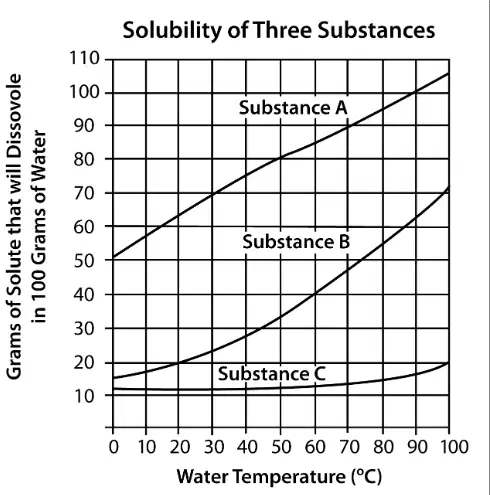
Which of the substances is the most soluble in water at any temperature? Refer to the 'Solubility of Three Substances' graph.
Substance A
Substance B
Substance C
Substance D
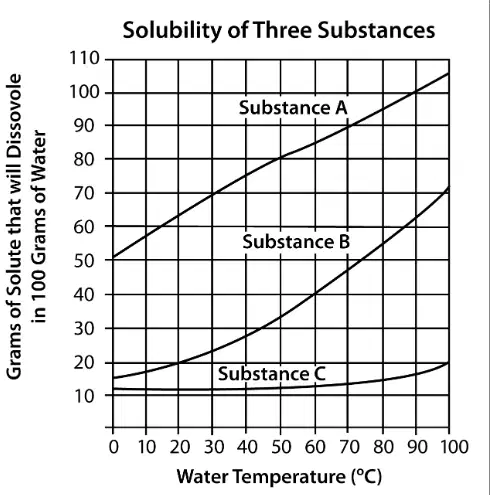
About how much of Substance B will dissolve in 100 grams of water when the water temperature is 50°C?
About 60 grams
About 20 grams
About 80 grams
About 100 grams
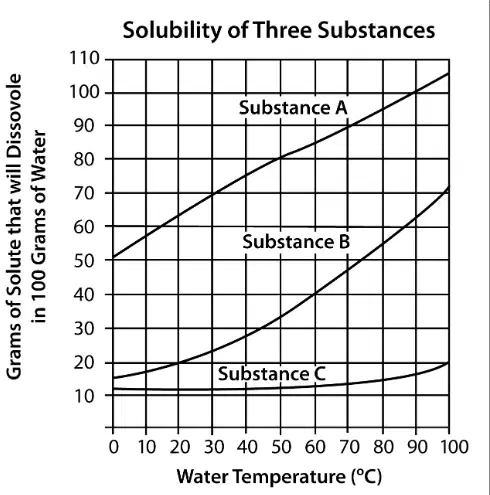
The graph shows the solubility of three unknown substances. (c) Write a statement to tell how the solubility of all the substances changes as the temperature changes. Refer to the 'Solubility of Three Substances' graph.
The solubility of all the substances increases as the temperature increases.
The solubility of all the substances decreases as the temperature increases.
The solubility of all the substances remains constant as the temperature increases.
The solubility of all the substances first increases and then decreases as the temperature increases.
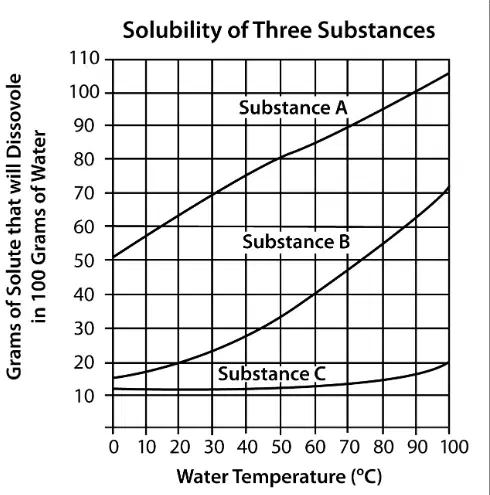
If you stirred 50 grams of Substance C in 100 grams of water at a temperature of 40°C, what do you think you would observe? Refer to the 'Solubility of Three Substances' graph.
Not all of the 50 grams of Substance C would dissolve; some would remain undissolved because the solubility of Substance C at 40°C is much less than 50 grams.
All 50 grams of Substance C would dissolve completely because the solubility at 40°C is more than 50 grams.
The solution would boil immediately due to the high temperature.
Substance C would react with water to form a new compound.
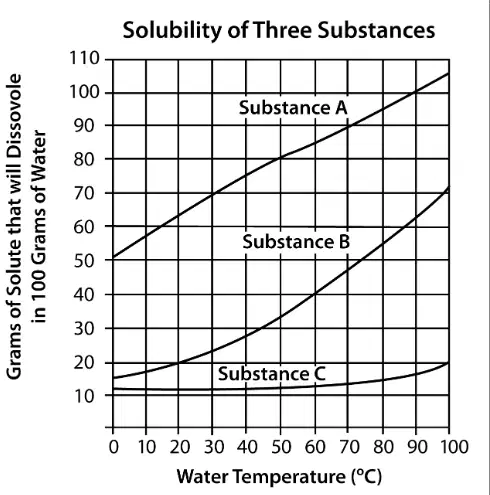
Is it possible to make all 60 g dissolve? If so, how could it be done? Refer to the 'Solubility of Three Substances' graph.
Yes, by increasing the temperature of the water, all 60 g of Substance B can dissolve.
No, increasing the temperature will not affect the solubility of Substance B.
Yes, by decreasing the temperature of the water, all 60 g of Substance B can dissolve.
No, only by adding more water can all 60 g of Substance B dissolve.
Which of the following best summarizes the organization of the elements on the periodic table by atomic number, metallic nature, state at room temperature, and number of valence electrons?
A web, mind map, or other graphic representation
A written essay
A list of element names only
A timeline of element discoveries

Rubidium (Rb) can be classified in which of the following ways?
As an alkali metal, as a chemical element, by its atomic number, by its physical state at room temperature
As a noble gas, as a nonmetal, by its radioactivity, by its use in medicine
As a transition metal, as a metalloid, by its color, by its magnetic properties
As a halogen, as a lanthanide, by its taste, by its smell

How many electrons does an atom of rubidium have?
37
35
39
36

How many valence electrons does an atom of rubidium have?
(a)

How many of each element are on each side of this chemical equation?
6 Carbon Atoms
12 Hydrogen atoms
18 Oxygen Atoms
6 Carbon Atom
12 Hydrogen Atoms
18 Oxygen Atom
3 oxygen atoms
6 Hydrogen atoms
12 Carbon atoms
Decide whether the following statement about elements is true or false: Group 16 on the periodic table includes metals, metalloids, and nonmetals.
True
False
Decide whether the following statement about elements is true or false: An isotope of tin could have 70 neutrons.
True
False
Decide whether the following statement about elements is true or false: Carbon easily forms ionic bonds.
True
False
Decide whether the following statement about elements is true or false: Sodium and chlorine have similar properties because they are both metals.
True
False
Decide whether the following statement about elements is true or false: The halogens have similar properties because they have the same number of electrons.
True
False
Which of the following is an example of a physical change that could take place for water?
Water freezing into ice
Water reacting with sodium
Water decomposing into hydrogen and oxygen
Water burning
Which of the following is an example of a physical change that could take place for table salt?
Dissolving table salt in water
Burning table salt
Reacting table salt with acid
Decomposing table salt by electricity
A physical change that could take place for a wooden toothpick is:
Burning it to ash
Breaking it into two pieces
Letting it rot
Painting it
Which of the following is an example of a chemical change that could take place for paper?
Tearing the paper
Burning the paper
Folding the paper
Cutting the paper
Which of the following is an example of a chemical change that could take place for iron?
Iron rusting
Iron melting
Iron being hammered into a sheet
Iron being magnetized
Which of the following is an example of a chemical change that could take place for glucose?
Glucose dissolving in water
Glucose melting
Glucose undergoing fermentation to produce ethanol and carbon dioxide
Glucose being crushed into powder
Sort as examples or indicators of "Endothermic" or "Exothermic" reactions:
melting ice
burning wood
boiling water
photosynthesis
cooking an egg
freezing water
combustion of natural gas
formation of snow
rusting of iron
release energy in the form of heat
absorb energy in the form of heat
cold chemical pack
To prove that a change illustrates the Law of Conservation of Mass in the lab, which procedure should be used?
Measure the mass of all substances before and after the reaction in a closed system.
Heat the substances and observe color changes.
Mix the substances in an open container and record the temperature.
Only observe the physical appearance of the substances.
The Law of Conservation of Mass can be illustrated using a chemical equation by showing that:
The total mass of reactants equals the total mass of products.
The mass of products is always greater than the mass of reactants.
The mass of reactants is always less than the mass of products.
The mass of reactants and products are unrelated.
Olivia was conducting an experiment in her kitchen. She added food coloring to a glass of water to make the water red. Explain if this is a chemical change or not, and provide your reasoning.
This is NOT a chemical change. The food coloring only changes the color of the water, but no new substance is formed.
This is a chemical change because the water becomes a new substance.
This is a chemical change because the food coloring reacts with the water to form a gas.
This is a chemical change because the temperature of the water increases significantly.
Anika and Mia were camping and decided to light a campfire. They noticed that when a match burns, it produces ash, gases, heat, and light. Explain if this is a chemical change or not, and provide your reasoning.
This IS a chemical change. The clue is that burning produces new substances (ash, gases, heat, and light).
This is NOT a chemical change. The match only changes its shape.
This is NOT a chemical change. The match can be returned to its original form.
This is NOT a chemical change. Only the color of the match changes.
Zoe was cooking soup on a hot stove. She noticed the temperature of the soup was changing. Explain if this is a chemical change or not, and provide your reasoning.
This is NOT a chemical change. Only the temperature of the soup changes, but no new substance is formed.
This is a chemical change because the soup is being cooked.
This is a chemical change because the soup changes color.
This is a chemical change because the soup produces bubbles.
A student combined a weak solution of hydrochloric acid (HCl) with calcium hydroxide (Ca(OH)2). Complete and balance the chemical equation for the reaction that took place.
CaCl2 + 2H2O
CaCl + H2O
CaCl2 + H2
CaO + 2HCl
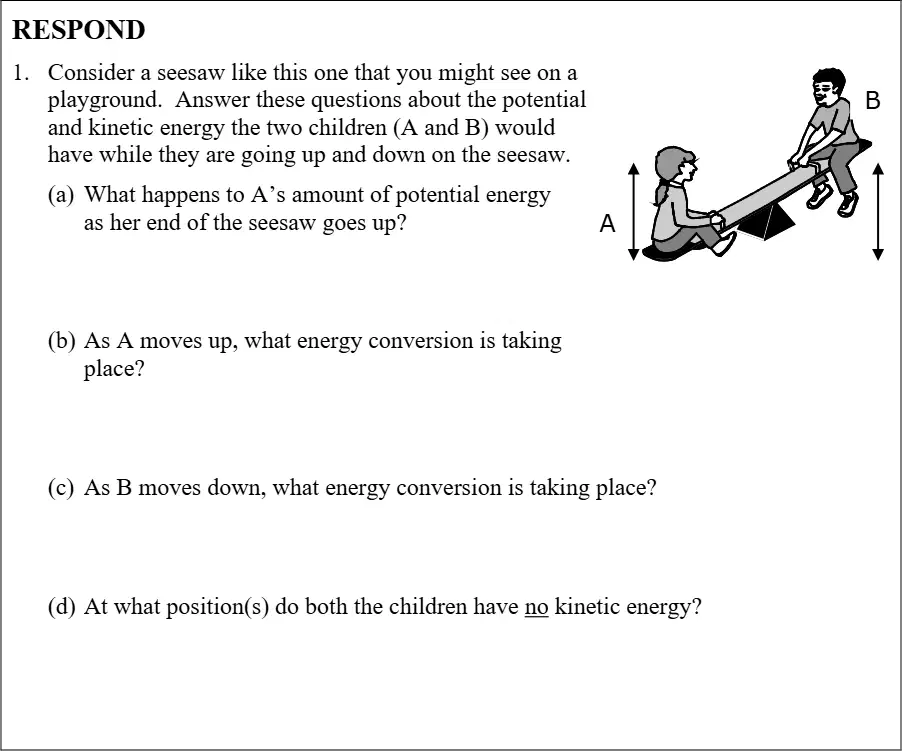
What happens to A’s amount of potential energy as her end of the seesaw goes up?
It increases.
It decreases.
It stays the same.
It becomes zero.
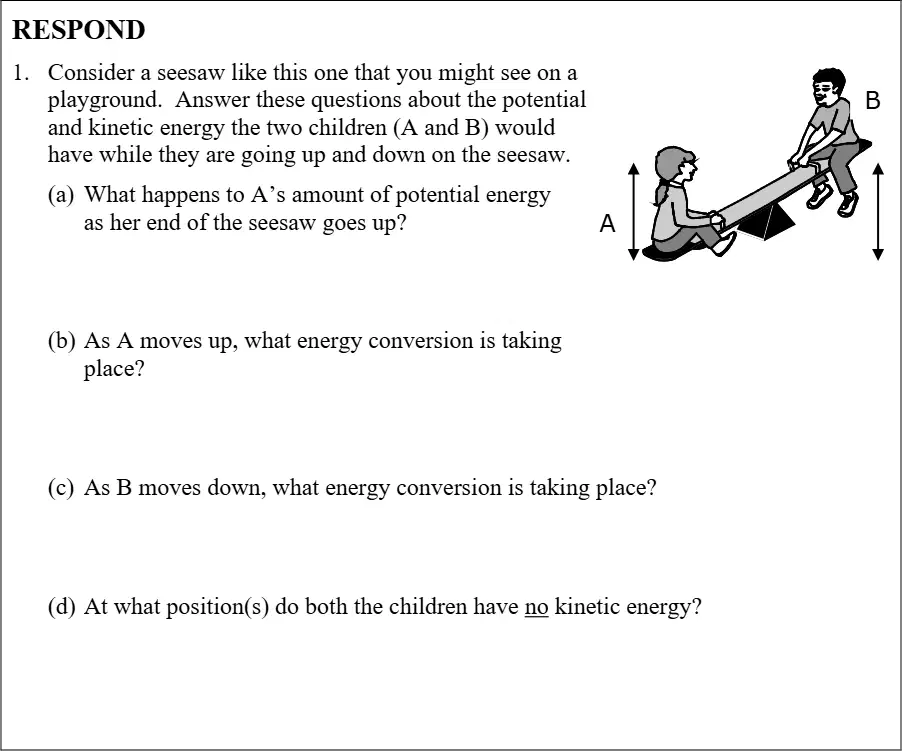
As A moves up, what energy conversion is taking place?
Kinetic energy to potential energy
Potential energy to kinetic energy
Thermal energy to kinetic energy
Chemical energy to potential energy
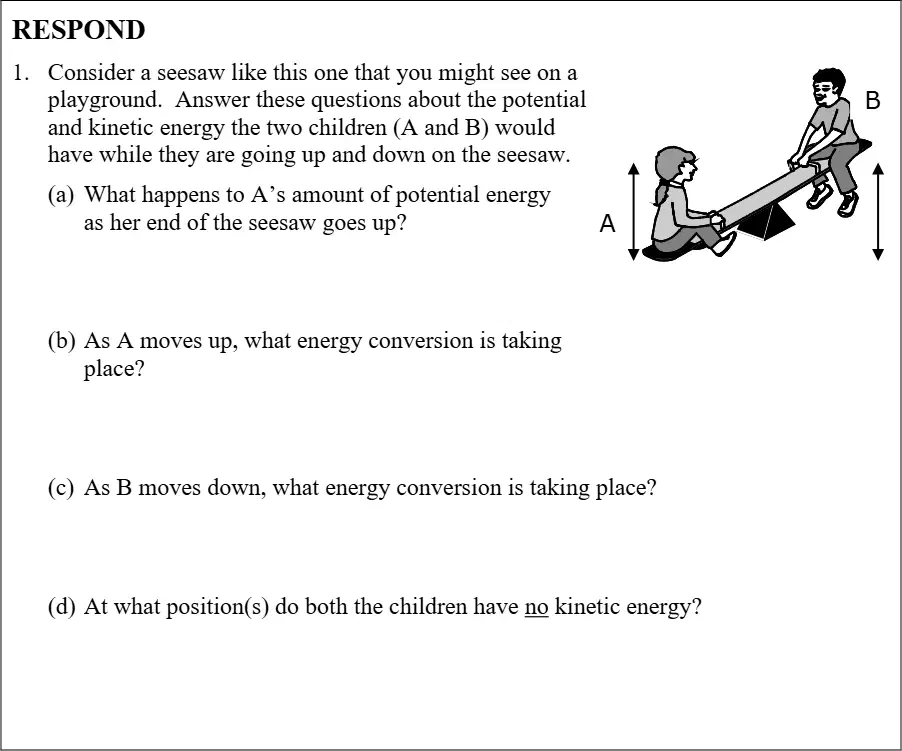
As B moves down, what energy conversion is taking place?
Kinetic energy to potential energy
Potential energy to kinetic energy
Thermal energy to kinetic energy
Chemical energy to potential energy
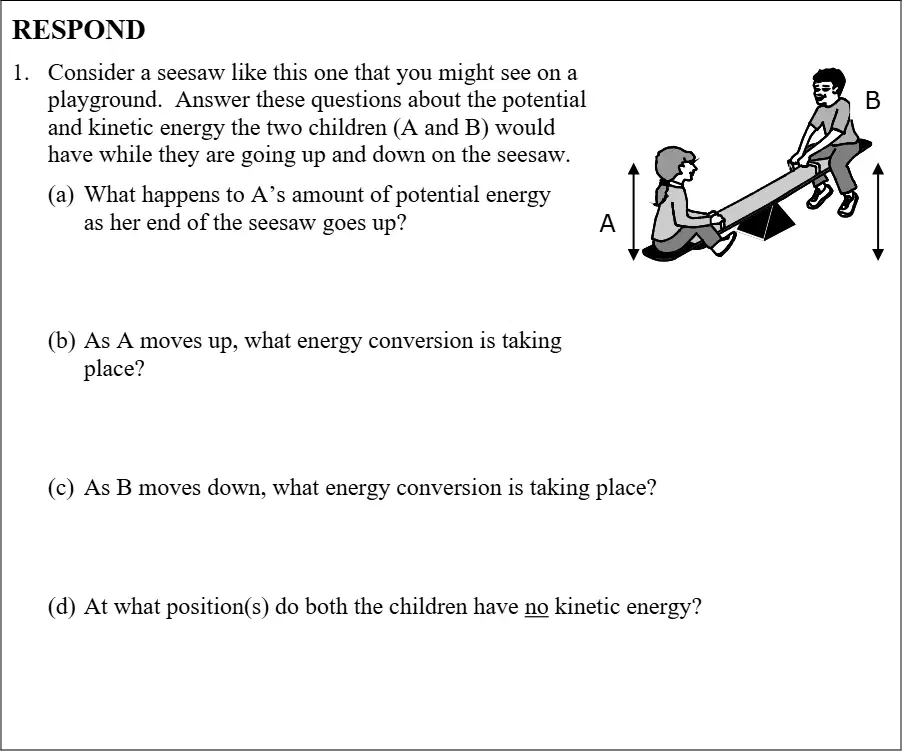
At what position(s) do both the children have no kinetic energy?
At the highest point of the swing
At the lowest point of the swing
At the midpoint of the swing
At any random point
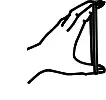
Ethan is playing with a rubber band and stretches it on his hand. For this scenario, is it potential energy (PE) or Kinetic Energy (KE)?
PE (Reason: The rubber band has stored energy due to its position or state of being stretched.)
KE (Reason: The rubber band is moving rapidly through the air.)
KE (Reason: The rubber band is vibrating while being held.)
PE (Reason: The rubber band is at rest and not stretched at all.)
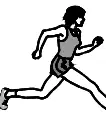
All forms of energy may be classified as either potential energy (PE) or kinetic energy (KE): Arjun is running in a race.
KE (Reason: Arjun is moving, so the energy is due to motion.)
PE (Reason: Arjun is at rest, so the energy is stored.)
PE (Reason: Arjun is at a height, so the energy is due to position.)
KE (Reason: Arjun is not moving, so the energy is due to position.)
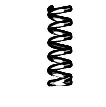
Jackson and Ethan are playing with a toy car that uses a spring mechanism. Does the spring in the toy have PE (potential energy) or KE (kinetic energy)?
PE (Reason: The spring has stored energy due to its position or compression.)
KE (Reason: The spring is moving rapidly back and forth.)
KE (Reason: The spring is releasing energy as it moves.)
PE (Reason: The spring is at rest and has no energy.)
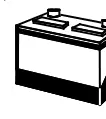
Mia is learning about energy types in her science class. Her teacher asks her to classify different objects as having potential energy (PE) or kinetic energy (KE). Does a car battery have PE or KE?
PE (Reason: The battery stores chemical energy for later use.)
KE (Reason: The battery is moving and producing energy.)
KE (Reason: The battery is generating heat while in use.)
PE (Reason: The battery is heavy and has gravitational energy.)
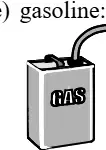
Aiden and Mia are learning about energy in their science class. All forms of energy may be classified as either potential energy (PE) or kinetic energy (KE). For each of the energy Goes a can of gasoline contain PE or KE?
PE (Reason: Gasoline contains stored chemical energy.)
KE (Reason: Gasoline is moving rapidly.)
KE (Reason: Gasoline is burning and releasing energy.)
PE (Reason: Gasoline is in motion.)
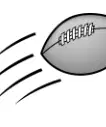
Scarlett threw a ball into the air during a game. For the ball in the air, does it have potential energy or kinetic energy?
PE (Reason: The ball has gravitational potential energy due to its position above the ground.)
KE (Reason: The ball is moving rapidly through the air, so it has kinetic energy.)
PE (Reason: The ball is at rest on the ground, so it has no energy.)
KE (Reason: The ball is spinning in place, so it has rotational kinetic energy.)
There are six forms of energy: electrical, chemical, mechanical, radiant, thermal, and nuclear. Complete the chart to show your understanding about energy transformations.
turning on a light switch
using cell phone
running a refrigerator
burning wood in fireplace
cooking food on gas stove
starting a car with a battery
riding a bike
opening a door
water flowing in a river turning a water wheel
There are six forms of energy: electrical, chemical, mechanical, radiant, thermal, and nuclear. Complete the chart to show your understanding about energy transformations.
feeling warm from the sun
using microwave oven
turning on a lamp
a hot cup of tea
warmth from light bulb
steam rising from boiling water
nuclear power plants
radioactive isotopes for medical diagnosis and treatment
PET scans
Using food in your body so you can walk and run. Energy changed from: ________ to: ________ (There may be more than one answer.)
Energy changed from: Chemical to: Mechanical, Thermal
Energy changed from: Electrical to: Light, Sound
Energy changed from: Mechanical to: Electrical, Chemical
Energy changed from: Light to: Chemical, Mechanical
Using a flashlight to see in the dark. Energy changed from: ________ to: ________ (There may be more than one answer.)
Energy changed from: Chemical (in batteries) to: Radiant (light), Thermal
Energy changed from: Electrical to: Mechanical, Sound
Energy changed from: Radiant (light) to: Chemical (in batteries)
Energy changed from: Mechanical to: Electrical, Sound
There are six forms of energy: electrical, chemical, mechanical, radiant, thermal, and nuclear. Each of the illustrations below shows an example of one form of energy being changed to another form. Complete the chart to show your understanding about energy transformations. (e) Watching a football game on TV. Energy changed from: ________ to: ________ (There may be more than one answer.)
Energy changed from: Electrical to: Radiant (light), Sound
Energy changed from: Chemical to: Mechanical, Thermal
Energy changed from: Nuclear to: Chemical, Mechanical
Energy changed from: Mechanical to: Electrical, Thermal
There are six forms of energy: electrical, chemical, mechanical, radiant, thermal, and nuclear. Each of the illustrations below shows an example of one form of energy being changed to another form. Complete the chart to show your understanding about energy transformations. (f) Pushing a box up a ramp. Energy changed from: ________ to: ________ (There may be more than one answer.)
Energy changed from: Chemical (in muscles) to: Mechanical
Energy changed from: Electrical to: Radiant
Energy changed from: Nuclear to: Thermal
Energy changed from: Mechanical to: Chemical
Soup is heated in the microwave by which method of heat transfer?
Conduction
Convection
Radiation
Combination of conduction and convection
An egg is fried in a frying pan.
Physical change
Chemical change
Both physical and chemical change
No change
A marshmallow is toasted over a fire.
Physical change
Chemical change
Both physical and chemical change
No change
Carrots are cooked in boiling water. The food is being heated primarily by which method?
Conduction
Convection
Radiation
Combination of conduction and convection
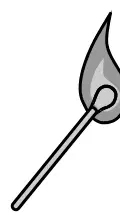
Which of the following best describes the interaction between a lighted match and the air around it using the three terms?
The match burns because the air provides oxygen, allowing combustion to occur and heat to be released.
The match cools down because the air absorbs all the heat, stopping combustion.
The air prevents the match from burning by blocking oxygen.
The match and air do not interact in any way.
Explain why there are no negative temperatures on the Kelvin scale.
Because the Kelvin scale starts at absolute zero, the lowest possible temperature.
Because the Kelvin scale is based on the Celsius scale.
Because negative temperatures are not possible in any temperature scale.
Because the Kelvin scale is only used in scientific experiments.
If it were possible to get a substance as cold as 0 K, what temperature would that be equal to on the Celsius scale?
0°C
-100°C
-273°C
273°C
What does the plateau (flat line) on the graph indicate?
A period of rapid increase
A period of no change
A period of rapid decrease
A period of fluctuation
At what point do you think the water temperature would no longer increase?
When the water starts boiling
When the water is frozen
When the water is at room temperature
When the water is being stirred
Why would the temperature stop rising?
Because heat is still being added
Because the substance is changing state
Because the temperature cannot increase further
Because the thermometer is broken
After about 5 minutes, tiny drops of water were noticed on the outside of the glass. Where did that water come from?
From the air around the glass
From inside the glass
From the melting ice cubes
From the table surface

