wayground logo

Free Printable Worksheets

NEW

Font size

S
M
L
XL
Worksheets

Unit 2 Energy Study Guide

Total questions: 71

Worksheet time: 38mins

Name
Class
Date
1.
Which electromagnetic waves have the highest frequencies and the shortest wavelengths?
a)
microwaves
b)
visible light
c)
gamma rays
2.
Which electromagnetic waves are used in ovens and cell phone communications?
a)
Infrared rays
b)
ultraviolet rays
c)
microwaves
3.
Which type of waves are used in broadcasting?
a)
radio waves
b)
infrared rays
c)
x-rays
4.
Electromagnetic waves that help your body produce vitamin D are called?
a)
ultraviolet rays
b)
x-rays
c)
gamma rays
5.
For waves in any medium, as the wavelength decreases, what happens to the frequency?
a)
It also decrease
b)
It stays the same
c)
It increases
6.
How much of the electromagnetic spectrum is made up of visible light?
a)
only a small portion
b)
a very l;arge portion
c)
about half
7.
Which of the following has wavelengths longer than microwaves?
a)
Infrared waves
b)
Radio waves
c)
Visible light
8.
Which electromagnetic waves allow us to diagnose & treat cancer?
a)
Gamma rays
b)
X-rays
c)
Ultraviolet rays
9.
The electromagnetic spectrum includes the complete range of electromagnetic waves placed in order of:
a)
increasing amplitutde
b)
increasing wavelength
c)
increasing frequency
10.
Which of the following has frequencies higher than ultraviolet rays?
a)
visible light
b)
infrared rays
c)
x-rays
11.
Which electromagnetic waves help doctors detect broken bones inside your body?
a)
gamma rays
b)
x-rays
c)
ultraviolet rays
12.
Which of the following lists the electromagnetic waves in order of increasing wavelength?
a)
X-rays, visible light, radio waves
b)
gamma rays, microwaves, UV rays
c)
infrared rays, radio waves, x-rays
13.
Which electromagnetic waves are used in devices such as heat lamps & TV remote controls?
a)
ultraviolet rays
b)
microwaves
c)
infrared rays
14.
Which of the following lists the electromagnetic waves in order of decreasing frequency?
a)
X-rays, microwaves, infrared rays
b)
UV rays, visible light, x-rays
c)
infrared rays, microwaves, radio waves
15.
Radar uses which type of electromagnetic waves to detect objects & measure their distance and speed?
a)
microwaves
b)
infrared rays
c)
x-rays
16.
Select the correct order of waves on the EMS from the longest wavelength to the shortest wavelength
a)
Radio, Micro, Infra, Visible, Ultra, X-ray, Gamma
b)
Gamma, X-ray, Ultra, Vis, Infra, Micro, Radio
c)
Vis, Micro, Infra, Ultra, X-ray, Gamma, Radio
d)
Micro, Radio, Vis, Infra, Ultra, X-ray, Gamma
17.
How are electromagnetic waves different from other waves? 
a)
They have very short wavelengths 
b)
They transmit energy instead of matter 
c)
They can travel through empty space
d)
They can change direction by reflection 
18.

The _______________ determines the color of visible light.

a)

wavelength (and frequency)

b)

speed

c)

amplitude

d)

particles of the medium

19.
These waves from the sun cause sunburn.
a)
Gamma
b)
Microwaves
c)
Radio
d)
Ultraviolet
20.
These waves are used to send signals, including WiFi and text messages.
a)
Gamma
b)
Microwaves
c)
Radio
d)
Ultraviolet
21.
A wave with a large wavelength will have a ______ frequency and _____ energy
a)
high, low
b)
high, high
c)
low, high
d)
low, low
22.
As the frequency of an electromagnetic wave increases, the amount of energy in that wave...
a)
increases.
b)
decreases.
c)
stays the same.
23.

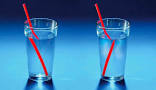
A student placed a pencil in a cup of water. The pencil appears broken because light

a)

always travels in a straight line.

b)

bends when it passes through water.

c)

makes the water in the glass evaporate.

d)

reflects the pencil on the water's surface.
24.
The velocity of light in vacuum is _______ m/s
a)
3x10⁸
b)
3x10¹²
c)
3x10⁶
d)
3x10¹⁰
25.
We can see objects because of_______
a)
reflection
b)
refraction
c)
transmission
d)
diffraction
26.
What is this called?
a)
refraction
b)
reflection
c)
reconstroction
d)
retraction
27.
Why does the lower part of the child appear so much different in size from the upper part?
a)
The light rays that travel through water and then into air are refracted.
b)
The light rays that travel through water and then into air are enlarged.
c)
The light rays that travel through air and then into water are reflected.
d)
The light rays that travel through air and then into water are reduced.
28.
We see the color _______ when a material absorbs all visible light.
a)
white
b)
black
29.
A prism separating white light is an example of...
a)
Refraction
b)
Reflection
30.
We see the color _______ when all visible light is reflected off an object.
a)
White
b)
Black
31.
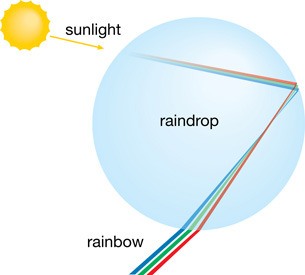
Light bending as it passes through a rain drop is an example of...
a)
Refraction
b)
Reflection
32.
What do we call this tool that separates white light into the colors of the Visible Spectrum?
a)
tuning fork
b)
prism
c)
microscope
d)
graduated cylinder
33.

When a rollercoaster goes to the top of the hill, you are gaining what type of energy?

a)

chemical potential energy

b)

gravitational potential energy

c)

gravitational kinetic energy

d)

chemical kinetic energy

34.
What describes "the energy of an object in motion, which is directly related to its velocity and its mass"?
a)
kinetic energy
b)
flat energy
c)
potential energy
d)
accelerated energy
35.
What is the possible or stored energy in an object called?
a)
Thermal Energy
b)
Kinetic Energy
c)
Chemical Energy
d)
Potential Energy
36.
At which point is potential energy greatest?
a)
W
b)
X
c)
Y
d)
Z
37.

Which letter shows where kinetic energy is at is highest point?

a)

X

b)

Y

c)

W

d)

Z

38.
What kind of energy is in a stretched rubber band?
a)
Potential
b)
Kinetic
39.

The Law of Conservation of Energy States

a)

Energy can be created or destroyed

b)

Energy can be created

c)

Energy can not be destroyed

d)

Energy cannot be created or destroyed

40.

Heat transfer always occurs

a)

from cold to hot.

b)

from hot to cold.

c)

in any direction.

41.

Which of the following is NOT a type of heat transfer?

a)

Conduction

b)

Convection

c)

Radiation

d)

Transformation

42.

Conduction is heat transfer by

a)

touch.

b)

currents.

c)

waves.

43.

Convection is heat transfer by-

a)

touch.

b)

currents.

c)

waves.

44.

Radiation is heat transfer by

a)

touch.

b)

current.

c)

waves.

45.

The sun's rays are an example of

a)

conduction.

b)

convection.

c)

radiation.

46.

Water molecules in boiling water is an example of

a)

conduction.

b)

convection.

c)

radiation.

47.

Burning your hand on a hot pan is an example of

a)

conduction.

b)

convection.

c)

radiation.

48.

Heat transfer from a fire is an example of

a)

conduction.

b)

convection.

c)

radiation.

49.

Ironing a shirt is an example of

a)

conduction.

b)

convection.

c)

radiation.

50.

The transfer of heat energy through direct contact is

a)

conduction.

b)

convection.

c)

radiation.

51.

The transfer of heat energy by the rising of warmer molecules and falling of cooler molecules is

a)

conduction.

b)

convection.

c)

radiation.

52.

The transfer of heat energy by the rising of warmer molecules and falling of cooler molecules is

a)

conduction.

b)

convection.

c)

radiation.

53.

The transfer of heat energy by the rising of warmer molecules and falling of cooler molecules is

a)

conduction.

b)

convection.

c)

radiation.

54.

What type of heat transfer is in the form of wave particles?

a)

Conduction

b)

Convection

c)

Radiation

55.

What type of heat transfer occurs from the sun to the Earth?

a)

Conduction

b)

Convection

c)

Radiation

56.

What type of heat transfer occurs when warm air rises and cool air falls back down to Earth?

a)

Conduction

b)

Convection

c)

Radiation

57.

What heat transfers by direct contact?

a)

Conduction

b)

Convection

c)

Radiation

58.

What heat transfers by the rising of warm molecules and falling of cool molecules?

a)

Conduction

b)

Convection

c)

Radiation

59.

What heat transfers by the rising of warm molecules and falling of cool molecules?

a)

Conduction

b)

Convection

c)

Radiation

60.

What heat transfers in the form of waves?

a)

Convection

b)

Conduction

c)

Radiation

61.

Hot air balloons work using what type of heat transfer?

a)

Convection

b)

Conduction

c)

Radiation

62.

An attic feeling warmer than the basement is an example of what type of heat transfer?

a)

Convection

b)

Conduction

c)

Radiation

63.

Lighting a candle with a match is an example of what type of heat transfer?

a)

Convection

b)

Conduction

c)

Radiation

64.
How do molecules at warm temperatures differ from molecules at cool temperatures? 
a)
a.  At warm temperatures, molecules move around more
b)
b.  At warm temperatures, molecules grow in siz
c)
c.  At warm temperatures, molecules exchange electrons more easil
d)
d.  At warm temperatures, molecules combine with each other more easil
65.
What is the difference between heat and temperature?    
a)
a.  Temperature measures the motion of molecules, and heat is the energy of that motion
b)
b.  Temperature is measured by a thermometer, and heat is measured by a barometer
c)
c.  Heat is measured in calories, and temperature is measured in joules
d)
d.  Heat is caused by the sun, and temperature is caused by conditions in the atmosphere
66.
Why is there more thermal energy in an iceberg than in a pot of boiling water?    
a)
a.  The pot insulates the heated molecules
b)
b.  Most icebergs are fairly warm to the touch
c)
  c.  Icebergs contain many more molecules than pots of water
d)
  d.  Water does not hold heat very well
67.
Why is there more thermal energy in an iceberg than in a pot of boiling water?    
a)
a.  The pot insulates the heated molecules
b)
b.  Most icebergs are fairly warm to the touch
c)
  c.  Icebergs contain many more molecules than pots of water
d)
  d.  Water does not hold heat very well
68.

Temperature of a material depends upon the average —————— of its particles

a)

Kinetic energy

b)

Thermal energy

c)

Heat energy

d)

Particle energy

69.

Thermal energy is transferred from————-

a)

A cooler object to a hotter one

b)

A hotter object to a cooler one

70.

If you brought sample A and B close together , in what direction would heat be transferred?

a)

From sample A to sample B

b)

From sample B to sample A

c)

Heat would not be transferred.

d)

sample A and sample B would both transfer heat to each other.

71.

In this picture, heat is being transferred from sample B to sample A. When will the heat transfer stop?

a)

Heat transfer will keep on until object B has zero thermal energy

b)

Heat transfer will not stop, it will keep going

c)

Heat transfer will stop when sample A and sample B have reached the same temperature.