
 Worksheets
Stars and Star Formation
Total questions: 44
Worksheet time: 22mins
The Sun is a ______ just like the other stars that you see twinkling in the night.
star
planet
comet
asteroid
Stars only appear to twinkle because we are looking through the ______ at a star.
atmosphere
telescope
clouds
window
Stars are balls of extremely hot ______.
gasses
liquids
rocks
metals
In the center of the star, the core, it is ______ million degrees.
15
5
50
100
Two hydrogen atoms (atomic #1) fuse together in nuclear fusion to produce ______ atoms (atomic #2).
helium
carbon
oxygen
nitrogen
What happens when the energy of fusion pushing out and the force of gravity pushing in are equal in a star?
The star explodes
The star becomes stable and enters its first stage as a star, the main sequence
The star collapses
The star turns into a planet
The Sun is a ________ star.
main sequence
red giant
white dwarf
neutron
What percentage of our galaxy is made of main sequence stars?
10%
50%
90%
100%
The Sun is average size and temperature for a ________ star.
medium sized
giant
dwarf
supergiant
What class of star is the Sun?
Class A
Class F
Class G
Class M
Our yellow star is ____ billion years old.
5
2
10
1
How many more years does the Sun have before it will change to its next phase in its life cycle?
1 billion
3 billion
5 billion
10 billion
What is the next life cycle for our star?
White dwarf
Red giant
Neutron star
Black hole
A star’s life is controlled by its _____
mass
temperature
color
distance
There are different types of stars: small, medium, giant, and super giant stars.
True
False
The more massive the star, the faster the star ages.
True
False
A star’s color depends on its temperature in the photosphere (the layer next to the core). If you change the temperature of a star it will change its _____
color
size
distance
shape
Larger stars follow one path as they age and smaller/medium stars take another path.
True
False
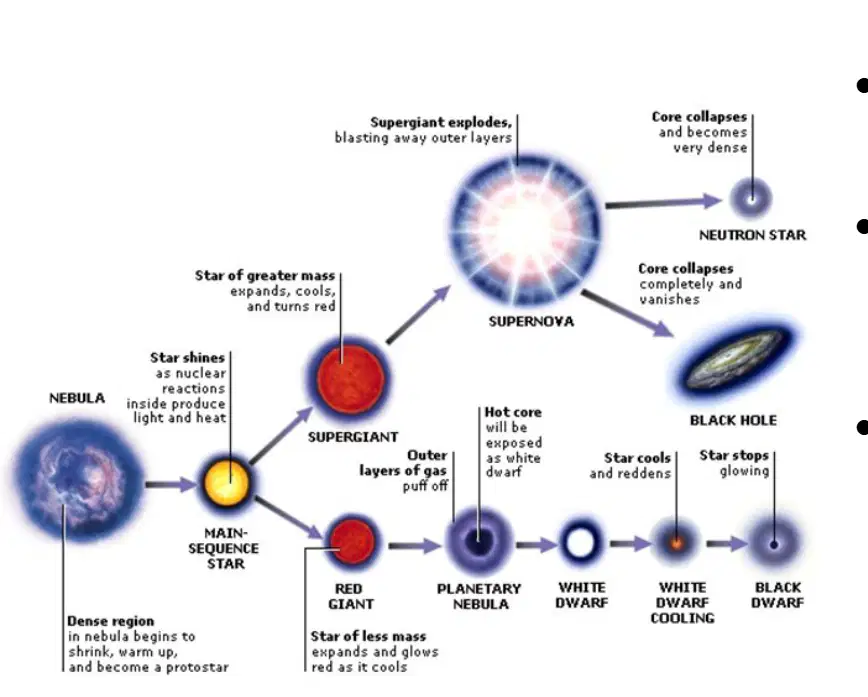
All stars start as a ______, which is a cloud of dust and gas.
Nebula
Comet
Asteroid
Planet
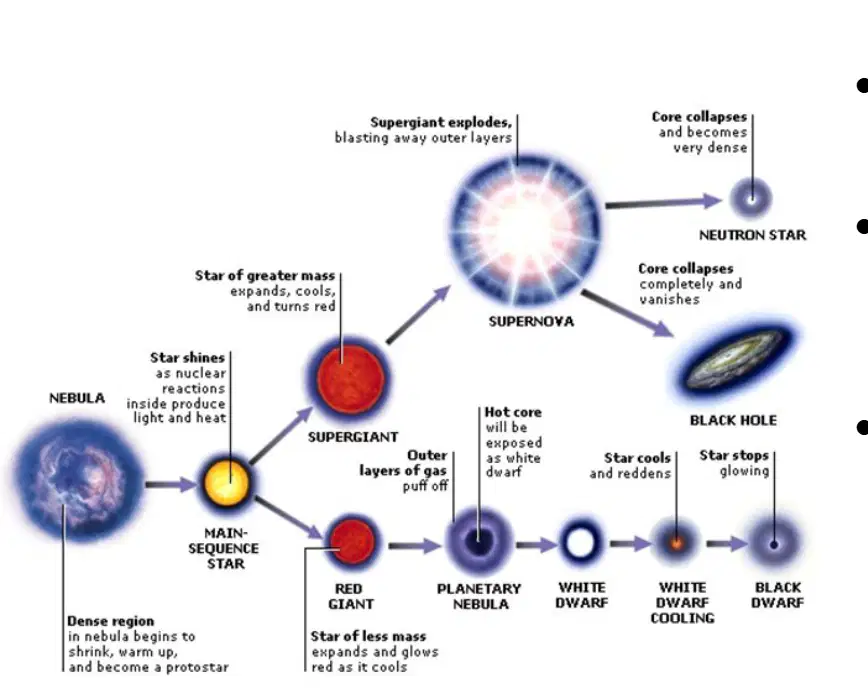
When a nebula compresses due to gravity, it starts to glow and is called a ______. Fill in the blank.
protostar
white dwarf
black hole
supernova
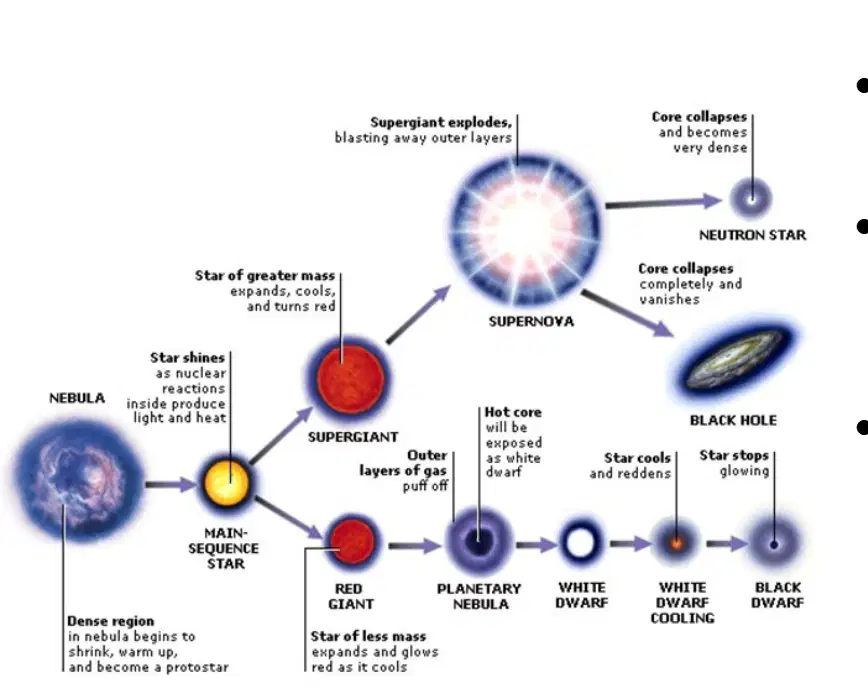
Which of the following is the correct order for the life cycle of a small or medium star?
Nebula → Main Sequence Star → Red Giant → Planetary Nebula → White Dwarf → Black Dwarf
Nebula → Supergiant → Supernova → Neutron Star
Nebula → Black Hole → Supernova → Red Giant
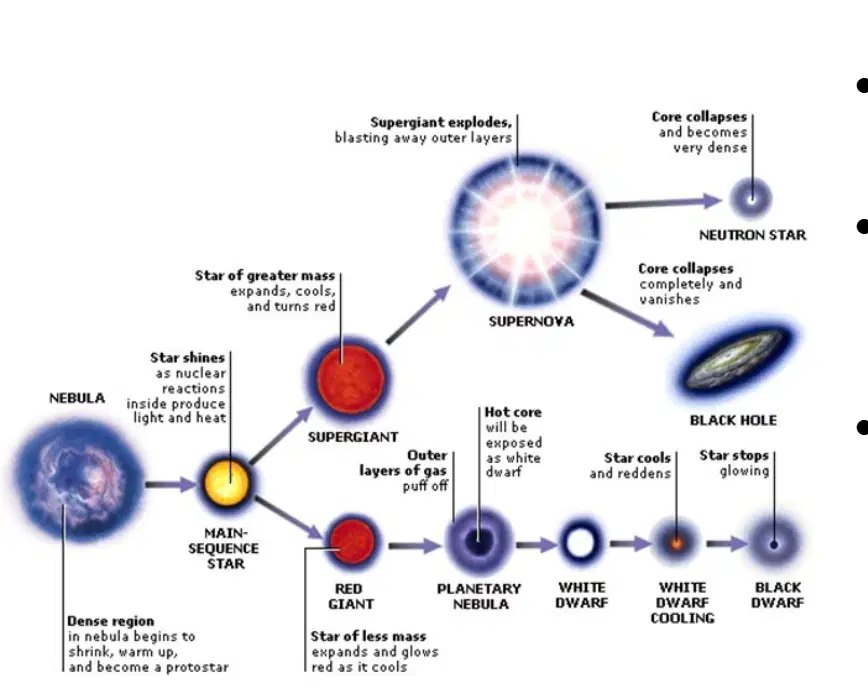
True or False: All stars eventually become black holes.
True
False
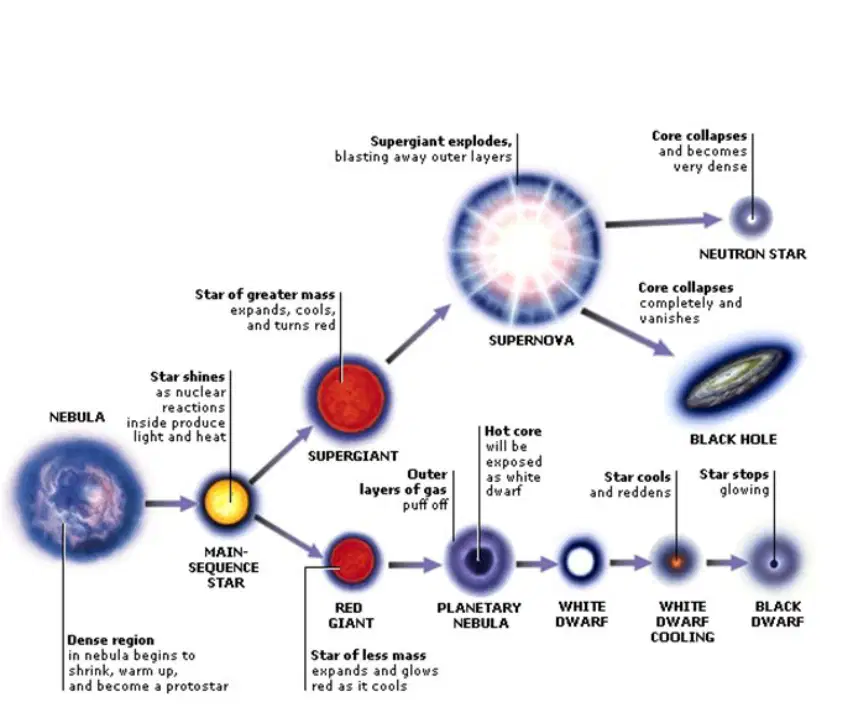
What is the first stage in the life cycle of a star?
Main-sequence star
Nebula
Red giant
Supergiant
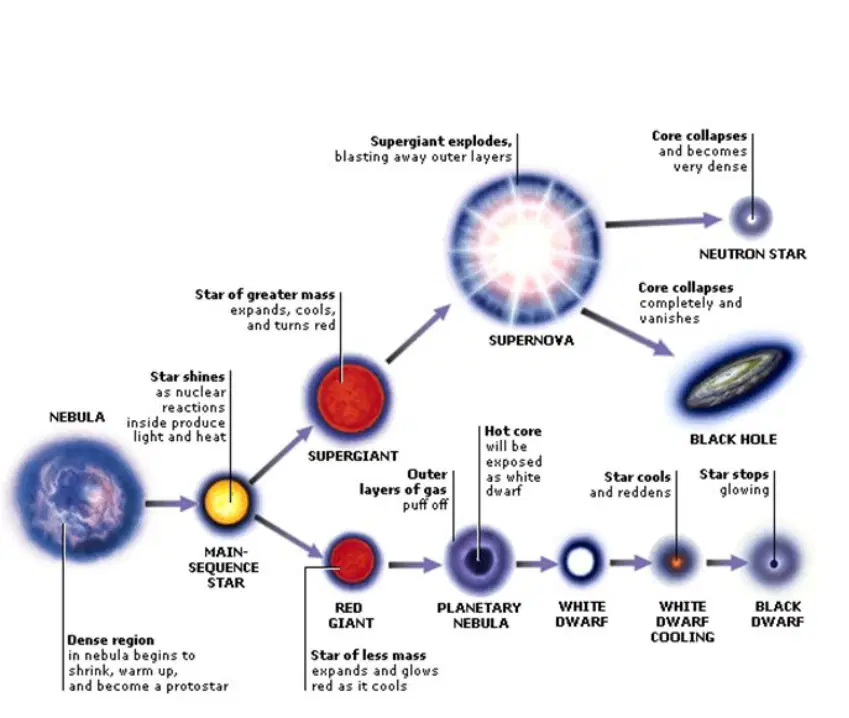
What happens to a star that is 3 times or more the size of our sun at the end of its life?
It becomes a white dwarf
It becomes a neutron star
It becomes a black hole
It becomes a red giant
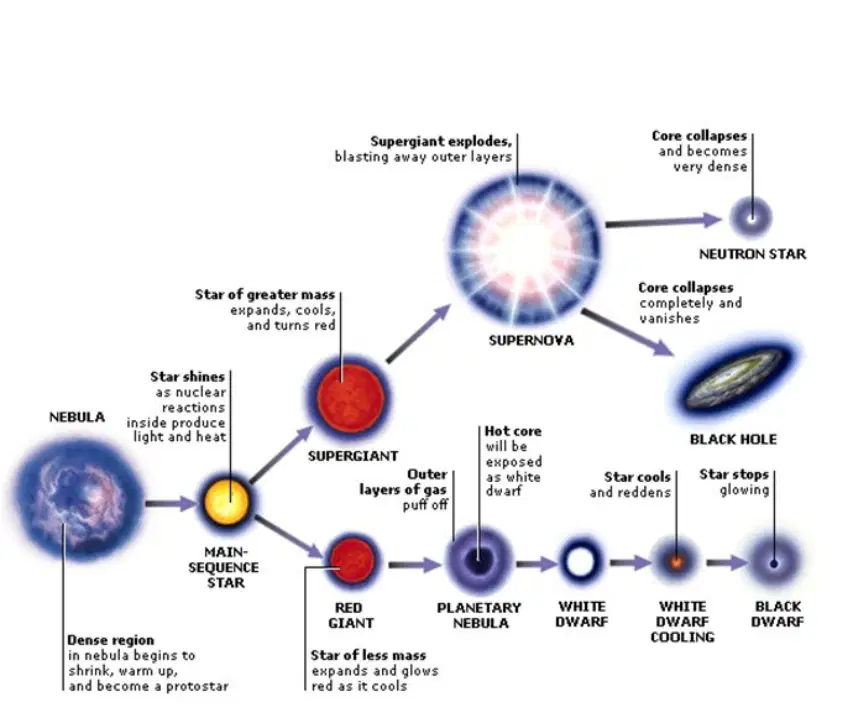
If a star is 1.4 to 3 times the size of our sun, it will end up as a ________ star.
neutron
white dwarf
red giant
black hole
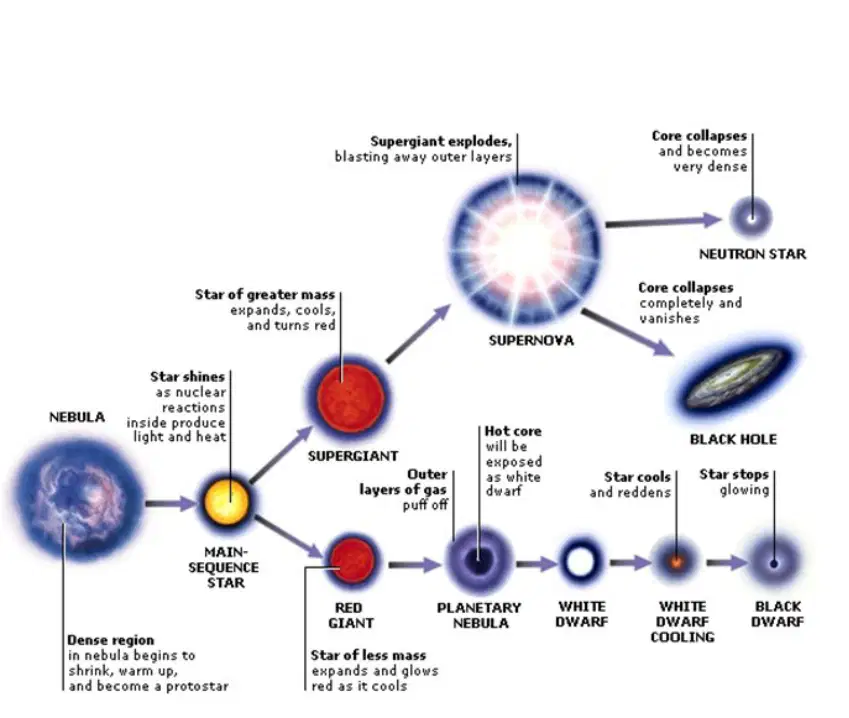
A black hole is formed when a star ends up smaller than the tip of a pin and not even light can escape its gravity.
True
False
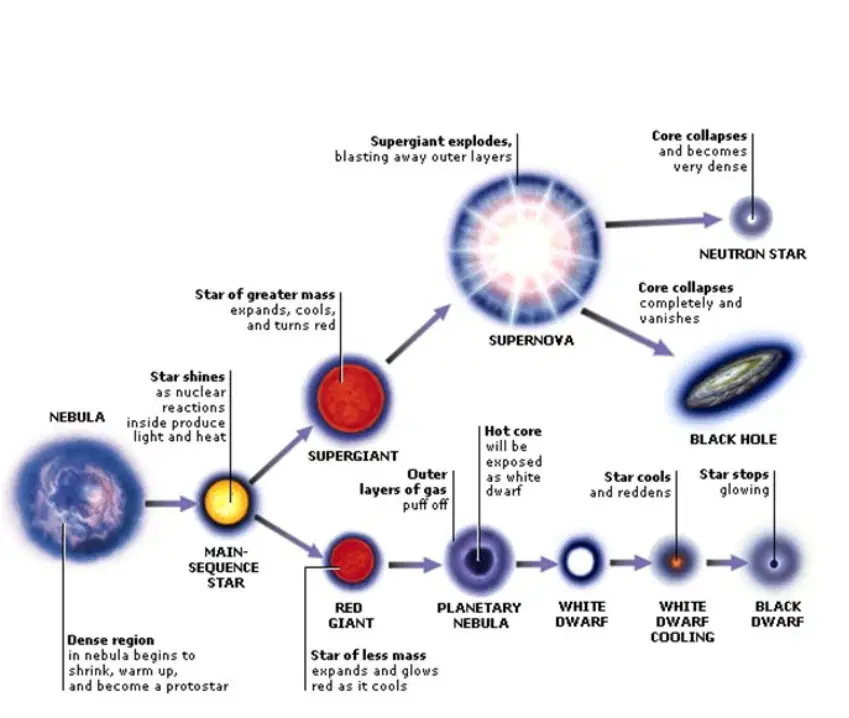
What is the stage called when a star of less mass expands and glows red as it cools?
Red giant
White dwarf
Neutron star
Black hole
What does an H-R diagram plot along the bottom and what does it plot on the other axis?
Temperature and luminosity
Mass and distance
Size and age
Speed and direction
Who were the two scientists that made the H-R diagram?
Hertzsprung and Russell
Newton and Galileo
Curie and Fermi
Einstein and Bohr
What did the H-R diagram show about color and temperature?
They are directly related
They are inversely related
They are not related
They are randomly related
Order the colors from coldest to hottest as shown in the H-R diagram:
red, orange, yellow, white, blue
blue, white, yellow, orange, red
yellow, red, blue, orange, white
orange, yellow, red, blue, white
According to the H-R Diagram, on the main sequence, which stars are the dimmest and smallest?
The hottest stars
The coolest stars
The brightest stars
The largest stars
Order the colors of stars from coldest to hottest:
red, orange, yellow, white, blue
blue, white, yellow, orange, red
yellow, red, orange, blue, white
orange, yellow, red, blue, white
True or False: The H-R Diagram placed all star life cycles on the chart.
True
False
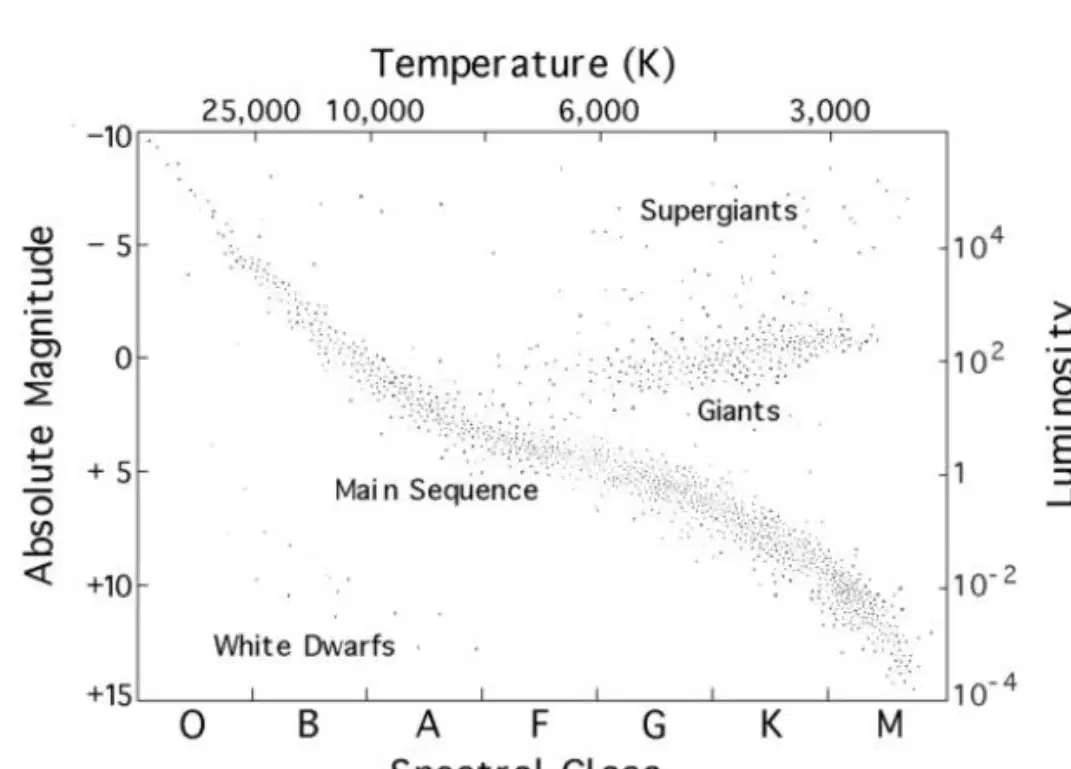
Refer to the HR diagram. What does the x-axis labeled 'Spectral Class' represent?
The age of stars
The temperature and classification of stars
The distance of stars from Earth
The size of stars
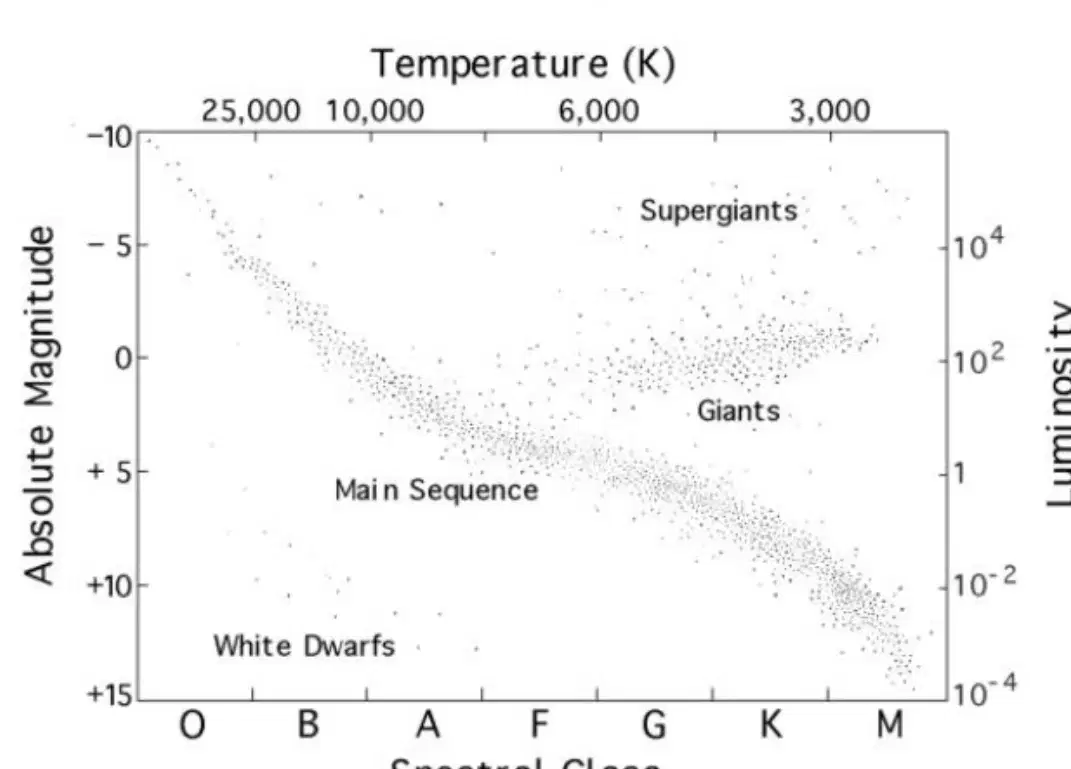
Refer to the HR diagram. Which group of stars is found in the upper right region of the diagram?
White Dwarfs
Main Sequence
Supergiants
Giants
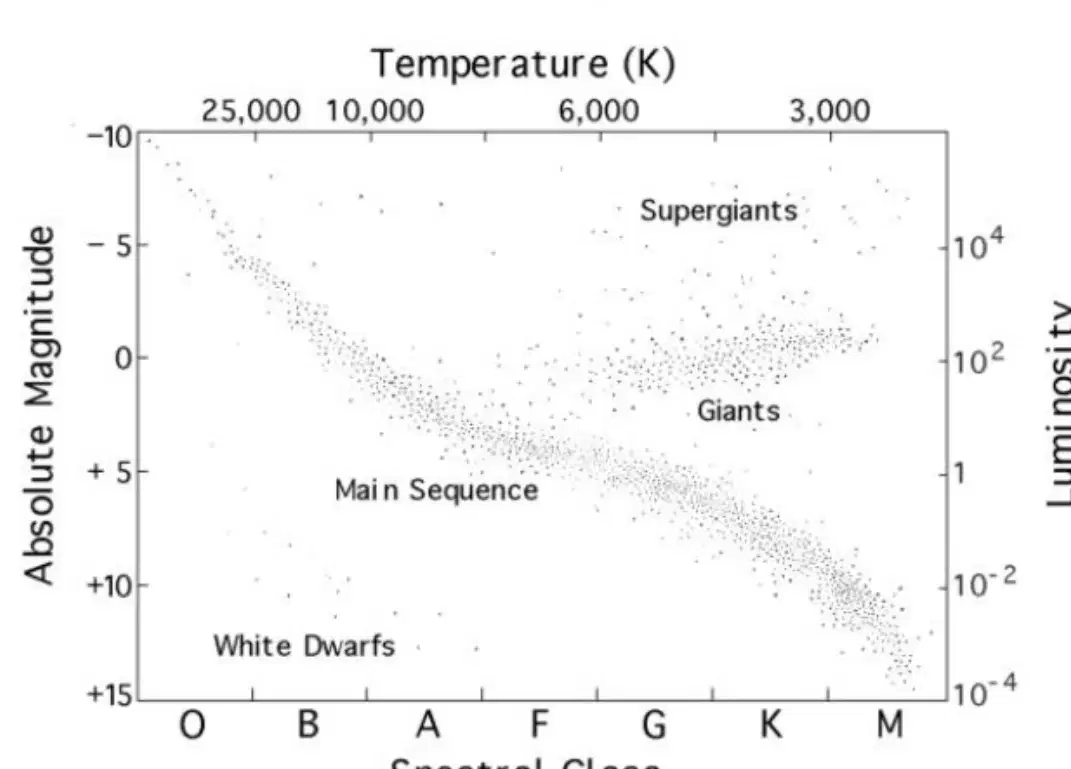
Refer to the HR diagram. Stars in the lower left region of the HR diagram are called _________.
White Dwarfs
Red Giants
Main Sequence Stars
Supergiants
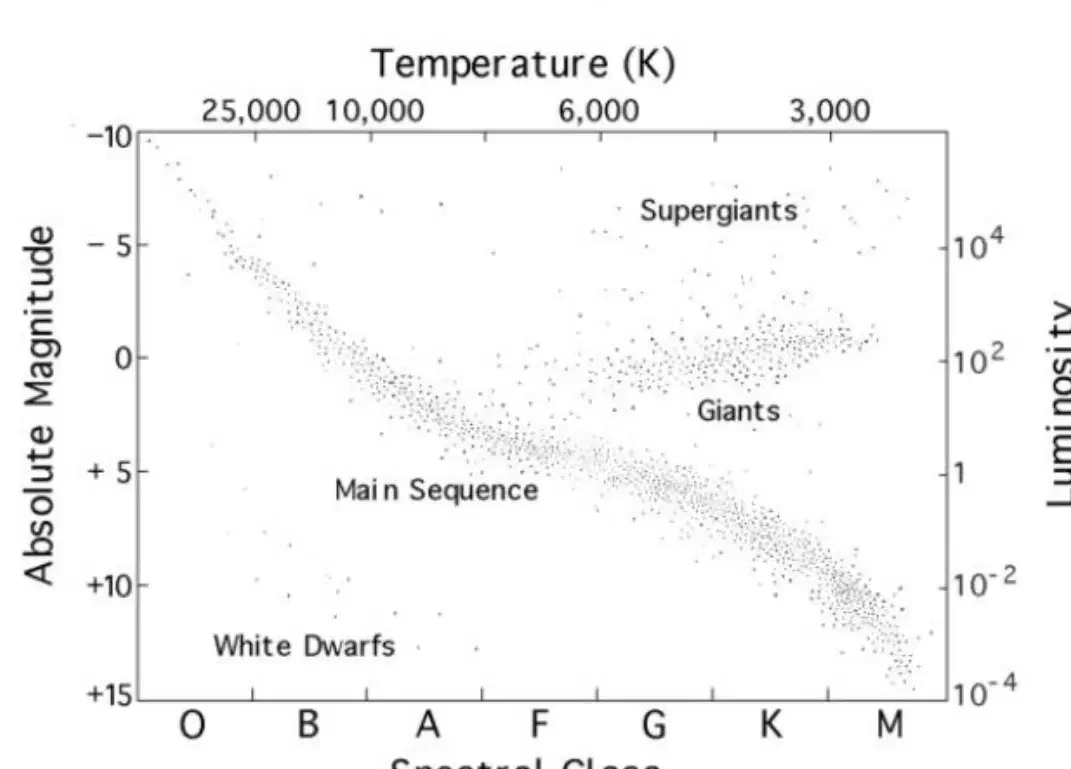
Refer to the HR diagram. Which spectral class corresponds to the hottest stars?
O
G
K
M

According to the diagram, which type of star is the brightest?
White dwarfs
Main sequence
Giants
Supergiants

What is the spectral class of the Sun according to the diagram?
(a)

As the temperature of a star decreases from 20,000 K to 3,000 K, what happens to its color according to the diagram?
It becomes bluer
It becomes redder
It stays the same
It becomes white

Which type of star is found at the lowest brightness and highest temperature according to the diagram?
White dwarfs
Red giants
Main sequence stars
Supergiants

According to the diagram, main sequence stars can have a wide range of temperatures.
True
False

What is the Eagle Nebula known for?
It is a planet in our solar system
It is one of the birth places of stars
It is the closest star to Earth
It is a type of comet

