
NEW
Font size
 Worksheets
IB Biology C1.3 Photosynthesis
Total questions: 68
Worksheet time: 2hrs 50mins

Plants produce carbon dioxide in respiration and use carbon dioxide in photosynthesis. The graph shows the volume of carbon dioxide exchanged in a plant at different light intensities.
What is shown by the graph?
A. There is no photosynthesis between W and X.
B. There is no photosynthesis between Y and Z.
C. There is more respiration than photosynthesis between Y and Z.
D. There is more respiration than photosynthesis between W and X.
What does the Rf value in thin layer chromatography represent?
A. The distance travelled by the pigment front in a fixed time period
B. The distance from the origin to the solvent front at the end of the experiment
C. The ratio of distances travelled by the pigment and solvent fronts
D. The concentration of the pigment applied to the chromatography plate
If a plant is exposed to light, which colour of light would lead to the lowest rate of oxygen release by a green plant?
A. Blue
B. Red
C. Green
D. White
What do chloroplasts and mitochondria have in common?
A. Both are found in the cells of Filicinophyta.
B. Both contain grana.
C. Both occur in all eukaryotic cells
D. Both are found in a Paramecium.
What is a feature of shorter wavelength visible radiation?
A. It includes violet light.
B. It has less energy per photon than longer wavelengths.
C. It is absorbed by greenhouse gases.
D. It is reflected by chlorophyll.
How can the rate of photosynthesis be measured?
I. By the amount of oxygen produced
II. By the increase in biomass
III. By the amount of carbon dioxide produced
A. I only
B. I and II only
C. I and III only
D. I, II and III
What is light energy used for in photolysis?
A. Formation of hydrogen and oxygen
B. Formation of carbon dioxide only
C. Formation of ATP and glucose
D. Formation of oxygen only

The fungus Rhytisma grows on the leaves of certain trees, causing a yellow leaf area in which chlorophyll is no longer present. A black, tar-like stain later spreads out.
What happens in the leaf when Rhytisma is present?
I. An increase in the intake of carbon dioxide
II. A reduction in the production of oxygen
III. An increase in the loss of water
A. I only
B. II only
C. II and III only
D. I, II and III

What is the relative wavelength in the visible spectrum of red light and blue light and are these colours absorbed or reflected by chlorophyll?
A.
B.
C.
D.

How does chlorophyll respond to the red, green and blue wavelengths in white light?
A.
B.
C.
D.
What is the source of the oxygen released into the atmosphere in photosynthesis?
A. Glucose
B. Carbon dioxide
C. Chlorophyll
D. Water
What is the source of the oxygen released into the air as a product of photosynthesis?
A. Chlorophyll
B. Carbon dioxide only
C. Water only
D. Both water and carbon dioxide
Which type of light is least useful for photosynthesis in terrestrial plants?
A. Blue
B. Green
C. White
D. Red
How is oxygen produced during photosynthesis?
A. Water molecules are split with energy from ATP.
B. Water molecules are split with energy from light.
C. Carbon dioxide molecules are split with energy from ATP.
D. Carbon dioxide molecules are split with energy from light
What are the effects of changing carbon dioxide concentration on the rate of photosynthesis?
I. At low and moderate carbon dioxide concentrations, decreases cause the rate of photosynthesis to fall.
II. At high carbon dioxide concentrations, increases do not alter the rate of photosynthesis.
III. At high carbon dioxide concentrations, increases cause the rate of photosynthesis to fall.
A. I only
B. I and II only
C. I and III only
D. III only
A plant is exposed to increasing light intensity from very dim to bright light, while the carbon dioxide concentration and temperature are kept at an optimum level. What will happen to the rate of oxygen production?
A. It will increase exponentially.
B. It will remain constant.
C. It will decrease to a minimum level.
D. It will increase to a maximum level.
Oxygen is produced during photosynthesis. What is the source of this oxygen inside the plant?
A. Air spaces in the leaf
B. Carbon dioxide
C. Glucose
D. Water

Which of the following graphs shows the relationship between substrate concentration and enzyme activity with a fixed concentration of enzyme?
A.
B.
C.
D.
What is used to reduce NADP in the light dependent reactions of photosynthesis?
Conversion of ATP into ADP +Pi
Electrons from photosystem I
Protons from the thylakoid space
Oxygen from the photolysis of water
Which space has the highest H+ concentration in a chloroplast?
Thylakoid space
Stroma
Intermembrane space
Matrix
Which reactions do not cause a net release of energy?
ADP combines with inorganic phosphate to form ATP
ATP releases inorganic phosphate to form ADP
Loss of hydrogen from reduced NAD
Oxidation of reduced FAD
Which process occurs during the light dependent reaction of photosynthesis?
ATP, CO2 and H2O are produced
CO2 is used to produce carbohydrates
ATP and O2 are produced
RuBP is phosphorylated
Besides ATP and O2, what other compound is produced as a result of the light dependent reactions?
NADPH (reduced NADP)
NADP+
Glucose
ADP
What feature of carbon makes it most suitable as a basis for life?
It is abundant in nature
Its bonding properties
Its reactivity to light
Its presence in the early atmosphere of Earth
What is reduced by photosystem I?
ADP
NADP
NAD
FAD
What is produced by chemiosmosis?
ATP
Oxygen
Water
Protons
Where does photoactivation of electrons take place
Photosystems I and II
Photosystem I only
Photosystem II only
Electron Transfer Chain
What is produced by the photolysis of two water molecules?
O2 + 4H+ + 4e-
O2 + 4H+ + 2e-
1/2 O2 + 2H+ + 2e-
1/2 O2 + 2H+ + 4e-

Chlorophyll absorbs a higher percentage of _____ and _______ light.
purple and green
red and blue
black and orange
yellow and green

The reactants of photosynthesis are...
sugar and water.
sugar and oxygen.
carbon dioxide and water.
carbon dioxide and oxygen.

What pigment absorbs sunlight for photosynthesis?
chloroplast
thylakoid
grana
chlorophyll

Most plants appear green because chlorophyll...
absorbs green light.
absorbs violet light.
does not absorb green light.
does not absorb violet light.

Which pigments absorbs green and blue light but reflects orange and red light?
Carotenoids
Chlorophylls

At approximately which wavelength does chlorophyll a absorb most light?
660 nm
640 nm
455 nm
425 nm

Chlorophyll absorbs a higher percentage of _____ and _______ light.
purple and green
red and blue
black and orange
yellow and green

Plants with the largest amount of which pigment will be best suited for growing conditions where light has a green hue.
Chlorophyll A
Chlorophyll B
Carotenoids
A combination of all 3

What pigment absorbs sunlight for photosynthesis?
chloroplast
thylakoid
grana
chlorophyll
What is the name given to the value a solute travels compared to the solvent?
Rf value
Wavelength
Chromatogram value
Solute value

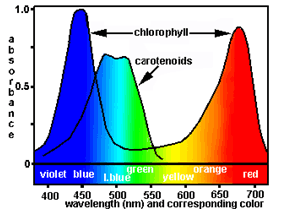
This is called...
an absorption spectrum
an action spectrum
a photosynthesis spectrum
a photolysis spectrum

Photosynthesis is essential for the survival of all living organisms on Earth?


Which of the pigments in found in chlorophyll is most efficient at lower wavelengths?
Chlorophyll A
Chlorophyll B
Carotenoids
All three are equally efficient

Which plant structure is extremely necessary for photosynthesis to take place?
leaves
roots
fruit
stem
At approximately which wavelength does chlorophyll 'a' absorb most light?
660 nm
640 nm
455 nm
425 nm


The light-dependent reactions occur in the ________ and the light-independent reactions take place in the ________.
Chloroplast / thylakoid membrane
stroma / thylakoid
mesophyl / stomata
thylakoid membrane / stroma

Plants use the following reactants for the light reaction
Water and CO2
Water and NADPH
Water and NADP+
NADPH and ATP
Rubisco is important in which step of photosynthesis
energizing the electrons in chlorophyll
carbon fixation when CO2 is connected to RUBP during calvin cycle
regeneration phase as RUBP is made during calvin cycle
reduction of the carbon chain during the calvin cycle
If the proton (H+) pump in the thylakoid was not working which molecule could not be made during the light reaction?
NADPH
ATP
Water
Oxygen gas
The NADP+ is
oxidized during the light reaction
reduced during the light reaction
oxidized during the Calvin cycle
reduced during the Calvin cycle
Which of the following would have the least affect on photosynthetic rate?
increase the temp from 20 C to 30 C
increasing the CO2 from 400 ppm to 600ppm
increasing the light intesity from 40 Watts to 60 Watts
increasing the amount of O2 from 20% to 30% in the air
ATP is made during the light reaction using all of the following EXCEPT
proton pump
hydrogen ion gradient
electron energy from photosystem II
NADPH donating electrons
During noncyclic photophosphorylation all of the following occur EXCEPT
ATP is made using electron energy that will leave on NADPH
results in oxygen gas being produced
water is split (photolysis)
electrons from photosystem 1 return back to photosystem 1

Where are the light-dependent and light-independent reactions taking place in the diagram below?

B
C
D
What is chemiosmosis?
Coupling of ATP synthesis to the electron transport and proton movement
Phosphorylation of glucose in the mitochondrial matrix
H+ ions moving down a concentration gradient into the mitochondrial matrix
Activation of ATPase in order to synthesize ATP

