
Font size
 Worksheets
Semester 2 Final Exam Review: Math 2 U1 & U2
Total questions: 144
Worksheet time: 9hrs 26mins
The graph of g is translated 8 units up and 3 units right on the graph of f(x)=3x . What is the equation for g ?


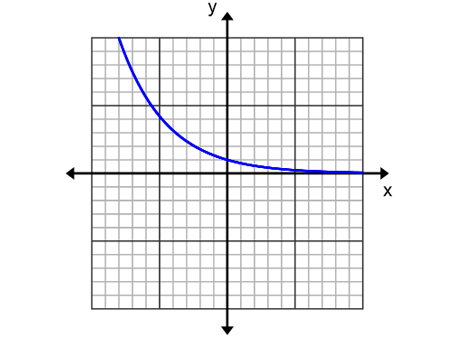
Which function is represented by the graph?


The graph of g is translated 2 units down and 7 units left on the graph of f(x)=3x . What is the equation for g?


Which function is represented by the graph?


Maria invests $2,500 in an account that earns 4.2% annual interest, compounded continuously. What is the value of the account after 8 years? Round your answers to the nearest dollar
About $3,498
About $3,578
About $3,610
About $3,657
Lena invests $3,750 in an account that earns 5.1% interest, compounded monthly. What is the value after 6 years?
Identify the range of the function f(x)=x−4+3
[4,3]
[4,∞)
[3,∞)
[0,∞)
Identify the domain of the function f(x)=x+8
[8,∞)
[−8,∞)
(−∞,8]
[0,∞)
What are the minimum and maximum values of the function f(x)=3x on the interval [−64,27] ?
minimum 3; maximum 4
minimum -4; maximum 3
minimum 27; maximum 64
minimum -64; maximum 27
What is the average rate of change of the function f(x)=3x+7 over the interval −6≤x≤0 ?
Round to two decimal places.
Write the radical expression as an exponential expression. 347
Write the radical expression as an exponential expression. 12
Write the radical expression as an exponential expression. 3=(2752)(34x)
Write the radical expression as an exponential expression. 512=(53x)(56x)
Write an exponential model given the two points (9,150) and (10, 230)
Round to THREE decimal places


What is the equation of the graph?
y = √(x - 3)
y = √(x) + 3
y = √(x - 5) + 4
y = √(x + 5) + 4


Find the Domain of the function.
f(x)=x−3
x =3
x>−3
x≥3
x=3
Find the Domain of the function.
x=1
x≥−1
x=1
x>−1
Find the Domain of the function.
x≥−3
x≥2
x≥32
x≥23
Find the Domain of the function.
x≥−8
x≥−16
x≥8
x≥16
Find the Domain of the function.
x=7
x≥7
x>7
x=7
Find the Domain of the function.
x≥2
x≥−8
x≥4
x≥16

Find the Domain of the function.
x≥2
x≥1
x≥0
x≥4

Find the Domain of the function.
x≥−3
x≥5
x≥0
x≥1

Find the Domain of the function.
x≥−4
x≥15
x≥0
x≥4


Match the equation with the graph
y=3x−3+5
y=3x−3−5
y=3x+3+5
y=3x+3−5

Match the equation with the graph
y=3x−3
y=3x+3
y=3x+3
y=3x−3


Which function matches the graph?
A
f(x) = ∛(x + 3) + 2
B
f(x) = − ∛(x - 3) - 2
C
f(x) = ∛(x - 3) + 2
D
f(x) = ∛(x - 2) + 3

What is the Range for the graph?
A
2 ≤ y < ∞
B
− ∞ < y ≤ 3
C
3 ≤ y < ∞
D
− ∞ < y < ∞
What does this transformation say to do?
f(x) = 2x -----> g(x) = 2x + 4
slide down 4
slide up 4
slide right 4
slide left 4
If the parent function is f(x) = √(x) then what translation describes what would happen to the graph.
Shifted down 2
Shifted up 2
Shifted left 2
Shifted right 2
Describe the transformations if the parent function is f(x) = √(x)
Translate Right 2, Down 4
Translate Left 2, Down 4
Translate Left 2, Up 4
Translate Right 2, Up 4
Write the equation for a graph that shift left 13.
g(x)=(x-13)
g(x)=(x+13)
g(x)=x-13
g(x)=-13x
Which equation would represent a move of 2 units up for parent function f(x) = 7x
g(x) = 9x
g(x) = 7x + 2
g(x) = 7(x+2)
g(x) = 7(x-2)
(x,y)→(x+9,y+8)
Translation
9 right & 8 up
Translation
9 up & 8 right
(x,y)→(x+4,y−7)
Translation
4 left & 7 up
Translation
4 right & 7 down
Translation
7 left & 4 up
Translation
7 right & 4 down
(x,y)→(x−6,y+13)
Translation
6 left & 13 up
Translation
6 right & 13 down
Translation
13 left & 6 up
Translation
13 right & 6 down
The linear parent function, f(x) = x, is transformed to g(x) = f(x) - 6. Describe the transformation.
g(x) is shifted up 6 units
g(x) is shifted down 6 units
g(x) is shifted left 6 units
g(x) is shifted right 6 units
down, which of the following equations would the new graphed
line represent?
Which represents the parent function shifted down two units?
f(x) = -2x
f(x) = x - 2
f(x) = x + 2
f(x) = 2x
The linear parent function, f(x) = x, is transformed to g(x) = f(x + 6). Does this result in a horizontal or vertical translation?
horizontal
vertical
The linear parent function, f(x) = x, is transformed to g(x) = f(x + 6). Describe the transformation.
g(x) is shifted up 6 units
g(x) is shifted down 6 units
g(x) is shifted left 6 units
g(x) is shifted right 6 units
The linear parent function, f(x) = x, is transformed to g(x) = f(x) + 3. Describe the transformation.
g(x) is shifted up 3 units
g(x) is shifted down 3 units
g(x) is shifted left 3 units
g(x) is shifted right 3 units
The linear parent function, f(x) = x, is transformed to g(x) = f(x + 3). Describe the transformation.
g(x) is shifted up 3 units
g(x) is shifted down 3 units
g(x) is shifted left 3 units
g(x) is shifted right 3 units
Describe how the graph g(x) compares with f(x).
f(x) = 5x + 2
g(x) = 5(x + 7) + 2
Up 7
Down 7
Left 7
Right 7
Which transformation of
y=f(x) moves the graph 7 units to the left and 3 units down?
y=f(x+7)−3
y=f(x+7)+3
y=f(x−7)−3
y=f(x−7)+3

A=1200(.85)6


Is the table linear, exponential, or neither?
Linear
Exponential
Neither

Simplify: (52)−2
425
254
−52
−254
Simplify: (−5)3
-125
−51
1251
25
Simplify: (31)0
1
0
31
-3
Evaluate: y=2(10)x when x = 0
2
0
1
20
Evaluate: y=5(21)x when x = -2
20
−45
10
25
Suppose the population of a species of insects doubles every year. There are 1600 insects initially. The function for the scenario would be?
f(x)=2x+1600
f(x)=1600×2
f(x)=1600⋅2x
Samantha's hair was known to grow very rapidly. It began at a length of 6 in and grew at a rate of 14% a week.
Write the expression in radical form: x43
4x3
3x4
x.75
x2
Rewrite as a rational exponent:
7x23
x723
x237
x16
x161


8a3
(3x² - 3x + 2) + (x² - 2x + 1)
4x³-2x²+2
4x² - 5x + 3
-2x³+2x+2
4x³-2x²-2
(2x2 + 5x - 7) + ( 3 - 4x2 + 6x)
(4x2+ x) - (x2+ 2x)
4x3 + 2x - 9
(5e + 2)(e2 - 3e + 6)
5e3 - 17e2 +24e +12
5e3 + 17e2 - 24e +12
5e3 - 13e2 + 24e +12
5e3 +13e2 - 24e - 12
Factor:
x2 − 15x + 50
(x − 10)(x − 15)
(x − 10)(x − 5)
(x − 25)2
(x − 5)(x − 5)
Factor:
x2 + 9x − 36
(x + 12)(x − 3)
(x + 9)(x − 4)
(x − 12)(x + 3)
(x − 9)(x − 4)
Factor:
n2 + 16n + 63
(n − 7)(n + 4)
(n + 7)(n − 9)
(n − 3)(n − 10)
(n + 7)(n + 9)
Factor:
n2 − 13n + 40
(n − 5)(n − 8)
(n + 5)(n − 8)
(n − 5)(n + 8)
(n + 6)(n + 1)
Factor:
x2 + 12x + 35
(x + 5)(x + 7)
(x + 4)(x + 3)
(x + 7)(x − 5)
(x − 4)(x − 3)
Factor:
x2 + 5x + 4
(x + 4)(x + 1)
(x + 2)(x + 2)
(x + 4)(x − 1)
(x + 5)(x + 1)
3a2 + 4a + 1
2n2 + 13n + 15
3v2 - 4v - 7
2x2 - 13x - 70
5x2 - 7x + 2
20x2+55x+30
10x2−32x+24
3x2+5x+2
Use x for your variable in your answer.
Factor
k2+7k+10 .(k+2)(k−5)
(k+2)(k+5)
(k+10)(k+4)
(k−2)(k−5)
Factor the polynomial completely.
x2 + 3x + 4
(x + 2)(x + 2)
(x - 1)(x + 4)
(x - 4)(x + 1)
cannot be factored.
Factor.
x2 + 4x - 12
Factor.
x2 - 6x - 16
10x2 + 15x-5
Factor:
4h² - 17h + 4
(2h - 2)²
4(h + 4)(h + 1)
(2h - 2)(2h + 2)
(4h - 1)(h - 4)
2n2 + 3n - 9
Factor:
2m² + 3m - 9
2(m + 3)(m - 3)
(2m - 3)²
(2m - 3)(m + 3)
(2m + 3)(m - 3)
What are the factors of 3x2 - 17x + 10?
(3x - 2)(x - 5)
(x + 5)(3x + 2)
(3x - 5)(x - 2)
(x + 5)(3x - 2)
Factor Completely:
2c2 + 4c - 84
(c-6)(2c+14)
(c+7)(2x-12)
(c-4)(2c+21)
2(c+7)(c-6)
Factor Completely: 3n² - 15n + 18
(n - 2)(n - 3)
3(n + 2)(n + 3)
(3n - 9)(n - 2)
3(n - 3)(n - 2)
Factor 2p2−9p +10
(a)
x2 - 8x + 15
x2 + 12x + 36
x2 + 9x - 36
x2 -16x + 48
x2 - 5x - 36
n2 + 5n - 6
a2 - a - 12
Factor k2+7k+10
Factor k2+3k-10
k2 - 2k - 24
n2 + 16n + 63
x2 +17x - 60
x2 - 25
x2 +5x - 36
k2 - 2k - 24
x2 - 4x - 32
(x2 + 17x+42) ft2.
If its width is (x + 3) ft.
What is its length?

