
 Worksheets
FINAL EXAM REVIEW PART 1
Total questions: 59
Worksheet time: 43mins
Name
Class
Date
1.

Which of the following is the first step in ANY emergency procedure?
a)
Call 911
b)
Tell the teacher.
c)
Go to the eye wash station.
d)
Use the fire extinguisher.
2.

What is located at the location marked with an "X"?
a)
Fire extinguisher
b)
Safety shower
c)
Emergency gas switch
d)
Fire blanket
3.

What is located at the location marked with an "X"?
a)
Fire extinguisher
b)
Safety shower
c)
Emergency gas switch
d)
Fire blanket
4.
Which of the following shows measurement conversions done correctly?
a)
b)
5.
Indicate the number of significant figures in the following number: 0.0056
a)
2
b)
3
c)
4
d)
5
6.
Round the following calculator answer to the correct number of sig figs: 23.1 x 7.2 = 166.32 (HINT:count the sig figs in the problem first...)
a)
200 to one sigfig
b)
170 to two sigfigs
c)
166 to three sigfigs
7.

What is the correct standard notation for the following number:
a)
727
b)
72,000
c)
72,000,000
8.
What is the correct scientific notation for the number 562,000,000
a)
b)
c)
9.

This famous scientist used the gold-foil experiment to support his idea that the atom has a positive nucleus.
a)
Democritus
b)
Dalton
c)
Rutherford
d)
Thomson
10.

This famous scientist used the cathode ray tube experiment to support his idea that the atom has negative electrons floating in a "plum-pudding" model.
a)
Democritus
b)
Dalton
c)
Rutherford
d)
Thomson
11.

Which of the following is the scientist that came up with this model?
a)
Rutherford
b)
Thomson
c)
Bohr
d)
De Broglie
12.
Which of the following subatomic particles is the one that is equal to the atomic number?
a)
Protons
b)
Neutrons
c)
Electrons
13.
Which of the following subatomic particles is the one that is orbiting the nucleus?
a)
Protons
b)
Neutrons
c)
Electrons
14.

What does a Bohr model show about atomic structure?
a)
The atom is indivisible
b)
The atom has negative electrons in a positive mass
c)
The atom has electrons that have determined energy levels
d)
The atom has a dense nucleus and a lot of empty space
15.

What is wrong in this Bohr model of the element Carbon?
a)
The model needs less electrons
b)
The model needs more energy levels
c)
The model has too many electrons in the first level
d)
The model needs less energy levels
16.
What is different about a Bohr model and a Lewis Dot structure?
a)
A Bohr model doesn't show valence electrons
b)
A Bohr model doesn't have levels
c)
A Lewis dot structure only shows valence electrons
d)
A Lewis dot structure shows all the electrons
17.
Which shows a correct Lewis Dot structure for the element Bromine?
a)
b)
c)
d)
18.
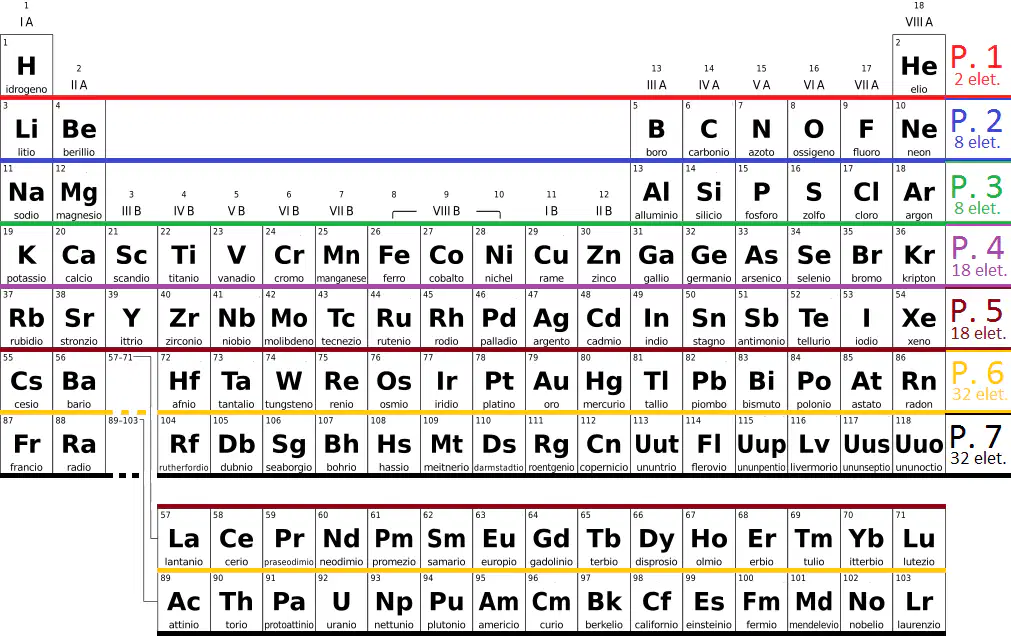
What does the a period in the periodic table tell us about the elements in that row?
a)
The number of valence electrons
b)
Elements that have similar properties
c)
The number of energy levels
d)
The oxidation numbers of the elements
19.

The following are characteristics of an element:
Shiny
Brittle
semi-conductor
What family does this element most likely belong to?
a)
Metalloids
b)
Nonmetals
c)
Halogen
d)
Nobel gases
20.

What does the group number "5A" tell us about the elements in that group?
a)
The number of valence electrons
b)
The number of energy levels
c)
The number of protons
d)
The atomic number
21.

Which of the following elements has less ionization energy and electronegativity than the other elements in the boxed in section? ?
a)
Boron
b)
Carbon
c)
Oxygen
d)
Fluorine
22.

Which of the following explains the trend for atomic radii down a group?
a)
The atomic radius decreases because the atom has less energy levels
b)
The atomic radius increases because the atom has less energy levels
c)
The atomic radius decreases because the atom has more energy levels
d)
The atomic radius increases because the atom has more energy levels
23.

Which of the following elements has a smaller atomic radius than Oxygen ?
a)
Boron
b)
Carbon
c)
Oxygen
d)
Fluorine
24.
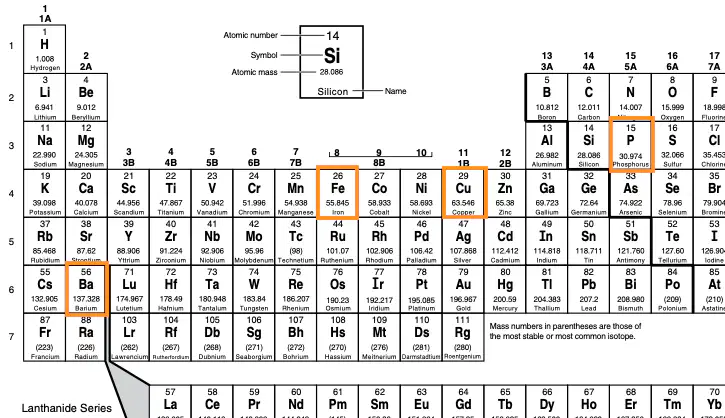
Use the following part of the periodic table. Which correctly lists the elements in order of increasing electronegativity?
a)
1 Barium 2 Iron 3 Phosphorus 4 Copper
b)
1 Barium 2 Iron 3 Copper 4 Phosphorus
c)
1 Phosphorus 2 Copper 3 Iron 4 Barium
d)
1 Iron 2 Phosphorus 3 Copper 4 Barium
25.
In this Isotope notation, what does the red number 9 on the left, bottom corner represent?
a)
The number of protons
b)
The number of electrons
c)
The atomic mass
d)
The electrical charge
26.
In this Isotope notation, what does the black number 13 on the left, top corner represent?
a)
The number of protons
b)
The number of electrons
c)
The atomic mass
d)
The electrical charge
27.

An isotope of Carbon is Carbon-14. What is different between this isotope and the information on the periodic table for Carbon?
a)
the atomic number 6
b)
the chemical symbol "C"
c)
the chemical name "Carbon"
d)
the atomic mass 12.011
28.

The following Bohr model is an isotope of which element?
a)
Hydrogen
b)
Helium
c)
Lithium
d)
Berylium
29.

Based on the information in the isotope notation, how many neutrons does this isotope of Neon contain?
a)
10 neutrons
b)
11 neutrons
c)
12 neutrons
d)
Cannot tell with this information
30.
How do we calculate the average atomic mass of three different isotopes of an element?
a)
Add the three masses and divide by 3 then multiply by 100
b)
Divide the atomic mass on the periodic table by 3 then multiply by the percent abundance
c)
Multiply the atomic mass of the isotope by the percent abundance written as a decimal then add
d)
Subtract each atomic mass of the isotope from the average atomic mass on the periodic table
31.
Calculate the average, weighted atomic mass of Boron if 19.91% of Boron-10 atoms have a mass of 10.0129 amu and 80.09% of Boron -11 atoms have a mass of 11.0093 amu. (Round to four sig figs)
a)
9.200 amu
b)
10.00 amu
c)
10.81 amu
d)
11.50 amu
32.
Why does this model show that this Beryllium atom is a positive ion?
a)
It has more electrons than protons
b)
It has more protons than electrons
c)
It has less neutrons than electrons
d)
It has less neutrons than electrons or protons
33.

What element does this electron orbital diagram represent?
a)
Oxygen
b)
Silicon
c)
Phosphorus
d)
Selenium
34.

A student completed the electron orbital diagram for Carbon. What is wrong with their diagram?
a)
It does not have a complete lower level
b)
It does not have one electron in each orbital before they pair
c)
It does not have both electrons spinning down in each orbital
d)
It does not have the correct number of electrons
35.

A student completed the electron orbital diagram for the element for Oxygen. What is wrong with their diagram?
a)
It does not have complete lower levels
b)
It does not have one electron in each orbital before they pair
c)
It does not have an electron spinning down in each orbital
d)
It does not have the correct number of electrons
36.

Which of the following is the correct electron configuration for the element Phosphorus?
a)
b)
c)
d)
37.

Using the periodic table strategy, find the missing orbital notation for the element Scandium 21
a)
b)
c)
d)
38.
Electron configurations can be abbreviated using the Noble gas configuration. Which is the correct Noble gas configuration for the element scandium?
a)
b)
c)
d)
39.

What is wrong with the following electron configuration for the element Titanium?
a)
It should be "3d" instead of "4d"
b)
There are too many electrons
c)
The last "2" should be a "6"
d)
The shapes' letters are out of order
40.

How are energy and frequency related in the energy level and wave diagram?
a)
Frequency and energy are directly proportional. Both increase together.
b)
Frequency and energy are inversely proportional. One increases the other decreases.
c)
Frequency and energy are always equal.
d)
Frequency and energy are not related.
41.

Scientists created the electromagnetic spectrum to categorize the different wavelengths and frequencies of all the electromagnetic waves. They do not show the energy levels. However, you can use the relationship between frequency and energy. Based on this diagram, which are the waves that have the lowest energy?
a)
Radiowaves
b)
Infrared
c)
Ultraviolet
d)
Gamma Rays
42.

When an electron is absorbing energy, it will...
a)
go to a higher energy level
b)
go to a lower energy level
c)
remain in the same energy level
43.

In the flame lab, electrons emitted light when...
a)
they got excited and moved up levels
b)
they relaxed and released energy
c)
they remained in the same energy level
d)
they flew out of the atom
44.

When scientists observe light waves through a spectrometer, they create an emission spectra. Using the key for emission spectra, which of the following is matches the unique spectra for the element hydrogen.
a)
b)
c)
45.

Using the chart below: In the flame lab, which of the following correctly describes the wavelength and frequency of the red light emitted?
a)
Wavelength: 625-740 nm Frequency: 400-484 THz
b)
Wavelength: 564- 590 nm Frequency: 508-526 THz
c)
Wavelength: 520-565 nm Frequency: 526-606 THz
d)
Wavelength: 380-435 nm Frequency: 700-789THz
e)
46.
Which of the following compounds contains the lead (II) ion?
a)
b)
c)
d)
47.
What is the correct formula for the compound sulfur hexafluoride?
a)
b)
c)
d)
48.
What is the correct formula for Calcium Carbonate?
a)
b)
c)
d)
49.
According to the Law of Conservation of Energy,
a)
Energy can be created or destroyed
b)
Energy can be created but not destroyed
c)
Energy cannot be created but can be destroyed
d)
Energy cannot be created nor destroyed
50.
An unknown substance with a mass of 100 grams absorbs 1000 J while undergoing a temperature increase of 15°C. What is the specific heat of the substance? (Show all six steps on your scratch sheet to receive credit!)
a)
0.7 J/(g°C)
b)
1,500,000 J/(g°C)
c)
2 J/(g°C)
d)
1.5 J/(g°C)
51.

When reading a phase change diagram that shows temperature and energy a flat line with a slope of zero indicates .....
a)
an increase in temperature
b)
an increase in pressure
c)
a phase change like melting or evaporating
d)
a liquid
52.
A reaction is performed in a beaker with a temperature probe recording the temperature changes of the reaction. If the temperature began at 15.0 degrees Celsius and ended at 27.5 degrees Celsius. Is the reaction endothermic or exothermic?
a)
Exothermic
b)
Endothermic
53.
Use Dalton's Law of Partial Pressures to solve the following problem. The partial pressures of gases A, B, and C in a mixture are 0.75 atmosphere, 0.25 atmosphere, and 1.25 atmospheres, respectively. What is the total pressure of the gas mixture?
a)
3.0 atm
b)
2.5 atm
c)
2.25 atm
d)
1.5 atm
54.
Use the Combined Gas Law to solve the following problem. A gas has a volume of 1400 milliliters at a temperature of 20. K and a pressure of 760 mm Hg. What will be the volume when the temperature is changed to 40. K and the pressure is changed to 380 mm Hg? (Formula: P1V1/T1=P2V2/T2)
a)
894 mL
b)
1200 mL
c)
2400 mL
d)
5600 mL
55.
Label the following subatomic particles.
a)
Proton
b)
Neutron
c)
Electron
d)
Positron
1
2
3
1)
2)
3)
56.
Cations have positive charges while anions have negative charges. What force bonds the two atoms together?
a)
The Dark Force
b)
Forcefield
c)
Electrostatic Force
d)
Gravitational Force
57.
A formula with the lowest whole # ratio of elements in a compound is called
a)
Molecular Formula
b)
Chemical Formula
c)
Empirical Formula
d)
Distance Formula
58.
Which of the following is considered an empirical formula?
a)
CH3COOH
b)
C6H12O6
c)
H2O
59.
Which of the following is considered an empirical formula?
a)
CH3COOH
b)
C6H12O6
c)
H2O
100 %

