
 Worksheets
Year 7 Term 2 revision
Total questions: 51
Worksheet time: 26mins
Judaism is an example of:
polytheism
monotheism
What is the name of Abraham’s wife?
Sarah
Saffira
Sally
Sophia
How many commandments did God provide to Moses on Mt Sinai?
40
12
613
10
For which reason did Paul NOT write to early Christian communities?
To give religious instruction.
To warn about false religious teachings.
To encourage people to observe Jewish religious law.
To settle disputes.
To encourage faith.
How many sons did Jacob have?
11
9
10
12
The Bible is described as inspired writing. This means:
certain people decided by themselves to reveal truth.
All Bible stories are historically and scientifically true.
the devil inspired chosen people to reveal truth.
God inspired chosen people to reveal truth.
The four grouping of books in the New Testament are:
The Gospels, The Acts of the Jews, The Gentile Books and Revelation.
The Gospels, The Acts of Jesus, The Letters and Revelation.
The Gospels, The Acts of the Apostles, The Myths and Revelation.
The Gospels, The Acts of the Apostles, The Letters and Revelation.
As part of the Covenant with Abram, God commanded that he leave his place of birth and resettle in the land of:
Canaan
Egypt
Babylon
Assyria
The sacred text of Christians is:
the Vedas.
the Qur’an.
the Torah.
the Bible.
The oral tradition of passing on stories about God involved:
writing stories down.
learning and then repeating stories by word of mouth.
Who wrote most of the Letters contained in the New Testament?
Jude
Peter
James
Paul
How many missionary journeys did Paul make to either establish or visit Christian communities?
5
2
3
4
Monotheism is the belief in only one God.
True
False
Who did God choose to lead the Jewish people out of slavery in Egypt?
Joseph
Aaron
Jacob
Moses
Jesus is thought to have lived between:
4 CE and 30 CE
4 BCE and 30 BCE
104 CE and 130 CE
104 BCE and 130 BCE
The majority of the Old Testament was originally written in:
the English language.
the Latin language.
the Greek language.
the Hebrew language.
The New Testament was written:
some years after the death of Jesus.
at the same time as the Old Testament.
while Jesus was alive.
before Jesus was born.
Which of the Gospels is thought to have been written last?
Mark
John
Luke
Matthew
In the Book of Exodus, we meet Moses and his family. What was the name of Moses’ brother?
Aaron
Abel
Abraham
Adam
The general theme of the Book of Revelation mainly concerns:
the history of the world.
the sin of the world.
the beginning of the world.
the end of the world.
The Gospels present:
stories about Noah.
stories about Abraham and his descendants.
stories about Adam and Eve.
stories about Jesus’ birth, his teaching and his death and Resurrection.
Abram was born in which city?
Ur
Bur
Mir
Fur
Abram changed his name to Abraham because:
his wife told him to.
God commanded him to.
it is Jewish custom to change one’s name in old age.
he didn’t like his name.
Some New Testament Gospels are described as synoptic because each gives a similar account of the life of Jesus and shares a similar style and structure. The three synoptic Gospels are:
John, Mark and Matthew.
Mathew, Mark and Luke.
Luke, John and Matthew.
John, Mark and Luke.
How many years did the Jewish people spend wandering in the desert after escaping slavery in Egypt?
10
20
30
40
How many Gospels are found in the New Testament?
2
3
4
5
In the Old Testament the term Covenant refers to agreement between God and the Jewish people. God promises to provide for the welfare of the Jewish people and in return he expects to Jewish people to:
be obedient to Egyptian law and worship only Egyptian gods.
make their own laws and worship only him
be obedient to God's law and worship only him.
follow no law and worship no god
The descendants of Jacob stayed in Egypt and eventually they:
became the rulers of Egypt.
became farmers in Egypt.
were enslaved.
abandoned their faith and worshipped Egyptian gods.
The Bible was written by one person.
True
False
Abraham was prepared to sacrifice his son Isaac because:
it was Jewish custom to sacrifice the eldest son.
he did not believe Isaac was his real son.
his son was possessed by the devil.
he wanted to show his faith in God.
Biblical prophecy talks about events:
that will never happen.
that are happening now.
that happened in the past.
that will happen in future.
Abraham had two sons. Their names were:
Isaac and Ishmael
Ishmael and Ian
Ian and Isaac
Immanuel and Ishmael
God promised that Abraham’s descendants would number:
as many as hairs on his head.
as many as fish in sea.
as many as trees in the forest.
as many as the stars in heaven.
The four grouping of books in the Old Testament are:
The Pentateuch, the historical books, the prophets and the poetry books.
The Pentateuch, the sacred books, the prophets and the wisdom books.
The Pentateuch, the historical books, the prophets and the myths books.
The Pentateuch, the historical books, the prophets and the wisdom books.
What is the name of the Biblical book that tells the story of the Jewish people escaping slavery in Egypt?
Deuteronomy
Leviticus
Genesis
Exodus
The Christian Bible is divided into:
the Old and Middle Testaments.
the Old, Middle and New Testaments.
the Old and the New Testaments.
the Last and New Testaments.
Polytheism is the belief in only one God.
True
False
Ancient Israel had a history of:
being invaded by its neighbours.
expanding it empire.
invading its neighbours.
fighting among themselves.
The Bible provides a historically and scientifically true account of creation.
True
False
While Moses was atop Mt Sinai for 40 days, the Jewish people lost faith in their own God and built what to worship?
A copper pig.
A silver mermaid.
A golden calf.
A bronze lion.
Catholics sing hymns at Mass. Hymns are similar in genre to:
Biblical poetry.
Biblical epics.
Biblical prophecy.
Biblical narratives.
The Book of Revelation is:
the last book of the New Testament.
the first book of the New Testament.
A story is considered sacred when it:
expresses myths.
expresses scary ideas.
expresses untruths.
expresses religious ideas.
Which Gospel writer is also thought to have written the Acts of the Apostles?
Luke
Mark
Matthew
John
Why did Jacob and his sons move from Canaan to Egypt to live with Joseph?
There was drought in the land of Canaan.
The land of Canaan had been invaded by the Assyrians.
God told them to move to Egypt.
There was a drought in Egypt.
Joseph was sold into slavery in Egypt by his brothers because they:
were forced to by bandits.
needed the money.
were trying to upset their father, Jacob.
were jealous of him.
St Paul was on his way to which city to persecute Christians when he was struck by a bright light and was converted to Christianity?
Emmaus
Bethlehem
Damascus
Jerusalem
The New Testament book, The Acts of Apostles, principally:
describes the life of the first Christian community living in Rome
describes the life of the early Christian community living in and around Jerusalem after Jesus’ Resurrection.
describes the life of the Jewish community living in Jerusalem before Jesus’ birth.
describes the life of the first Gentile community living in Jerusalem after Jesus’ Resurrection.

Which journey did the Jewish people take during the Exodus?
Egypt (start) - through Sinai Peninsula -toward Jordan and Israel/Palestine
Brisbane - Townsville - Carins - Egypt
Tenochtitlan - Florida - Yucatan
Egypt - through Sinai Peninsula - Brisbane

What is happening in this image?
A person is performing a night-time ritual to call down rain in the desert.
A modern astronomer is using a telescope to map out constellations in the night sky.
A hiker is taking a selfie under the Northern Lights during a camping trip.
Abraham is standing on a mountain, looking up at the stars, symbolizing God's promise about his descendants.
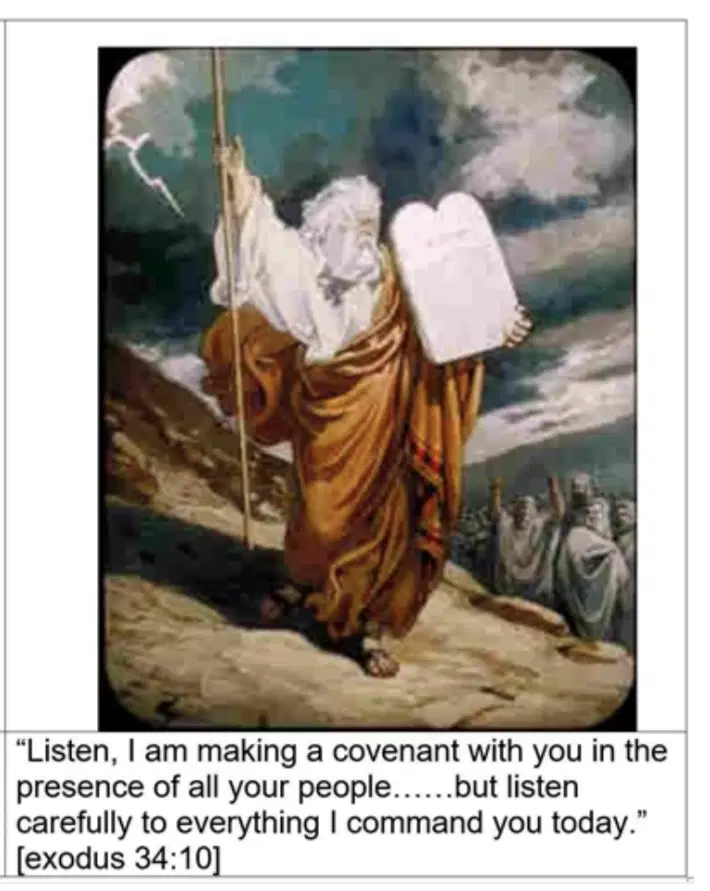
What is happening in this image?
A prophet is warning a city about an approaching army.
A king is declaring war while holding a battle plan.
Moses is receiving the Ten Commandments from God and announcing a covenant to the people of Israel.
Jesus is preaching to his disciples on a mountain.

